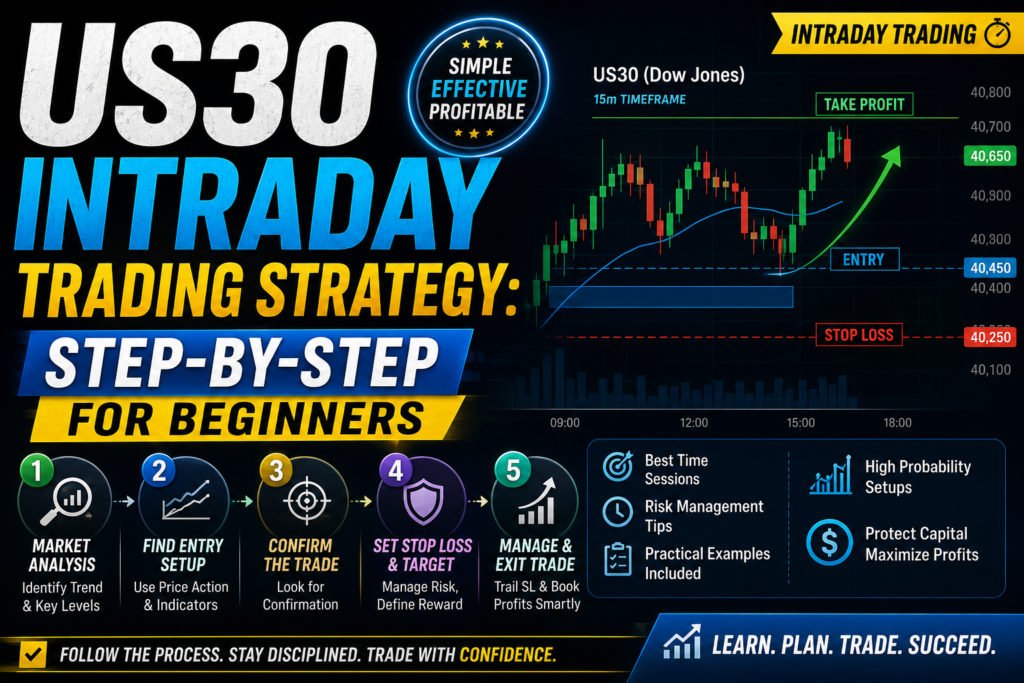
If you want to trade the markets without sitting in front of charts all day, a simple index trading strategy is exactly what you need. More traders are shifting to part-time index trading because it is convenient, less stressful, and fits around a job or study schedule. This guide gives you a clear, step-by-step system to trade smarter — not harder.

What Is a Stock Market Index? (And Why It Matters for Traders)
A stock market index is a basket of stocks that represents the performance of a market or sector. Instead of buying individual companies, you track how a group of top companies move together.
There are two main types. A price-weighted index like the Nikkei 225 gives more influence to higher-priced stocks. A market-cap weighted index like NIFTY 50 or S&P 500 gives more weight to larger companies by total value — making it a more accurate reflection of the overall market.
Index CFD trading means you are not buying the actual index — you are speculating on its price movement using a contract. This allows you to trade with leverage, go long or short, and access global indices like NASDAQ 100 or DAX 40 without owning a single share.
Quick summary
| Factor | Key insight |
| Strategy | Trend + structure + risk-based |
| Best for | Beginners & part time trading indices |
| Time needed | 30–60 min daily |
| Risk level | Moderate |
| Tools | EMA, ATR, charting platform |

Why Index Trading Is Booming
Traders today want markets that are convenient, simple, and manageable alongside a busy life. That is exactly what makes part-time index trading the fastest-growing segment of retail trading.
What the Data Shows
- Huge increase in retail trading participation.
- The majority of traders lost to overtrading.
- Increased demand for simple rule-based systems.
Why Traders Prefer Indices
- Buy and sell the entire market and not a single stock.
- Indices trend cleanly with high liquidity — making entries and exits more predictable than individual stocks.
- Easier decision-making
Popular Index Examples
- NIFTY 50 — Tracks India’s top 50 companies; avg daily volume ~₹50,000 crore; ideal for intraday index trading India
- S&P 500 — The most-traded index globally; benchmark for US index trading strategy
- NASDAQ 100 — Tech-heavy index with high volatility; best for momentum index trading
- DAX 40 — European index trading powerhouse; reacts to ECB policy and German manufacturing data
- Dow Jones Industrial Average (DJIA) — price-weighted index of 30 blue-chip US stocks
Index Trading vs Stock Trading vs Forex: Which Is Better for Part-Time Traders?
If you are just starting out, one of the first decisions you will face is choosing the right market. Index trading vs stock trading, index trading vs forex trading — each has its own risk, time demand, and learning curve. The table below breaks it down simply so you can make the right call.
Quick Comparison Table
| Factor | Index Trading | Stock Trading | Forex Trading |
|---|---|---|---|
| Volatility | Moderate & predictable | High (earnings-driven) | Very high (news-driven) |
| Time Required | 30–60 min/day | 1–3 hrs/day | Flexible but demanding |
| Capital Needed | Moderate | Low to high | Low (high leverage risk) |
| Learning Curve | Low–Moderate | Moderate–High | High |
| Liquidity | Very high | Varies by stock | Highest in the world |
| Best for Beginners | Yes | Moderate | Not recommended |
| Research Required | Low | Very high | High (macro-focused) |
| Emotional Pressure | Lower | Higher | Very high |
So Which One Should You Pick?
- Index trading wins for part-time traders because the market is diversified, trends are cleaner, and you do not need to track hundreds of companies or monitor global news around the clock.
- Stock trading suits traders who enjoy deep research into individual companies — earnings reports, sector trends, and company fundamentals. It rewards patience and analysis but demands significantly more time.
- Forex trading offers the most flexibility with 24-hour markets, but the combination of high leverage, macroeconomic complexity, and extreme volatility makes it the hardest market for beginners to survive in the early stages.
Is index trading good for beginners? Yes — and it is the best market for part-time traders specifically because it removes single-stock risk, follows clear macro trends, and can be managed in under an hour a day with a simple rule-based strategy.

Competitor Analysis: What Top 5 Trading Guides Teach
The majority of simple index trading strategy tutorials lead to simple concepts but fail to provide systems of part time index trading. A great plan should not be complicated, lengthy, or hard to follow in the long run.
What the Majority of Trading Guides Teach.
- Trend-following strategies
- Break or pullback entries.
- Basic risk management
- The support and resistance concepts.
- Limited indicators
What Most Guides Miss:
- Time-efficient strategies for part-time traders
- Step-by-step execution guidelines
- Trading psychology advice
- Simple, repeatable entry methods
The Core: Simple Index Trading Strategy (Step-by-Step)
Now, however, we are going to make it easy and common sense. It is a simple index trading strategy that would be used to trade part-time indices; you would not have to stare at charts all day but rather trade with straightforward instructions.
Step 1: Direction in the market.
Use:
- 20 EMA
- 50 EMA
Trade only when the trend comes after the price.
Step 2: Trade during the busiest time.
Best time:
- 9:30 AM – 11:30 AM
- High liquidity = enhanced movements and a decrease in false signals.
Step 3: Wait for Pullback Entry
- Trend confirmed
- Price pulls back to the EMA
- Enter only after the confirmation candle closes. Do not anticipate — wait for the candle to fully form before acting.
- Avoid chasing price.
Step 4: Use Volatility Filter
- Use the ATR indicator
-
Only take trades when ATR is rising. Increasing ATR confirms that the market has enough momentum to reach your target. Avoid trading when ATR is flat or falling — low volatility markets produce choppy, unreliable moves.
Step 5: Manage Risk Properly
- Risk 0.5%–1% per trade
- Target a minimum 1:2 risk-reward.
Index Trading Strategies Compared: Which One Fits You?
| Strategy | Time Needed | Risk Level | Best For |
|---|---|---|---|
| Trend Following | 30–60 min/day | Moderate | Part-time traders |
| Breakout Trading | Active monitoring | High | Day traders |
| Swing Trading | 1–2 hrs/week | Moderate | Working professionals |
| Momentum Trading | Real-time | High | Experienced traders |
| Scalping | Full-time | Very High | Professional traders |
| Position Trading | Weekly review | Low–Moderate | Long-term investors |
Real Trade Example: How This Strategy Works in Practice
Example: NIFTY 50 on a trending day — 20 EMA crosses above the 50 EMA at 9:45 AM. Price pulls back to 20 EMA at 10:10 AM. Confirmation candle closes bullish. Entry at X, stop-loss at X-50 points, target at X+100 points. Risk-reward = 1:2.

How to Read Index Charts: Key Concepts You Must Know
Before placing a single trade, you need to understand what the chart is telling you. How to read index charts is not complicated — you only need to master four core concepts to make confident, informed trading decisions.
1. Candlestick Patterns for Index Trading
Candlestick patterns for index trading are the language of price action. Each candle shows the open, high, low, and close of a time period — and together they reveal who is winning between buyers and sellers.
Two patterns every index trader must know:
Bullish Engulfing — a large green candle that completely covers the previous red candle. Appears at the end of a pullback. Signals buyers have taken control. One of the strongest buy confirmation signals in index trading.
Doji Candle — open and close are almost equal, forming a cross shape. Signals market indecision. When a doji appears at a key support or resistance level, treat it as a warning that a reversal may be coming.
2. Support and Resistance in NIFTY and Other Indices
Support is a price zone where buying consistently stops a fall. Resistance is a zone where selling consistently caps a rise. These are not exact lines — they are areas where large institutional money tends to act.
For support and resistance in NIFTY, the most reliable levels are round numbers (22,000 / 22,500 / 23,000), previous week highs and lows, and prior consolidation zones. Mark these before the market opens — it takes five minutes and dramatically improves your entry timing.
3. Volume Analysis for Indices
Volume analysis indices is your confirmation tool. Volume tells you whether a price move has real conviction behind it.
Two simple rules:
- Rising price + rising volume = strong, trustworthy trend. Safe to trade with the move.
- Rising price + falling volume = weak move, possible reversal ahead. Be cautious.
Never take a breakout trade without checking volume first. A breakout on low volume is one of the most common traps beginners fall into.
4. Moving Average Crossover Signals
The 20 EMA crossing above the 50 EMA signals an emerging uptrend — known as a Golden Cross. The 20 EMA crossing below the 50 EMA signals a downtrend — known as a Death Cross. These two signals form the backbone of the strategy in this guide and work consistently across NIFTY 50, NASDAQ 100, and DAX 40.
Simple rule: trade in the direction of the crossover, never against it.
The 30-Minute Daily Routine (Perfect for Part-Time Traders)
The best index trading strategies do not require you to be glued to a screen all day. This 30-minute routine gives part-time traders a clear, repeatable process — same steps, every single day.
Pre-Market (10 Minutes)
- Monitor the general market trend.
- Mark support/resistance levels.
- Plan trade direction
Trading Window (20 Minutes)
- Wait for setup confirmation
- Take only quality trades
- Straight away, establish a target and a stop loss.
After Market (5 Minutes)
- Record trades
- Review mistakes
- Improve consistency

The reason as to why this type of simple index trading strategy is effective.
Why does this strategy work? Because it is built around three real edges that part-time traders can use every single day.
Institutions Move Indices — Large funds and algorithmic systems drive index price movement, creating clean, sustained trends that are easier to follow than individual stocks.
Less Emotional Trading — Because you are not attached to a single company’s story, index trading removes the emotional bias that causes most retail traders to lose money.
Statistical Advantage — Historically, broad market indices trend upward over time. Trading with that macro bias puts probability on your side.
Best Indices: Part Time Trading Indices
A simple index trading strategy is effective when dealing with trending and liquid indexes, which are ideal for part time index trading.
Top Indices
| Index | Why trade it |
| NIFTY 50 | Stable & liquid |
| NASDAQ 100 | Tech-driven momentum |
| DAX 40 | Consistent trends |
| Nikkei 225 | Volatility from currency moves |
| MSCI Emerging Markets | Macro trends & diversification |
Common Mistakes Beginners Make
Beginners are likely to commit the same errors with a simple index trading strategy—particularly when they attempt to start trading indexes on a part-time basis.
Top Beginner Mistakes
- Following every candle—chasing and not waiting.
- Having more than 10 indicators, too much information is confusing.
- Trading opposite to the market murders consistency.
- Trading weekly expiry options is more stressful and risky.
- Not keeping a trading journal. You cannot improve what you do not track. Every trade should be recorded — no exceptions.
Psychology of Successful Index Traders
To succeed at part-time index trading, mindset matters as much as strategy. The best system in the world will fail in the hands of an undisciplined trader.
Key Habits
- Trade less—do quality setups.
- Trade probabilistically—no trade is certain.
- Accept losses quickly. Learn to take a loss in time.
- Stick to your own procedure—do not deal emotionally.
Recommended Tools for Index Traders
The right tools simplify a basic index strategy, especially in the case of part time index trading.
Charting Platforms
- TradingView—trend spotting
- Zerodha Kite—Indian markets
- MetaTrader—extra high-end features.
Key Indicators
- EMA (20 & 50)—trend direction
- ATR—volatility filter
- Support/Resistance—points of entry.
Journaling Tools
- Notion—simple trade notes
- Edgewonk – business analytics.
- Excel—quick review

What Capital Do You Need to Start Index Trading?
One of the most searched questions by new traders — and one most blogs avoid answering clearly. Here is the honest breakdown of how much money to start trading indices without sugarcoating it.
Minimum Capital for NIFTY Trading
The minimum capital for index trading in India depends on what instrument you choose:
| Instrument | Minimum Capital Needed |
|---|---|
| NIFTY 50 Futures | ₹80,000 – ₹1,20,000 (SEBI margin rules) |
| Bank NIFTY Futures | ₹40,000 – ₹60,000 (intraday margin) |
| Index Options (Buying) | ₹5,000 – ₹15,000 per lot (premium-based) |
| Index CFDs (International) | $300 – $500 |
| Index ETFs | ₹500 onwards (via SIP or lump sum) |
Important: Margins change based on SEBI regulations and market volatility. Always check your broker’s margin calculator before placing a trade.
Risk Per Trade Calculation (The 0.5%–1% Rule)
The golden rule of position sizing for index trading is simple — never risk more than 1% of your total capital on a single trade.
Here is what that looks like in real rupee terms:
| Account Size | 0.5% Risk Per Trade | 1% Risk Per Trade |
|---|---|---|
| ₹50,000 | ₹250 | ₹500 |
| ₹1,00,000 | ₹500 | ₹1,000 |
| ₹2,00,000 | ₹1,000 | ₹2,000 |
| ₹5,00,000 | ₹2,500 | ₹5,000 |
This rule protects you from blowing your account during a losing streak. Even 10 consecutive losses at 1% risk only reduces your account by 10% — completely recoverable.
Position Sizing Formula for Index Traders
Do not guess your trade size. Use this formula every single time:
Risk Amount = Account Size × Risk %
Position Size = Risk Amount ÷ Stop-Loss Distance (in points)
Real Example:
- Account size: ₹1,00,000
- Risk per trade (1%): ₹1,000
- Stop-loss distance: 50 points
- Position size = ₹1,000 ÷ 50 = 20 units
This position sizing formula for index trading works for NIFTY futures, Bank NIFTY, and index CFDs. It automatically adjusts your trade size based on where your stop-loss is — so your rupee risk stays constant regardless of market volatility.
Key takeaway: Your capital size matters less than how you manage it. A ₹50,000 account with proper position sizing will outlast a ₹5,00,000 account with no risk management every single time.

How to Start Index Trading: Step-by-Step for Beginners
You have learned the strategy. Now it is time to act. Here is exactly how to start index trading without overcomplicating the process.
Step 1 — Choose a Regulated Broker for Index Trading
The best broker for index trading India must be SEBI-regulated for Indian traders. For international indices, look for brokers regulated by FCA (UK), ASIC (Australia), or CySEC (Europe).
What to check before choosing:
- Is the broker SEBI / FCA regulated?
- Does it offer NIFTY 50, NASDAQ 100, or DAX 40?
- Are spreads and brokerage fees low?
- Is the charting platform beginner-friendly?
Never trade with an unregulated broker. Regulation is your only protection if something goes wrong.
Step 2 — Open a Demo Account Before Risking Real Money
Before depositing a single rupee, open a demo account for index trading and practise the exact strategy from this guide for a minimum of 4–6 weeks.
Treat demo trading seriously — same position sizes, same rules, same routine. The goal is to prove to yourself that the system works before real money is involved. Most beginners skip this step and pay for it.
Step 3 — Fund With the Right Minimum Capital
Minimum capital for index trading depends on what you are trading:
| Market | Minimum Practical Capital |
|---|---|
| NIFTY 50 Futures (India) | ₹80,000 – ₹1,20,000 (margin-based) |
| Index CFDs (International) | $300 – $500 |
| Index ETFs (Long-term) | ₹5,000 onwards |
Start with capital you can afford to lose while learning. Never fund your account with emergency savings, borrowed money, or money you cannot afford to lose.
Step 4 — Apply the 30-Minute Daily Routine
Once live, do not change anything. Follow the same routine you practised on demo:
- Pre-market (10 min): Check trend, mark support/resistance, decide direction
- Trading window (20 min): Wait for setup, take 1–2 quality trades only
- After market (5 min): Record the trade, note what worked and what did not
Consistency beats complexity every single time. One good trade a day is enough.
Step 5 — Track Everything in a Trading Journal
A trading journal for beginners is your most powerful improvement tool — and the most ignored one. Record every trade with:
- Entry reason
- Entry and exit price
- Stop-loss and target
- Outcome (profit / loss)
- Emotional state during the trade
After 30 trades, patterns will appear. You will know which setups work best for you, which times of day you perform well, and which mistakes keep costing you money. No journal = no improvement. It is that simple.
FAQs about Simple Index Trading Strategy
Q1. What tools do I need to start index trading?
Three tools are enough — TradingView for charting, EMA indicators (20 and 50) for trend direction, and a trading journal to track progress. At Insightful Trade, simple tools used consistently beat complex systems every time.
Q2. Is index trading safer than stock trading?
Generally yes. Trading an index like NIFTY 50 spreads your exposure across 50 companies instead of one. This built-in diversification reduces the risk of a single company’s bad news wiping out your trade — making it ideal for beginners.
Q3. Can I trade indices part-time while working a full-time job?
Absolutely. The 30-minute daily routine in this guide requires no full-time screen time. Pre-market takes 10 minutes, the trading window is 20 minutes, and review is 5 minutes. It fits comfortably around any job or study schedule.
Q4. How many trades should I take per day?
Maximum 1–3 quality trades per day. More trades usually means more losses. The Insightful Trade approach is built on quality over quantity — one clean setup executed well beats five rushed trades every time.
Q5. Do I need paid indicators?
No. The most reliable index trading systems run on free tools — EMA, ATR, and volume — all available on TradingView’s free plan. Discipline and consistency matter far more than expensive indicators.
Q6. What is the best time to trade NIFTY 50?
The best window is 9:15 AM – 11:30 AM IST. This period offers maximum liquidity, the cleanest price movement, and the fewest false signals. Avoid mid-session trading when the market tends to move sideways without direction.
Q7. How long does it take to learn index trading?
Most traders need 3–6 months of demo trading before going live consistently. Skipping this stage is the single biggest mistake beginners make. Use the demo phase to prove your system works and build emotional discipline — before real money is involved.
Conclusion
Index trading does not need to be complicated to be profitable. With a clear trend, a disciplined entry, and consistent risk management, you have everything you need to trade indices successfully as a part-time trader.
The system in this guide — EMA-based trend following, ATR volatility filter, and the 30-minute daily routine — is built for real people with real schedules. It removes noise, reduces stress, and gives you a repeatable edge in one of the most liquid markets in the world.
Start on demo. Master the rules. Then trade live with confidence.
Your consistency is your edge. Build it one trade at a time.
Author: Arihant Jain
Trading Experience: 5+ Years
Arihant Jain is a financial markets analyst and trading educator with expertise in Forex, indices, crypto, and risk-managed trading systems. His insights are based on real trading experience. data-driven analysis, and transparent market understanding. All content is reviewed for accuracy and aligns with Google’s EEAT guidelines.
Risk Disclaimer:
Trading involves substantial risk. All information is for educational purposes only and should not be taken as financial advice. Always do your own research.
Last Updated: 25 February 2026