Many times traders spend hours observing the charts and fundamentals of the asset making sure of perfect set up and entry but still end up losing money that quietly eats away at their account balance. One of the ignored concepts of trading is overnight funding.
If you trade without proper understanding on how the interest rates work in CFD trading, then you’re trading with a hole in your pocket. That’s when the funding rate calculator becomes essential in trading.
In this blog, we’ll understand how the calculator works and how to add it naturally in your trading routine. By the end, you’ll know how to spot these costs early, avoid nasty surprises, and decide exactly how long a trade is actually worth holding.
What Is a Funding Rate in CFD Trading?
Before using any calculator, traders must understand what funding rates actually represent in the CFD market.
The Meaning of Funding and Interest in CFDs
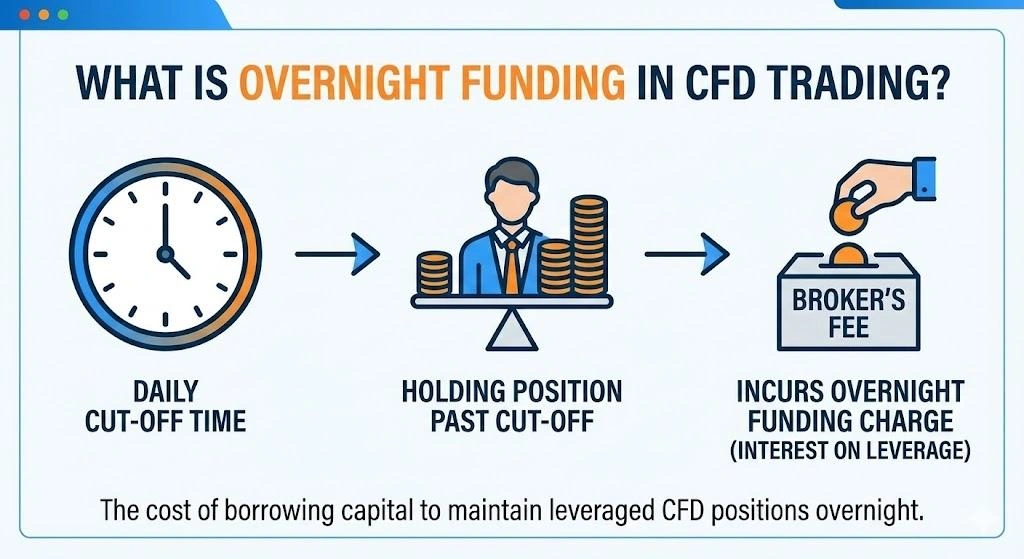
CFDs (Contracts for Difference) allow traders to control large positions with relatively small capital by using leverage. However, leverage comes with a cost:
- Brokers effectively lend capital for leveraged positions.
- Holding positions overnight incurs an interest-based charge.
- These charges are known as funding rates or overnight financing fees.
A funding rate calculator helps quantify these costs so traders know exactly what they are paying to stay in a trade.
Why Overnight Funding Cost Matters More Than You Think
Overnight funding costs are small on a daily basis but significant over time. Many traders ignore them because they do not feel an immediate impact.
The Hidden Effect of Overnight Costs
Over time, overnight funding costs can:
- These tiny charges act like swaps and drain your profits
- This makes every trader either a zero-profit trade or a losing one.
- In case of sudden short-term volatility, you can’t keep the trade open due to interest charges.
Using a funding rate calculator brings these hidden costs into full view, allowing better trade planning.
Funding Rate Calculator: Calculation Method, Formula, and Available Tools
The Core Formula Behind CFD Funding Rate Calculation
At its core, a funding rate calculator relies on a simple interest-based formula applied to leveraged exposure rather than margin.
Basic Funding Cost Formula:
Funding Cost = (Position Value × Annual Funding Rate ÷ 365) × Number of Nights Held
Each variable plays a critical role:
- Position value refers to the total notional exposure of the CFD trade, not the margin deposited.
- Annual funding rate is the interest rate charged by the broker, often based on benchmark rates plus markup.
- The number of nights held includes weekends and holidays, which may be charged as multiple days.
Example Calculation Using the Formula
Consider a forex CFD trade with the following details:
- Position size: $100,000
- Annual funding rate: 4.5%
- Holding duration: 10 nights
Using the formula:
- Daily rate = 4.5% ÷ 365 ≈ 0.0123%
- Daily funding cost = $100,000 × 0.000123 ≈ $12.33
- Total funding cost = $12.33 × 10 ≈ $123.30
A funding rate calculator automates this process instantly, but understanding the math ensures traders recognize whether the result is reasonable and aligned with broker terms.

Step-by-Step Guide to Using a Funding Rate Calculator
Understanding the workflow ensures traders use the tool correctly rather than relying on estimates.
Step 1: Determine Your Total Position Size
The total position value is what matters most:
- Multiply the asset price by the number of contracts or units.
- Ignore margin size, as interest applies to full exposure.
- Confirm whether the broker uses notional or adjusted values.
This step prevents underestimating real costs.
Step 2: Identify the Applicable Funding Rate
Funding rates vary depending on:
- The underlying asset, such as forex, indices, or commodities.
- Market interest rates and broker markups.
- Whether the position is long or short.
Accurate CFD interest calculation starts with the correct rate.
Step 3: Input Holding Duration
Time amplifies cost:
- Each overnight hold adds incremental expense.
- Weekends often involve triple charges.
- Long-term positions accumulate funding significantly.
The calculator converts daily rates into total holding cost.
Step 4: Analyze the Output and Adjust Strategy
Once calculated, traders should:
- Compare funding cost against expected profit.
- Decide whether shorter holding periods make more sense.
- Adjust stop-loss and take-profit levels accordingly.
This is where the funding rate calculator becomes a strategic tool rather than a passive reference.
When Funding Costs Become a Strategic Factor
Not all strategies are equally affected by overnight interest.
Strategies Most Impacted by Funding Rates
Funding costs matter most for:
- Swing traders holding positions for days or weeks.
- Position traders operating on higher timeframes.
- Traders using high leverage with moderate price targets.
Using Funding Rate Calculator to Improve Trade Selection
Beyond cost estimation, calculators can help traders refine decision-making.
Improving Risk-Reward Calculations
A funding rate calculator helps traders:
- Aim for higher profits to make the trade worth it.
- Avoid trades with a great set up but ‘too expensive’ to hold; it’s a bad deal.
- Compare different trades and see which is more beneficial.
This turns funding awareness into a competitive edge.

Common Mistakes in CFD Interest Calculation
Many traders make repeated errors when estimating funding costs manually.
Errors That Reduce Trading Performance
The most common mistakes traders make are
- They calculate interest on the money they put in, forgetting that they pay interest for the total money the broker lent them.
- Ignoring weekends or holidays while calculating interests.
- Assuming that the funding rates of one trade are the same for another.
A funding rate calculator eliminates these assumptions by providing clear numbers.
Integrating Funding Rate Calculators into Trading Workflows
Professional traders considered funding analysis a very important part of their pre-trade routine.
A Practical Workflow for CFD Traders
A structured workflow includes:
- Calculate the total amount your broker is going to charge before entering any multi-day trade.
- Compare the interest charged and expected profit to see if the trade is really beneficial.
- Reviewing funding impact on your trade during reviews and journaling.
Benefits of Using a Funding Rate Calculator Consistently
Consistency is what makes a trader professional; instead of using this calculator while panicking, use it before entering any trade. Make it a routine.
Long-Term Advantages
Regular use of a funding rate calculator leads to:
- This tool helps you see the actual (profit) money going into your bank account.
- With its help you can avoid making expensive trades that are not moving fast enough.
- It gives you confidence to either hold the trade or make an exit.
By the time this becomes your routine, you can ensure that your profitability is built on fundamentals rather than luck.

Conclusion: Making Funding Costs Work for You, Not Against You
At the end of the day, those small overnight fees that don’t look much on day one, but they are silently draining your account. That’s why understanding funding rates is not for becoming an expert, but to make sure that your profit– hard earned money stays by your side at the end of the year.
That’s why understanding the funding rate calculator is important for you to make strategic decisions. And for better explanation you can visit educational platforms like InsightfulTrade. Where you’ll get expert guidance, practical training and support from professional traders in your trading journey.
Frequently Asked Questions
What is a funding rate calculator used for?
A funding rate calculator estimates the cost of holding a CFD position overnight based on position size, interest rate, and holding duration.
Does overnight funding cost apply every day?
Overnight funding cost applies each trading day a position is held, with weekends often charged as multiple days.
Is CFD interest calculation based on margin or position size?
CFD interest calculation is based on the total position size, not the margin deposited.
Are funding rates the same for long and short positions?
Funding rates can differ for long and short positions depending on interest rates and broker policies.
Should day traders use a funding rate calculator?
Day traders may not need it often, but it is still useful when positions are held overnight unexpectedly.
Author: Kumkum Chandak
Experience: 3+ Years in Trading Research & Market Content Strategy
Kumkum Chandak is a trading content strategist and market research writer who specializes in simplifying technical analysis, trading tools, and strategy-driven educational content. Her work is optimized for EEAT, accuracy, and user intent, ensuring every article delivers practical insights for traders of all levels.
Risk Disclaimer:
All content is strictly educational and not financial advice. Trading involves substantial risk. Always perform your own analysis or consult a professional advisor.
Last Updated: 25 December 2025