Quick Summary
| Aspect | Key Insight |
| Focus | Give priority to entry quality over quantity in trading |
| Related concepts | Risk management, selective trading strategy |
| Benefits | High success rate with fewer trades |
| Goal | Increase long-term profitability and reduce mistakes |
Introduction
In these fast-moving markets, traders like you are continuously bombarded with alerts, signals, algorithm-driven volatility, and ideas from social media, which makes you feel like opportunity is everywhere. But this is not true; it can be bitter but true that having more opportunities doesn’t mean that it translates into more profits automatically. Here, what changes the whole game is the philosophy of entry quality over quantity.
What Entry Quality Over Quantity Really Means
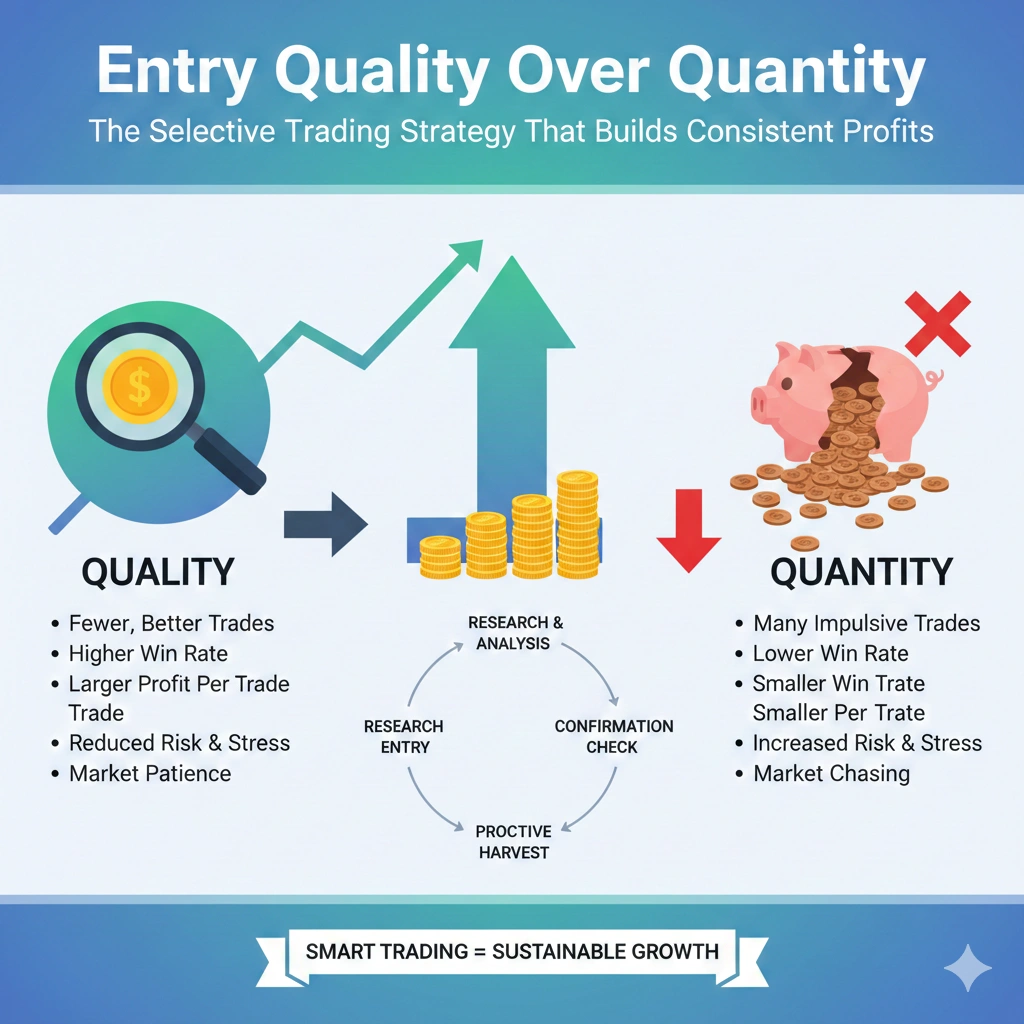
At its core, it simply means that you make fewer but smarter trades instead of trying to be constantly active in the markets. Practically, it means to analyze every potential trade carefully and, on every market movement, not act impulsively. Quality entries rely on several pillars, such as
- Technical confirmation
- Market Context Awareness
- Confluence Across Timeframes
- Defines Risk-Reward Ratios
Why Quality Matters More Than Quantity
It is very obvious to think that having more trades increases the chances of profits, but this is not the reality. If you start chasing every small opportunity, it can lead you to emotional burnout, overtrading, and inconsistent results.
1. Management of risk becomes better
If you start focusing on quality trades, management of risk becomes intentional. Using a selective trading strategy prevents unnecessary losses and makes sure that your capital is preserved for high-probability setups.
2. Win rates become higher
Your hit rate automatically improves when you filter out the low-quality setups. Fewer trades mean meaningful, profitable trades, not fewer gains.
3. Fewer costs and more profit
As you all know, each trade incurs costs like commission and slippage. When you take a few high-quality trades, it maximizes net returns and reduces the costs, which is more efficient.
4. Optimized risk-reward ratios
The ability to secure stronger risk-reward ratios is one of the biggest advantages, and they often target 2:1 or higher.
5. Emotional discipline
Overtrading fuels anxiety, stress, or emotional decisions, and if you prioritize entry quality over quantity, it helps you with reducing the emotional interference.

Tools to Help Your Quality-First Approach
Let’s break down some tools that help you to filter noise and focus only on high-probability setups:
1. Platforms for charting & technical analysis
Platforms such as NinjaTrader, MetaTrader 5, and TradingView allow you to do multi-timeframe analysis, custom alerts, and backtesting.
2. Indicators for trend & confirmation
These are essential because they prevent premature or counter-trend entries. A strong strategy combines RSI for momentum shifts, ATR for volatility context, and moving averages for direction.
3. Volume analysis tools
Tools that reveal the conviction behind the movements in the price. Volume profile, VWAP, and relative volume indicators help you to distinguish real breakouts from the false ones.
4. Risk management calculators
These calculators are the best option that helps you to determine the stop-loss distance, percentage of risk per trade, and position size in your trading.
How to Build Your Personalized Entry Checklist
If you want to master entry quality over quantity, then you also structure with motivation. It starts with a personalized entry checklist that transforms emotional guessing into a repeatable, rule-based selective trading strategy in your trading.
Here is why it matters:
- It eliminates impulsive or rash decisions
- Protects your trading capital and improves consistency
- Helps you to reduce overtrading and reinforces discipline

How can you build it?
- First of all, define the market context
- Confirm multi-timeframe alignment because a strong selective trading strategy requires
- Don’t rely on a single indicator and require signal confluence
- Before making any entry, define your risk
- Mental state affect trade execution quality, so emotional readiness check
- Assign scores to transform your ability into a profitability-based system
Common Mistakes to Avoid
After understanding the real concept of entry quality over quantity trading, you can also fall into hidden traps that sabotage your performance just like other traders. Here are some mistakes that you should avoid:
- If you are avoiding your own rules of trading
- Without any confirmation, you are chasing breakouts
- Avoiding the risk-reward, which is not strategic trading
- Not reviewing your journaling your past trades
- After a loss, if you increase position size

Conclusion
If you focus more on entry quality over quantity, it will help you to reduce noise, avoid rash decisions, and create clean performance data. With this, you can also build consistency and control your emotions for long-term sustainability.
If you make up your mind that you will apply a quality-first mindset, it helps you in:
- Less trade and more wins
- Less stress and think smarter
- Performance refinement rather than disguising flaws
Check out Insightful Trade for additional educational resources and insights on quality-based trading strategies, where disciplined execution and real-world strategy development are key.
FAQs
Q1: How does a selective trading strategy reduce stress?
If you only focus on high-probability trades, this strategy reduces impulsive decisions and lowers the emotional fatigue to help you maintain clarity and consistent performance.
Q2: Do I need advanced software for quality over quantity trading?
It can help, but the core of quality over quantity trading is clear criteria, management of risk, and disciplined strategy.
Q3: How do I know if my entries are high quality?
The entries that align with your defined criteria offer you a favorable risk-reward ratio, show indicator confirmation, and consistently improve your selective trading strategy.
Author: Arihant Jain
Trading Experience: 5+ Years
Arihant Jain is a financial markets analyst and trading educator with expertise in Forex, indices, crypto, and risk-managed trading systems. His insights are based on real trading experience, data-driven analysis, and transparent market understanding. All content is reviewed for accuracy and aligns with Google’s EEAT guidelines.
Risk Disclaimer:
Trading involves substantial risk. All information is for educational purposes only and should not be taken as financial advice. Always do your own research.
Last Updated: 14 February 2026