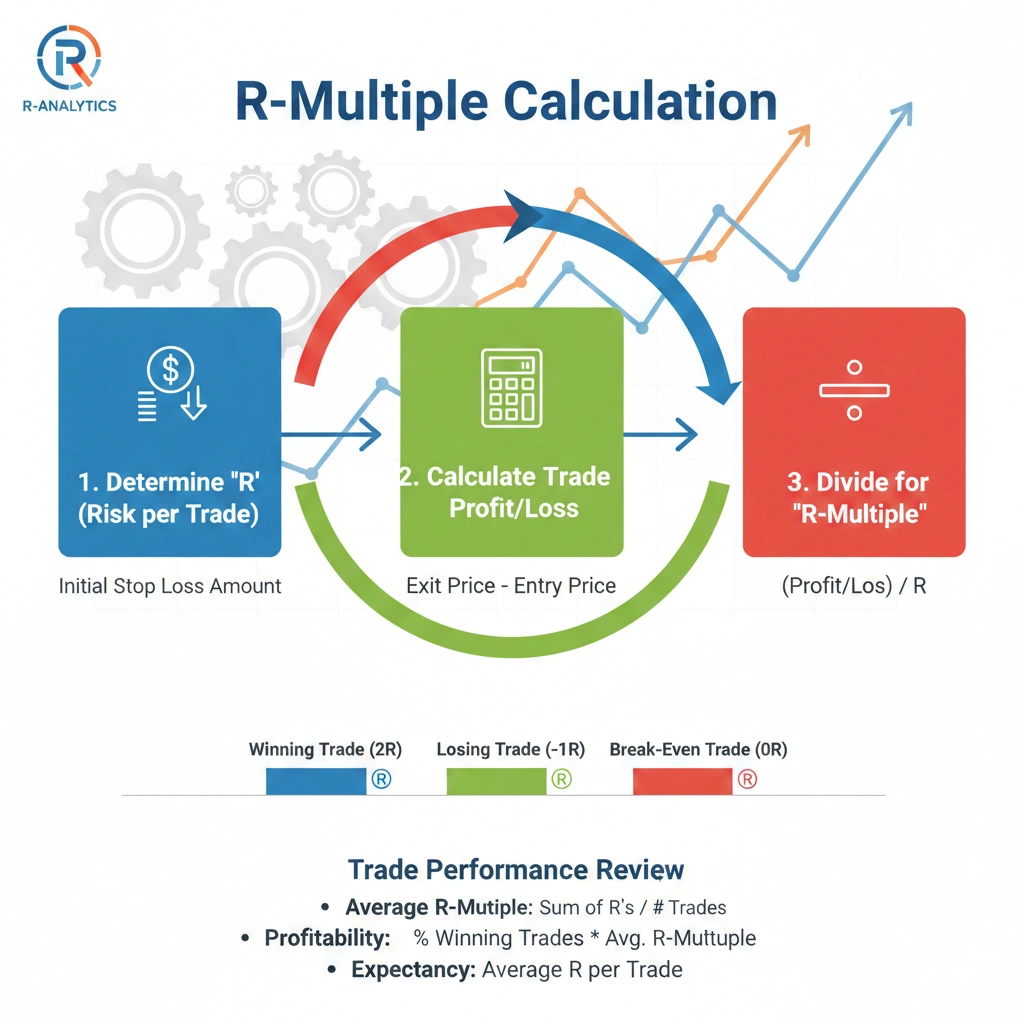
R-multiple calculation is a brilliant method of looking at your trade results, at its most basic level, without being confused by the number of dollars. It uses the question, How well did this trade pay off versus the risk I took as opposed to How much did I make? As an illustration, when you risk 1R (1000R) and earn 3000R, your reward-to-risk multiple is +3R. If you lose ₹500, it’s -0.5R. This makes trade review very easy to understand, as all the trade is rated on a common scale, with no emotion, no speculation, and just pure data that is observable.
Quick summary
| Term | Simple meaning |
| R – multiple | Profit or loss compared to risk |
| 1R risk | Fixed risk per trade |
| Potential R | Planned reward before trade |
| Actual R | Real result after trade |
| Positive R | Profitable trade |
| Negative R | Losing trade |
| Expectancy | Average R over time |
What Is R-Multiple? A Clear Definition
Let’s keep this simple and real. R-multiple calculation involves the level of performance of a trade with respect to the risk you take, rather than the amount of money you see. If you risk ₹1,000, that’s your 1R. Make ₹2,000 profit? It has a +2R reward-risk multiple. Lose ₹500? That’s -0.5R. It is for this reason that R-multiple calculation is so effective when it comes to trade review.
R-multiple calculation = (Profit or loss) ÷ (Initial risk).
It puts all the trades on the same level and assists one in enhancing the reward-to-risk multiples and reading through trades vividly.
R-Multiple Calculation Formula
R-Multiple Formula:
R = (Exit Price − Entry Price) ÷ (Entry Price − Stop Loss)
This shows how many times your risk (1R) you gained or lost.
What’s a Good R-Multiple?
- Below 0.5R average → exits need work
- Around 1R → stable
- 1.5R+ → strong structure
Don’t chase huge Rs. Stay consistent

Why R-Multiple Calculation Is So Important
- Normalizes Performance: Reveals trade performance with regard to risk, rather than money, rendering the reward-risk multi-meaningful.
- Improves Trade Review: Assists in tracking gains/losses per trade in the review of trades.
- Increases Discipline: Predefined risk ensures that feelings are kept out of trading, and it becomes regular.
- Supports Long-Term Expectancy: 2 R/T of trades is whether your strategy is profitable.
- Investments in Multiple Markets: Stock, Forex, and Crypto: R-multiple computation is universal.
Step-by-Step: How to Calculate R-Multiple
1. Define Your Risk (1R)
You must also set your entry price and stop-loss, the amount of money you are prepared to lose before joining a trade. That difference is your 1R.
Example:
Entry: ₹100
Stop-loss: ₹95
115
Risk per share: ₹5 → 1R = ₹5
2. Calculate Potential R-Multiple
Potential R-Multiple = (Target Price – Entry Price) ÷ (Entry Price – Stop-Loss)
If your target is ₹115:
Potential R-Multiple = (115 − 100) ÷ (100 − 95)
= 15 ÷ 5
= 3R
It is an indication that you had planned to make 3 times your risk, which is an important aspect of reward-risk multiple planning.
3. Calculate Actual R-Multiple
When the trade is closed, examine the actual result:
Real R-Multiple = (Exit Price – Entry Price) ÷ (Entry Price – Stop-loss).
If you exit at ₹110:
Actual R-Multiple = 110 − 100 ÷ 100 − 95
= 10 ÷ 5
= 2R
Your trade ended up showing the actual performance of your trade with +2R.
Common R-Multiple Examples You’ll See in Trading
Let’s make this super simple. R-multiple calculation assists you in the visualization of how a trade has done relative to the risk you have undertaken. This is what the average results will look like:
- −1R: You lost it, all right, just as you risked it, a dropped-out trade.
- OR: No profit or loss, trade break-even.
- +1R: You earned as much as your risk—some even trade.
- +2R to +3R: The winners are strong with great efficiency in terms of reward risk.
- +5R+: Stunning trades, typically large trends or breakout trades.
With such examples, it is easy to compare trades that you do during trade review, and thus you can make your overall performance better.

How R-Multiple Helps With Trade Review
- Track Average R: reflects actual expectation and profitability.
- Winners and Losers Separately: Find ways of making exits better.
- Graphical R Distribution: Weak spots and spot consistency.
- Compare Strategies: Compare the reward-to-risk multiple of which setup is better.
R-multiple calculation simplifies the process of trade review, turning it into a data- and emotion-free process.
Trending Numbers & Market Context (2025–2026)
This is the actual scenario of 2025-2026 in terms of traders. R-multiple calculation is not only a theory, but it is also a reality in terms of performance in markets:
- The majority of retail traders can hardly make above a +0.5R average per trade.
- Proper trade review and adherence to disciplined risk management will result in 1R+ expectancy regularly for traders.
- As R increases, such as +2R or more, it does not necessarily make you win more; only when your win rate favors it is the expectation true—expectancy still prevails.
These tendencies explain why learning to do R-multiple calculation and emphasizing reward-risk multiples is superior to doing what it takes to make big money or win unrealistically.

Advanced Tips for Better R-Multiple Results
- Combine with win rate: Do not pay attention only to R. High average R wins will be beaten by a 30% win rate with high average R wins.
- Adjust Position Sizing: With 1R = 1% of the account, a +2R trade increases it by 2%. The Smart sizing increases your reward risk multiplier.
- Use Journaling Tools: Such tools as TradesViz ↗ track R-multiples automatically, which assists in the identification of trends expeditiously.
- Do Not Use Emotional Exits: Trading at +0.5R will murder your reward risk several times and diminish long-term expectancy.
These small adjustments can improve your consistency over time.
FAQs:
Q1: What is an R-multiple calculator?
An R-multiple calculator is a trading instrument that automatically calculates the performance of a trade expressed in units of R—it makes it simpler to evaluate the performance of trades risk-adjusted.
Q2: How does R-multiple relate to reward risk multiple?
R-multiple is an expression of reward in comparison to risk in quantity. The reward-risk multiple outcome is directly indicated by a well-calculated R-multiple.
Q3: Why should I use R-multiple in a trade review?
It provides you with a uniform measure to provide against trade performance, which makes your analysis of it more objective and implementable.
Q4: Can I use R-multiple for all markets?
Yes—be it stocks, forex, crypto, or futures, R-multiple can be calculated in the same way.
Conclusion
Smart trading is made best friends by the R-multiple calculator at the end of the day. It demonstrates the performance of each trade against risk, and therefore, the reward-to-risk ratio makes planning and reviewing trades an easy task. It is a strategy to track R-multiples and eliminate emotion, grade trades on equal terms, and enhance long-term expectation. This is even simpler with platforms such as Insightful Trade that assist traders in converting disciplined R-multiple calculations into actual, steady gains across markets.
Author: Arihant Jain
Trading Experience: 5+ Years
Arihant Jain is a financial markets analyst and trading educator with expertise in Forex, indices, crypto, and risk-managed trading systems. His insights are based on real trading experience, data-driven analysis, and transparent market understanding. All content is reviewed for accuracy and aligns with Google’s EEAT guidelines.
Risk Disclaimer:
Trading involves substantial risk. All information is for educational purposes only and should not be taken as financial advice. Always do your own research.
Last Updated: 12 February 2026