
Quick Summary
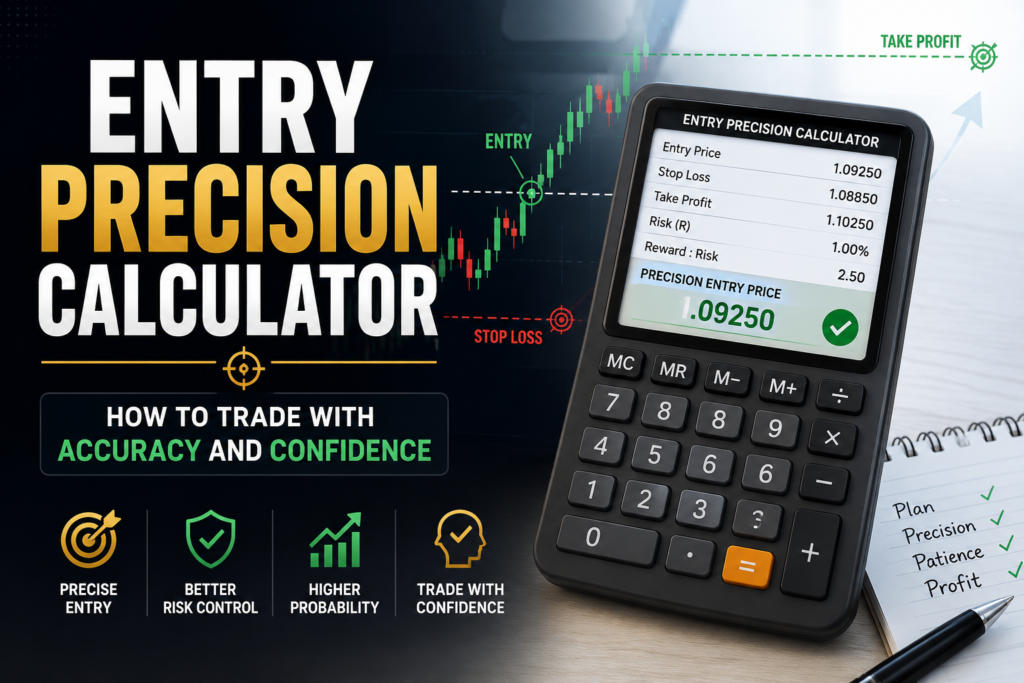
Have you ever struggled to figure out the correct time to enter into a trade? Then make the entry precision calculator your best friend because it will help you to trade with confidence and accuracy rather than guesswork.
You can think of this as a guide that can help you in any market, whether it is Forex, crypto, indices, or gold. Let’s understand more about this accurate entry trading tool.

What is an Entry Precision Calculator, and Why Do Traders Need It?
So, what exactly is an entry precision calculator? In simple words, an entry precision calculator is a tool that helps you find out the best time to enter into any trade. Even if you’re a beginner or an experienced trader, it makes things simple, sharpens your strategy, and highlights high-probability opportunities.
Here’s why traders use this:
Every trader like you needs it because your winning and losing trades depend on time, and it helps you make informed decisions consistently. One of the biggest benefits is how it improves entry accuracy for forex and other markets by helping you choose the most reliable price levels based on risk and market behavior.
- When entering trades, it helps you avoid emotional decisions
- Limit drawdowns and protect capital
- Quickly adapt to market volatility
- Ensures consistent position sizing
How Does an Entry Precision Calculator Work?
So how does it work? This accurate entry trading tool is very simple to use. It converts your risk rules into exact trading numbers. It tells you, “What is the safest and most accurate way to enter this trade?” Here are some steps. Let’s break it down.
Step 1: Input your Account Balance
Step 2: Define the percentage of risk
Step 3: Place Stop Loss Distance
Step 4: Calculate Lot Size
Step 5: Check Entry Price vs Market Price
Which Markets Can Benefit Most from Entry Precision Calculators?
Every financial market can benefit from the entry precision calculator, but some gain more. Here are the markets that benefit the most:
- Forex Market
This calculator improves entry accuracy in Forex by helping traders identify precise entry levels, calculate the lot size, and define exact stop-loss points.
- Cryptocurrency Market
This market is highly volatile, and the calculator helps you avoid over-risking and allows traders to trade more confidently, even during rapid market movements.
- Gold & Commodities
This market requires extremely accurate entry planning, and this calculator helps traders select precise entry points and calculate the safest lot size.
- Indices
Indices move quickly in big points, and with the help of this calculator, you can ensure safe position sizing and smart entries.
- Stock Market
This market benefits greatly from this calculator, especially those who rely on accurate timing, such as intraday and swing traders.
What Are the Key Features of an Entry Precision Calculator?
| Feature | Example |
| Entry Price Calculator | EURUSD 1.1020 |
| Stop Loss Calculator | 20 pips below entry |
| Lot Size Calculator | 0.05 lots for $10 risk |
| Risk/Reward Ratio | 1:3 ratio |
| Multi-Market Compatibility | US30, Gold, BTCUSD |
How to Use an Entry Precision Calculator for Forex Trading?
The smartest way to use this calculator is that, instead of guessing, the calculator gives you exact numbers that save your capital and stabilize your profits. Here are the steps:
- Identify Your Trading Setup
- Decide Your Risk Percentage
- Define Your Stop Loss
- Enter Values into the Calculator
- Place the Trade with Precision
- Let Mathematics Control Your Emotions
Can Entry Precision Calculators Improve Trading Discipline?
Yes, because of trading discipline, professional traders like you rely on them. How it directly improves discipline, let see.
- Enforces 0.5-2% risk per trade
- Removes Emotional Lot Sizing
- Prevents Revenge Trading
- Builds Professional Trading Habits
- Creates a Pre-Trade Checklist
How to Choose the Best Entry Precision Calculator?
Choosing the best entry precision calculator can dramatically improve your trading accuracy and capital safety. A calculator with high quality acts like a virtual risk manager that ensures that your trade is safe. Now we’ll see how you can identify the best calculator for your trading style:
- Correct Lot Size & Pip Value Calculations
- Multi-Market Compatibility
- Simplicity and Speed
- Built-In Trade Planning Features
- Mobile and Desktop Accessibility
- Flexible Risk Management Options
- Trusted Platform and Data Reliability
What Are Common Mistakes Traders Make With Entry Precision Calculators?
Here are some of the mistakes that you make with entry precision calculators:
- Ignoring proper stop-loss placement
- Using random risk percentages
- Not respecting the suggested lot size
- Entering trades emotionally
- Ignoring market structure
- Skipping trade journaling
- Overtrading
If you avoid these mistakes, it will work as your risk-control partner rather than just another tool.

Pros and Cons of Using an Entry Precision Calculator
Pros
- Reduces emotional trading
- Improves trade discipline
- Quick calculations
- Ensures consistent risk management
Cons
- Can’t predict market reversals
- Not a substitute for strategy
- Manual errors if data entered incorrectly
- May encourage over-reliance
Pro Tips to Maximize Your Entry Precision Calculator
- Before live trading, test on a demo account.
- Update pip value for each instrument
- Maintain trade journal
- Adjust stop loss for market events
- For better decisions, combine with risk/reward ratio
Real Trading Example Using Entry Precision Calculator
Let’s take an example to understand easily. So, suppose that you’re trading EUR/USD in Forex. Your account balance is $2,000, and you’re risking 1% per trade. With this risk percentage, your maximum loss is $20.
- Account balance: $2,000
- Risk: 1%
- Entry price: 1.1025
- Stop Loss: 1.1005
- Pip Value: $1 per pip
Now calculate lot size:
Lot size = 20 = 1 standard lot
20 * 1
FAQs About Entry Precision Calculators
Q1: Can I use an entry precision calculator for crypto trading?
Yes, this calculator is very effective for crypto trading and also helps to prevent sudden market swings from causing oversized losses.
Q2: How much account risk should I use per trade?
Keeping it on the safe side, you should not risk more than 1-2% per trade of your total capital to protect your capital from large drawdowns and maintain emotional stability.
Q3: Does the calculator replace a trading strategy?
No, it doesn’t replace your trading strategy. It only refines your execution and how safely to manage your risk.
Q4: Are there free entry precision calculators online?
Yes, many platforms provide free calculators. But if you’re a professional trader, use Insightful Trade’s tool to get more advanced features.
Q5: Can it help in scalping strategies?
Absolutely yes, it is most valuable for scalping strategies and ensures precise risk control and faster execution decisions.
Conclusion: Why Every Trader Needs an Entry Precision Calculator
In the end, the entry precision calculator is not just a calculator. It helps you to protect your capital, trade smarter, and work as a confidence booster. In this fast-moving market, you need an Entry Precision Calculator to remove the confusion and replace the guesswork with clarity and also improve consistency and long-term performance.
In any trade, mistakes happen not because your strategy is not good; your entry timing also affects it. If you use this calculator, you know your trade very well before you even click the buy or sell button.
Try InsightfulTrade’s Entry Precision Calculator and discover the details before entering into a trade, and turn every move into a calculated decision.
Author: Arihant Jain
Trading Experience: 5+ Years
Arihant Jain is a financial markets analyst and trading educator with expertise in Forex, indices, crypto, and risk-managed trading systems. His insights are based on real trading experience, data-driven analysis, and transparent market understanding. All content is reviewed for accuracy and aligns with Google’s EEAT guidelines.
Risk Disclaimer:
Trading involves substantial risk. All information is for educational purposes only and should not be taken as financial advice. Always do your own research.
Last Updated: 05 January 2026