

When we are trading multiple set ups together it becomes quite stressful to track all at once and that’s where most of the traders accidentally lose control. One cannot make big losses in one single trade except if he is betting too much on the same sector or currency without realizing it until it’s too late.
This is where a risk exposure calculator becomes an important partner to manage our risk exposure and avoid unnecessary losses. In this blog, we’ll explore exactly what a risk exposure calculator is and how you can use it to keep your portfolio safe. We will also walk through real-world examples, step-by-step calculations, and simple daily habits you can use to prevent major losses and trade with much more consistency.
Understanding Risk Exposure in Multi-Position Trading
Before we talk about the calculators, it’s important for you all to know what the risk exposure is in the trading context.
What Risk Exposure Really Represents
The total amount of your capital that you put at risk across all the open positions, not just a single trade is called Risk exposure. It includes:
- The percentage of your capital you’ll lose if your stop-losses hit.
- It means if you’re too much involved in one asset then you’re over-exposed.
- When you buy two similar kinds of trade, that doubles your risk without you seeing it.
A risk exposure calculator will help you quantify these factors instead of relying on intuition.
Why Individual Trade Risk Is Not Enough
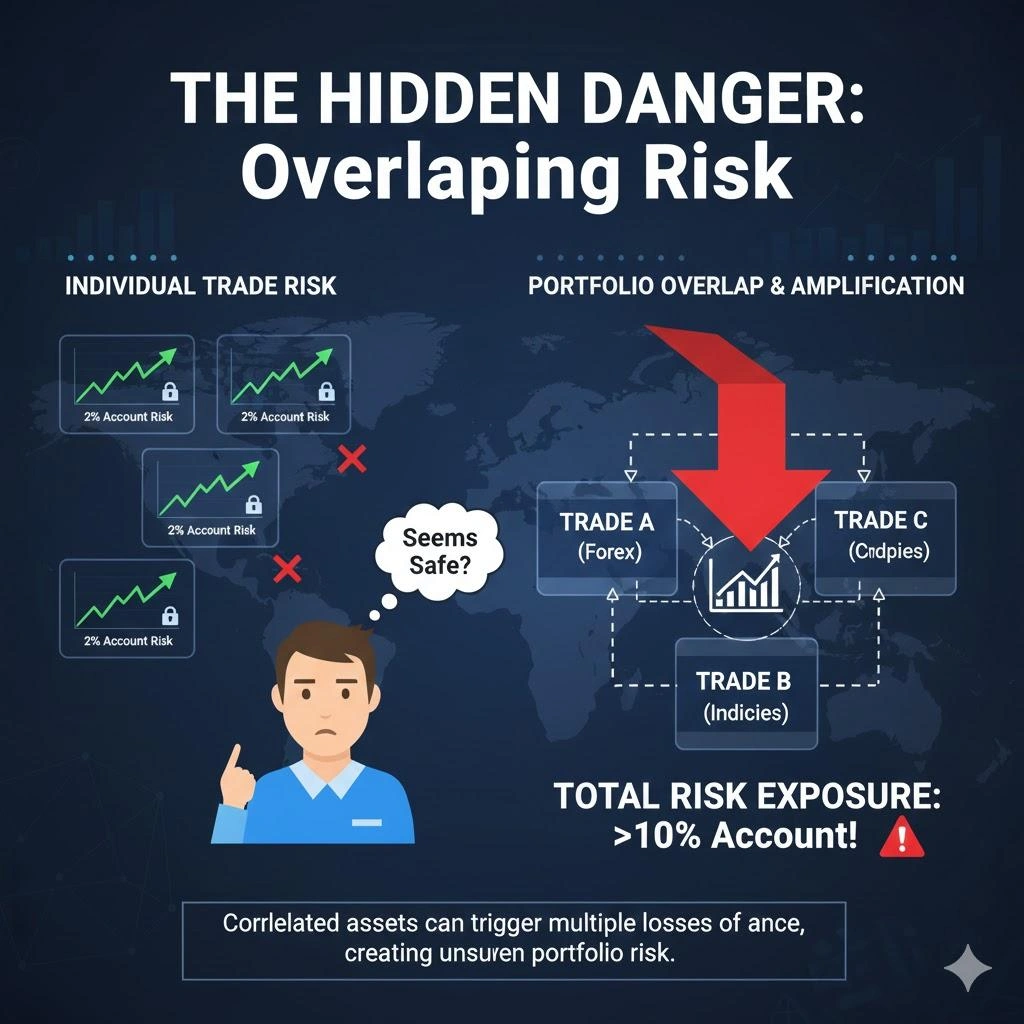
Many traders believe they are safe because they risk only 1–2% per trade. However, this approach ignores portfolio-level interactions.
The Problem with Isolated Risk Thinking
When trading multiple positions:
- Five related trades with each at the risk of 2% becomes total 10% risk exposure.
- If you’re trading two same sector stocks, it can increase the losses.
- Suppose that the central bank announces news tonight it can have several stop-losses to hit at once.
Portfolio risk management tools exist specifically to solve this blind spot.
What Is a Risk Exposure Calculator?
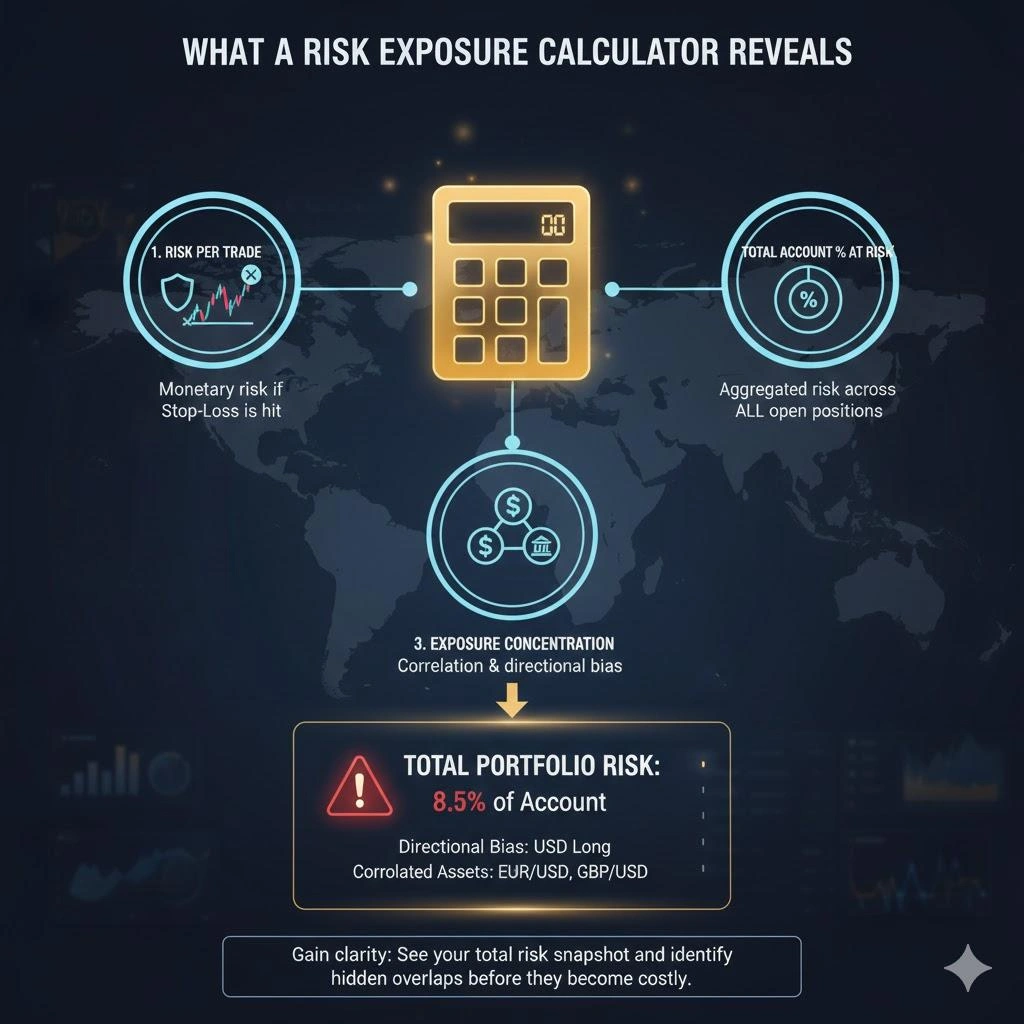
A risk exposure calculator is a tool that aggregates risk across all open trades to show total exposure in real terms. Instead of viewing trades individually, it provides a portfolio-wide risk snapshot.
What a Risk Exposure Calculator Measures
Most calculators focus on:
- Risk per trade based on stop-loss distance and position size.
- The total percentage of capital at risk including all the positions.
- Exposure concentration by asset class, direction, or correlation.
This allows you to see whether you are truly diversified or unknowingly overexposed.
How a Risk Exposure Calculator Works
When you learn how the calculator works, you stop guessing and start trading with real conviction. With it your trading becomes more impactful and your decision making also improves.
Core Inputs Used in Exposure Calculation
To give an accurate result, a standard risk exposure calculator analyze the following inputs:
- Your total account balance or equity.
- The entry price and stop-loss level.
- The position size or lot size.
- Asset type and direction (long or short).
From these inputs, the tool calculates how much capital is at risk if stops are triggered.
The Risk Exposure Calculation Method Explained
Although calculators automate the process, the underlying math is straightforward.
Basic Risk Per Trade Formula
The foundational formula looks like this:
Risk per Trade = (Entry Price – Stop-Loss Price) × Position Size
This gives the monetary risk of a single position.
Portfolio-Level Risk Formula
To calculate total exposure:
Total Risk Exposure = Sum of All Individual Trade Risks
Step-by-Step Guide to Using a Risk Exposure Calculator
Let’s break down a practical workflow traders can use daily.
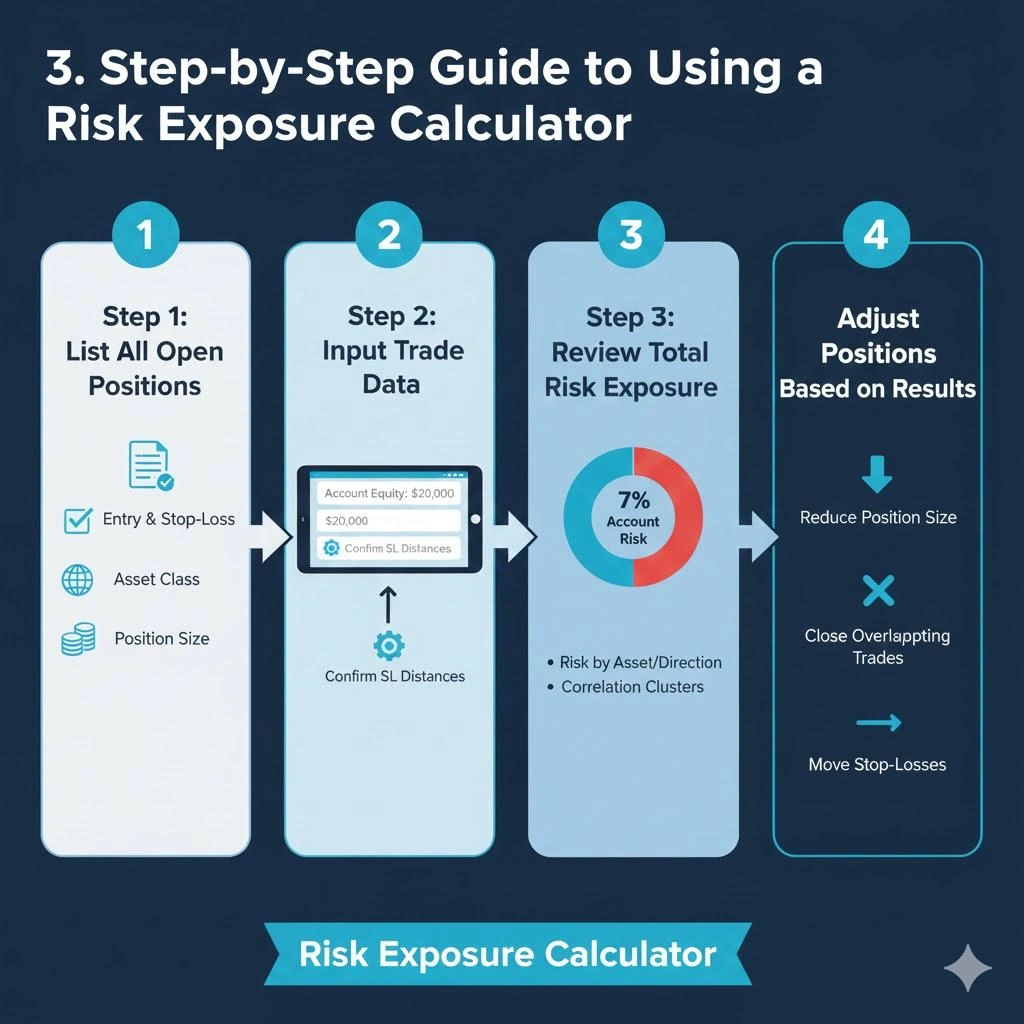
Step 1: List All Open Positions
Start by gathering accurate trade data:
- Record each open trade’s entry and stop-loss.
- Include all asset classes such as forex, indices, stocks, or crypto.
- Ensure position sizes are correct and up to date.
Accuracy here determines the reliability of the output.
Step 2: Input Trade Data into the Calculator
Enter each trade individually:
- Use the same account equity value for all trades.
- Confirm whether the calculator uses fixed or dynamic equity.
- Double-check stop-loss distances.
Most errors come from incorrect inputs rather than faulty tools.
Step 3: Review Total Risk Exposure
Once calculated, the tool will show:
- Total percentage of account at risk.
- Risk distribution across trades.
- Concentration in specific markets or directions.
This is where traders often experience “aha” moments.
Step 4: Adjust Positions Based on Results
If exposure is too high, traders can:
- Reduce position sizes.
- Close overlapping trades.
- Move stop-losses strategically, not emotionally.
This transforms exposure calculation into actionable risk control.
Real-World Example: Multi-Position Risk Exposure
Let’s look at a realistic trading scenario.
Example: Forex Portfolio Exposure
A trader with a $20,000 account holds:
- EUR/USD long risking $200.
- GBP/USD long risking $200.
- AUD/USD long risking $200.
Individually, each trade risks only 1%. However, all three are USD-correlated.
A risk exposure calculator reveals:
- Total risk = $600 or 3% of the account.
- Directional bias heavily exposed to USD strength.
- Potential for simultaneous stop-outs during a single news event.
Without the calculator, this overlap is easy to miss.
Correlation and Hidden Risk Exposure
Understanding the correlation is really important for your portfolio. Because if you don’t keep analyzing the relation between your trades, you’ll think you have a well diversified portfolio when actually you’ve doubled your risk.
Why Correlation Matters
Correlation increases risk because:
- The market often moves together during high volatility.
- Your stop-losses can be triggered across multiple trades simultaneously.
- Loss tends to compound much faster than expected.
Advanced portfolio risk management tools often highlight correlation clusters.
When to Use a Risk Exposure Calculator
Timing matters as much as accuracy.
Key Moments to Calculate Exposure
The best time to calculate the risk exposure is:
- Before you enter a new trade.
- Every time you enter or exit a trade.
- Before any big announcements like inflation, interest rates or etc.
- At the end of every week or month when you sit to review the performance.
Consistent use builds discipline and confidence.
Common Mistakes Traders Make with Risk Exposure
Even with the right tools, misuse can limit effectiveness.
Mistakes to Avoid
Traders often make these errors:
- Widening the stop-loss without updating your risk exposure
- Just because the trades have different names doesn’t mean they are not from the same bet.
- You can trade with zero leverage, and still can lose everything.
A risk exposure calculator only works when paired with honest inputs and realistic assumptions.
Benefits of Using Risk Exposure Calculators Consistently
Over time, exposure awareness changes trading behavior.
Long-Term Advantages
Regular use leads to:
- Fewer surprise drawdowns.
- Improved capital preservation.
- Better emotional control during volatility.
- More stable equity curves.
This is why professional traders prioritize exposure calculation over trade frequency.
Integrating Risk Exposure Calculators into Your Trading Routine
To become a successful trader you need to make it a routine. And be aware of what’s coming before the market tells you.
A Simple Daily Workflow
A practical routine might include:
- Checking the total amount at risk before the market starts.
- Every time you add a new trade, you must check the shift in risk exposure. To avoid over-exposure.
- On weekends compare between the total risk and expected profits.
With this approach soon the process will become a habit.
Conclusion: Why a Risk Exposure Calculator Is Non-Negotiable
Look, trading too many trades at once is okay, but if you don’t track your risk exposure correctly you might end up losing all your capital. That’s why you need a risk exposure calculator to manage your risk effectively, trade with right position sizing and to stop reacting to the market in a panic. Make it a habit, a part of your healthy trading journey
At InsightfulTrade, we help young traders learn these kinds of tools through simple, practical education. They provide well structured guidance and frameworks you need to manage your portfolio with confidence, ensuring you’re always prepared for whatever the market does next.
Frequently Asked Questions
What is a risk exposure calculator used for?
A risk exposure calculator is used to measure the total amount of capital at risk across multiple open trading positions.
How is exposure calculation different from position sizing?
Position sizing focuses on individual trades, while exposure calculation evaluates combined portfolio-level risk.
When should a trader calculate risk exposure?
A trader should calculate their risk before entering a trade and during portfolio analysis.
Can beginners use risk exposure calculators?
Yes, it will be very beneficial for beginners to use it, to calculate their risk exposure and manage them accordingly. In fact they include it in their daily routine.
Do risk exposure calculators guarantee lower losses?
They do not guarantee profits or prevent losses, but they significantly reduce the chance of uncontrolled drawdowns.
Author: Kumkum Chandak
Experience: 3+ Years in Trading Research & Market Content Strategy
Kumkum Chandak is a trading content strategist and market research writer who specializes in simplifying technical analysis, trading tools, and strategy-driven educational content. Her work is optimized for EEAT, accuracy, and user intent, ensuring every article delivers practical insights for traders of all levels.
Risk Disclaimer:
All content is strictly educational and not financial advice. Trading involves substantial risk. Always perform your own analysis or consult a professional advisor.
Last Updated: 25 December 2025