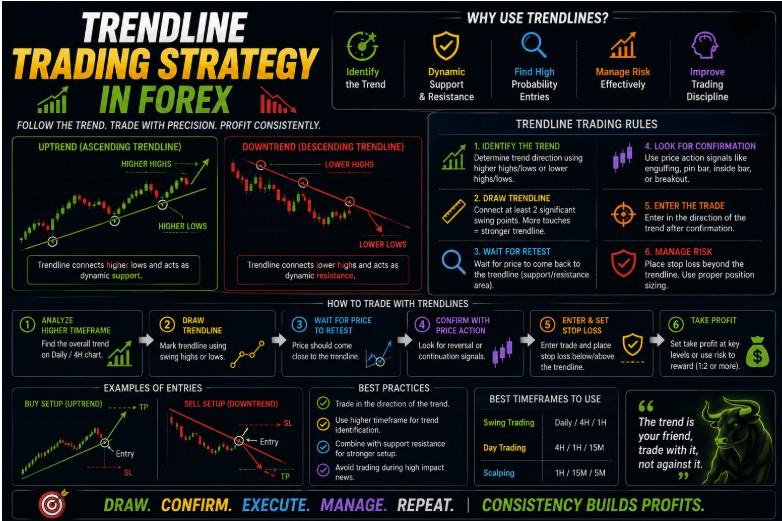
Introduction to Trendline Trading in Forex
Among the many methods available to forex traders, the trendline trading strategy remains one of the simplest yet most effective techniques for analyzing market direction and identifying trading opportunities. Trendlines have been used by professional traders for decades because they visually represent market trends, support and resistance levels, and potential reversal areas.
A well-executed trendline trading strategy allows traders to follow the market rather than predict it. Instead of relying solely on indicators, traders use price movements to identify the dominant trend and make informed decisions based on actual market behavior.
The popularity of the trendline trading strategy comes from its versatility. Whether a trader prefers scalping, swing trading, or position trading, trendlines can be applied across all timeframes and currency pairs.
When combined with sound risk management and proper market analysis, trendline trading can become an essential component of a successful forex trading plan.
Understanding the Basics of Trendlines
Trendlines are diagonal lines drawn on charts to connect significant highs or lows. In an uptrend, trendlines connect higher lows, while in a downtrend they connect lower highs.
The purpose of a trendline trading strategy is to identify the direction of the market and anticipate areas where price may react in the future.
Trendlines help traders recognize market structure, determine trend strength, and identify potential breakout or reversal opportunities. Properly drawn trendlines often act as dynamic support and resistance zones.
Unlike horizontal support and resistance levels, trendlines move with price, providing traders with a dynamic perspective of market conditions.
The Importance of Technical Analysis in Trendline Trading
Every successful trendline trading strategy relies heavily on technical analysis. Technical analysis involves studying historical price movements to identify recurring patterns and market behavior.
Through technical analysis, traders can determine trend direction, identify significant support and resistance levels, and assess overall market conditions.
Trendlines themselves are one of the most fundamental tools in technical analysis. They help traders visualize trends and establish a framework for making trading decisions.
Combining technical analysis with trendlines improves market understanding and allows traders to develop more structured trading plans.
Support Resistance and Trendline Trading
The relationship between support resistance and trendlines is extremely important in forex trading. Trendlines frequently act as dynamic support resistance zones where price may reverse or continue in the prevailing direction.
During an uptrend, an ascending trendline often serves as support resistance by providing buying opportunities when price retraces.
Similarly, descending trendlines in downtrends may act as resistance levels where sellers re-enter the market.
Understanding how support resistance interacts with trendlines helps traders identify higher-probability trading opportunities and improve risk management.
Identifying Trends Using Trendlines
One of the primary objectives of a trendline trading strategy is identifying market trends. Trend identification is essential because trading in the direction of the dominant trend generally increases the probability of success.
An uptrend is characterized by higher highs and higher lows, while a downtrend consists of lower highs and lower lows.
By connecting significant swing points, traders can quickly determine whether the market is trending or consolidating.
Successful trend trading often begins with accurately identifying the prevailing market direction before searching for specific trade opportunities.
Forex Entries Using Trendlines
Finding precise forex entries is one of the most challenging aspects of trading. Many traders correctly identify trends but struggle with timing.
Trendlines can significantly improve forex entries by highlighting areas where price is likely to react.
In an uptrend, traders frequently wait for price to retrace toward the trendline before searching for bullish confirmation signals. In downtrends, traders may look for bearish setups near descending trendlines.
Carefully planned forex entries improve risk-to-reward ratios and reduce emotional decision-making.
Trend Trading With Ascending Trendlines
Ascending trendlines form during bullish market conditions and represent one of the most common applications of trend trading.
As price creates higher lows, traders connect these lows to establish a rising trendline. This line often acts as dynamic support.
Many traders using a trendline trading strategy monitor ascending trendlines for potential buying opportunities.
When price respects the trendline repeatedly, market confidence often increases, supporting continued trend trading opportunities.
Trend Trading With Descending Trendlines
Descending trendlines appear during bearish markets and help traders identify selling opportunities.
A descending trendline connects lower highs and serves as dynamic resistance. Traders frequently use these structures to participate in ongoing downtrends.
Effective trend trading involves waiting for price to approach the trendline before evaluating potential entry signals.
Combining descending trendlines with broader technical analysis improves trade quality and enhances consistency.
Combining Technical Analysis With Trendlines
A comprehensive trading approach integrates technical analysis with trendline evaluation.
While trendlines provide directional guidance, additional technical analysis tools such as candlestick patterns, moving averages, and momentum indicators can strengthen trade confirmation.
For example, bullish candlestick formations appearing near an ascending trendline often reinforce long trade opportunities.
Integrating multiple forms of technical analysis helps traders avoid false signals and improve overall decision-making.
Support Resistance Confluence in Forex Trading
Confluence occurs when multiple technical factors align at the same location. In trendline trading, confluence between trendlines and support resistance levels often produces high-quality setups.
For instance, an ascending trendline intersecting with a major horizontal support resistance zone may significantly strengthen the likelihood of a market reaction.
Professional traders frequently seek such confluence because it increases trade probability.
The combination of support resistance and trendline analysis creates a more robust trading framework.
Breakout Opportunities in Trendline Trading
Although trendlines often provide continuation opportunities, they can also signal potential reversals.
When price decisively breaks a trendline, market sentiment may be changing. Trendline breakouts frequently create attractive forex entries for traders anticipating new trends.
However, traders should exercise caution because false breakouts occur regularly.
Confirmation through technical analysis and price action remains essential before acting on trendline breakouts.
Common Mistakes in Trendline Trading Strategy
Despite its simplicity, many traders misuse the trendline trading strategy.
One common mistake involves drawing trendlines incorrectly by forcing lines to fit price action rather than connecting genuine swing points.
Another frequent error is relying exclusively on trendlines without considering broader technical analysis.
Some traders also ignore support resistance levels, reducing the effectiveness of their analysis.
Poorly timed forex entries and failure to follow prevailing trend trading principles often contribute to inconsistent performance.
Avoiding these mistakes significantly improves long-term results.
Risk Management in Trendline Trading
No trading methodology guarantees success. Therefore, risk management remains essential regardless of strategy.
Traders should establish stop-loss levels beyond logical market structure points and determine position sizes based on account risk tolerance.
Even highly reliable trendline setups occasionally fail.
Strong risk management ensures that individual losses remain manageable and protects trading capital over the long term.
Developing a Complete Trendline Trading Plan
A successful trendline trading strategy requires clear and consistent rules.
Traders should define how trendlines will be drawn, which timeframes will be analyzed, and what conditions must be present before entering trades.
A structured plan should also include criteria related to technical analysis, support resistance confluence, forex entries, and trend trading confirmation.
Consistency in applying predefined rules often proves more important than strategy complexity.
Long-Term Success Through Trend Trading

Long-term profitability in forex markets depends on discipline, patience, and continuous improvement.
Traders who consistently apply a structured trendline trading strategy, utilize sound technical analysis, respect support resistance levels, refine forex entries, and align positions with broader trend trading conditions often achieve more consistent results.
Markets constantly evolve, but the principles underlying trendline analysis remain relevant across all market environments.
Continuous learning, trade journaling, and regular performance evaluation further strengthen long-term success.
Conclusion
The trendline trading strategy remains one of the most valuable tools available to forex traders. Its simplicity, flexibility, and effectiveness make it suitable for traders of all experience levels.
By combining comprehensive technical analysis, understanding support resistance, improving forex entries, and embracing disciplined trend trading, traders can significantly enhance their market performance.
While no strategy guarantees profits, traders who consistently apply these principles with patience and sound risk management are better positioned to achieve sustainable success in the forex market.