What is trading risk management?
Hey traders! Are you also worried about the risk while trading? Use this process of identifying, assessing, and mitigating potential losses, which we call trading risk management. This is for your personal safety, which saves you from unpredictable price movements.
It involves how much money you should risk, not how much you want to make, which keeps your mindset stable and reduces panic. It is about making sure losses stay small enough for you to keep playing the game, whether you trade in stocks, forex indices, or crypto.
In essence, if you also want to become a successful trader, you should control your trade strategically instead of avoiding losses. So, now that you know about trading risk management, let’s discuss why it is important for traders.
Why is Risk Management Crucial for Traders?
If you’re thinking of trading without risk management, it can be unsafe for your trade even if you use high-win-rate strategies and wipe your accounts.
- The main goal of this process is to protect your trading capital during trades.
- It saves you from stress and impulsive decisions, because you know that you’re not going to lose more than the amount decided by you.
- It helps you to trade with a calm, relaxed, and clear mind.
- It ensures your long-term survival in the market.
- Helps in managing drawdowns and reduces the impact of losing streaks.
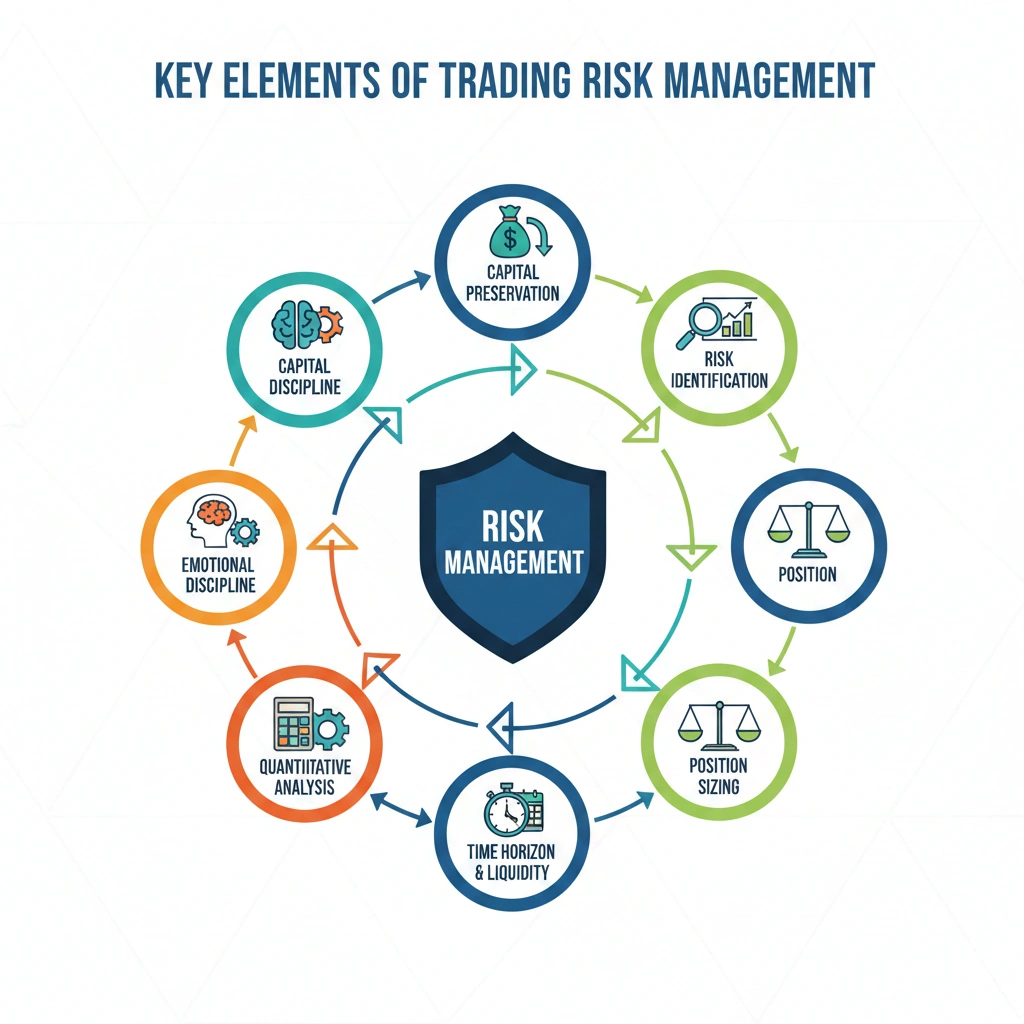
Key Elements of Risk Management in Trading
- Position Sizing
The most important element is that which determines how much of your capital you put into each trade.
- Stop-loss Orders
With this help, you can automatically stop your trade if the price goes against you.
- Take-Profit Levels
Book your profit to avoid your greed-driven decisions.
- Risk-to-Reward Ratio
Most traders target a ratio of 1:2 or 1:3 to ensure profit outweighs potential loss.
- Manage Drawdowns
If you’re in your losing phase, it prevents desperate attempts to recover losses quickly.
- Trading Plans
It ties all the key elements together because if you don’t have any plan, the best tools won’t work effectively.
Tools to Manage Trading Risks
- Position Size Calculators
- Risk-Reward Ratio Calculators
- Volatility Indicators
- Margin and Leverage Calculators
- News and Economic Calendar Tools
- Risk Dashboard Tools in Brokers
Why do these matter to you?
- It reduces emotional decision-making in trading
- These tools keeps losses under control
- It helps you trade with discipline
- It helps in making your vision clear and predictable
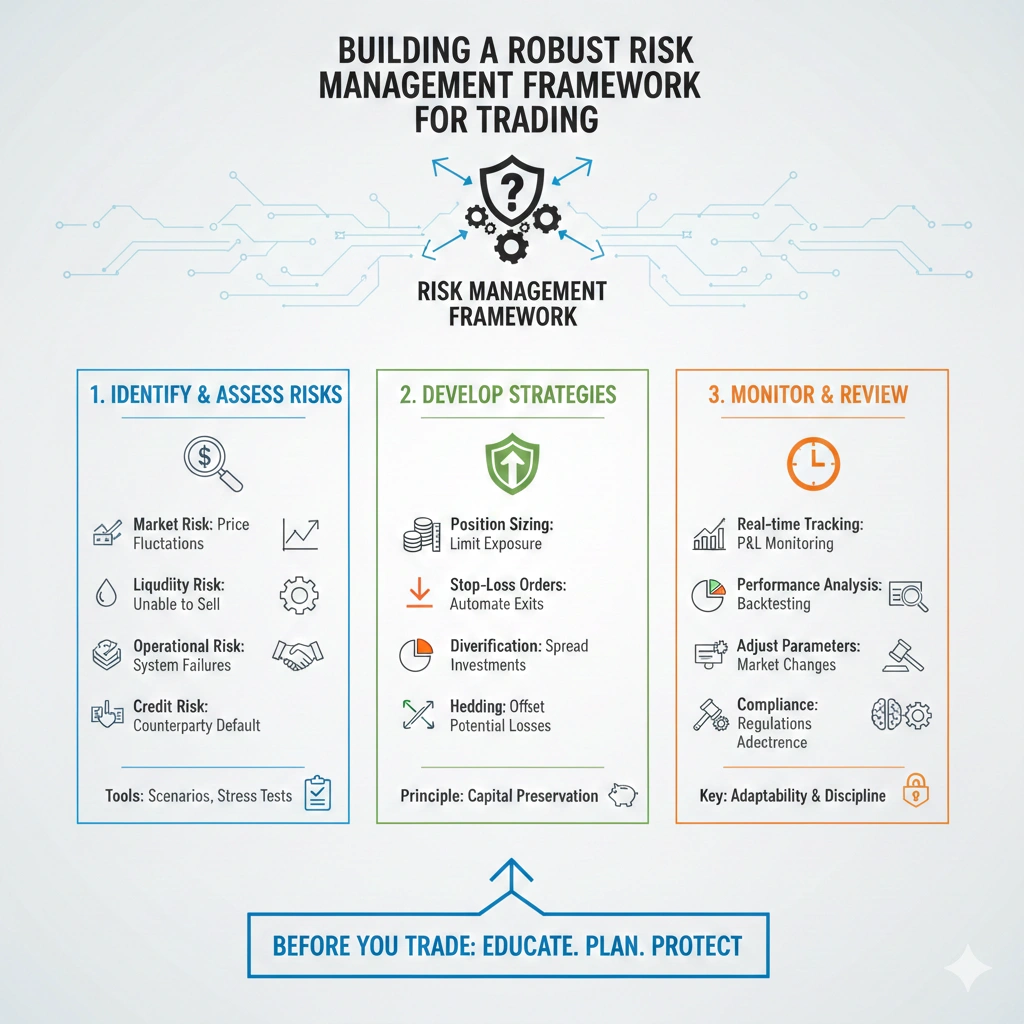
How Do You Build a Strong Risk Management Framework Before Trading?
As a trader, you know very well that before placing any trade, you should design a risk plan. So, here is a step-by-step guide to learn better.
Define Your Capital:
It is one of the most important steps before entering markets. After defining your trading capital, you can easily calculate your risk per trade.
Identify Your Risk Appetite:
To make a sustainable trading plan, it is crucial to identify your risk appetite, which helps you in preventing the adoption of unmatched strategies.
Set Risk Per Trade Techniques:
With this technique, you can decide how much you are willing to lose in one trade.
Choose a Trading System
A roadmap that helps you in knowing when to start any trade, when to exit, how much to risk, and how to interpret market decisions.
Put a Drawdown Limit in Place
Being a trader is the smartest decision that ensures you remain in the trading game for a long time, growing.
Common Trading Risks and How to Avoid Them
- Market Volatility: Stick to a clear trading plan, never overleverage, and review your trade on a regular basis.
- Emotional Trading: Don’t trade when stressed or tired, and use a proper journal for your trading.
- Overtrading: Avoid too many trades, limit daily trades, and trade only when your strategy gives a valid signal.
- Lack of Risk Management: Avoid high leverage, use stop-loss, and follow the risk rule of 1-2%.
- Improper Trading Plan: Make and follow a master plan that covers risk rules, entry, and exit.
- Not Understanding Market Conditions: To understand it, first analyze the market before entering into it and stay updated.
Risk Management for Different Types of Traders
For every trade and trader, risk management is different because of their style, strategy, and exposure level.
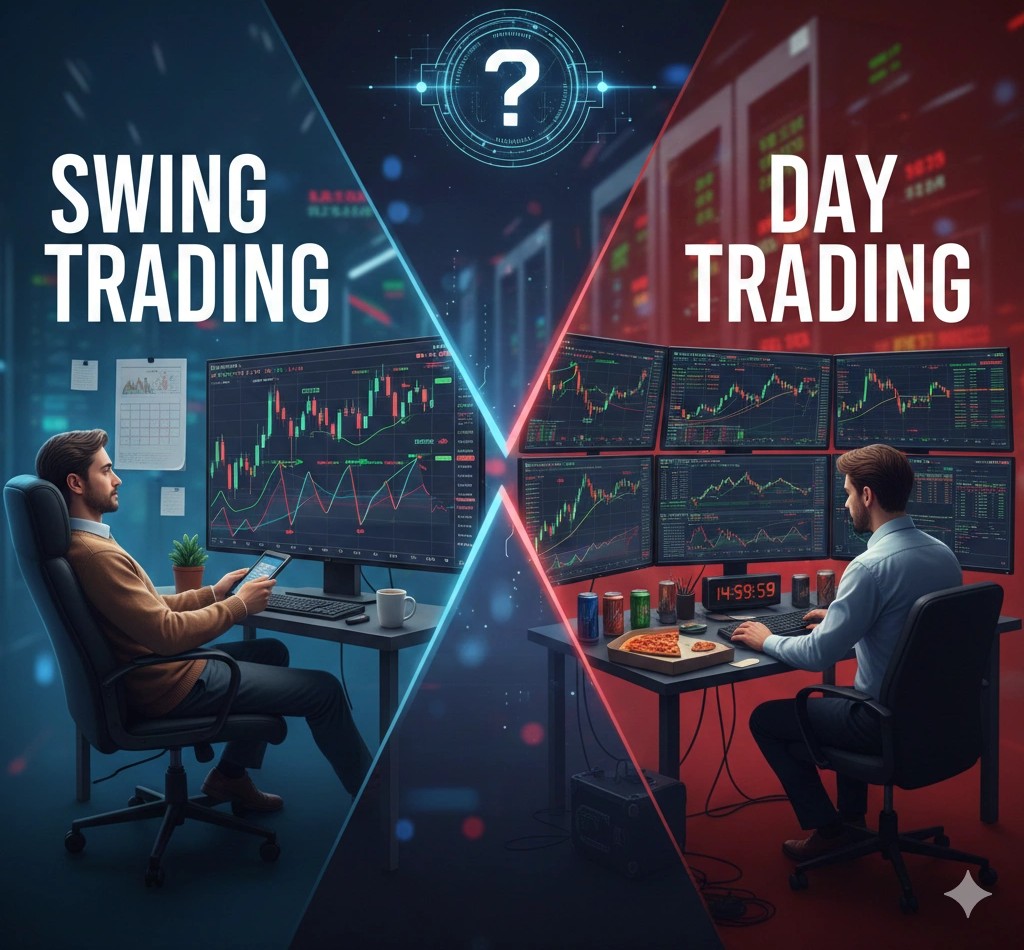
- Day Traders
Those trades close the multiple positions on the same day and use 0.5%-1% risk per trade. They are risk-takers and follow a strict risk trading plan to manage risk.
- Swing Traders
They are traders who may risk 1-2% per trade, and positions are usually held 2-20 days.
- Position Traders
Traders who held their trade for a week or months and rely on economic data and long-term chart patterns for their trading decisions.
- Algorithmic Traders
Who depends on systematic strategies based on patterns, historical data, and statistical models. They use software to place trades and process thousands of transactions in milliseconds.
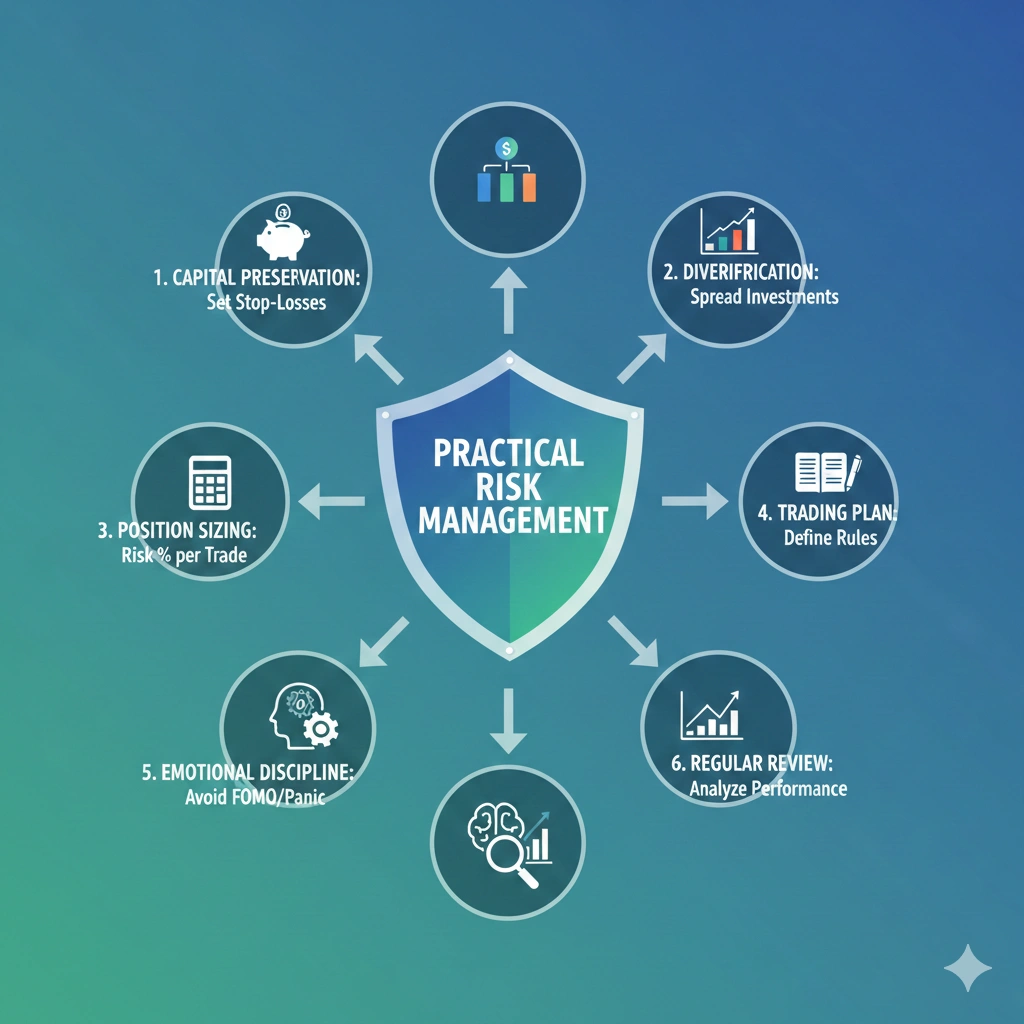
Practical Risk Management Strategies
To manage risk, you should follow these strategies given below. Let’s check quickly:
- Firstly, follow a fixed risk percentage for every trade.
- To automate limit losses, you can use stop-loss orders.
- Book your gains with set take-profit targets.
- Maintain a journal to find out the profit or losses in your trading.
- Stick to a plan that includes your entry, exit, and risk rules.
How to Review and Adjust Your Risk Management Plan
In every trade, it is very important to review and adjust your plan that helps you to stay consistent in the trading markets. For that you need to:
- Evaluate and review your recent trades.
- Then, analyze your and manage drawdowns.
- Check if market conditions have changed.
- Add any rule to reduce emotional decision-making to refine it.
- After every 20-30 trades, review your trade.
- Make sure your plans are flexible to adapt to changing market behavior.
- If you’re in confusion during any trade, make your entry or exit criteria simple.
- If you make any change in rules, check it before using it in live trading.
How to calculate position size?
With the help of position size, here are some
Let’s look for an example:
Just imagine, you are a trader and have a $10,000 account balance and want to risk only 1% for one trade.
- Now the risk for $10,000 is $100
which means in case your trade fails, you’ll lose only $100.
- Stop-loss distance is 50 pips on EUR/USD
- If we calculate numerically, the result is
- $100 risk ÷ 50 pips = $2 per pip
- $2 per pip ≈ 0.2 lots
FAQs About Trading Risk Management
- What percentage of capital should be risked per trade?
Talking about the risk, you should risk only 1-2% per trade of your total capital. More than 1-2% can ruin your account during losing streaks.
- How do stop-loss and take-profit work to limit losses?
Basically, stop-loss and take-profit are very necessary to manage trading risk. It helps you when the price moves against you beyond a set level and secures profit when it meets expectations.
- Can risk management guarantee profits?
Talking about the guarantee, then the answer is no. It cannot guarantee profits in trading, only ensure you survive losing streaks to capitalize on winners.
- When to adjust risk management strategies?
If market volatility spikes or your account balance changes, you should adjust risk management strategies. Adapt for new asset classes that keep your plan huge and protect your capital.
- How does emotional control relate to risk management?
If you take rash decisions or are in fear, greed can lead to risk. So, it is necessary to maintain control over your emotions and follow predefined risk management rules.
Start Managing Your Trading Risk Today
So now, let’s turn your trading talks into real action to manage your risk. The reason behind successful trading is effective risk management. Any strategy never guarantees success, but proper management of risk can lead you to success and let you stay in the game. Trading risk management is a cornerstone for every beginner and experienced trader.
In essence, trading risk management is about consistency, protection, and long-term growth. If you combine tools and strategic planning, you can easily create a robust framework that will help you enhance your performance in the market and boost your confidence.
What are you waiting for? Join Insightful Trade today! With the help of their toolkit, you can simplify your key money management tasks. Sign up now to protect your capital and also trade smarter!
Author: Arihant Jain
Trading Experience: 5+ Years
Arihant Jain is a financial markets analyst and trading educator with expertise in Forex, indices, crypto, and risk-managed trading systems. His insights are based on real trading experience, data-driven analysis, and transparent market understanding. All content is reviewed for accuracy and aligns with Google’s EEAT guidelines.
Risk Disclaimer:
Trading involves substantial risk. All information is for educational purposes only and should not be taken as financial advice. Always do your own research.
Last Updated: 15 December 2025