
Today’s fast-moving markets are dominated by algorithmic trading, shorter holding periods, and volatile macro events. Traders like you are talking more than ever about consistency and discipline.
In this comprehensive guide, we are going to talk about the most common trading journal mistakes that you make and how they affect your performance, how you fix them, and some practical methods that suit today’s markets.

What Are Trading Journal Mistakes, and Why Do They Matter?
Trading journal mistakes are the structural, psychological, and behavioral errors that prevent a journal from doing the one job it’s meant to do. It should function like a performance mirror that reflects your discipline, thinking, and emotional control.
Why these mistakes matter:
- Hide your real edge
- Create unnecessary self-doubt and false confidence
- Strengthen bad habits
Simply, no journal is better than a bad journaling trading.
Metrics That Changed After Correcting Trading Journal Mistakes
The trader analyzed key metrics after 8 weeks of disciplined journaling:
| Metric | Before | After | Improvement |
| Rule violations | 12/week | 7/week | -42% |
| Average daily trades | 15 | 10 | -30% |
| Maximum drawdown | 8% | 6.5% | -18% |
| Profitable days | 12/30 | 16/30 | +33% |
When you correct journal mistakes, profitability will automatically increase, and tracking emotions and market context will help you to reduce overtrading and rash or impulsive decisions.
Top Trading Journal Mistakes Traders Make
Here are some of the common mistakes made by you while journaling your trade:
- If you are only recording profit and losses
- When you journal inconsistently
- You treat your journal like a personal diary
- Journal without market conditions
- If you don’t review your journal on regular basis
- Journal data is not linked to strategy changes
Why Reviewing Your Journal Is Just as Important as Writing It
Are you also journaling your trade but not reviewing it? It’s like you never see a doctor and are only collecting the reports.
If you will not review:
- Mistakes will be repeated
- Progress stalls
- The pattern will go unnoticed
How to fix it:
- Review your journal weekly
- Summary of monthly performance
Timeline of Progress
- Month 1: Incomplete and Reactive Journaling
- Month 2: Pattern recognition and awareness
- Month 3: Rule-based and structured journaling
- Months 4-6: Optimization and consistency of performance

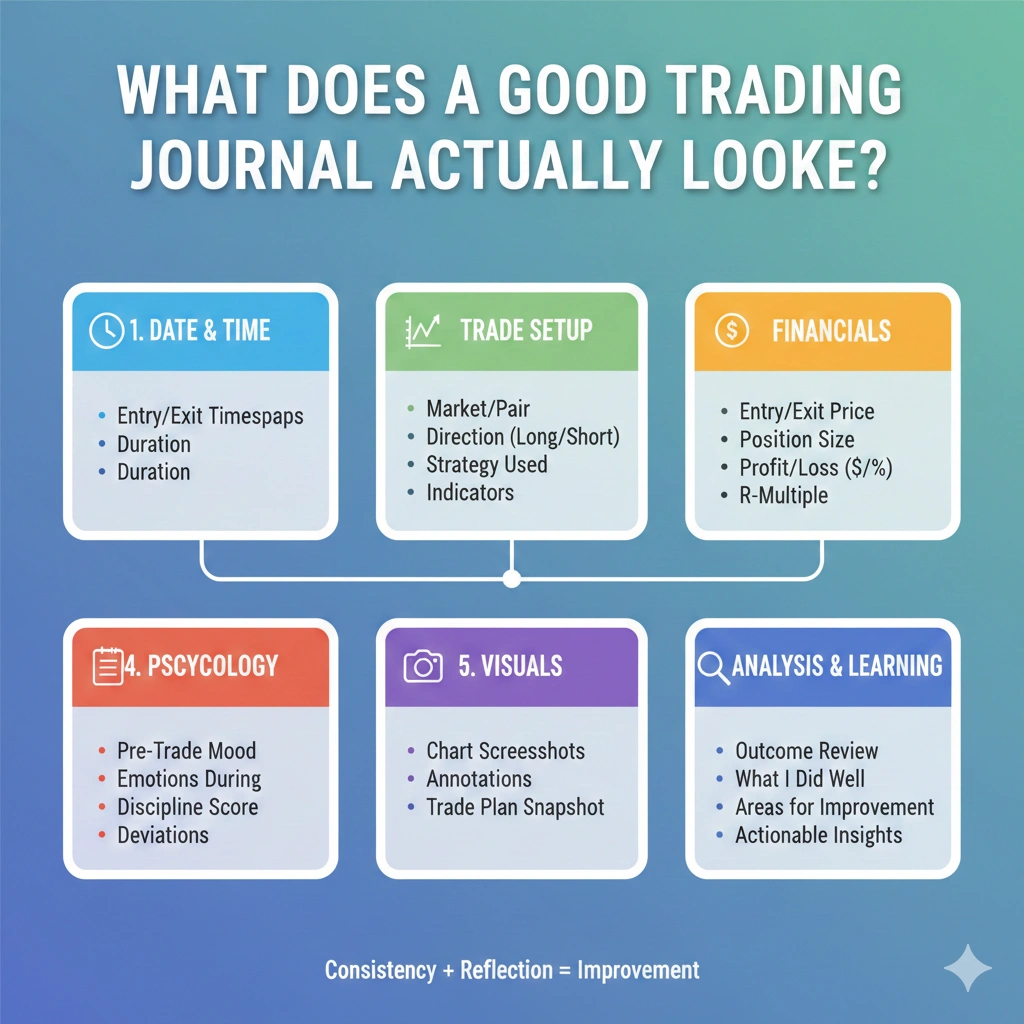
What Does a Good Trading Journal Actually Look Like?
A good and strong journal is clear, honest, and repeatable, and its main focus is to help you in making better decisions, trade after trade.
- Captures the reason behind every trade
- Tracks rule adherence
- Includes brief notes on emotional state
- Reviewed regularly
- Reflection of Post-trade
Case Study: How Fixing Trading Journal Mistakes Improved Your Consistency
An intraday index trader who is 32 years old has struggled for more than three years with inconsistent results with a proven strategy. He maintained a trading journal that revealed some trading journal mistakes. It shows that he was only recording losing trades, and his focus was only on profit and loss.
Then he restructured his journal and committed to journaling all trades, including the profitable ones. Clear patterns emerged within 8 weeks, and overall consistency was improved.
It teaches you that only correcting journal mistakes can improve your trading performance.
Some Interview-Style Quotes in Trader’s Own Words
- “What I thought about journaling was only writing down profit and losses, and I never realized that how I felt before clicking mattered more than the setup itself.
- The biggest mistake that I made was assuming that discipline would come with experience automatically, but this is not true.”
Q&A on Trading Journal Mistakes
Q: What was the biggest trading journal mistake made by you?
A: “I ignored profitable trades because I felt it was right and journaled only losing trades. Then, after I realized that most profits come from only two setups.”
Q: How did fixing journal mistakes impact consistency?
A: “My drawdown reduced without making any change in strategies when I tracked rule violations and emotions honestly.”
Modern Journaling Best Practices Traders Are Using Today
Markets have become emotionally demanding and faster; you are adopting modern systems of journaling to eliminate journal mistakes. It doesn’t focus on excessive documentation, while its main focus is accountability, clarity, and data-driven self-improvement. Here are some of the modern journals:
- Tag-based journaling
- Hybrid journaling
- Structured reviews
- Performance analytics tool
Conclusion: Fixing Trading Journal Mistakes Is a Performance Edge
Don’t think that you are failing because your strategy is bad; it is because you never truly understand yourself. Edge no longer comes from indicators or strategies in today’s fast-driven markets. You can gain clarity once you fix how you journal by market context and execution quality, which leads you to better control of risk and more consistent results in trade.
Stop repeating the trading journal mistakes and visit Insightful Trade, which helps you in improving your decision-making and building a data-driven trading journal.
FAQs: Trading Journal Mistakes
Q1. What is the biggest trading journal mistake beginners make?
Being a beginner, if you ignore emotional behavior and decision quality and focus only on profit and loss.
Q2. How often should traders review their trading journal?
To identify execution errors and rule violations, you should review your trading journal weekly and monthly to evaluate win rates and strategy performance.
Q3. Can journaling improve trading psychology?
Yes, increasing emotional control and self-awareness can significantly improve your trading psychology.
Q4. Should I journal paper trades and demo trades?
Yes, if you’re a beginner, it is very crucial to journal paper trades and demo trades to reveal early mistakes without financial risk.
Author: Arihant Jain
Trading Experience: 5+ Years
Arihant Jain is a financial markets analyst and trading educator with expertise in Forex, indices, crypto, and risk-managed trading systems. His insights are based on real trading experience, data-driven analysis, and transparent market understanding. All content is reviewed for accuracy and aligns with Google’s EEAT guidelines.
Risk Disclaimer:
Trading involves substantial risk. All information is for educational purposes only and should not be taken as financial advice. Always do your own research.
Last Updated: 30 January 2026