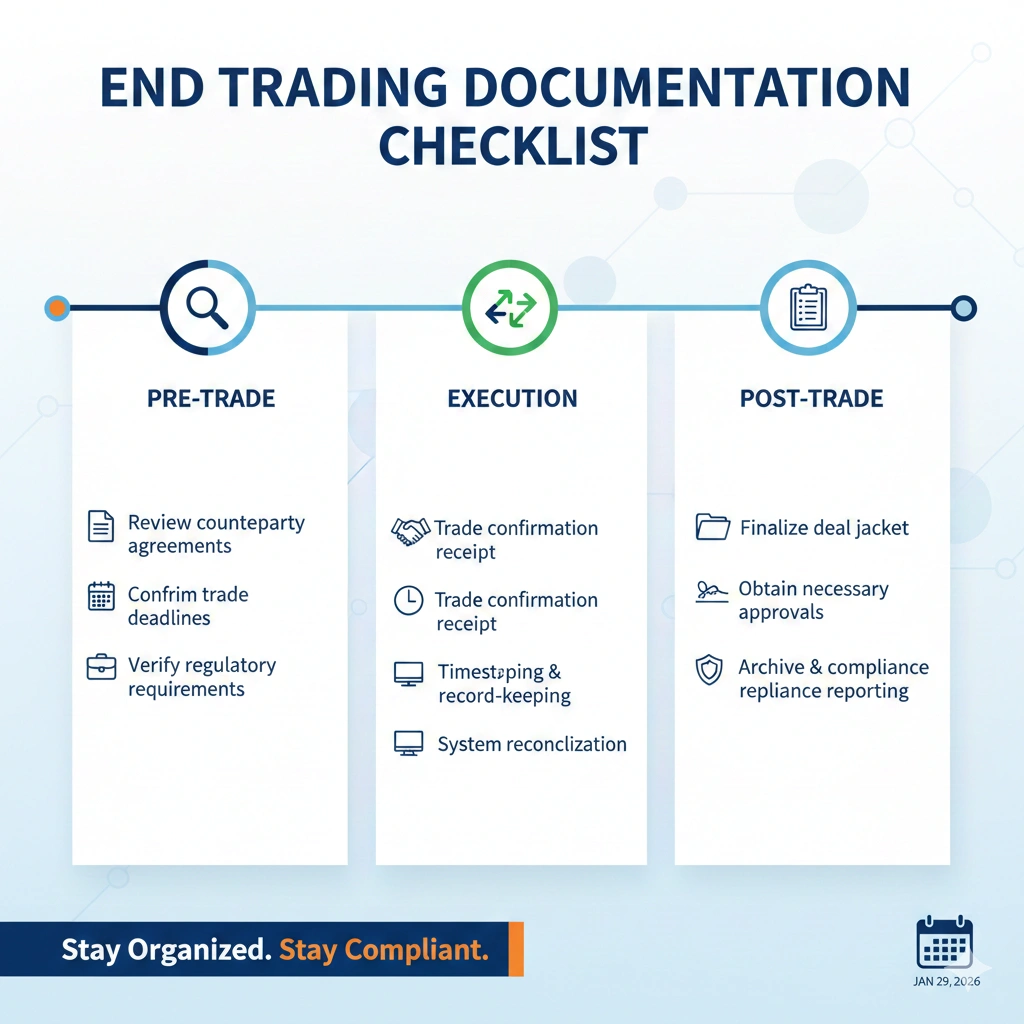
Quick Summary
A lot of traders wait for the profits to start recording and tracking their trades, but you really need it from the very first trade. A missing contract detail or an incomplete bank detail can cause a big headache even after a trade is over. To stay prepared for any tax audit, broker inspection, or bank questions, you need a solid trading documentation checklist.
In the blog, we’ll cover all major documents one needs in trading, how to manage them, and how they can impact your trading experience.
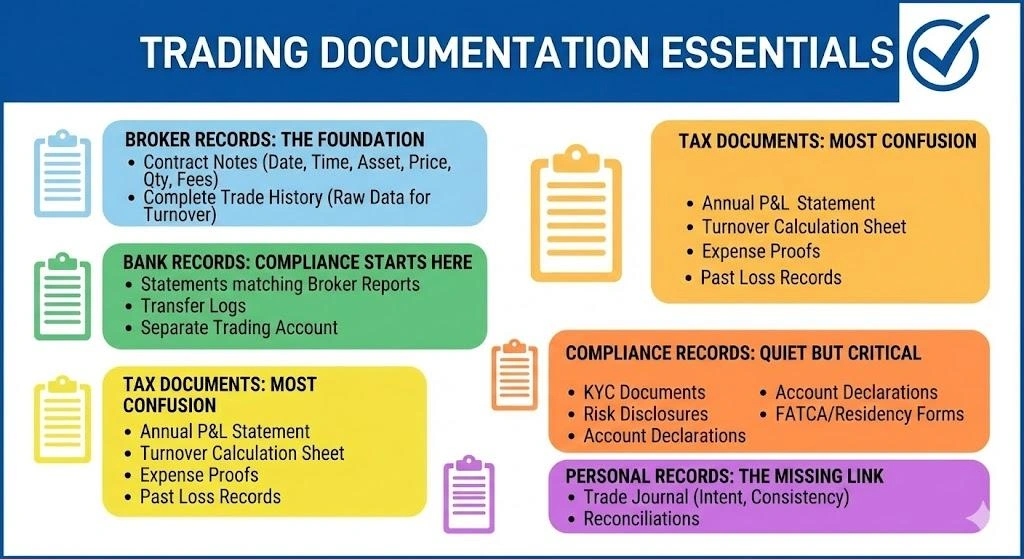
In simple terms, a trading documentation checklist includes broker contract notes, complete trade history, bank statements, turnover calculations, tax filings, KYC records, and basic personal trade logs. These documents help traders respond to tax audits, bank queries, and compliance reviews.
Trading Documentation Checklist – Overview Table
| Category | Documents Included | Purpose |
| Broker Records | Contract notes, trade history | Proof of trades |
| Bank Records | Statements, transfer logs | Fund trail |
| Tax Documents | P&L, turnover working | Tax filing |
| Compliance Records | KYC, declarations | Regulatory alignment |
| Personal Records | Journals, reconciliations | Consistency & clarity |
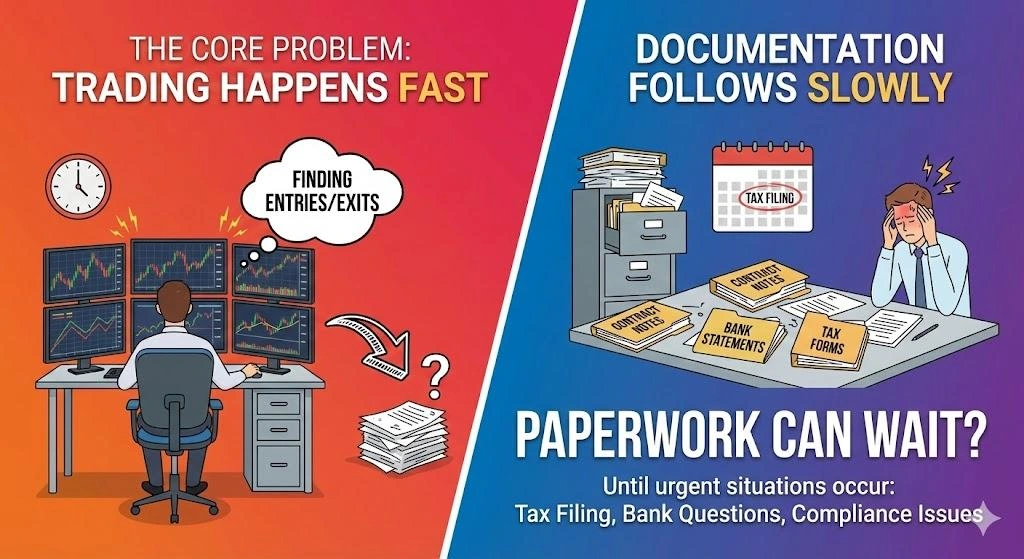
The Core Problem: Trading Happens Fast, Documentation Follows Slowly
Most of the time traders are glued to the charts finding the best entries or exits. This paperwork feels like it can wait. But this approach is where you’re wrong; you realize it when a sudden urgent situation occurs.
In India, this issue usually pops up when:
- Filing your income tax
- Carrying forward trading losses
- Answering the bank’s question
- Upgrading your broker account
- Facing a compliance issue
At such times you actually realize that you don’t have a well-structured trading documentation checklist. All your reports and paperwork are scattered; some are missing or incomplete.
Why Documentation Exists (And Why It’s Not Just Bureaucracy)
To traders this may seem like a burden, but for regulators and banks it’s about rebuilding.
They want to know:
- What’s actually happening
- When and how money moved
- Do you trade relatively in the same way
After the fact, your compliance and tax file is there to enable an accurate review of what you traded.
Broker Records: The Foundation of Any Trading Documentation Checklist
Contract Notes
First comes the contract details, the most important record you’ll ever keep.
They show:
- The exact date and time
- What asset do you trade?
- Your entry and exit price
- The total quantity
- Broker fees and charges
Your broker’s dashboard layout or app design can change, but those contract details will remain permanent proof.
Why it matters:
In the case of a dispute, audit, or tax filing, these are the first things that anyone will ask to see.
Complete Trade History
We often collect the partial trading data, the one we need at the moment. But that’s not enough.
You need:
- Full trading history
- Entry and exit prices
- Quantity per trade
These are the basic details you need to calculate your turnover and pick the right tax category. A solid trading documentation checklist always includes raw trade data.
Bank Records: Where Compliance Usually Starts
Your strategies don’t matter, but your deposits and withdrawals do draw the attention of banks.
- The amounts are highly inconsistent
- Transaction don’t match your reported income
- Trading funds mix with personal bills
What to Maintain
- Your transactions must match in both bank and broker
- The source of fund
- Keep a separate trading account
Why this matters:
The process of matching your bank records with your broker’s report makes it easy to answer the authorities’ questions.
Tax Documents: Where Most Confusion Happens
At this point the trading process becomes too complex for traders to handle. Trading income doesn’t always behave like salary income. They have different elements like profits, losses, turnover, and expenses, all with different functions.
Core Tax Documents to Keep
- Annual P&L statement
- Turnover calculation sheet
- Expense proof (internet, data feeds, software)
- Records of past loss
They focus on two main things, which include correct documentation and answers to questions asked by investigators.
Turnover: The Part Traders Rarely Understand
A trader would earn ₹1 lakh but would report ₹80 lakh in turnover. This surprises people.
That’s because:
- Turnover in derivatives based on the total value of trades
- Not just your profit
A trading documentation checklist should always include turnover workings, especially for:
- Options traders
- Intraday traders
The requirement for a tax audit depends on your total turnover, instead of just the profits you made.
Compliance Records: Quiet but Critical
These are easy to overlook, in part because they don’t directly impact your daily trading.
Until they do.
Examples of Compliance Records
- KYC documents sent to brokers
- Risk disclosures you’ve signed
- Account declarations
- FATCA or residency forms
Any missing information from the list can freeze your account and will prevent the withdrawals.
Personal Records: The Missing Link for Most Traders
It’s not something that you need to do, but it’s quite helpful. A simple trade journal helps:
- Clarify your intent
- Show your consistency
- Separate serious trading from random activity
The journal will help you answer the questions asked by CAs when under pressure.
India-Specific Reality: Rules Feel Vague, Documentation Becomes the Anchor
In India you especially need to maintain because of:
- There’s a lot of FEMA uncertainty
- Broker have limitations
- Reporting formats keep changing
Because of all this, keeping records becomes essential.
Tools That Actually Help (And Those That Don’t)
For this you don’t need any special tools or trading platforms. Just simple record-keeping stuff like:
- Broker report downloads
- Simple spreadsheets
- Cloud storage organized by financial year
What you don’t need is any complicated tool or app that hides raw data. Tools are just to help you make a perfect trading documentation checklist, not replace it.
Where Traders Overdo Documentation
This happens a lot; traders often end up saving things that have no connection with your broker. This creates a cluster of:
- Duplicate files
- Mismatched copies
- No structure
What’s important is to keep records tidy; there’s no need to overstuff things.
Common Documentation Mistakes Traders Make
- Depending too much on your broker’s dashboard
- Forgetting to track your turnover
- Mixing personal and trading funds
- Missing out on your previous years’ losses
- Thinking small trades means low visibility
You can easily prevent these mistakes by keeping a trading documentation checklist.
When Documentation Becomes Critical (Not Optional)
Let’s see when documentation becomes compulsory:
- Your profits grow
- You want to claim losses
- The bank start asking about the transfers
- When broker freeze your account
- When auditors show up
When all this happens, you need to start maintaining your documents.
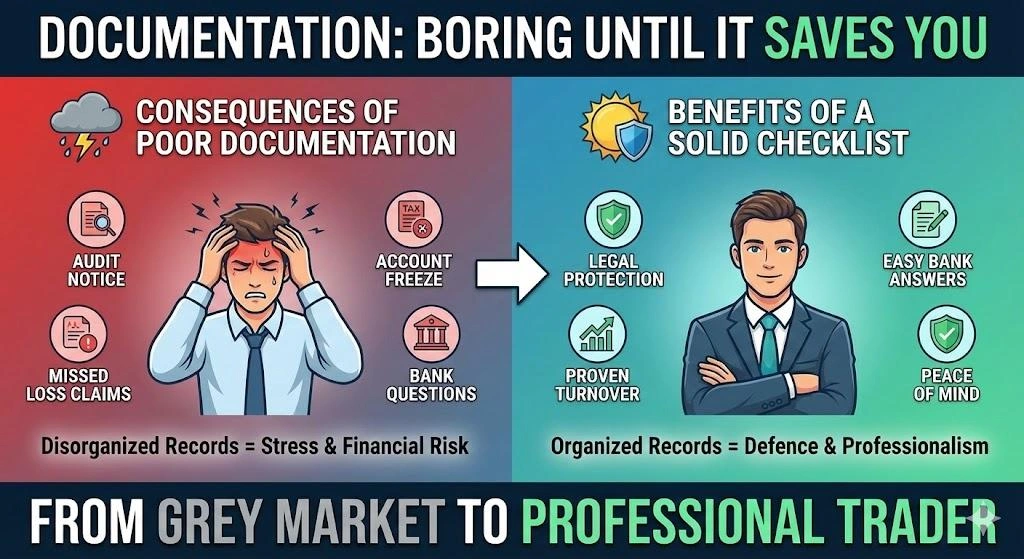
Conclusion: Documentation Is Boring—Until It Saves You
To wrap it up, your paperwork is more than just a duty; it is your only defense when things ever get against you. The current Indian market policies require complete documentation because it establishes legal protection and enables tax compliance and performance tracking.
In short, documentation separates you from a grey market trader to a professional trader. For further guidance and recent updates on global rules, connect with Insightful Trade. The tools help traders keep their work organized while they reduce their mental stress from unnecessary work.
FAQs
Do small traders really need a trading documentation checklist?
Yes, no one can escape it; size might reduce the visibility, but it won’t prevent it.
Are broker P&L reports enough for tax filing?
No, you’ll also need trade logs, bank statements, and broker contracts.
What tax documents should active traders maintain?
Here’s a short list of documents to maintain: P&L, turnover report, expense proof, and past loss records.
Do tools replace manual documentation?
No, they don’t. Tools are just to help you trade, but your documents and details are what the regulation asks for when you start trading, and they matter more.
Is documentation different for Indian traders?
Yes, for Indian law and rules, the documentation becomes more vital if you want your trading to be calm without complications.
Author: Kumkum Chandak
Experience: 3+ Years in Trading Research & Market Content Strategy
Kumkum Chandak is a trading content strategist and market research writer who specializes in simplifying technical analysis, trading tools, and strategy-driven educational content. Her work is optimized for EEAT, accuracy, and user intent, ensuring every article delivers practical insights for traders of all levels.
Risk Disclaimer:
All content is strictly educational and not financial advice. Trading involves substantial risk. Always perform your own analysis or consult a professional advisor.
Last Updated: 6 February 2026