
Trade Management Errors After Entry: Why Good Trades Fail After Execution
Quick Summary
Messing up a trade after it’s active in the market is one of the challenges to a trader’s strategy-making capability; apart from causing a loss, it brings a trader’s morale down. Sometimes traders are so focused on finding the perfect entry that they completely overlook the importance of managing a trade once it’s live. Post-entry mistakes ruin the complete mood and kill your long-term growth.
That’s why you should go through this blog; here we’ll talk about strategy formation, how to manage your trade once it’s live, and the perfect way to stay disciplined and make smarter choices.
Key Insights at a Glance
| Factor | Common Error | Impact on Performance |
| Stop Loss Management | Moving stops emotionally | Increased risk exposure |
| Profit Taking | Closing trades too early | Reduced reward potential |
| Position Size | Adding impulsively | Overexposure risk |
| Market Monitoring | Ignoring changing conditions | Strategy mismatch |
| Emotional Control | Panic reactions | Inconsistent outcomes |
| Planning | No exit strategy | Poor decision-making |

Why Trade Management Errors After Entry Matter
After you enter a trade, it becomes very important for you to control your mind and stick to your plan. When our money is active in the market, it creates a fog effect in our brain, which often declines our decision-making quality.
In such a situation, how you handle your trades affects
- How much risk you’re actually taking
- The profit you will earn in the end
- Your ability to stay consistent in the plan
- Your emotional stability
- Long-term account growth
And no matter how good a trader is, it’s common to struggle with post-entry trading mistakes because making decisions under pressure is different from calmly planning.
The Psychology Behind Post-Entry Mistakes in Trading
The doubts in your mind increase the moment a trade goes live:
- You fear loss.
- Desperate to protect tiny gains
- Feeling anxious with every price move
- You feel overconfidence on a winning trade
Trade management errors after entry mostly happen when the above feelings clog your thoughts, reducing your thinking capacity. For example, you might move your stop-loss or exit too early.
Common Trade Management Errors After Entry
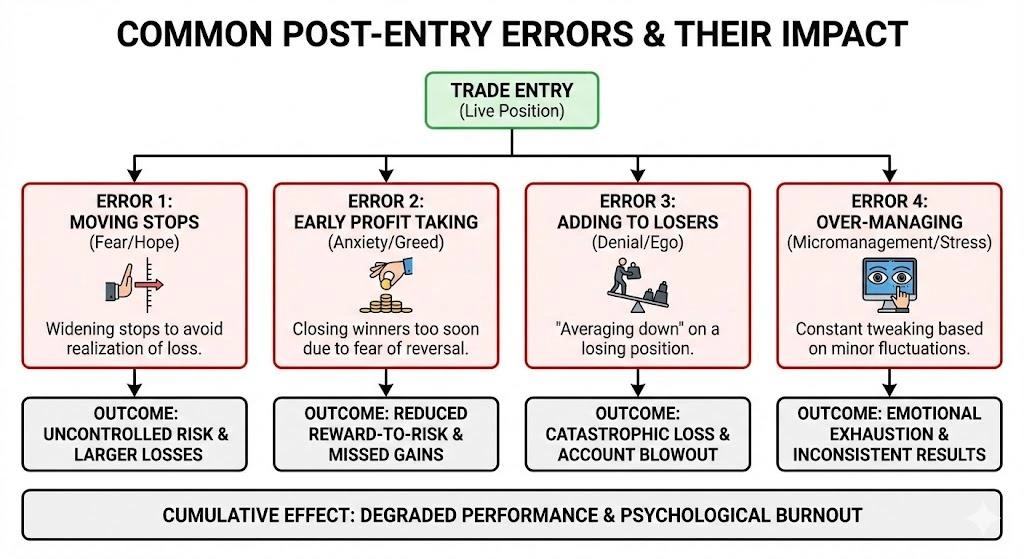
1. Moving Stop Loss Without Strategy Justification
Often when we start doubting our strategy, we move the stop loss in the middle of an ongoing trade. It’s a very common mistake here, traders:
- Widen stops to avoid losses
- Tightening too much out of fear
- Removing stop-loss
Due to this, our risk rules fail, and results become unpredictable.
2. Taking Profits Too Early
In the fear of losing unrealized profit, we often book it too soon before it hits our target.
Consequences include:
- A lower reward-to-risk ratio
- It reduces the strategy’s efficiency
- Feeling frustrated when the trade continues moving after you exit
3. Adding to Losing Positions
Many times traders add more stocks when the prices are low to average the price.
Risks include:
- Increases the risk
- Rising stress
- Account pressure
This one is a dangerous post-entry mistake that can totally eat away your capital.
4. Ignoring Market Context Changes
The market doesn’t stay in peace. There are some circumstances that might be forming, so you need to be aware of them.
After entry:
- Sudden shift in price moments
- Any big economic event
- The cash flow might shift
The market is a dynamic concept, and if you fail to adapt accordingly, these trade management errors after entry will continue.
5. Over-Managing Trades
Thinking too much can also lead to decisions based on market noise
Examples:
- Changing targets repeatedly
- Changing your stops based on minor fluctuations
- Watching every single price move
A trader enters EUR/USD, risking 1%. Price pulls back slightly; fear triggers widening stop to 2%. Trade eventually hits the expanded stop, doubling the intended loss. The mistake was not entry; it was emotional stop adjustment.
Planning Before Entry: The Foundation of Good Management
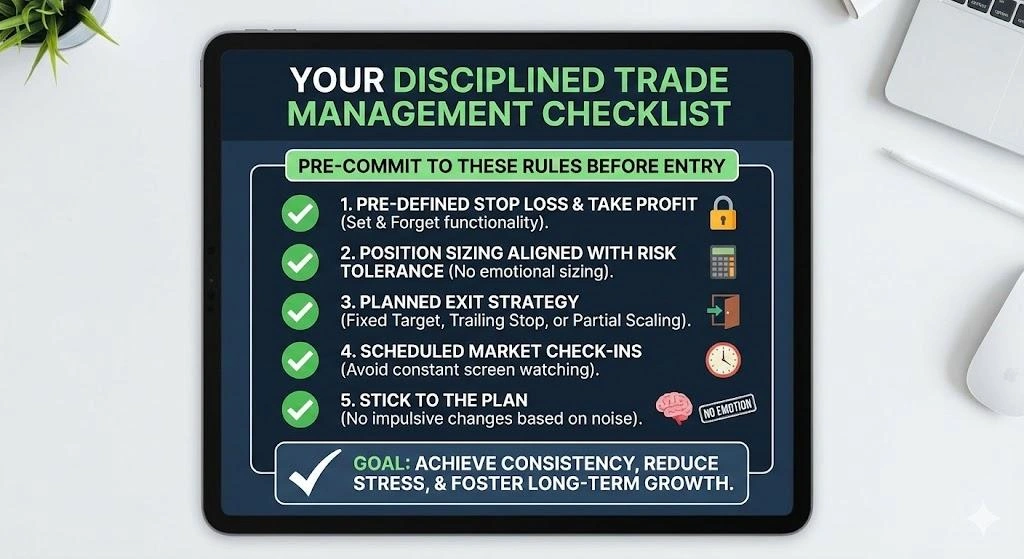
If you want to reduce your post-entry mistakes, there are just a few steps you need to take or that you need to keep in your mind, like:
- Stop-loss level
- Profit target
- Position size
- When to avoid a trade
- Management rules
Planning everything out before entering a trade can help you avoid emotions during heated sessions.
Risk-Reward Alignment and Trade Management
Errors that are made up to an entry often interrupt your overall risk-reward calculation.
For example:
- Bringing your stops near can kick you out too early
- Exiting early reduce your profit potential
- Adding more can increase the risk from your capacity
To stay consistent in the market, you need to follow your rules.
Volatility and Trade Management Decisions
Market speed changes how you handle a live trade.
High volatility may require:
- A loose stop to avoid getting kicked out early
- Small position sizes
- Longer holding time
In a quiet market, using tighter stops is not a problem. Most post-entry trading mistakes happen when traders ignore the market flow before making their moves.
Position Sizing and Emotional Stability
The size of your trade should be within your capacity; above that, it can directly impact your stress level.
Oversized trades create:
- Stress
- Quick decisions
- Not following the official plan
If you’re using the right size for the trade, it’s acceptable; you might not worry much, but if the trade size is too big for the order, it can cause little pressure.
Monitoring Without Overreacting
To avoid making mistakes after an entry and effectively follow your strategy. Then you should:
- Do a routine check of key levels
- Watch shifts in volatility
- Keep an eye on the overall structure
You don’t need to watch every price movement.
Exit Strategy Types
Different strategies require different management approaches.
Fixed Target Strategy
- Predefined profit level
- Minimal intervention
Trailing Stop Strategy
- Locking profits gradually
- Adapting to trend movement
Partial Profit Strategy
- Scaling out positions
- Balancing risk and reward
Choosing the right exit approach reduces post-entry trading mistakes.
Technology Tools for Trade Management
Trading platforms and analytics tools help traders:
- Set automated stops and targets
- Monitor risk exposure
- Track performance metrics
- Review management decisions
Automation reduces emotional interference.
Why Discipline Improves Over Time
Trade management is a learned skill.
With experience:
- Emotional reactions decrease
- Confidence increases
- Decision consistency improves
Recognizing post-entry mistakes in trading patterns accelerates improvement.
Common Myths About Trade Management
- One is that a good setup will always be profitable.
- By being active and constantly watching the price, you can improve results.
- Pro traders don’t make adjustments once the trade is live.
Understanding these realities helps reduce trade management errors after entry.
Long-Term Impact of Management Quality
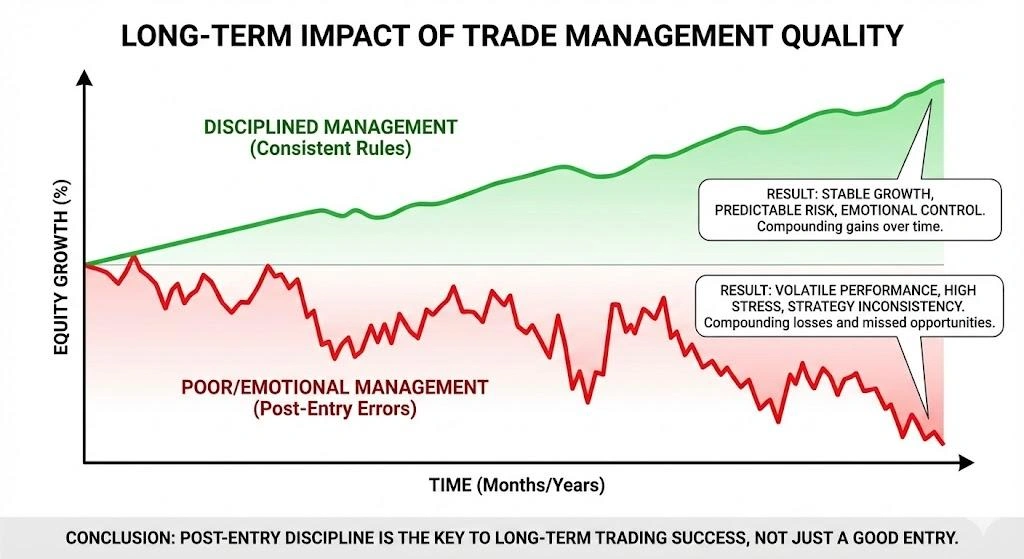
Consistent management produces:
- Stable equity growth
- Predictable risk exposure
- Improved psychological control
Poor management leads to:
- Performance volatility
- Emotional stress
- Strategy inconsistency
Bullet list:
- Checking charts every minute
- Moving stops more than once
- Feeling relief instead of strategic exit
- Breaking position size rules
Trade management errors after entry accumulate over time if not addressed.
Conclusion: Trade Management Errors After Entry
How you manage a trade once it’s live in the market shows how disciplined you are as a trader. It is very common to make mistakes after entering a trade due to emotional reactions, poor planning, large positions, and simply not being able to read the market mood. If you are following your trading rules and your strategy then you will be more consistent in the market. Connect with Insightful Trade here; they can tell you where you’re lacking by evaluating your past performance and help you improve.
FAQs: Trade Management Errors After Entry
1. What are trade management errors after entry?
In trading, after a trade goes live, the mistakes we make, like shifting the stop-loss or exiting too early, are post-entry mistakes.
2. Why do post-entry trading mistakes happen frequently?
When the actual money is at stake, it causes fear and anxiety in traders, which affects decision-making.
3. Do Indian traders need to maintain trade records?
Yes, every trader should keep detailed documentation to stay on the good side of the law and be ready for sudden audits.
4. Is trade management more important than entry?
Both are important; it’s just how you manage your emotions after you enter a trade and follow the strategy and rules you have prepared beforehand.
Author: Kumkum Chandak
Experience: 3+ Years in Trading Research & Market Content Strategy
Kumkum Chandak is a trading content strategist and market research writer who specializes in simplifying technical analysis, trading tools, and strategy-driven educational content. Her work is optimized for EEAT, accuracy, and user intent, ensuring every article delivers practical insights for traders of all levels.
Risk Disclaimer:
All content is strictly educational and not financial advice. Trading involves substantial risk. Always perform your own analysis or consult a professional advisor.
Last Updated: 18 February 2026

