What is stop loss distance and why does it matter?
“Stop loss distance” is the exact price gap between your entry price and your stop loss price — and getting it wrong is one of the top reasons beginner traders blow their accounts. If you’ve just started trading, then you might be wondering, “Where on earth should I place my stop loss?” Well, you’re not alone. Every trader at least once in their career has struggled with stop-loss determination; in such cases a solid stop loss distance formula, a reliable stop loss distance calculator, and a clear risk percentage calculation come in handy.
In the blog, you’ll learn how the stop loss distance calculator works step by step, how to turn that into a precise risk percentage per trade, and how to plug everything into a stop loss distance calculator so that you don’t have to depend on the guesswork again.

What Is a Stop Loss?
A stop loss order is an instruction to your broker to automatically exit a trade when the price reaches a predetermined level. It protects your trading capital from outsized losses without requiring you to watch the screen all day. The stop loss level is where that automatic exit triggers.
What Exactly Is Stop Loss Distance?
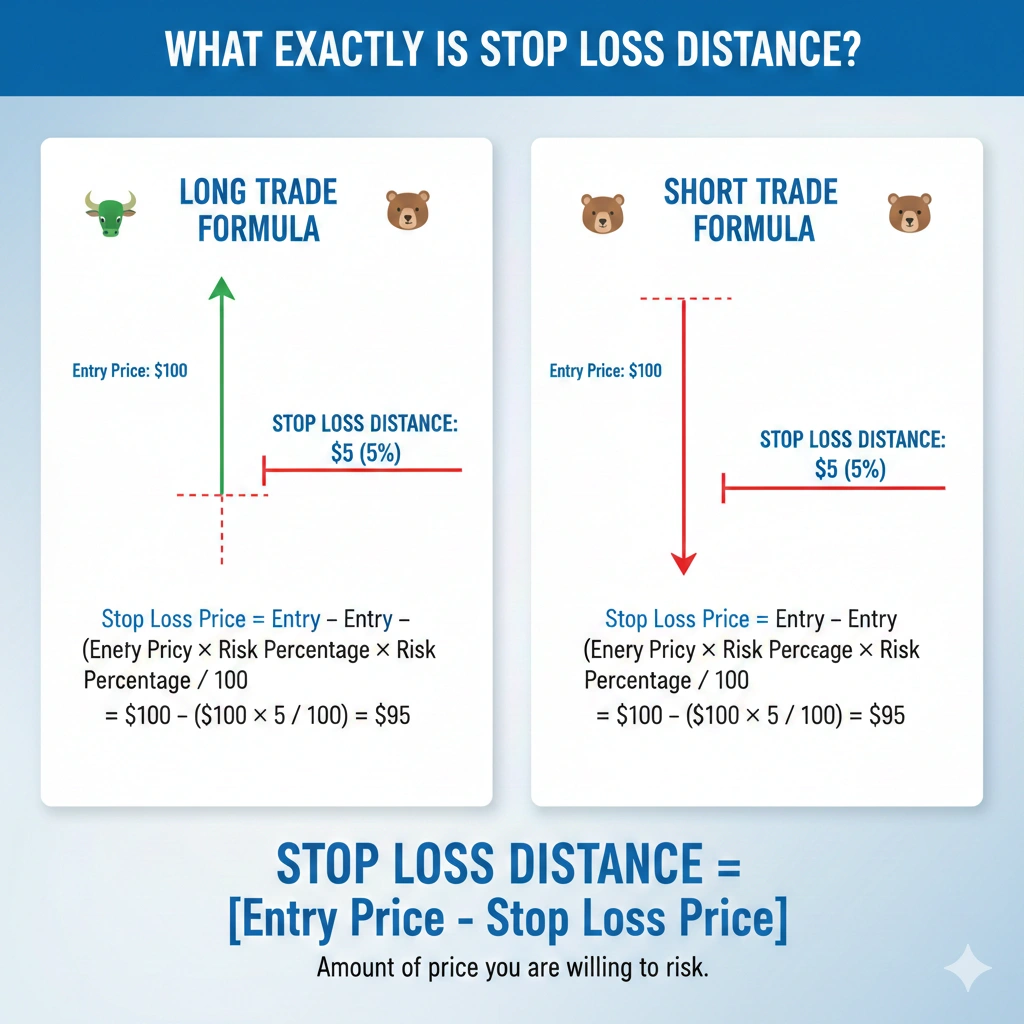
Ok, so let’s first understand what stop-loss distance is. When you enter a trade, you have an entry price and a stop-loss price. The difference between these two levels is called the stop-loss distance. It is the amount of price that you are willing to put at risk if that trade goes wrong, and you could make an exit.
Long Trade Formula
For a long trade (buying an asset), the stop-loss price is calculated as
Stop Loss Price = Entry Price − (Entry Price × Risk Percentage / 100)
This formula ensures that the stop loss is set below the entry price, protecting you from excessive losses if the market moves against you.
Short Trade Formula
For a short trade (selling an asset), the stop-loss price is calculated as
Stop Loss Price = Entry Price + (Entry Price × Risk Percentage / 100)
In this formula the stop loss is set above the entry price, limiting losses if the market moves against the short position.
Why Stop Loss Distance Matters So Much
You might already know you “should” use a stop loss, but here’s what most traders miss:
It’s not enough to just place a stop somewhere below or above the current price. The distance itself must be aligned with:
- Your account size
- Your risk percentage per trade
- Market volatility
- The structure on the chart (support, resistance, swing highs/lows)
If your stop loss distance is too small, you’ll get stopped out constantly by normal market noise. If it’s too big, you’ll risk too much capital or end up taking tiny position sizes that barely move the needle.
Stop Loss Too Tight vs Too Wide
| Scenario | Stop Distance | Result |
|---|---|---|
| Too Tight | 0.1% from entry | Stopped out by normal market noise |
| Too Wide | 10% from entry | Huge loss if trade fails |
| Optimal | 1–3% (or 1–2× ATR) | Balanced risk vs. reward |
The 3 Most Popular Stop Loss Calculation Methods
Before you dive into calculators, you need the basic ingredients. Let’s break them down.
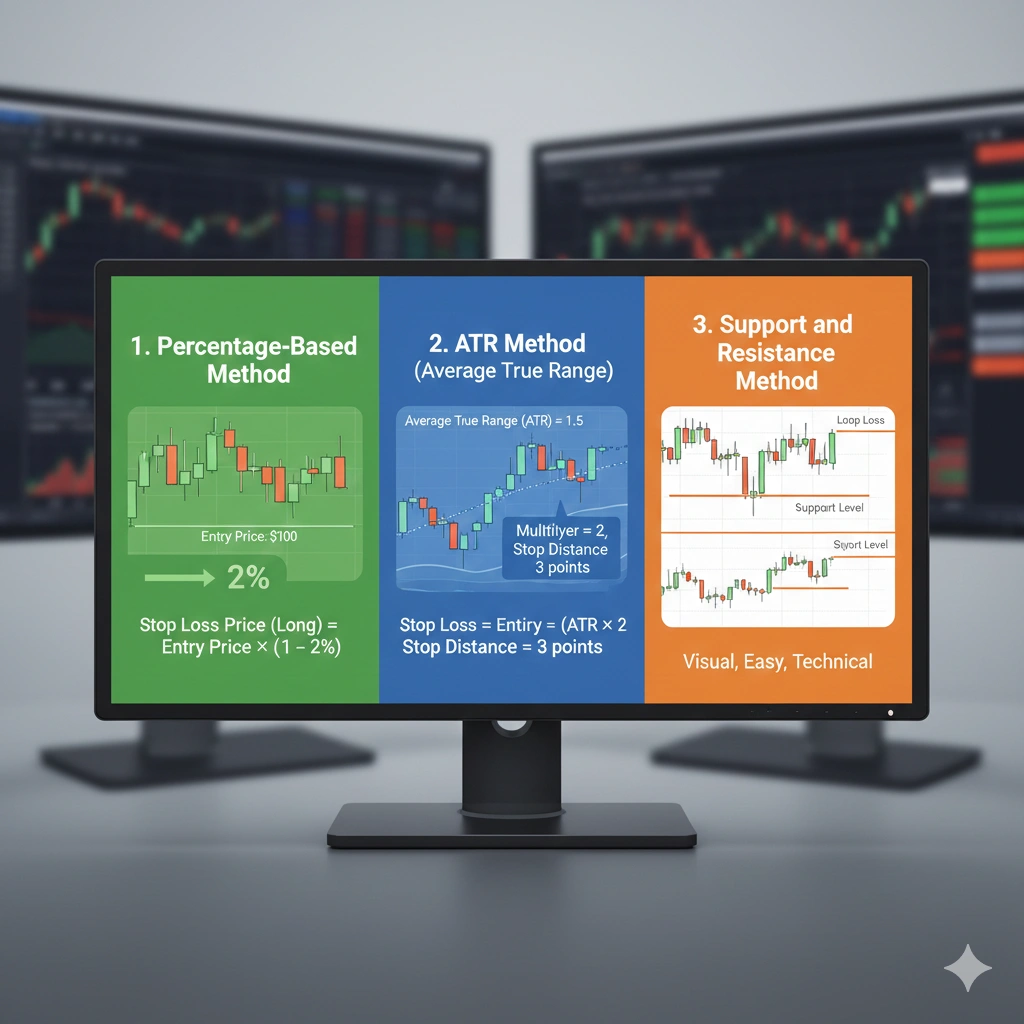
1. Percentage-Based Method
This is the most simple and powerful one. Just you decide directly that you won’t risk more than (say) 2% of your capital per trade.
Formula:
Stop Loss Price (Long) = Entry Price × (1 – Stop Loss %)
Want a quick example? If you enter at $100 and risk 2%, set your stop at $98. Got it?
2. ATR Method (Average True Range)
Markets are noisy. The ATR method is most preferable when the market is volatile; it adapts your stop to daily volatility.
Formula:
Stop Loss = Entry Price – (ATR × Multiplier)
If ATR is 1.5 and your multiplier is 2, your stop sits 3 points away. This method keeps stops realistic, matching the market’s temperament.
3. Support and Resistance Method
This rule is based on the charts. Here, you “analyze and study the charts.” And place your stop-loss right below support for longs (or above resistance for shorts). It’s visual, easy, and favored by technical traders.
Comparison Table — ATR Method vs. Percentage Method vs. Support/Resistance
| Method | Best For | Pros | Cons |
|---|---|---|---|
| Percentage-Based | Beginners | Simple, consistent | Ignores market volatility |
| ATR Method | Volatile markets (Crypto/Forex) | Adapts to market noise | Needs indicator knowledge |
| Support/Resistance | Technical traders | Chart-based, logical | Subjective |
How to Use a Stop Loss Distance Calculator — Step-by-Step
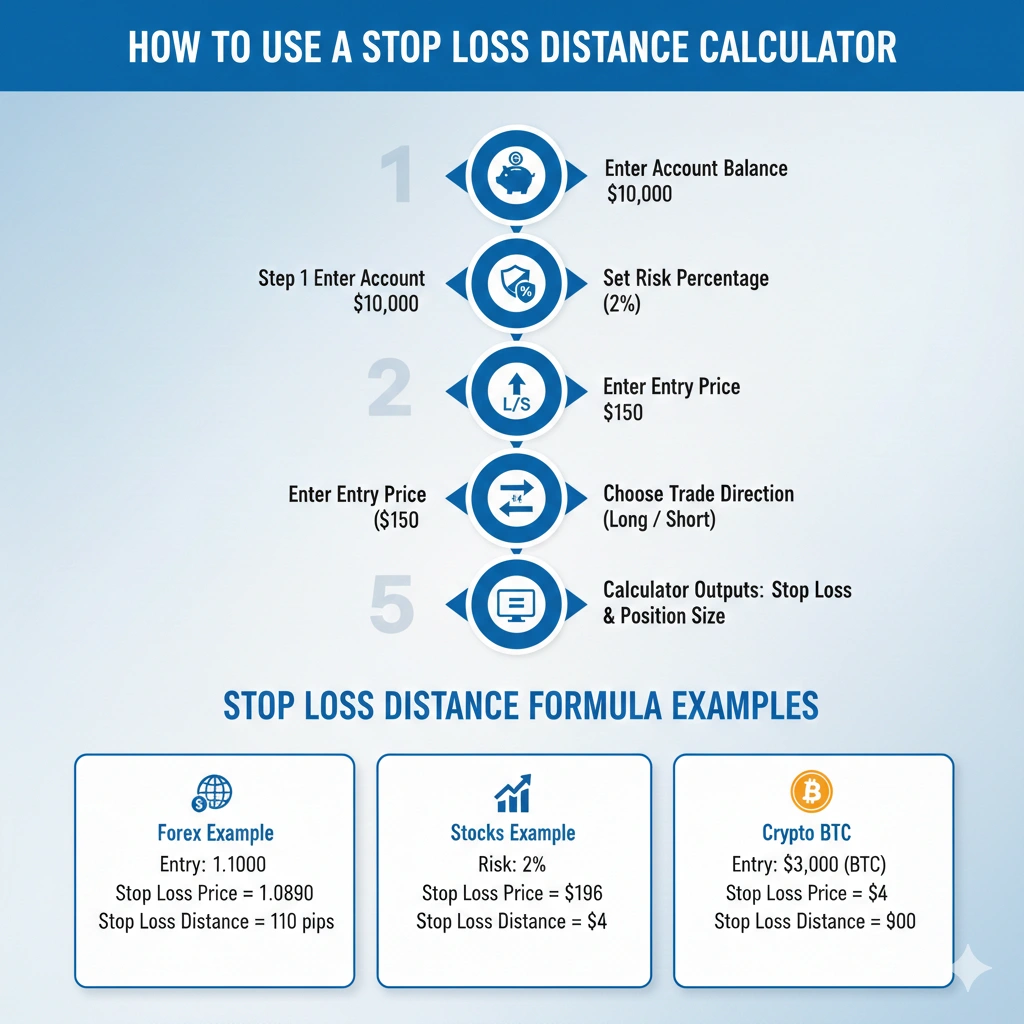
Step 1: Enter your account balance (e.g., $10,000)
Step 2: Set your risk percentage per trade (e.g., 2%)
Step 3: Enter your entry price (e.g., $150)
Step 4: Choose trade direction — long trade or short trade
Step 5: The calculator outputs your stop loss price and maximum position size
Stop Loss Distance Formula with 3 Asset-Class Examples
Forex Example:
Entry: 1.1000 | Risk: 1% | Stop loss price = 1.0890 | Stop loss distance = 110 pips
Stocks Example:
Entry: $200 | Risk: 2% | Stop loss price = $196 | Stop loss distance = $4
Crypto Example:
Entry: $30,000 (BTC) | Risk: 3% | Stop loss price = $29,100 | Stop loss distance = $900
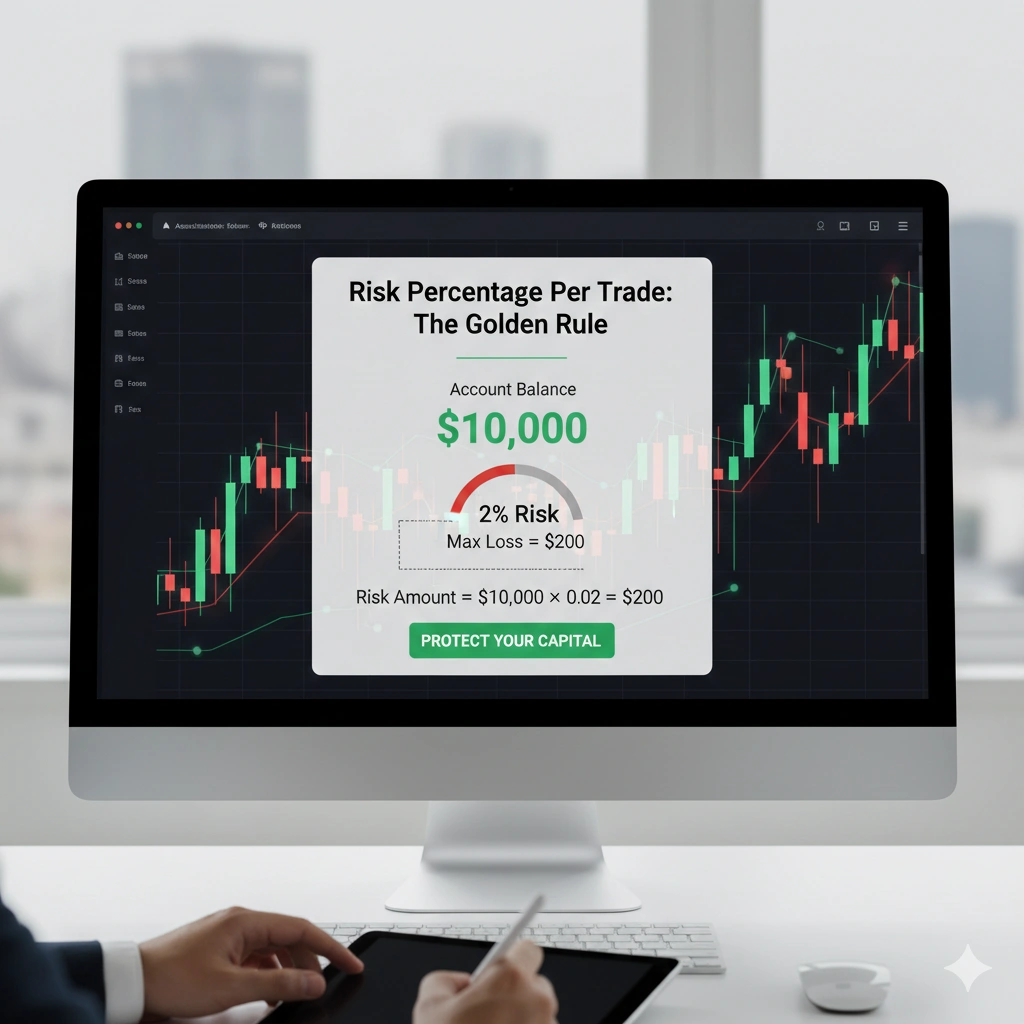
Calculating Your Risk Percentage Per Trade: The Golden Rule
Want to keep trading for the long haul? Never risk more than 1–3% of your trading capital per trade.
Formula:
Risk Amount = Account Size × Risk %
(If your account is $10,000 and you risk 2%, max loss is $200.)
Combine risk percentage with stop loss formula for bulletproof risk management.
Stop Loss Distance vs. Position Size — How They’re Connected
The wider your stop loss distance, the smaller your position size must be to keep risk fixed. Example: risking $200 on a $10,000 account — if stop distance is $4, position size = 50 shares. If stop distance is $2, position size = 100 shares.
Risk Management Best Practices for All Asset Classes
- Forex: In forex trading, tighter spread allows you to set your stop-loss near the entry level, while the leverage increases risk.
- Stocks: In stocks the volatility can be different from one sector to other; therefore always consider support and resistance levels before making entry or exit in stocks.
- Crypto: With crypto the high price movements often makes larger ATR multipliers more effective.
You must analyze how the professional traders use a blend technical analysis (support/resistance, ATR) with smart risk percentage rules. And avoid putting stop-loss too close to entry price— so that you’re not getting knocked out on a slight movement—or so far away that it keeps you up all night.
Step-by-Step Risk Percentage Calculation
- Determine Account Balance: Select the total amount of capital you are using in a single trade.
- Set Risk Percentage: Then keep the risk percentage as per the amount you are willing (commonly 1-2%) to put at risk in single trade.
- Calculate Risk Amount: By multiplying your account balance with the risk percentage you get the amount that you’re willing to lose in the trade.
- Apply to Stop Loss: With this risk amount you set your stop-loss, ensuring your potential loss stays within your overall risk tolerance.
Example Calculation
If your account balance is $10,000 and you set a 2% risk per trade:
Risk Amount = $10,000 × 0.02 = $200
This means you’re willing to risk $200 on the trade, and your stop loss should be set to ensure your loss does not exceed this amount.
Benefits of Using a Stop-Loss Calculator
- Risk Control: It helps you manage your risks effectively and avoid leaving your trades naked.
- Professional Approach: It prevents emotions from leading to your decisions in trading.
- Trade Planning: It helps in evaluating trade strategies to find the best one based on clear risk-reward parameters.
- Performance Measurement: With regular calculation of stop-loss and take-profit levels, you can track the financial performance of your stock and form strategies accordingly.
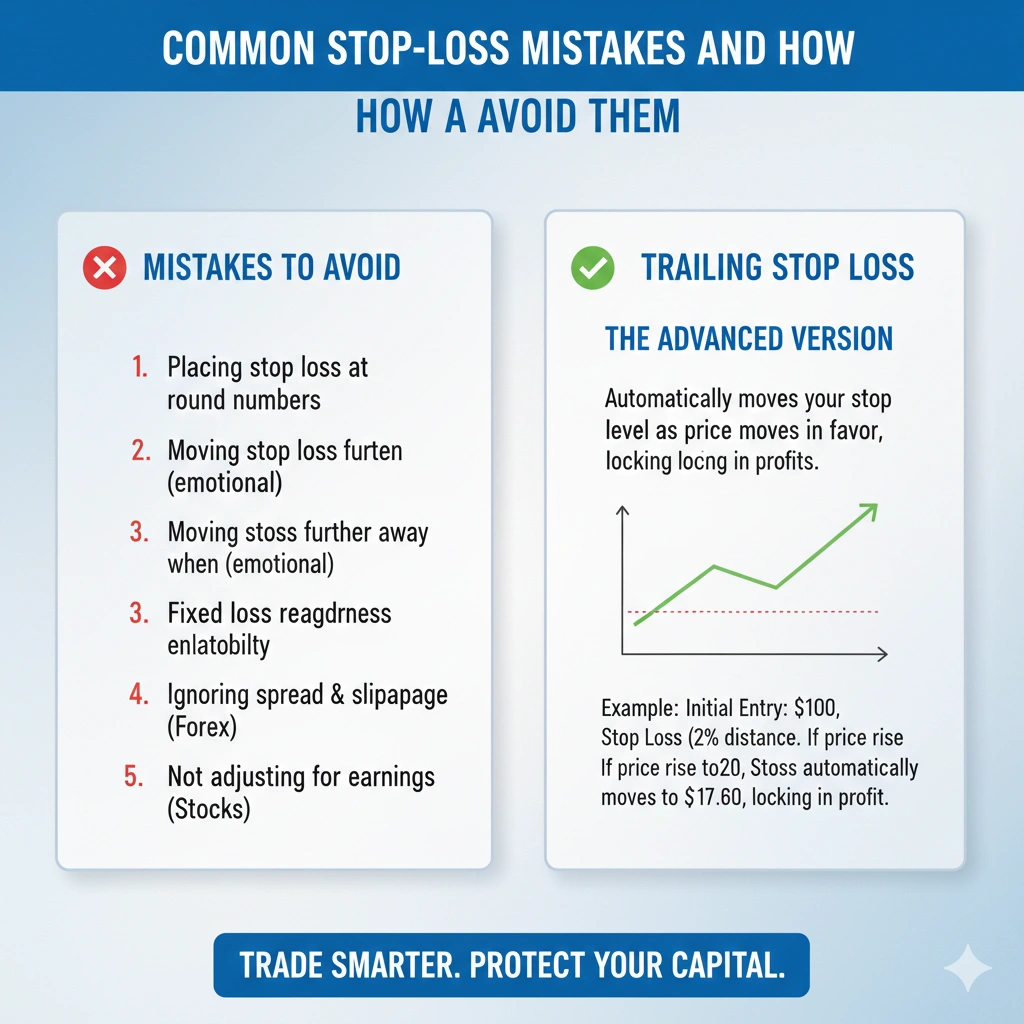
Common Stop-Loss Mistakes and How to Avoid Them
- Placing stop loss at round numbers (they get hunted)
- Moving stop loss further away when losing (emotional stop loss)
- Using the same fixed stop loss distance regardless of volatility
- Ignoring spread and slippage in forex
- Not adjusting stop loss for earnings announcements in stocks
Trailing Stop Loss — The Advanced Version
A trailing stop loss automatically moves your stop level as price moves in your favor, locking in profits while limiting downside. Example: if you set a trailing stop distance of 2%, and price rises from $100 to $120, your stop moves from $98 to $117.60 automatically.
FAQs: Stop loss distance calculator
Q: What is the best stop-loss formula for beginners?
A: For beginners, the percentage-based stop loss formula is the easiest and most reliable starting point. Simply decide the maximum percentage of your trading capital you’re willing to risk — typically 1–2% — and apply it to your entry price. For example, if you enter a trade at $100 and set a 2% risk per trade, your stop loss price will be $98 for a long trade. This method is straightforward, keeps your risk amount consistent, and doesn’t require any technical indicators to implement.
Q: How does stop loss distance affect position size?
A: Your stop loss distance and position size are directly linked. The wider your stop loss distance, the fewer units you can buy to keep your risk fixed. For example, if you’re risking $200 on a $10,000 account and your stop loss distance is $4 per share, you can take 50 shares. If the distance narrows to $2, you can take 100 shares. This is why using a stop loss distance calculator alongside a position size calculator is essential for consistent risk management.
Q: Is it better to use the ATR method or support and resistance for stop loss?
A: Both methods are effective, but they serve different trading styles. The ATR (Average True Range) method is best for volatile markets like crypto and forex, where price swings are large and unpredictable — it adapts your stop loss level to current market volatility automatically. The support and resistance method works better for stocks and swing trading, where price respects defined chart levels. As a beginner, start with percentage-based stops, then layer in ATR or support/resistance as you gain experience reading charts.
Q: Can I automate stop-loss calculation?
A: Yes. Most modern trading platforms — including Insightful Trade, TradingView, MetaTrader 4/5, and Zerodha — allow you to automate stop loss placement based on a fixed risk percentage, ATR multiplier, or a set number of points from your entry price. Additionally, dedicated tools like a stop loss distance calculator let you input your account size, risk percentage, and entry price to instantly compute your stop loss price and position size — eliminating guesswork and emotional decision-making from your trades.
Key Takeaways Box
- Stop loss distance = Entry Price − Stop Loss Price
- Risk no more than 1–3% of account balance per trade
- Use ATR method for volatile markets; percentage method for beginners
- Always connect stop loss distance to position size
- Use a stop loss distance calculator to eliminate guesswork
Conclusion
Getting your stop-loss distance right is key to protecting your capital and trading with confidence. With a pair of solid stop-loss distance formulas, a risk percentage calculation, and a reliable stop loss distance calculator, you can replace the guesswork with a consistent routine. Remember, the best stop-loss strategy is the one that suits your trading style, market depth, and overall risk tolerance.
For a clear understanding, visit InsightfulTrade’s website; they offer expert guidance, step-by-step tutorials for calculation, and tailored risk management strategies designed for traders of all levels. Don’t leave your trades to chance—trade smarter with InsightfulTrade’s proven methods and calculators.
Author: Kumkum Chandak
Kumkum Chandak is a trading content strategist and market research writer with 3+ years of experience covering technical analysis, risk management, and trading tools across forex, stocks, and crypto markets.
Risk Disclaimer:
All content on this page is strictly for educational and informational purposes only and does not constitute financial, investment, or trading advice. Trading in stocks, forex, and cryptocurrency involves substantial risk of loss and may not be suitable for all investors. Past performance is not indicative of future results. Always conduct your own research and consult a licensed financial advisor before making any trading decisions.
Last Updated: 26 February 2026