Introduction to the Stochastic Oscillator Forex Strategy
The Stochastic Forex Strategy is one of the most popular momentum-based trading approaches used by Forex traders to identify potential market reversals, trend continuation opportunities, and ideal trade entry and exit points. Created by George Lane, the Stochastic Oscillator is a technical indicator that measures the position of the current closing price relative to its recent trading range. Unlike indicators that follow price, the Stochastic Oscillator focuses on market momentum, helping traders understand whether buying or selling pressure is strengthening or weakening.
The foundation of the Stochastic Oscillator Forex Strategy is based on the belief that momentum changes before price changes. This means traders can often identify potential reversals before they become obvious on the chart. Whether you are a beginner learning technical analysis or an experienced trader refining your strategy, understanding how the Stochastic Oscillator works can improve trading accuracy and decision-making.
When combined with momentum indicator analysis, proper technical analysis, and confirmation from price action, the Stochastic Oscillator Forex Strategy becomes a powerful tool for navigating the Forex market with greater confidence.
Understanding the Stochastic Oscillator
The Stochastic Oscillator is a momentum indicator that compares the latest closing price with the highest and lowest prices over a selected period. The indicator moves between 0 and 100, making it easy to identify whether the market is reaching extreme conditions.
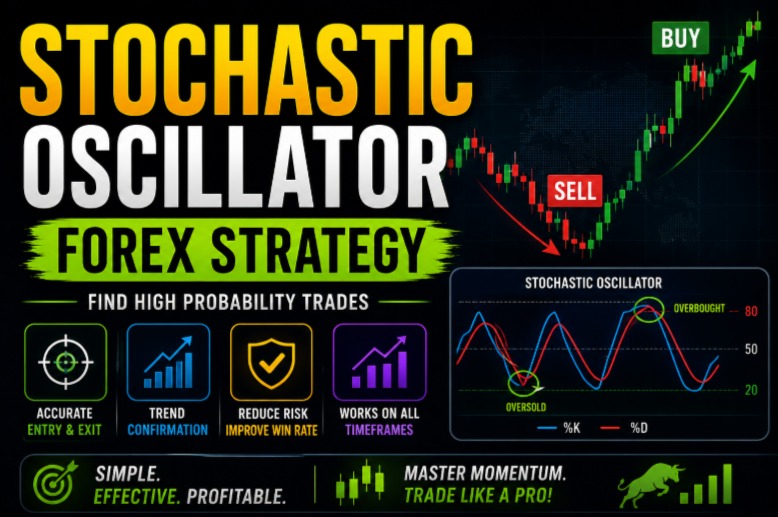
The indicator consists of two lines known as %K and %D. The %K line reacts quickly to price movement, while the %D line acts as a smoother signal line. Crossovers between these two lines often generate trading opportunities within the Stochastic Oscillator Forex Strategy.
Unlike many lagging indicators, the Stochastic Oscillator attempts to anticipate changes in price by monitoring momentum. Since momentum usually shifts before price direction changes, traders can often prepare for upcoming market moves earlier.
The momentum indicator works especially well when combined with support and resistance zones, trend confirmation, and overall technical analysis.
Why the Stochastic Oscillator Forex Strategy Works
The Forex market constantly alternates between trending and consolidating conditions. During these movements, momentum naturally accelerates and slows down. The Stochastic Oscillator Forex Strategy captures these momentum shifts before they become visible through price alone.
The strategy helps traders avoid emotional decision-making by providing objective market conditions based on mathematical calculations rather than opinions. Instead of guessing whether buyers or sellers are gaining strength, traders use the momentum indicator to identify measurable changes in market behavior.
Another advantage is its versatility. The strategy works across multiple currency pairs and timeframes, making it suitable for scalpers, day traders, swing traders, and long-term investors performing detailed Forex analysis.
Understanding Overbought Oversold Conditions
One of the most valuable features of the Stochastic Oscillator Forex Strategy is identifying overbought oversold market conditions.
When the oscillator rises above the 80 level, the market enters an overbought zone. This does not automatically mean price will fall immediately, but it suggests buying momentum may be weakening.
When the oscillator falls below the 20 level, the market enters an oversold zone. Again, this does not guarantee an immediate reversal, but it indicates selling pressure may be losing strength.
Successful traders understand that overbought oversold readings should not be traded blindly. Instead, they should be combined with price action, trend direction, and broader technical analysis before making trading decisions.
Using the Stochastic Oscillator for Reversal Trading
One of the most common applications of the Stochastic Oscillator Forex Strategy is reversal trading.
A bullish reversal setup develops when the oscillator leaves the oversold region while the %K line crosses above the %D line. This crossover often suggests buyers are beginning to regain control.
A bearish reversal occurs when the oscillator exits the overbought region while the %K line crosses below the %D line. This indicates sellers may be taking over market momentum.
Although reversal trading can generate excellent opportunities, confirmation from candlestick patterns and support or resistance levels significantly improves reliability.
Bullish Stochastic Oscillator Forex Strategy
A bullish setup begins when price approaches a strong support area while the oscillator enters the oversold region.
The trader waits for bullish crossover confirmation before entering the trade. Additional confirmation through bullish engulfing candles, pin bars, or higher lows further strengthens the signal.
Using this approach allows traders to combine the strengths of the momentum indicator, technical analysis, and price action into a single trading decision.
Bearish Stochastic Oscillator Forex Strategy
The bearish version follows the opposite logic.
Price reaches resistance while the oscillator enters the overbought region. After the %K crosses below the %D line, traders begin looking for short-selling opportunities.
The strongest bearish setups occur when resistance aligns with previous market structure and broader Forex analysis confirms a downward trend.
Patience is essential because entering too early during strong trends may lead to unnecessary losses.
Combining the Stochastic Oscillator with Technical Analysis
Although the indicator is powerful by itself, combining it with broader technical analysis dramatically increases its effectiveness.
Support and resistance levels help determine where reversals are most likely to occur. Trendlines identify the overall market direction. Candlestick formations provide entry confirmation. Together, these tools complement the Stochastic Oscillator Forex Strategy by filtering low-quality signals.
Instead of relying solely on one indicator, traders build confidence by allowing multiple forms of technical analysis to support the same trade idea.
Using the Stochastic Oscillator During Strong Trends
Many beginners believe the Stochastic Oscillator should only be used for reversal trades. However, it is equally valuable during trending markets.
During strong uptrends, the oscillator may remain in overbought territory for extended periods without producing a reversal. Likewise, during powerful downtrends, oversold conditions may continue for a long time.
In these situations, traders should focus on pullbacks rather than attempting constant reversal trading against the dominant trend.
Understanding market structure through Forex analysis helps traders distinguish between temporary corrections and genuine trend reversals.
Risk Management for the Stochastic Oscillator Forex Strategy
Every successful trading strategy requires disciplined risk management.
Stop-loss orders should be placed beyond nearby support or resistance rather than directly beneath the oscillator crossover.
Risking only a small percentage of trading capital on each position helps traders survive losing streaks while maintaining long-term profitability.
Even the best momentum indicator cannot eliminate losing trades, making proper money management an essential part of the Stochastic Oscillator Forex Strategy.
Common Mistakes Traders Make
One of the biggest mistakes is selling immediately whenever the oscillator reaches overbought territory or buying every oversold reading.
Markets can remain in overbought oversold conditions far longer than expected during strong trends.
Another common mistake is ignoring the overall trend while attempting aggressive reversal trading against market momentum.
Many beginners also neglect broader Forex analysis, relying entirely on oscillator crossovers without considering support, resistance, or economic conditions.
Best Timeframes for the Stochastic Oscillator Forex Strategy
The Stochastic Oscillator Forex Strategy performs well across different trading styles.
Scalpers often use the five-minute and fifteen-minute charts for short-term opportunities.
Day traders frequently prefer one-hour charts, while swing traders rely on four-hour and daily timeframes because they produce more reliable signals and smoother price action.
Regardless of the timeframe, combining the strategy with proper technical analysis consistently improves results.
Advantages of the Stochastic Oscillator Forex Strategy
One reason the Stochastic Oscillator Forex Strategy remains popular is its simplicity.
The indicator is easy to understand, visually clear, and suitable for traders at every experience level. It provides valuable insight into market momentum, highlights potential reversal zones, and works effectively alongside other trading tools.
When combined with disciplined Forex analysis, traders gain a structured method for identifying high-probability opportunities.
Limitations of the Stochastic Oscillator Forex Strategy
Despite its strengths, the strategy has limitations.
During highly volatile markets, false signals can occur frequently. Strong trends may also keep the oscillator in overbought oversold regions longer than many traders expect.
Because of these limitations, the Stochastic Oscillator Forex Strategy should never be used in isolation. Confirmation through price action, trend direction, and broader technical analysis greatly improves reliability.
Conclusion
The Stochastic Forex Strategy remains one of the most effective methods for identifying momentum shifts, potential reversal trading opportunities, and improving overall Forex analysis. By understanding how this momentum indicator measures buying and selling pressure, traders can better recognize overbought oversold conditions and make more informed decisions. While no indicator guarantees success, combining the strategy with sound technical analysis, disciplined risk management, and patience allows traders to develop a consistent trading approach. With practice and experience, the Stochastic Oscillator can become an essential part of any successful Forex trading system.
Frequently Asked Questions
What is the Stochastic Oscillator Forex Strategy?
The Stochastic Oscillator Forex Strategy is a momentum-based trading method that uses the Stochastic Oscillator to identify trend strength, potential reversals, and trading opportunities in the Forex market.
Is the Stochastic Oscillator a momentum indicator?
Yes. The Stochastic Oscillator is a momentum indicator that measures the relationship between the current closing price and the recent trading range to identify changes in buying and selling momentum.
What do overbought oversold levels mean?
Overbought oversold levels indicate that market momentum has reached extreme conditions. Readings above 80 suggest overbought conditions, while readings below 20 indicate oversold conditions, although confirmation should always be used before entering trades.
Is the Stochastic Oscillator good for reversal trading?
Yes. Many traders use the Stochastic Oscillator for reversal trading, especially when oscillator crossovers occur near important support or resistance levels with confirmation from price action.
Can beginners use the Stochastic Oscillator Forex Strategy?
Absolutely. The Stochastic Oscillator Forex Strategy is beginner-friendly because it is easy to understand, works across multiple timeframes, and integrates well with technical analysis and broader Forex analysis for improved trading decisions.