

Quick Summary
Spread costs are built into the bid-ask price gap, while commission is a fixed fee per trade. The cheaper option depends on your strategy, trade frequency, and real execution quality, not just advertised pricing.
Selecting a broker is the step to begin trading; mostly it depends on spread costs and commissions that play a huge part in broker selection. But often traders realize it late when these charges start affecting their profits. Many brokers have zero commission schemes, but they have wide spreads, while others charge a flat fee and offer tighter buy-sell gaps. If you don’t do a proper inspection, you might choose an account that looks cheap but costs you way more in the long run. In this blog, you’ll learn how both models work, why they change, and how to calculate your true costs.
Key Insights at a Glance
| Cost Component | Spread-Based Model | Commission-Based Model | Performance Impact |
| Pricing Method | Built into bid–ask spread | Fixed fee per trade | Transparency vs simplicity |
| Entry Cost | Immediate via spread | Spread + commission | Total cost varies |
| Scalping Impact | Higher sensitivity | Often more predictable | Strategy dependent |
| Liquidity Influence | Spread widens in volatility | Commission stable | Market conditions matter |
| Cost Visibility | Less transparent | More transparent | Easier comparison |
| Best Fit | Casual traders | Active traders | Depends on volume |
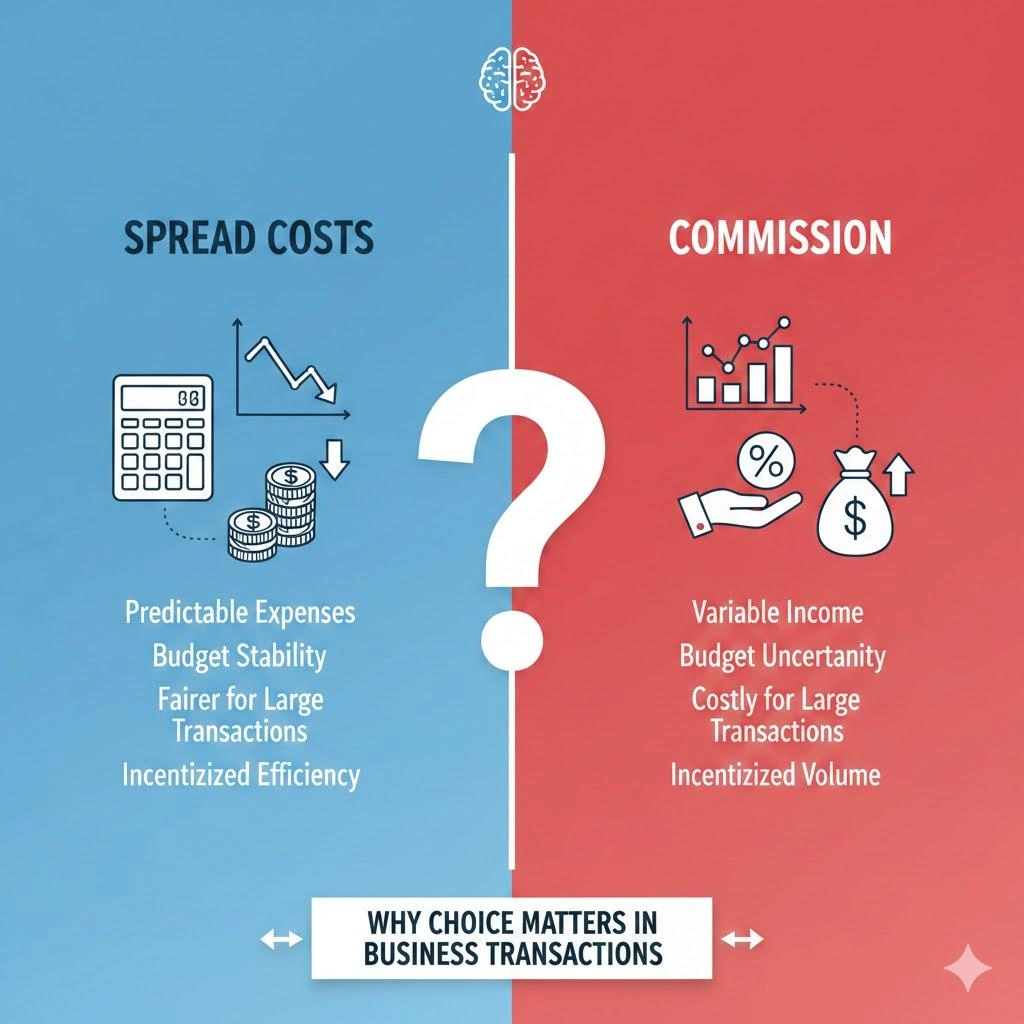
Why Spread Costs vs Commission Matters
Trading isn’t for free. You have to pay some sort of charge; like even in a no-commission brokerage, you’ll pay through spreads.
Spread costs vs commission decisions influence:
- The total profit you take home
- Your break-even price target
- Success rate of your strategy
- Risk-reward ratios
- Scalping performance
Ignoring these costs can make a good strategy look like a bad one, as it impacts your overall risk and reward. For example, your plan was for a small profit, but it will fail if the spread amount is too big.
Understanding Spread Costs
The spread is just the gap between the selling price and buying price.
When you enter a trade:
- Traders buy at the ask
- Traders sell at the bid
The gap between them is your instant cost.
Example
If EUR/USD shows:
- Bid: 1.1000
- Ask: 1.1002
The spread cost is 2 pips.
This means every trade starts slightly in the red, equal to the spread. When you are comparing spread costs vs commission comparisons, you have to factor in these instant price gaps.
Understanding Commission-Based Pricing
Commission is a straightforward fee that your broker charges you for every trade.
Some brokers offer:
- Very thin raw spreads
- With a fixed set of fee for each lot you trade
Example:
- Spread: 0.2 pips
- Commission: $7 per round turn
Your total cost would be spread plus commission. In the beginning they look a bit costly, but they often end up being cheaper depending on your trading style.
The Real Question: Total Trading Cost
For total training cost, you need to look at both spreads and commissions together.
What matters is:
Total Cost = Spread + Commission + Slippage
A true trading cost check has to involve all these three factors together.
Strategy Type and Cost Sensitivity
Different strategies react differently to cost structures.
Scalping
- Highly sensitive to spreads
- Commission accounts often preferred
Day Trading
- Balanced sensitivity
- Depends on frequency
Swing Trading
- Less sensitive to small cost differences
- Spread-only accounts may be sufficient
Trading cost comparison should align with strategy duration and frequency.
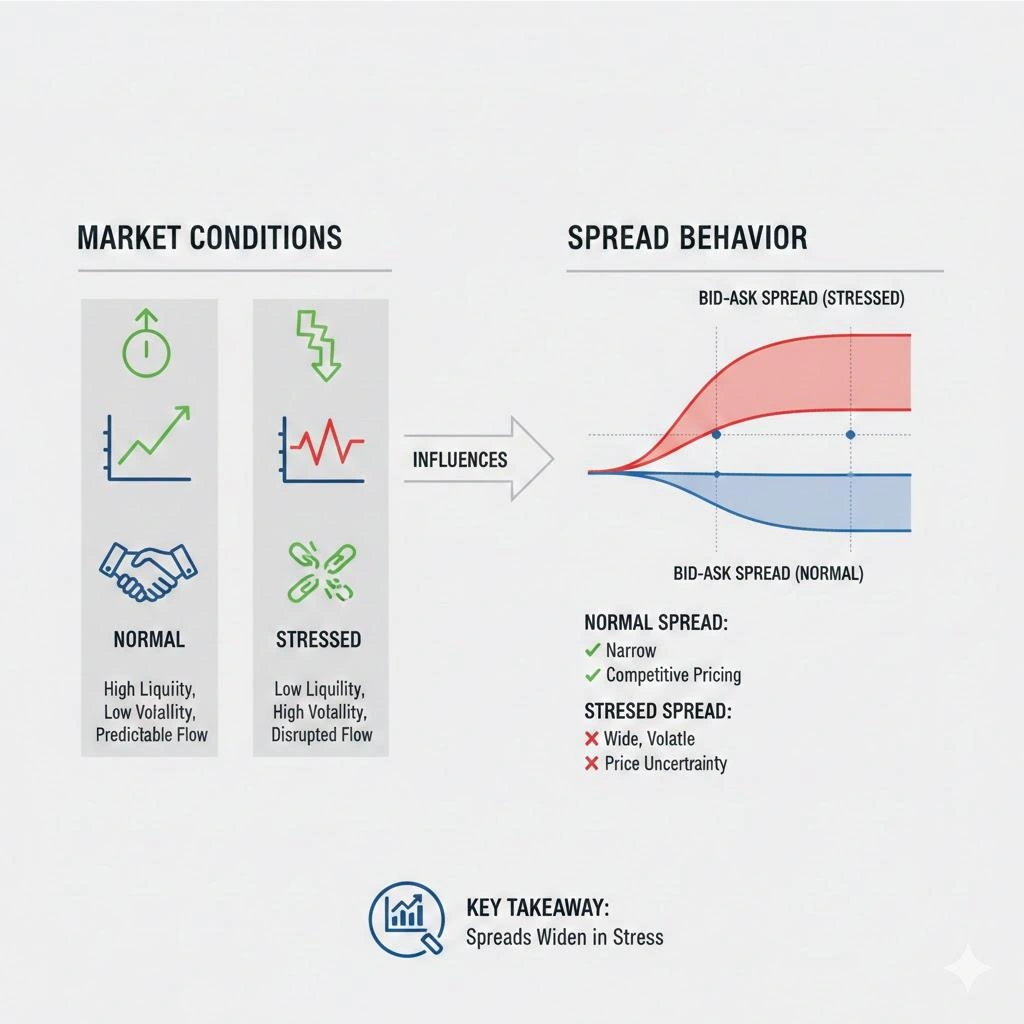
Market Conditions and Spread Behavior
Spreads are not fixed; they keep changing.
They widen during:
- News events
- Low liquidity periods
- Market open and close
- Volatility spikes
While commission fees usually stay exactly the same. This makes the choice between spread costs and commission much easier, especially in a chaotic market.
Based on broker data analysis across multiple ECN and market-maker accounts, cost differences can reach 20–35% depending on trade frequency.
Psychological Factors in Cost Perception
Traders prefer accounts with no commission because:
- Price looks cheaper
- Expenses are less obvious
- It simply feels more attractive
But in this they often forget that hidden spreads can actually be more expensive than a flat fixed fee. To avoid emotions from leading your decisions, use logical data for decisions.

High-Frequency Trading and Cost Accumulation
Active traders are constantly entering and exiting trades. Those tiny extra charges can become a huge overtime.
Example:
- 1 pip extra cost
- 500 trades per year
The total impact on profit is huge. Therefore, comparing spreads and commissions is important for high-frequency trading.
Liquidity and Instrument Differences
Costs might change according to various assets you trade:
- Major forex pairs: tight spreads
- Exotic pairs: wider spreads
- Indices: variable costs
- Commodities: session-dependent spreads
Any trading cost comparison needs you to focus on the specific asset you are trading.
Slippage Interaction with Cost Models
Slippage can easily cancel any cost savings.
For example:
- Raw spread account with high slippage
- Spread-only account with stable execution
Your true cost depends on the fill quality, not just the commissions. Always include real execution data in your comparison.
Broker Models and Cost Structure
The way your broker fills your trade can change your cost. Most used structures include:
- Market maker models
- STP/ECN models
Since both handles spread and fees differently, knowing the difference makes your cost comparison much more accurate.
Regional Considerations for Indian Traders
If you’re trading in foreign currency, then make sure to include:
- Currency conversion costs
- Payment gateway fees
- Government paperwork cost
- The broker’s home country rule
All these extra expenses can change the real cost behind your spread costs vs commission comparison.
How to Measure Your Real Trading Cost
You can calculate your trading cost using:
- Average spread at entry
- Commission paid
- Slippage per trade
- Total number of trades
You can calculate an honest cost and compare.
Choosing the Right Cost Model
There’s nothing like the best option. There are factors that can affect your choice.
- How often you trade
- How long you hold a position
- The type of asset you trade
- Your broker’s quality
- Account size
Cost comparison should be personal, not just based on advice.
Why Cost Awareness? Improves Performance
The knowledge of spread costs vs commission will help you:
- Better risk-reward planning
- More realistic assumptions
- Better ways to judge your strategy
- Less emotional stress
Knowing your final training cost helps you make smart, data-driven decisions.
Common Mistakes Traders Make
- Collecting your account based on advertisement
- Forgetting spread jumps during wild markets
- Failing to keep a track of your trading data
- Thinking slippage doesn’t matter
- Moving to new broker without proper analysis
Avoid it if you want to continue your trading journey for long.
Long-Term Impact of Trading Costs
If the trading cost gets out of control, then it can turn a winning trade into a failure.
Over time:
- Slowly it compounds
- Eating away at the profit margin
- Decrease the strategy efficiency
Knowing which one is best for you is important for long-term performance.
Conclusion: Spread Costs vs Commission
This blog from InsightfulTrade helps you understand the difference between spread costs vs commission, to improve your trading experience. Deciding between spreads and commission isn’t a simple choice; it’s about understanding your trading cost and how it impacts your specific strategy. For a proper comparison, you need more than just advertisement cost; you need spreads, fees, slippage, and fill quality. Traders who track their actual expenses and pick account types that match their style are better positioned for the long term consistently.
FAQs: Spread Costs vs Commission
1. What is the difference between spread costs vs commission?
Spreads are inserted into the buy-sell price gaps, while commission is a common charge that is charged for every trade.
2. Which is cheaper, spreads or commissions?
For this you need the total trading cost, including spreads, fees, and slippage. You need to see the whole cost to be sure.
3. Are raw spread accounts better for active traders?
Yes, tighter spreads are better than commission costs, but you need to be careful with your trading quality.
4. Do Indian traders need to track trading costs for compliance?
Yes, every trader should keep documentation of the trades. It helps them stay on the good side of the law and ready for any sudden tax audit.
5. Can tools help analyze trading costs?
Tools that can calculate spreads, fees, and slippages can give you realistic trading cost comparisons.
Author: Kumkum Chandak
Experience: 3+ Years in Trading Research & Market Content Strategy
Kumkum Chandak is a trading content strategist and market research writer who specializes in simplifying technical analysis, trading tools, and strategy-driven educational content. Her work is optimized for EEAT, accuracy, and user intent, ensuring every article delivers practical insights for traders of all levels.
Risk Disclaimer:
All content is strictly educational and not financial advice. Trading involves substantial risk. Always perform your own analysis or consult a professional advisor.
Last Updated: 18 February 2026

