
Introduction
Smart money concepts (SMC trading) are simply about tracking the actions of the largest players in the market, such as banks and hedge funds, who govern the large market flows through the market structure order blocks, liquidity areas, and price imbalances. SMC allows you to realize where smart money makes orders and causes price actions. This is not a plan of reading charts but a plan of learning institutional behavior and market psychology.
The traders get to know how to detect the transition of trends in time, how to identify high-probability entry levels, and how to set stops beyond the usual liquidity levels to prevent whipsaws. The perfect command of SMC will help you to match professional capital to make better trade and risk management with better profit. It is a blend of price movements and a profound understanding of the market to enable the traders to trade the market in a major strategic way, rather than a reactive way.
The basic aspects of SMC are market structure, order blocks, liquidity zones, and fair value gaps that indicate the movement of smart money and trapping of retail traders.

What are the SMC trading basics?
The guide to big market players using smart money concepts aids the SMC trading basics. Trading smarter with where institutions move by identifying liquidity zones, explained. These fundamentals eliminate the stab in the dark and follow the money smarts. Want to trade like the pros? The first step is to master the basics of SMC trading.
Why use the Smart Money Concepts Guide?
- The guide might be assessed to use smart money concepts to trade smarter in trading by following what the big players are doing in the market, without you noticing that liquidity zones are clarified that they do not understand.
- This manual will help you filter out the noise so that you can make clearer decisions, avoid false moves, and increase your trading page with SMC trading basics that have worked.
How to spot liquidity zones explained?
- The basics of SMC trading are aimed at following the presence of big players using order block structure breaks and liquidity zones as their analysis.
- These tools can assist you in trading in line with intelligent money flow, which maximizes your opportunities for success and minimizes speculation.
When to trade using SMC basics?
- Trade on SMC basics where there are voluminous and volatile trading sessions, particularly the London-New York overlap (8:00-11:00 AM ET) when smart money is at work.
- Look at major time frames, such as daily charts and 4-hour charts, to identify a more favorable market structure. Lower timeframes are used to achieve accurate entries that are in tandem with the idea of smart money guides.

SMC trade example
EUR/USD bullish trade:
Date / chart timeframe: oct 10, 2025 / 1 hr
Position: price in uptrend is pulled back into bullish order block at 1.1720
Entry: but limit at 1.1720
Stop loss: under order block at 1.1700.
Target: previous high at 1.1800
Result: price rebuffs order block and drives to target, verifying smart money entry setup.
Where are smart money concepts applied?
Market Structure analysis
With the SMC tool, you can detect order blocks, liquidity pools, and price swings, and with the help of these, you are able to know where an institution is operating.
Timing and entry points
Identify the best entry points through trading liquidity holes and order flow, and have the trades match the smart money moves.
Risk management
Use it to more effectively set better stop-loss and take-profit levels and risk-manage your smart money flow.
Can liquidity zones explained help entry?
The explained liquidity zones are beneficial to your entry, as they indicate where numerous orders are clustering, commonly leading to intelligent money flows. When the price goes down into the variance and comes up past, then the smart money takes the liquidity.
Coming in after these turnarounds attests that you are dealing with wise money, better timing, and less chance of losing. Knowing how to identify these areas and how they respond would give you an advantage in using SMC trading basics properly.
What makes the SMC Trading Basics effective?
The SMC trading basics are good, as they indicate the location where the large players, such as banks, present large orders, thus indicating the actual direction of the market.
A guide of smart money concepts assists you in matching your trades to such institutional actions that would provide superior timing and greater probability arrangements.
How do smart money concepts guide profits?
- It shows where Megalobucks established positions; therefore, you trade with the market movers, not against them.
- The liquidity zone explains, and the order blocks allow you to enter high-probability trades at more opportune times by identifying them.
- It makes smarter risk management by displaying the probable sports and reversals to safeguard your capital and increase your victory with the Smart Money Concepts Guide.
Why focus on liquidity zones first?
Smart money opens under liquidity zones:
Explain liquidity zones and also inform traders of the very points that the big players place their orders, enabling you to trade in their direction rather than opposing them.
Concentrating on liquidity zones, sharp entry, and risk:
When you first enter the zones, it is possible to anticipate the price reversal and place a superior stop loss, which enhances your trading precision and risk management.
Is SMC trading basics for all traders?
The smart money concept SMC trading fundamentals can guide you on where megabucks are placing their orders, such as the banks and hedge funds. This is because once you understand order blocks, liquidity zones, and market structure, you will be trading smarter and more in harmony with actual market movements.
This method fits those traders who are willing to acquire sophisticated techniques for time and risk management but could otherwise be complicated for those who are novices in the trade.
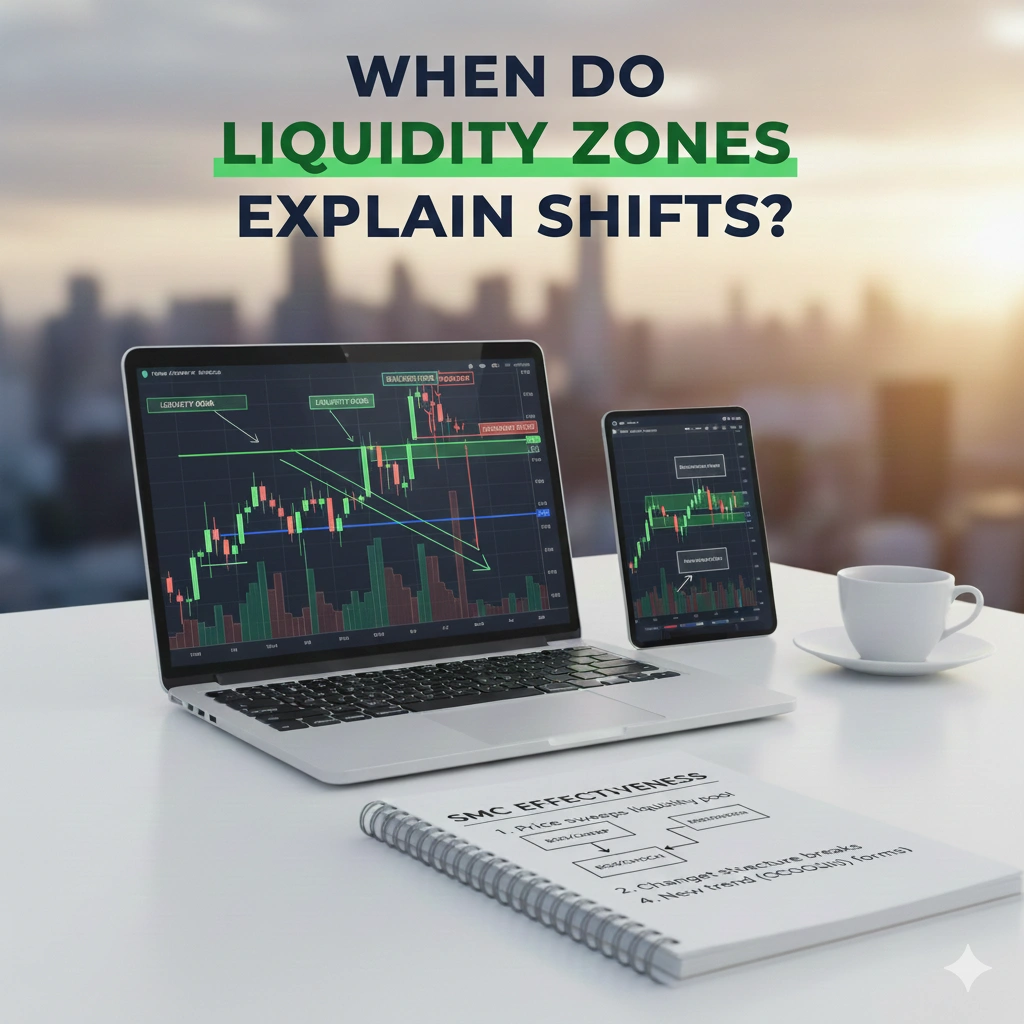
When do liquidity zones explain shifts?
The explanation of the liquidity zones moving is when the smart money causes the order flows and stop-loss clusters, and when the price moves and reestablishes new liquidity zones.
These changes normally occur on high-volume sessions or post-breakout and market structure variations, indicating new liquidity domains for trade arrangements.
What risks exist in SMC trading basics?
Early entry risk
Getting into trades prematurely on the premise of smart money can lead to stop losses, which will result in losses. The most important thing is patience and timing so as not to cause counterfeit moves.
Challenge of complexity and discipline.
SMC trading calls on an in-depth knowledge of the market structure, liquidity zones, and order flow. The absence of discipline or an order strategy may result in emotional decisions and a waste of capital despite the smart money concepts guide.
How do smart money concepts guide market moves?
| Chart feature | What to watch | Why it matters |
| Market structure | Look for trade swings and breaks | Shows market direction |
| Order blocks | Find candles before big moves | Marks where smart money enters |
| Liquidity zones | Stop clustered stop orders | Indicates price reversal points |
Entry and Exit Strategies Using SMC
Entry and exit using SMC
Enter near order blocks or fair value gaps using smart money concepts after making sure that market structure changes, such as break of structure BOS or change of character, have occurred. To cash in on profits without disrupting market flow, exit trades are done around liquidity zones or past structural points.
Liquidity zone guides tops and targets.
Stop loss should be set slightly above liquidity zones to prevent stop hunting, and take profit should be set near the next strong liquidity zone or order block to get optimum reward-risk diversity.
FAQs
- What is Smart Money Concepts (SMC)?
SMC is a trading strategy that assists you in trading with the order blocks, liquidity zones, and market structure
- How do I find entry points in SMC trading?
Search around order blocks or fair value gaps following a market structure chain, such as a break of structure.
- Where to place stops and targets using liquidity zones?
Position stop loss outside liquidity areas and position take profit outside the following liquidity area or order block.
- How do liquidity zones affect SMC trading?
They demonstrate the location of smart money hunts of stop losses and price reversals or breakouts to pursue.
- How can I spot false breakouts with SMC?
To avoid pitfalls around liquidity pools and keep a check on price behavior to ensure one can be confident in the traits before committing to them.
Conclusion
The smart money concept, SMC trading, changes the way you take the markets, as it trains you to trade with the institutions and not with them. Through the learning of the most vital tools, such as order blocks, liquidity areas, and making structure changes, you would have a better understanding of where the big money is moving and the price action. It assists in enhancing your entry points, preventing losses, and extracting profit levels, thus making your trades more intelligent and accurate.
SMC is not an indicator game but rather a game of market psychology and institutional prints. Through responsible use, SMC can enhance risk management, reduce retail traps, and make more money, which will eventually provide you with the strategic advantage of making a professional trader stand out among the rest.
Ready to level up your trading game? Start learning SMC trading basics with InsightfulTrade today and trade smarter with proven, market-driven concepts. Begin your journey now!
Author: Kumkum Chandak
Experience: 3+ Years in Trading Research & Market Content Strategy
Kumkum Chandak is a trading content strategist and market research writer who specializes in simplifying technical analysis, trading tools, and strategy-driven educational content. Her work is optimized for EEAT, accuracy, and user intent, ensuring every article delivers practical insights for traders of all levels.
Risk Disclaimer:
All content is strictly educational and not financial advice. Trading involves substantial risk. Always perform your own analysis or consult a professional advisor.
Last Updated: 26 November 2025