Introduction
Smart money concepts reveal what retail traders never see — the deliberate moves banks and institutions make before every major price swing. If you have ever been stopped out right before the market moved in your direction, smart money was behind it.
The SMC trading guide is created to simplify things clearly and in a conversational manner to make you learn the institutional trading basics without feeling overwhelmed. Let’s learn together.

What Are Smart Money Concepts in Trading?
Smart Money Concepts concerned the actual movement of the market by banks and institutions. Smart money concepts allow you to know why prices move as opposed to when they move.
Intelligent money traders think otherwise and pose:
- Where is liquidity sitting?
- Getting stuck between retail traders?
- In what locations do institutions order?
This constitutes the basis of institutional trading. The key concept in this SMC trading guide is as follows:
- It is the price movement since the institution requires liquidity and not the indicators.
Who Created Smart Money Concepts?
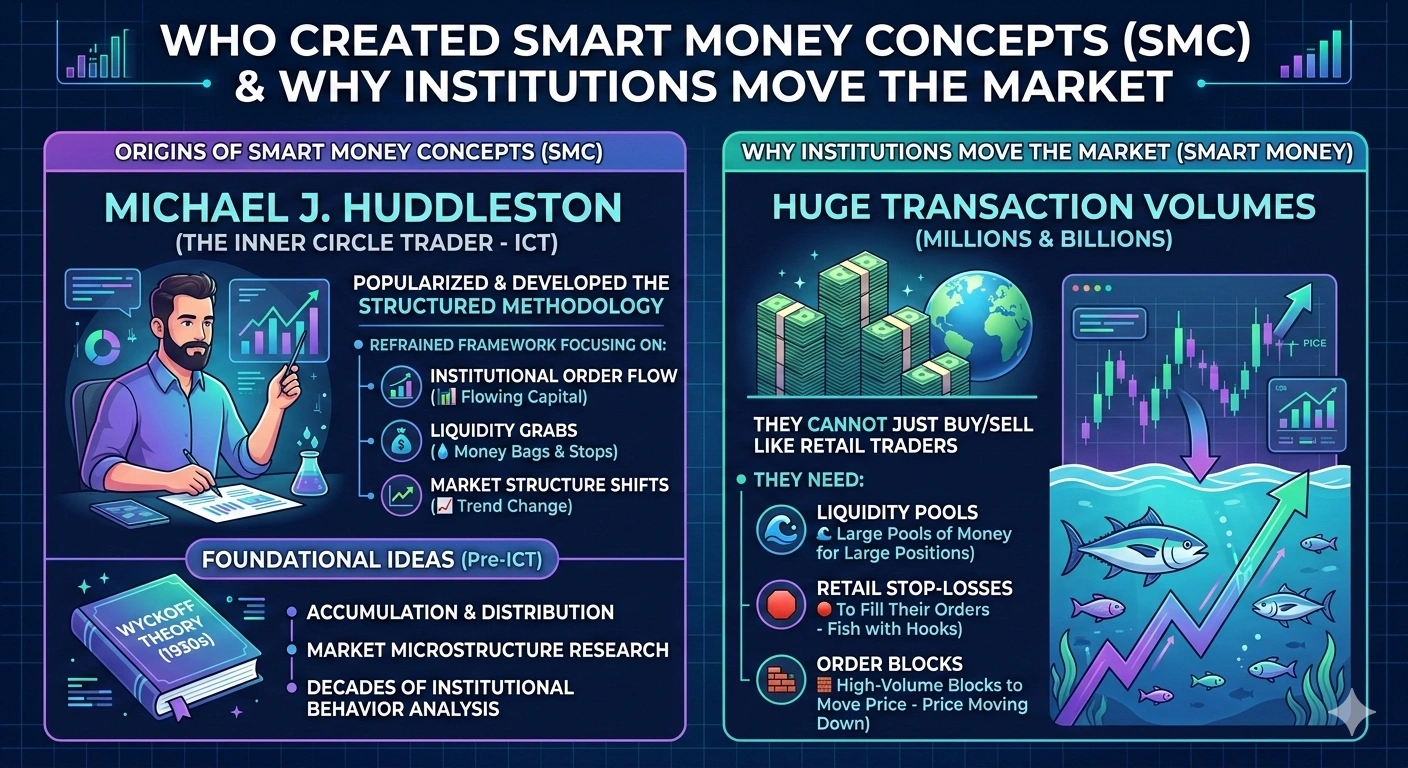
Smart Money Concepts as a structured trading methodology was popularized by Michael J. Huddleston, widely known as The Inner Circle Trader (ICT). He developed and refined a framework focused on institutional order flow, liquidity grabs, and market structure shifts — concepts that later formed the backbone of modern SMC trading.
However, the foundational ideas behind SMC go back further, drawing from Wyckoff’s accumulation/distribution theory (1930s), market microstructure research, and decades of institutional behavior analysis. ICT packaged these into a teachable system for retail traders.
Today, SMC is taught across YouTube, prop firm communities, and trading academies worldwide — and remains one of the most searched price action trading strategies.
Why Do Institutions Move the Market?
In smart money concepts, the market is moved by institutions since they transact large volumes of money, and these are sometimes in millions or even billions. They cannot merely buy or sell like the retail traders.
Institutions need:
- Large positions to enter via liquidity pools.
- Retail stop-loss to be filled.
- Order blocks (high-volume) in which the rice is movable.
What Are the Institutional Trading Basics?
The fundamentals of institutional trading all revolve around the fact that giant traders such as banks and hedge funds operate in a very different way as compared to the small retail trader. Institutions do not follow indicators in the smart money concept, but rather pricing, liquidity, and volume.
Here’s the real difference
| Retail traders | Institutional traders |
| Chase indicators | Trade pure price action |
| Enter impulsively | Scale positions patiently |
| Small lot sizes | Huge capital |
| Emotional decisions | Data- & algorithm-based logic |
How Does Smart Money Manipulate Price?
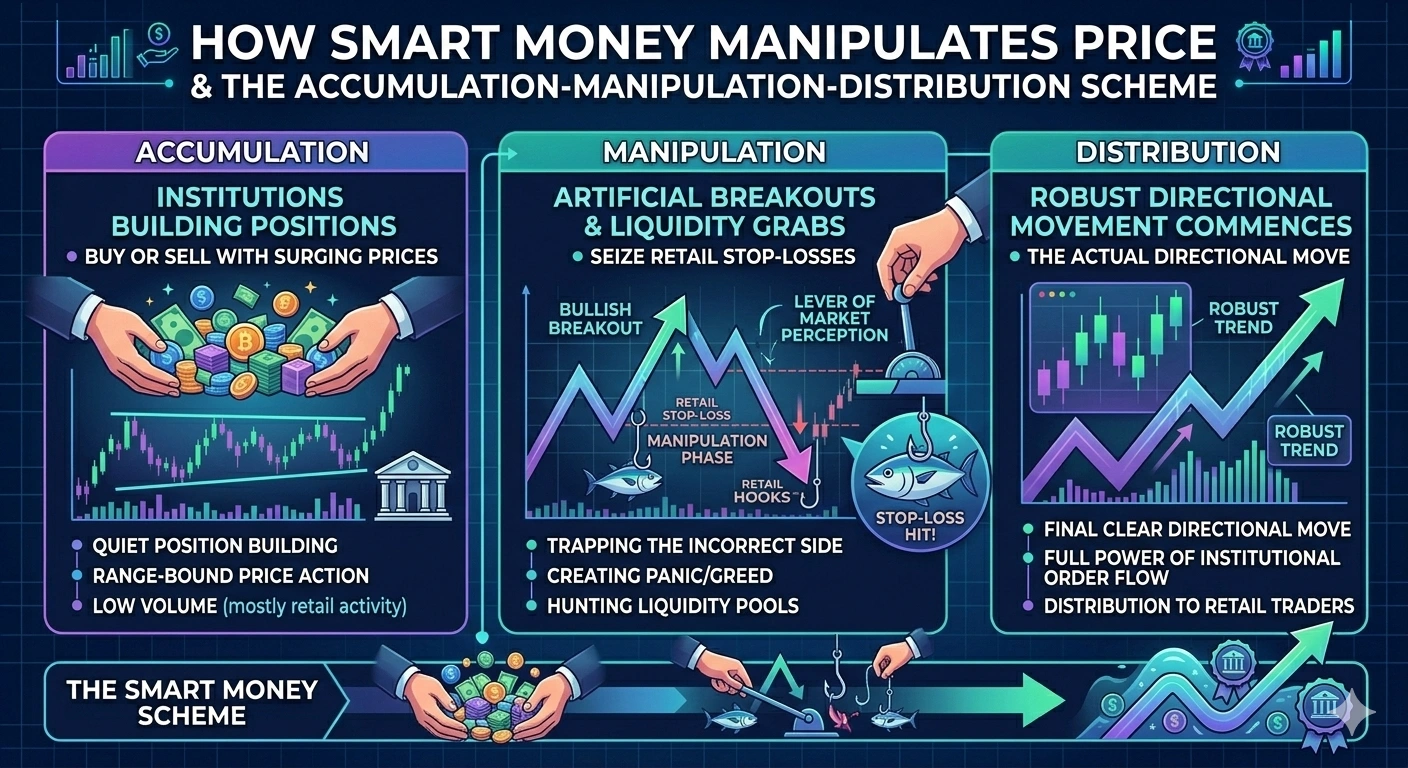
In smart money concepts, the appearance and disappearance of price are not arbitrary—institutions have a precise scheme of creating and finishing positions. It is an essential point in the basics of institutional trading and all of the SMC trading manuals.
Smart money typically takes place in three stages:
- Accumulation—Buy or sell by institutions with surging prices.
- Manipulation—This involves artificial breakouts by Price to seize retail stop-losses.
- Distribution—The actual, robust directional movement commences.
What Is the Power of Three (AMD) in Smart Money Concepts?
The Power of Three — also called the AMD Model — is one of the most important frameworks in smart money trading. It describes the three phases of how institutions engineer every significant price move:
- Accumulation — Smart money quietly builds positions while price consolidates in a range. This phase appears “boring” to retail traders.
- Manipulation — Price fakes a breakout in the wrong direction to trigger retail stop-losses and collect liquidity. This is the classic stop hunt or liquidity grab.
- Distribution — The real, sustained directional move begins as institutions have now filled their positions using retail liquidity.
Recognizing the AMD model stops you from being the trader who gets trapped at the manipulation phase and instead positions you to enter during distribution.
What Is Market Structure in Smart Money Concepts?
Market structure in smart money concepts just makes it easier to realize who controls the market: the buyers or the sellers. Price is read on obvious swing points instead of guessing.
Market structure is determined as
- Higher Highs (HH)
- Higher Lows (HL)
- Lower Highs (LH)
- Lower Lows (LL)
Smart Money Rule:
- Bullish: Positive Upward BOS.
- Bearish: Downward Change of Character (CHoCH)
What Are Order Blocks, and Why Do They Matter?
In the concept of smart money, the last bullish or bearish candle in the path of a powerful institutional action is known as an order block. It accentuates the areas in which banks and institutions made huge orders, and that is why the price tends to respond in those areas.
Types of Order Blocks:
- Bullish Order Block—A final down candle, then an up move.
- Bearish Order Block—Last up candle before moving down.
What Are Premium and Discount Zones in SMC?
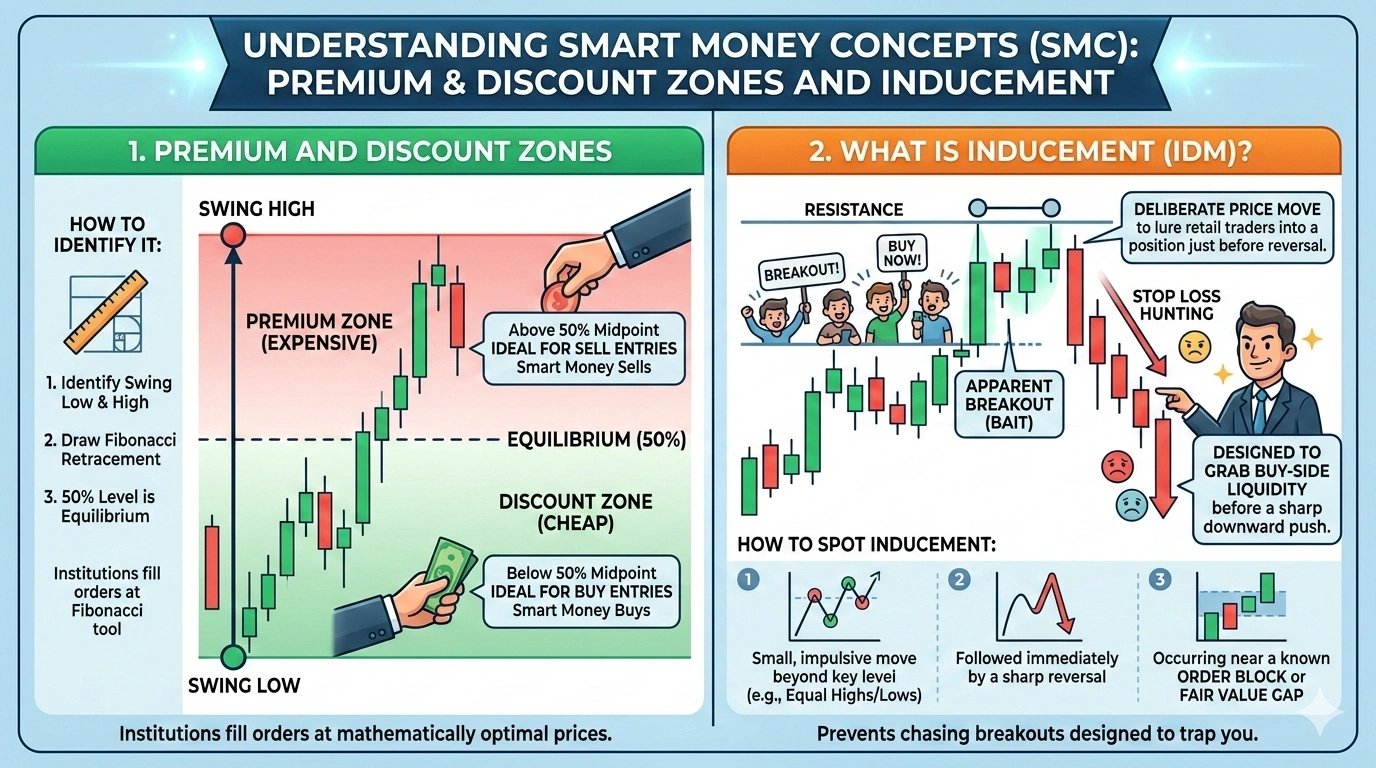
In smart money concepts, price is always evaluated relative to a range — either at a premium (expensive) or a discount (cheap).
- Discount Zone = Below the 50% midpoint of a price range → ideal for buy entries
- Premium Zone = Above the 50% midpoint → ideal for sell entries
Smart money buys in discount and sells in premium. This is why price so often reverses from levels that seem random to retail traders — institutions are simply filling orders at mathematically optimal prices.
How to identify it: Draw a Fibonacci retracement from the swing low to swing high. The 50% level (equilibrium) divides the range. Anything below = discount; above = premium.
What Is Inducement (IDM) in Smart Money Concepts?
Inducement in SMC refers to a deliberate price move that lures retail traders into a position — just before smart money reverses the market. It’s essentially bait.
For example: price forms what appears to be a breakout above a resistance level, encouraging retail traders to go long. In reality, this move is designed to grab buy-side liquidity before institutions push price sharply downward.
How to spot inducement:
- A small, impulsive move beyond a key level (equal highs/lows)
- Followed immediately by a sharp reversal
- Occurring near a known order block or fair value gap
Understanding inducement in trading prevents you from chasing breakouts that are designed to trap you.
What Is a Breaker Block in SMC?
A breaker block is a failed order block. When price breaks through an order block instead of respecting it, that order block “breaks” and becomes a breaker block — which now acts as a zone of resistance (if previously bullish) or support (if previously bearish).
Why it matters: Breaker blocks signal that institutional order flow has shifted. Smart money has changed sides, and the zone that once supported price now opposes it. Entering trades at breaker blocks — in the direction of the new institutional flow — gives high-probability setups.
What Is Liquidity in Smart Money Trading?
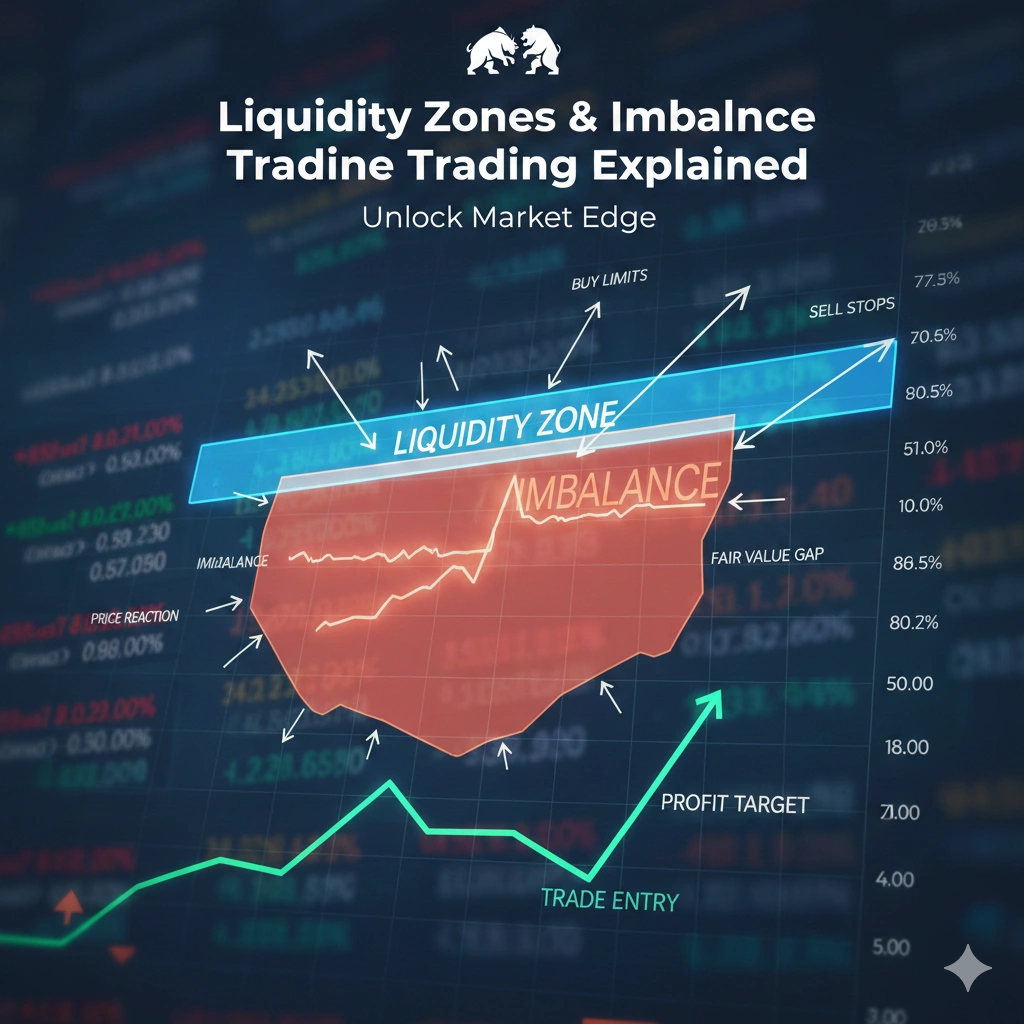
In smart money ideas, liquidity merely refers to where purchase and sell orders are being placed in the marketplace, most of them being retail stop-losses and impending entries. This liquidity is necessary to enable institutions to get into large trades easily, which is one of the fundamental principles of institutional trading.
Popular liquidity zones are:
- Equal highs and equal lows
- Trendline stop areas
- Session highs and session lows.
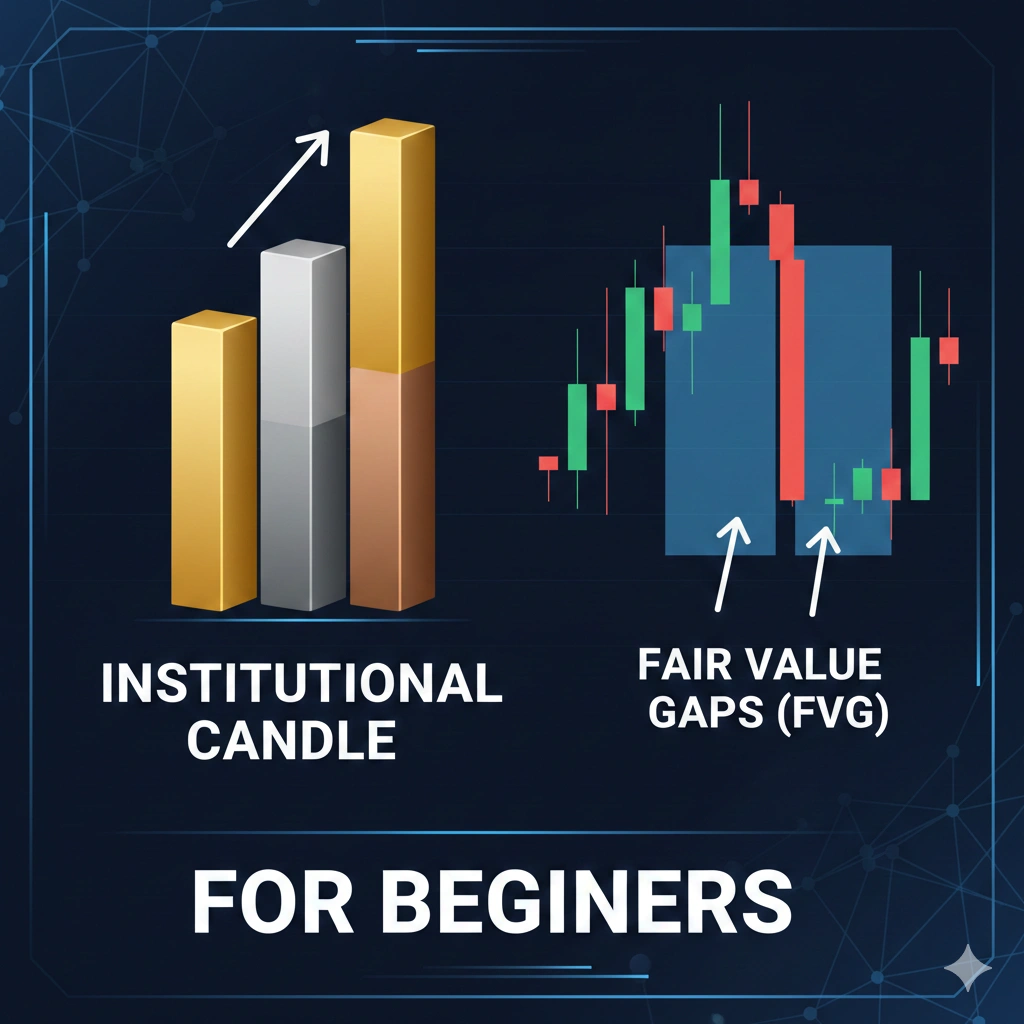
What Is Fair Value Gap (FVG) or Imbalance?
When money has gone up or down too quickly and leaves a disequilibrium in the market, a Fair Value Gap (FVG) occurs in smart money concepts. In a nutshell, the buyers and sellers did not have equal opportunity to trade there.
FVG Formula:
- Bullish FVG: Candle 1 High Candle 3 Low
- Bearish FVG: Case 1 Low > Case 3 High.
How to Trade Smart Money Concepts Step by Step?
The concepts of trading with smart money are best applied to a simple procedure, as shown in the basics of institutional trading and all other SMC trading manuals. Let’s see step by step:
Step 1: Higher Timeframe Bias
- Use H4 daily.
- Determine market structure and liquidity.
Step 2: Mark Key Zones
- Draw order blocks and FVGs
Step 3: Wait for Liquidity Sweep.
- Let stops get taken first
Step 4: Lower Timeframe Entry
- Enter on M5 or M15
- Aim for 1:3 RR or better
How Do Trading Sessions Affect Smart Money Concepts?
Institutional trading activity is concentrated in specific sessions. Understanding these windows is essential for timing SMC setups:
| Session | Time (EST) | SMC Behavior |
|---|---|---|
| Asian Session | 7 PM – 4 AM | Low volatility; liquidity builds |
| London Session | 3 AM – 12 PM | High volatility; often sets daily high or low |
| New York Session | 8 AM – 5 PM | Liquidity sweeps at open; major moves complete |
Key insight: The London session typically creates the liquidity grab (manipulation phase). The New York session often delivers the actual directional move (distribution). Watching for a London open liquidity sweep followed by a New York continuation is one of the most powerful SMC timing strategies.
What Is a Real Smart Money Trade Example?
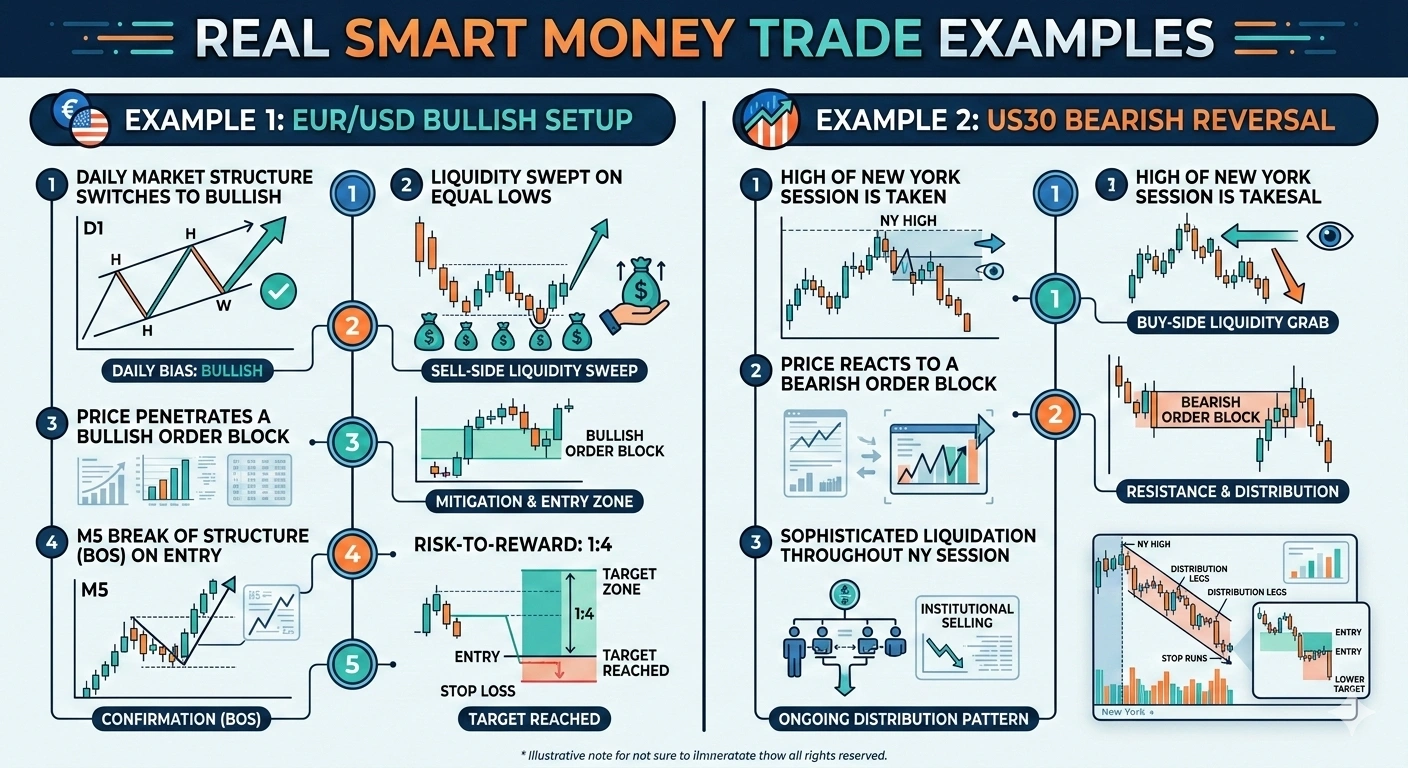
EURUSD Example
- Market structure switches to bullish per day.
- The liquidity is swept on the lows of equality.
- Price penetrates a bullish order block.
- On entry on M5 Break of structure (BOS).
- Risk-to-Reward: 1:4
US30 Example
- High of the New York session is taken.
- Price is a bearish reaction to an order block.
- Sophisticated liquidation throughout the NY session.
How Do Lot Size & Pip Value Work in SMC?
The concepts of smart money are significant in lot size and pip value to manage the risk properly.
| Lot size | Pip value (forex) |
| 0.01 | $0.10 |
| 0.10 | $1 |
| 1.00 | $10 |
Does SMC Work in Crypto, Gold, and Indices?
Yes. Smart money concepts apply to any market where institutional players are active:
- SMC in Forex — Most commonly used. EUR/USD, GBP/USD pairs respond strongly to SMC structure.
- SMC in Crypto — Bitcoin (BTC) and Ethereum (ETH) show clear order blocks and liquidity sweeps, especially as institutional funds enter crypto.
- SMC in Gold (XAU/USD) — Gold is highly sensitive to liquidity grabs around key session opens. A favorite for SMC traders.
- SMC in Indices (US30, NAS100, S&P500) — New York session killzones produce textbook AMD moves on indices daily.
The universal applicability of SMC is one of its greatest strengths — the same concepts that work on EUR/USD at 8 AM EST also work on Bitcoin on a daily chart.
What Are Common Smart Money Trading Mistakes?
- Marking too many order blocks or FVGs Marking through zones Overmarking
- Liquidity trading—In none of the cases should an attempt be made to trade without a stop.
- Disregarding more timeframe—heavy focus on big matters before entry.
- Overleveraging—too much will spoil the discipline.
What Are the Pros and Cons of Smart Money Concepts?
There are strengths and weaknesses to every strategy in smart money concepts. They are an important aspect of the basics of institutional trading and all SMC trading manuals.
Pros
- High accuracy—trades are not based on guessing but on institutional logic.
- Indicators are free—you use price, order blocks, and liquidity.
- Trades in diverse markets—Forex, indices, crypto, and stock.
- Well orchestrated—you trade like the big boys.
Cons
- High learning curve—It is difficult to learn the market structure and FVGs.
- Patient and long-term oriented—you wait till you have ideal liquidity arrangements.
- Not mechanical at first—it is not rules but art at first.
SMC vs ICT: What’s the Difference?
| SMC (Smart Money Concepts) | ICT (Inner Circle Trader) | |
|---|---|---|
| Creator | Community-evolved from ICT | Michael J. Huddleston |
| Focus | Simplified institutional concepts | Advanced institutional methodology |
| Complexity | Beginner-intermediate | Intermediate-advanced |
| Key Tools | Order blocks, FVG, BOS, liquidity | Killzones, PD arrays, IPDA |
| Best For | Systematic retail traders | Deep institutional mimicry |
In short: ICT is the origin framework; SMC is the community-simplified version. Both teach you to trade alongside institutional money, but SMC is generally more beginner-friendly while ICT goes deeper into the mechanics.
FAQs
Q1. Is Smart Money Concepts good for beginners?
Yes. Smart money concepts are beginner-friendly — but only when approached with patience. Start with the basics: learn market structure first (Higher Highs, Higher Lows), then move to order blocks and liquidity zones. Avoid jumping into advanced concepts like inducement or breaker blocks until the foundation is solid. Most beginners see real clarity within 2–3 months of consistent chart study.
Q2. Does SMC work in Forex only?
No. Smart money concepts work across any market where institutional players are active — Forex (EUR/USD, GBP/USD), Indices (US30, NAS100), Crypto (Bitcoin, Ethereum), and Gold (XAU/USD). The same institutional order flow logic applies universally because institutions operate across all these markets, not just Forex.
Q3. How long does it take to master SMC?
Realistically, 6 to 12 months of consistent practice is the standard timeline. The first 1–3 months focus on understanding market structure and key zones. Months 3–6 involve screen time and trade journaling. Full confidence — where you can read institutional order flow in real time — typically comes after 12+ months of disciplined study and live trading experience.
Q4. Is Smart Money Concepts better than indicators?
They serve fundamentally different purposes. Indicators are lagging — they show you what price has already done. Smart money concepts are leading — they show you why price is likely to move and where institutions are positioned before the move happens. SMC is cause-oriented; indicators are effect-oriented. That said, some traders combine SMC with volume profile or ATR for additional confluence.
Q5. What timeframe is best for SMC?
SMC uses a top-down multi-timeframe approach. Establish your higher timeframe bias on the Daily or H4 chart first. Then drop to H1 or M15 to identify order blocks and fair value gaps. Finally, use M5 or M15 for your entry trigger — a break of structure (BOS) or change of character (CHoCH). The higher timeframe decides direction; the lower timeframe decides timing.
Conclusion: Start Trading Like Smart Money — Not Against It
Understanding smart money concepts is only half the journey. The real edge comes when you can consistently apply them — spotting liquidity sweeps before they happen, reading order blocks with confidence, and entering trades aligned with institutional order flow rather than fighting it.
The traders who win with SMC are not the ones who memorized the most concepts. They are the ones who practiced with structure, learned from real trade breakdowns, and had a system for every market condition — whether it is Forex, Gold, Crypto, or Indices.
This SMC trading guide has given you the foundation. Now the question is: what do you do with it?
Ready to Go From Learning SMC to Trading It Profitably?
At Insightful Trade, we do not just teach theory — we show you how smart money concepts work on live charts, in real market conditions, every single session.
Here is what you get when you learn with us:
- Structured SMC mentorship — from market structure basics to advanced institutional order flow reading
- Live trade breakdowns on EUR/USD, US30, Gold (XAU/USD), and crypto — so you see exactly how order blocks, FVGs, and liquidity sweeps play out in real time
- Risk management frameworks built specifically around SMC setups — because a good entry without proper risk is still a losing strategy
- Real-time market analysis so you always know the higher timeframe bias before you even look at an entry timeframe
“SMC changed the way I read charts entirely — but it was the live sessions and mentorship at Insightful Trade that made it click for me.” — Active community member, Forex & Indices trader
Author: Arihant Jain
Trading Experience: 5+ Years
Arihant Jain is a financial markets analyst and trading educator with expertise in Forex, indices, crypto, and risk-managed trading systems. His insights are based on real trading experience, data-driven analysis, and transparent market understanding. All content is reviewed for accuracy and aligns with Google’s EEAT guidelines.
Risk Disclaimer:
Trading involves substantial risk. All information is for educational purposes only and should not be taken as financial advice. Always do your own research.
Last Updated: 27 February 2026