Slippage cost calculation measures the difference between the expected trade price and the executed price, multiplied by the trade size. It helps traders identify hidden execution costs and improve real trading performance.
Never made a trade and found the price was not as you had anticipated? This is where slippage cost calculation becomes important. It helps you measure the difference between the expected price and the actual executed price. In actual trading, there is slippage that affects your trading performance and raises your cost of execution, which is usually not evident to you. You can calculate the slippage costs, calculate the hidden cost, execute more accurately, and make more profitable trading decisions by learning the calculation of slippage costs.
Quick summary
| Section | Focus |
| Main Topic | Slippage Cost Calculation |
| Purpose | Measure hidden execution costs |
| Target Audience | Traders & Beginners |
| Key Benefit | Improve real trading performance |
What Is Slippage in Trading?
The difference between the price that is expected and the executed price is referred to as slippage. It adds to the cost of execution, and that is why slippage cost calculation can be used to measure real trading cost and learn about the effect of slippage on trading performance.
Equation to be used in the calculation of slippage cost:
Slippage = Expected Price – Executed Price.
Example
| Trade detail | Value |
| Expected Price | ₹500 |
| Executed Price | ₹502 |
| Quantity | 50 shares |
| Slippage per share | ₹2 |
| Total Slippage Cost | ₹100 |
In simple words:
- The difference in prices during execution is the slippage.
- It pushes up your total cost of execution.
- It occurs because of rapid movement in the market.
- Slippage cost computation is used to trace and minimize it.
Why Slippage Cost Matters for Traders
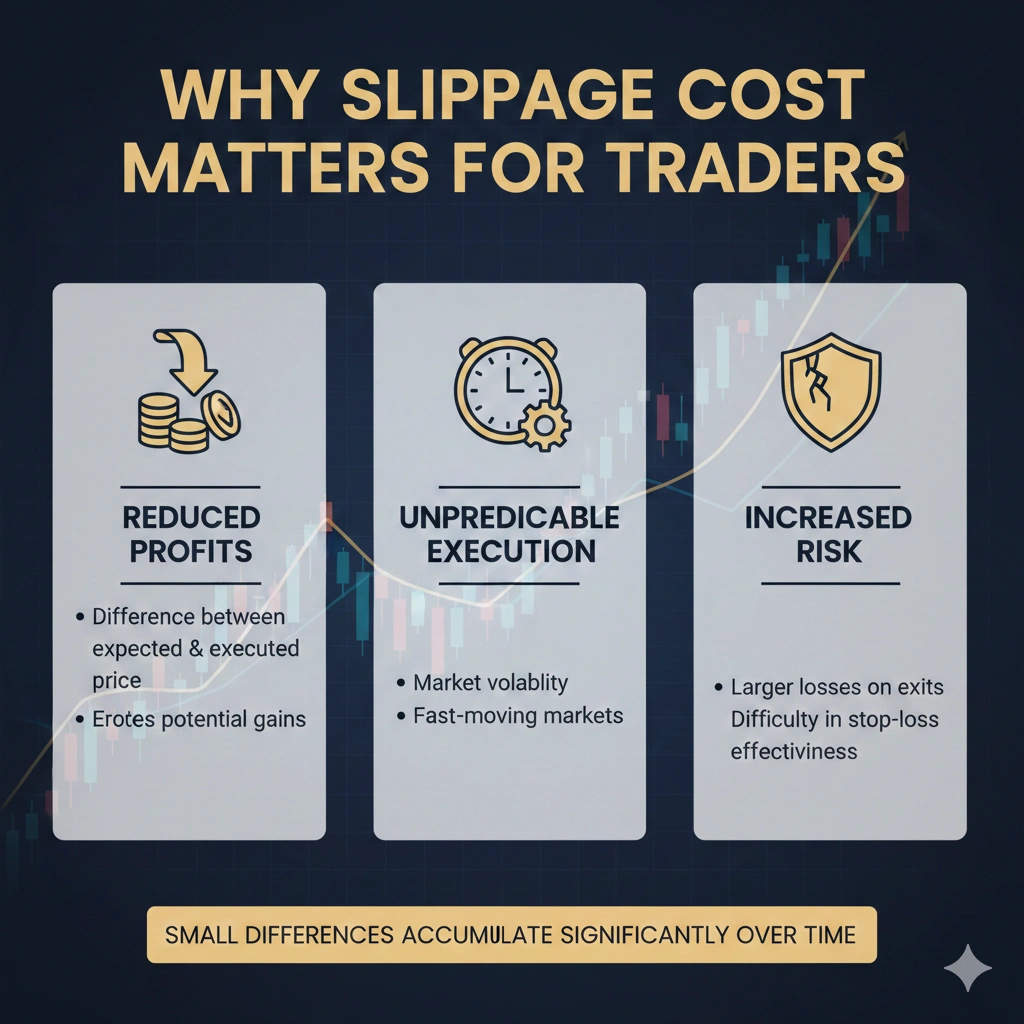
Slippage increases your implementation cost and decreases actual profit. That is why the calculation of slippage costs can make you see what the overall effects of trading really are.
The importance of slippage cost calculation is as follows:
- Expenses more on your total execution.
- Reduces your real profit
- Influences the accuracy of entry and exit.
- Helps enhance the trading decisions.
- Displays actual performance in trading.
Slippage vs Spread vs Execution Cost (Explained)
Other components of the trading cost are spread, slippage, and execution cost. Calculating slippage cost assists you in quantifying hidden costs and comprehending actual trading performance slippage influence.
Basic difference:
| Term | Role in Execution Cost | Example |
| Slippage | Hidden cost | Expected vs executed price difference |
| Spread | Visible cost | Buy and sell price difference |
| Execution Cost | Total real cost | Spread + Slippage + Fees |
Example:
| Cost component | Value |
| Slippage | ₹5 |
| Spread | ₹10 |
| Broker fee | ₹5 |
| Total Execution Cost | ₹20 |
Key points:
- Spread is a visible cost
- Slippage is a hidden part of your total execution cost.
- Total trading cost is the cost of execution.
- Calculation of slippage cost is useful in tracking real cost.
The Formula for Slippage Cost Calculation
Calculation of slippage cost assists you in gauging actual execution cost, and you can perceive the effects of slippage on trading performance.
Step 1: Slippage per share
- Slippage = Executed Price – Expected Price.
Step 2: Total slippage cost
- Total Slippage Cost = Slippage × Quantity
Example 1: Basic Slippage Calculation
| Trade Detail | Value |
| Expected Price | ₹500 |
| Executed Price | ₹502 |
| Quantity | 50 shares |
| Slippage per Share | ₹2 |
| Total Slippage Cost | ₹100 |
Calculation:
Slippage per share = ₹502 − ₹500 = ₹2
Total Slippage Cost = ₹2 × 50 = ₹100
Percentage slippage equation:
- Percent Slip = (Slippage / Expected Price) x 100.
How to Calculate Slippage Cost (Step-by-Step)
- Note your expected entry price
- Record your executed price
- Calculate price difference
- Multiply by quantity traded
- Divide by expected price to get percentage impact
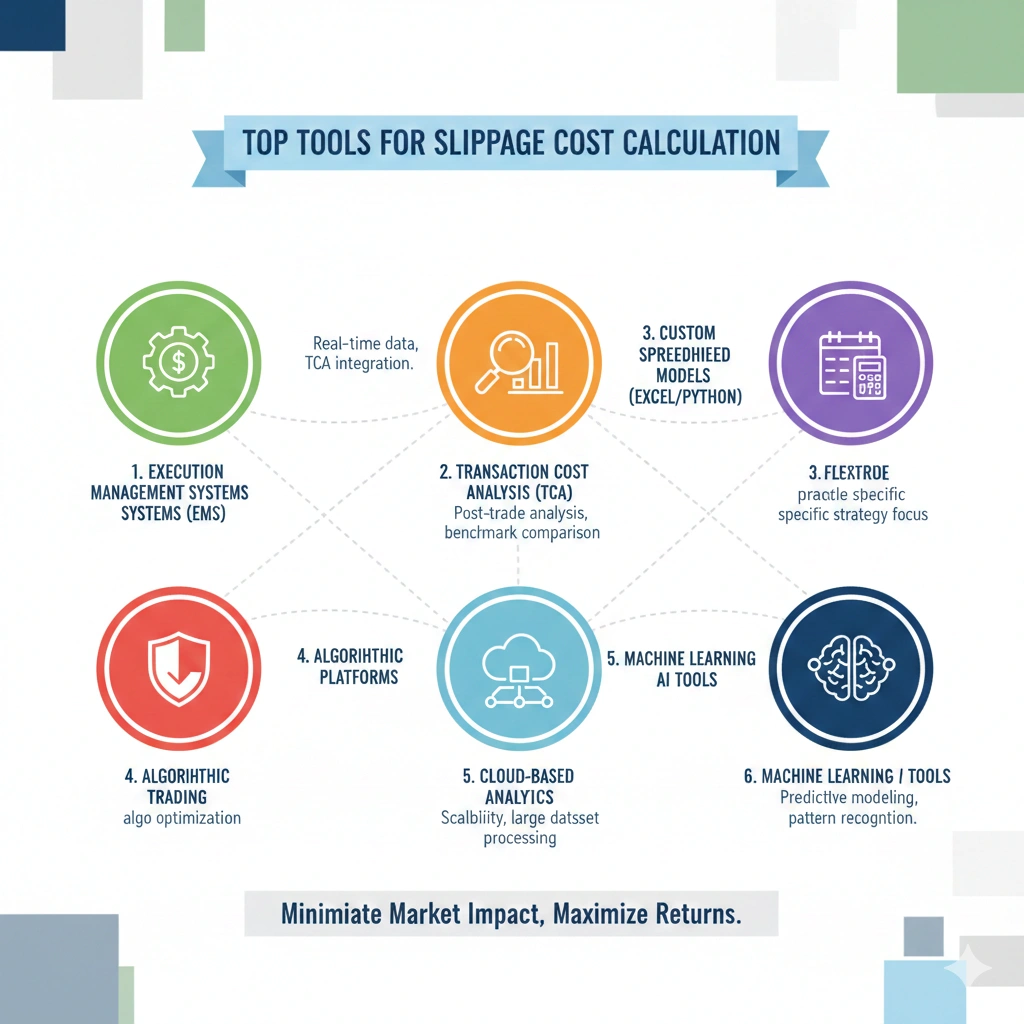
Top Tools for Slippage Cost Calculation
It is important to know that slippage is an impact that can occur in trading and that the calculation tools of slippage costs can easily monitor the actual execution cost.
- Intraday Slippage Cost Calculator.
Enter price, executed price, and trade size to view real-time slip.
- Liquidity and Slippage Calculators.
Anticipate possible slippage with market depth and order book information, and then make trades.
- Broker Slippage Analyzer
Determine previous trades and compute slippage and fees and the general quality of execution.
- Crypto Slippage Calculator
Reckon on the slip of crypto markets to prevent shocks in volatile situations.
Bottom line: The tools are useful in monitoring slippage, managing the cost of execution, and trading smarter.
How to Interpret Slippage Calculator Results
Once you have finished your slippage cost calculation, the way to read it is as follows:
- Slippage under 0.2% – Liquid market, smooth execution.
- Slippage more than 1% – Check size or time of order.
- High when volatile – Reflective of actual market influence.
Summary: Slippage can be monitored, execution cost can be decreased, and slippage impact on trading can be improved using the calculator.

5 Common Causes of Slippage in Trading
Slippage raises your cost of execution and has an impact on slippage impact trading. Common causes include:
- Spikes of volatility – Pricing reacts swiftly to news.
- Poor liquidity- Thin markets augment slippage.
- Large orders can move prices in low-liquidity markets, increasing slippage.
- Market orders – Quick fills, unheard price.
- Delays in execution- Latency causes delay
Bottom line: These understandings assist in minimizing slippage as well as monitoring real trading expenditures.
Trending Slippage Tips You Should Know
These tips will reduce the effect of slippage in impact trading and reduce the cost of execution:
- Limit orders, not market orders.
- Split large orders into small trades.
- Do not trade when it is very volatile.
- Smooth execution of trades in liquid markets.
- Execute execution algorithms VWAP or TWAP.
Hint: at the cost of calculation of slippage, monitor slippage to avoid loss of profits.
How Insightful Tools Complement Your Trading Toolbox
Trading tools and calculators unveil concealed execution costs and allow tracking the influence of slippage trading.
- Together with backtesting and risk calculators, complete information.
- Compare slippage vs spread to compare real trading costs.
- Calculation of slippage cost is used to guard the profits and to trade more wisely.
Hack: Strategy execution quality and performance are easy to define with the help of such tools, as InsightfulTrade recommends.
Trending Slippage Data You Should Know
Slippage impacts the costs of execution and trading. Critical information about the implications of the slippage impact on reading:
- 54 percent: among the retail traders experience slippage in forex.
- Average slippage: 0.5%–2% per trade
- During big events: up to 5 percent of the value of trade.
Bottom line: The calculation of slippage costs should be used to monitor the real performance cost and enhance trading performance.
FAQs
What is a slippage cost calculator?
A tool that calculates any discrepancy between the expected and the executed trade price, which will assist you in measuring the real execution cost.
Can the slippage cost calculation improve my strategy?
Definitely, by considering the cost of execution, your profit projections come out real and practical.
Do all markets have slippage?
Yes, always, whether stocks, forex, crypto, or derivatives, slippage happens whenever there is a change in price between placing an order and receiving it (filled).
Is slippage the same as commission or spread?
No, it is an implicit cost of execution that is independent of explicit charges and spread differentials.
Which tools help minimize slippage impact trading?
Slippage calculators, liquidity tools, and algorithm execution systems, as well as broker analysis widgets, are all assisting in measuring and reducing the cost of execution.
Conclusion
It is the duty of every trader to know how to calculate slippage cost. It reveals the actual implementation cost and assists in cutting the unestablished losses through slippage impact trading. You can monitor slippage, enhance strategy performance, and make smarter trading decisions by means of calculators and other useful tools. It is important to remember that measuring your slippage is not a figure or a set of numbers but a step to smart trading and safeguarding your profits in any market.
Calculate your actual cost of execution using Insightful Trade! Calculate hidden trading costs, improve strategy performance, and make more profitable trading decisions today using our slippage cost calculation tools.
Author: Arihant Jain
Trading Experience: 5+ Years
Arihant Jain is a financial markets analyst and trading educator with expertise in Forex, indices, crypto, and risk-managed trading systems. His insights are based on real trading experience, data-driven analysis, and transparent market understanding. All content is reviewed for accuracy and aligns with Google’s EEAT guidelines.
Risk Disclaimer:
Trading involves substantial risk. All information is for educational purposes only and should not be taken as financial advice. Always do your own research.
Last Updated: 18 february 2026