Introduction
The biggest struggle a trader faces while trading is not the lack of information– it’s handling too many strategies at once. Because in the beginning a trader is jumping between different indicators and methods trying to find best setups which often cause confusion, inconsistent results and decisions made in panic. After a time, it becomes impossible to tell what’s actually working and why your account is singing up and down.
A single setup trading plan helps in solving these problems by focusing on one thing at a time rather than doing everything. This doesn’t make your training easy by cutting out hard work, it simply makes your decisions much clearer by getting rid of all the extra and unnecessary variables.
| Aspect | Single Setup Trading Plan | Multiple Strategy Approach |
| Decision-Making | Structured and rule-based | Reactive and inconsistent |
| Learning Curve | Deeper understanding of one setup | Shallow understanding of many |
| Emotional Control | Higher due to clarity | Lower due to confusion |
| Performance Review | Data-driven and measurable | Difficult to evaluate |
| Long-Term Consistency | Easier to maintain | Harder to sustain |
In this blog, we will look at how a proper plan and discipline helps a trader achieve long term trading success.
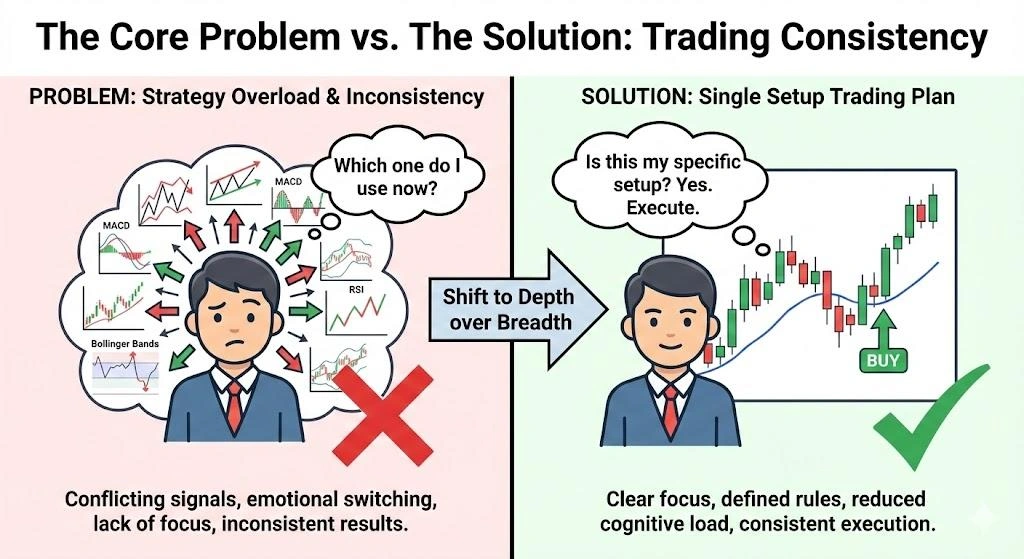
The Core Problem: Strategy Overload and Inconsistency
Too Many Strategies, Too Little Mastery
As a retail trader we are surrounded by countless number of strategies from YouTube, social media, and paid courses. They can be really helpful in trading, but jumping from one to another makes it impossible to actually track your progress and see what’s truly working for you.
Common consequences include:
- Executing trades different every single time
- Switching strategies in panic, the moment you hit a loss
- Never really trusting your own analysis
- Feeling tired from overtrading
Without a firm framework, It’s easy for traders to blame the mindset or the market, when they do not have a clear setup or solid strategy made before entering a trade.
Why One Strategy Often Works Better Than Many
Markets Reward Consistency, Not Variety
Financial markets do not reward creativity in strategy selection. It rewards you for being consistent and sticking to the one setup that allows you to:
- Observe how the market is repeated self over and over
- Build the real confidence by repeating process everyday
- See for yourself what’s working without the guesswork
When you use one set up repeatedly it becomes a routine. You also start understanding that one more better which helps you stop guessing and start understanding the reason behind the price movements.
What Is a Single Setup Trading Plan?
A single setup trading plan is a structured trading framework built around one clearly defined market setup. This includes:
- Exactly how the market should look
- Clear list of reasons why you should enter a trade
- Firm risk management to protect your money
- A proper plan to handle your trade once it’s live
- A logical reason to exit the trade
The goal is not to trade frequently, but to trade selectively and consistently.
A single setup trading plan does not mean trading only one market or timeframe. It means applying the same logic and rules across situations, allowing performance to be measured and improved.
Why a Single Setup Trading Plan Improves Decision-Making
Reducing Cognitive Load
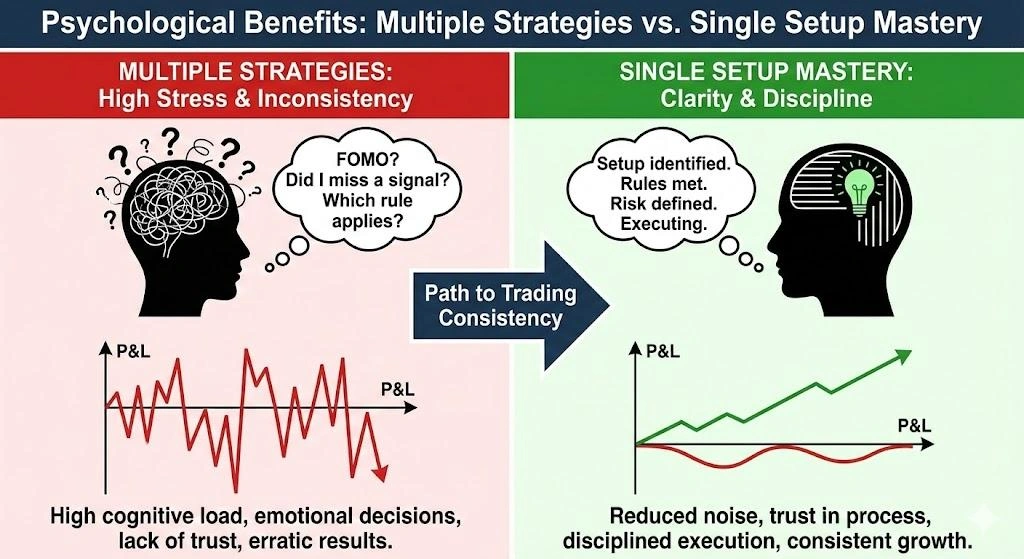
In trading you have to make a lot of decisions at once. If you are confused between multiple strategies, it would lead to a lot of stress and impulsive actions.
A single strategy plan will clear the mess by answering all your important questions before you even open your laptop:
- Is this my specific setup?
- Do the conditions look valid?
- Is the risk okay?
This kind of clarity you need while trading to avoid your emotions from running the show.
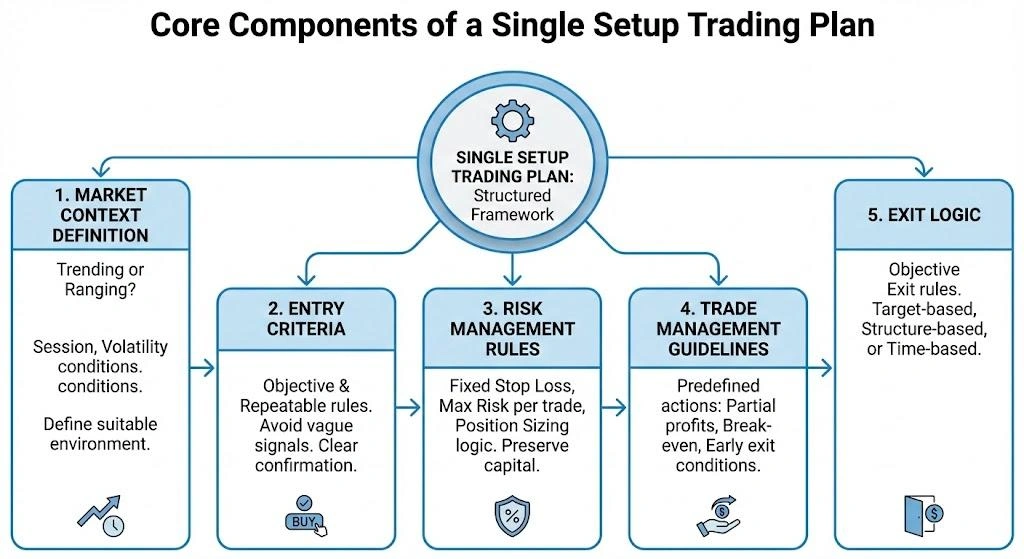
Core Components of a Single Setup Trading Plan
1. Market Context Definition
Every strategy has a sweet spot where it works the best. A single set a plan could clearly define:
- Whether the market is moving in a clear direction or just sideways?
- What time of the day is it like the London or New York open?
- How fast and aggressive the price is actually moving?
Without this big picture context, even a great looking set up can easily go against you.
2. Entry Criteria
Entries are a very important move in trading; they need to be clear and consistent. A good plan avoids vague feelings like “it looks strong” or “it feels right”.
Clear entry criteria allow traders to:
- Act without second guessing yourself
- See exactly what’s working and what’s not
- Stop trying to force trade that aren’t there
3. Risk Management Rules
Risk management is the heart of any single set up plan; it’s what actually keeps you in the game and avoids capital loss. This includes:
- Clear stop loss you must know where you will exit, if the trade goes against you.
- Firm risk limits decide exactly how much money you are willing to risk on a single trade.
- Smart trade sizing you need simple calculators to decide your position so you never over-levarage.
When you keep your risk consistent, your results will show you how well your strategies are actually working rather than just being the result of random guesswork or luck.
4. Trade Management Guidelines
For a trade to be successful you need to plan it properly before you click buy or sell. And a single setup plan should clearly state:
- If you are allowed to take some profit from the trade early.
- Exactly when you should move your stop loss to break even.
- And when it’s okay to bail out of a trade before it’s your target .
Having these rules ready keeps your emotion in check, so you don’t panic or get greedy while your money is actually on the stake.
5. Exit Logic
Your exit rules the final puzzle of the complete plan. Whether you’re getting out at a set target, when the chart’s direction shifts, or even when the clock runs out, your exit has to match the logic of why you entered first.
A single setup trading plan treats exits as a core part of the strategy, not just something you figure out at the last minute.
Practical Example of a Single Setup Trading Plan
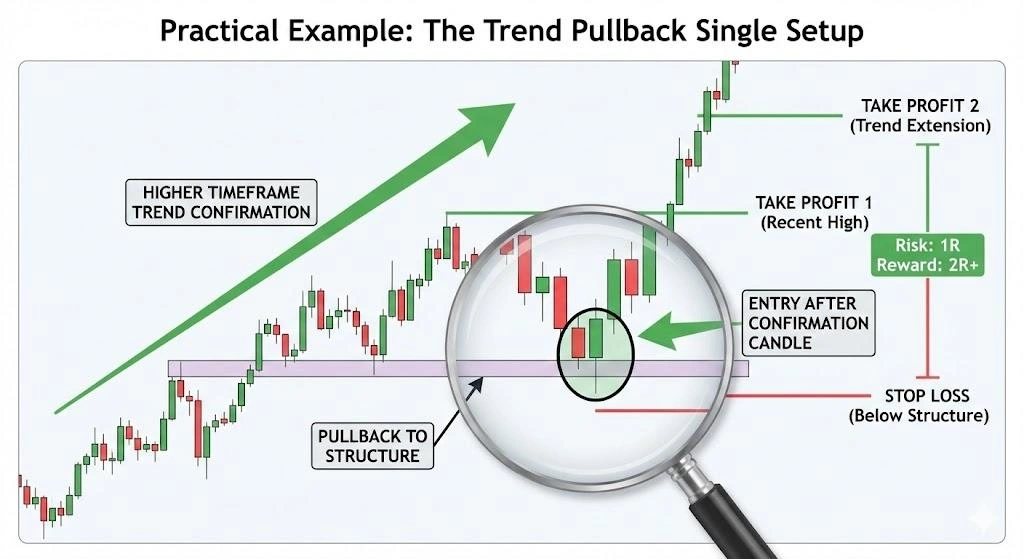
Example: Trend Pullback Setup
A traded build a plan that only triggers when the market is clearly moving in one direction:
- Checking the higher timeframe to confirm the trend.
- Waiting for the price to dip back into solid support zone.
- Entering only when a strong confirmation candle forms.
Why this works:
The trader stops trying to fight the market and only takes trades when the market conditions are clear. This makes it much easier to track the results and see exactly how the strategy is performing when the market is moving fast or slow.
Why a Single Setup Trading Plan Improves Psychology
It’s a common human behaviour to blame the mindset for our losses, but your head naturally clears up once you have a solid structure in front of you. Sticking to that one setup takes the guesswork out of your routine, telling you exactly when to act and more importantly when to stay away from the market.
This leads to:
- No more impulsive trades
- It helps building trust on your own strategies
- Way fewer emotional ups and downs
And this helps in boosting your confidence which helps in long trading journeys.
Common Mistakes When Using a One Strategy Trading Plan
Expecting the Setup to Work Every Day
No setup performs equally in all conditions. A single setup trading plan accepts drawdowns as part of statistical distribution.
Modifying Rules Too Quickly
Frequent changes prevent meaningful evaluation. Adjustments should be based on data, not emotions.
Trading the Setup Outside Its Context
Forcing a setup into unsuitable conditions undermines its edge.
How to Evaluate a Single Setup Trading Plan
While checking your progress, focus on:
- Evaluate all your trades, not just one or two
- Compare your risk-to-reward ratio of till now
- How well you followed your rules and stayed disciplined
- How calm you were while your trades were live
A one strategy trading plan is more effective when you look at the bigger picture over many trades, rather than just stressing over the outcome of every single trade.
Tools That Support a Single Setup Trading Plan
Even though it’s your plan that helps you achieve your target, a few more tools can make your daily routine much more easier:
- Chart replay feature which is great for practicing your setups
- Trading journals to track trades and your analysis
- Risk calculators to ensure that a position size is safe
These tools help you stay disciplined and organised, but they are not a shortcut for your own logic and planning, At the end of the day, it’s you whose driving the car.
Risk Management and Capital Preservation
A single setup plan is all about survival. By keeping your risk on each trade small, you make sure that one bad day doesn’t wipe out your entire account.
When you risk the same small amount every time, you stay in the game long enough to understand how the math actually works in your favor.
Regulatory and Compliance Considerations in India
Indian traders must trade within:
- SEBI-regulated broker frameworks
- RBI and FEMA guidelines
- Approved currency pairs only
Together with the above points, just a single strategy plan is enough to trade with responsibility because it focuses on keeping your risk low and your decisions organised.
Conclusion
At the end of the day, having a single setup trading plan isn’t about limiting yourself to just one path, it’s about finding clarity and staying confident. By following one single plant you avoid noises that confuse you, execute your trade with more confidence and finally start understanding the real reason behind the market’s every move.
So instead of chasing behind multiple strategies, you should focus on mastering one move and learning exactly where it shines and where it struggles. For further guidance visit Insightful Trade’s website, where expert traders will help you achieve long-term growth with discipline and confidence.
Frequently Asked Questions (FAQs)
Is sticking to one strategy good for beginners?
Truly it’s the best thing for a beginner. Instead of feeling overwhelmed by various indicators, if they focus on mastering one thing it would be more helpful in building confidence and avoiding impulsive mistakes.
Can I use my own single setup trading plan on different markets?
Of course. Just make sure that the logic behind your move is solid and the market is moving well, and you can apply your plan to other charts. It’s like having a reliable recipe that works just as well in a different kitchen as long as you have the right ingredients.
Is it legal to trade forex in India?
Yes, it is. Just make sure that you are following the rules set by SEBI and stick to the specific currency pair that Indian regulations allow.
Does having one setup guarantee that I’ll make money?
In trading nothing can guarantee success, but it does give you much better shot at being consistent. You will have less losing trade, and they won’t be random incident anymore because you are following a clear and logical process.
Author: Kumkum Chandak
Experience: 3+ Years in Trading Research & Market Content Strategy
Kumkum Chandak is a trading content strategist and market research writer who specializes in simplifying technical analysis, trading tools, and strategy-driven educational content. Her work is optimized for EEAT, accuracy, and user intent, ensuring every article delivers practical insights for traders of all levels.
Risk Disclaimer:
All content is strictly educational and not financial advice. Trading involves substantial risk. Always perform your own analysis or consult a professional advisor.
Last Updated: 5 January 2026