
The growing prop trading firms have opened new income opportunities for traders everywhere, including Vietnam. Many locals are now trading remote-funded accounts from companies abroad. However, this has also led to a lot of confusion regarding prop firm payout tax in Vietnam.
A common myth about the firms based abroad is that the profits earned through them are not taxable or sit in a regulatory grey zone. Believing this can lead to serious legal issues. Vietnamese law focuses on your residency and the nature of the income, not where the company is from.
In this blog, we’ll talk about the prop firms, your legal duties, and how you can avoid getting on the wrong side of the law.
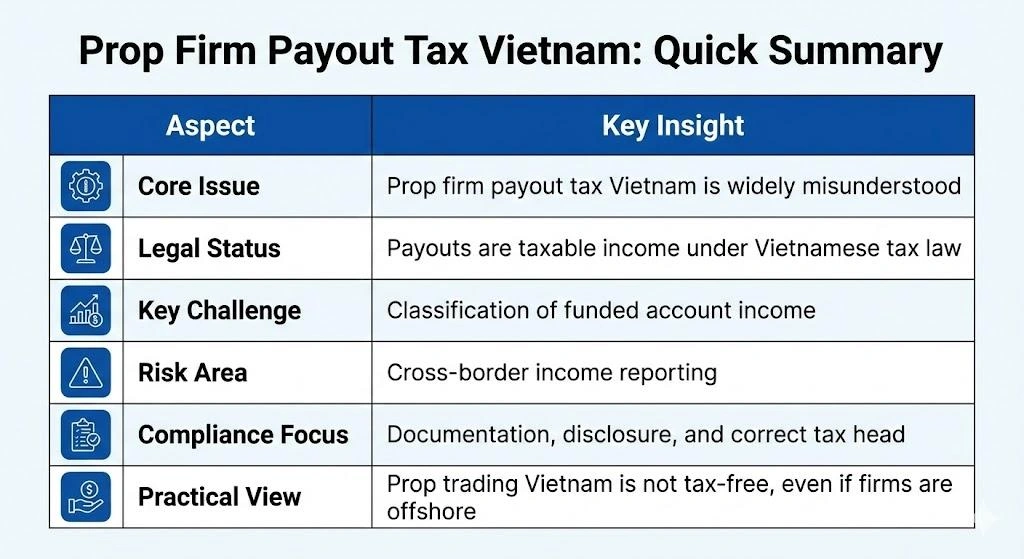
Quick Summary
| Aspect | Key Insight |
| Core Issue | Prop firm payout tax Vietnam is widely misunderstood |
| Legal Status | Payouts are taxable income under Vietnamese tax law |
| Key Challenge | Classification of funded account income |
| Risk Area | Cross-border income reporting |
| Compliance Focus | Documentation, disclosure, and correct tax head |
| Practical View | Prop trading Vietnam is not tax-free, even if firms are offshore |
Direct Legal Position in Vietnam
Under Vietnam’s Personal Income Tax (PIT) Law, residents are taxed on worldwide income. Prop firm payouts are generally classified as service income or other taxable income, not capital gains.
Understanding Prop Trading and Funded Accounts
Before addressing the prop firm payout tax in Vietnam, it is important to understand how prop trading works.
What Is a Funded Account?
A funded account is a trading account provided by a proprietary trading firm where:
- The trader does not use personal capital
- Profits are shared between the trader and the firm
- Losses are borne by the firm (within limits)
You’re receiving a performance-based profit share, not just gain on personal capital. This is why the tax rules for funded accounts are different from standard retail trading.
Why Prop Firm Payout Tax Vietnam Is a Compliance Issue
Due to the unclear classification of income earned in trading in Vietnam. They look at:
- Nature of income
- Economic benefit received
- Tax residency of the recipient
For those living in Vietnam, global income is taxable. This is the basis of prop firm payout tax in Vietnam.
Why Offshore Structure Does Not Eliminate Tax
Even if:
- The firm is based abroad
- Payment comes from global platforms
- There is no legal entity involved
The income earned by a resident is taxable. This is why prop trading in Vietnam carries a personal income tax obligation.
Legal Framework Governing Prop Firm Payout Tax Vietnam
1. Vietnamese Personal Income Tax (PIT) Law
Vietnam’s tax law covers:
- Global income for residents
- Pay from jobs or freelance work
- Other income with economic value
Prop firm payouts usually fall under:
- Income from independent services, or
- Other taxable income
2. Cross-Border Income Rules
Vietnam expects you to report:
- Money earned from abroad
- Foreign transfers tied to your services
This can impact your overall tax amount, since almost all these firms are located abroad.
- Progressive PIT Rates: Vietnam applies progressive tax rates for residents, ranging from 5% to 35%, depending on total taxable income.
- Filing Deadline: Annual personal income tax finalization is usually due by March 31 of the following year if income is not fully withheld at source.
- Penalties: Late or non-declaration can lead to administrative fines, daily late-payment interest on unpaid tax, and heavier penalties in cases of serious underreporting.
How Prop Firm Payouts Are Classified for Tax
Let’s see how the payouts from prop trading are classified in Vietnam.
Why Payouts Are Not Capital Gains
In prop trading in Vietnam, the trader:
- Doesn’t own the trading capital
- Doesn’t hold assets
- They receive compensation for their performance
This makes these payouts feel more like an income rather than an investment return.
Funded Account Tax Logic
From a tax point of view:
- Your skills and efforts generate the money
- The firm provides capital
- Your profit share is your pay
This explains why funded account tax is unavoidable, even when no personal funds are used.
Common Misunderstandings About Prop Trading Vietnam
- No tax duty cause the firms are outside Vietnam
- Profit from trading is not income
- Only money sent to Vietnam are taxable
- Trading income is capital gains
Vietnamese tax law focuses on when you earn income, not just bank deposits. This is central to the prop firm payout tax in Vietnam.

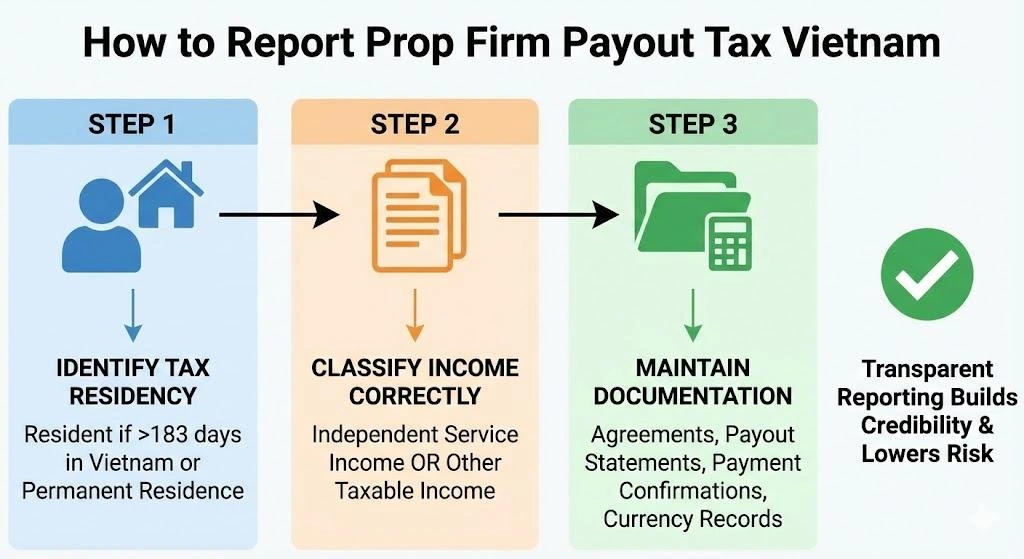
How to Report Prop Firm Payout Tax Vietnam
Step 1: Identify Tax Residency
If a trader:
- Is living in Vietnam for past 183+ days, or
- Has permanent residence
They will be considered as residents and will have to pay tax on income earned through prop firm payout.
Step 2: Classify Income Correctly
The income from prop trading is considered as
- Independent service income
- Other taxable income
This classification:
- Your specific tax rates
- Allowable deductions
Step 3: Maintain Documentation
For funded account tax compliance, traders should retain:
- Prop firm agreements
- Payout statements
- Payment confirmations
- Currency conversion records
Good paperwork serves as evidence that your work is genuine.
Double Taxation & Foreign Tax Credits in Vietnam
- If you are a Vietnamese tax resident, you are taxed on global income. Even if a foreign prop firm or payment provider deducts tax abroad, you still need to declare the full amount in Vietnam.
- If foreign tax was actually paid and you have proper proof, you may claim a credit against your Vietnamese tax. But the credit is capped at the Vietnamese tax on that same income. If the foreign tax is lower, you pay the difference. If it is higher, the extra amount is usually not refunded.
- In reality, most prop firms do not withhold tax. Payments are made in full, and the trader is responsible for reporting the income. Keeping contracts, payout statements, and bank records is important in case the tax authority asks for clarification.
Tax Rates and Payment Obligations
The tax rates in Vietnam change according to your income.
Key Considerations
- Progressive or flat rates may apply
- Foreign tax credits could be useful
- You may need to pay tax in advance
Knowing this will help you manage your money better in Vietnam prop trading.
Why Authorities Scrutinize Prop Firm Income
The tax regulators in Vietnam pay close attention to:
- Digital income
- Overseas services
- Online trading
Prop firm payout falls right in this category, which explains the extra focus on prop firm payout tax in Vietnam.
Compliance vs Avoidance: Why Transparency Matters
If you don’t report the funded account, it might lead to:
- Audits
- Limited banking access
- Create difficulties with transfers
Transparent reporting:
- Builds credibility
- Lower long-term risk
- Match regulatory expectations
This is important to know for traders planning to prop trade as their primary source of income.
Tools That Help With Prop Firm Tax Compliance
Here’re some modern tools that can help you with:
- Tracking income across different platforms
- Currency conversion accuracy
- Annual income summaries
- Organizing your records
Using these tools will make it easy for you to report your income accurately and efficiently.
Comparing Prop Trading With Other Income Types
| Income Type | Capital Ownership | Tax Treatment |
| Retail Trading | Personal capital | Capital or business income |
| Employment | None | Salary income |
| Prop Trading | Firm capital | Service/other income |
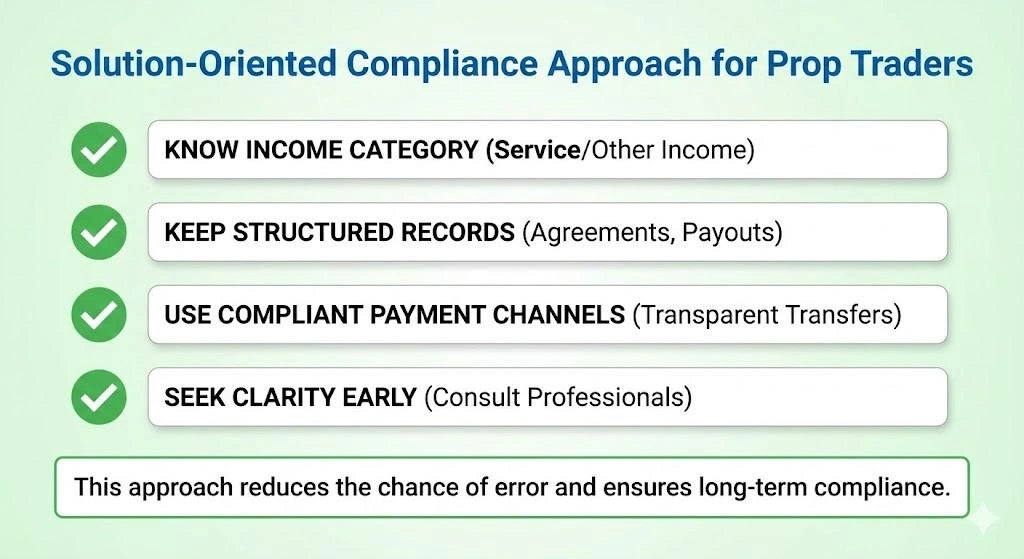
Solution-Oriented Compliance Approach
Don’t try to avoid your duties; find the right way to report your income accurately and easily.
Practical Steps
- Know income category
- Keep structured records
- Use compliant payment channels
- Seek clarity early
This approach reduces the chance of error around prop firm payout tax in Vietnam.
Conclusion
To wrap it up, income earned from prop trading is considered taxable income. The funded account income is basically payment for your skills and service; it’s taxable for residents no matter where the firm is located.
Getting a handle on funded account tax and keeping the right records will allow you to take part in prop trading in Vietnam without any compliance risk or legal headache.
To understand the regulatory rules and learn how to classify your income, connect with Insightful Trade. They offer clear explanations and guidance to help traders in the long term.
FAQs: Prop Firm Payout Tax Vietnam, Tools & Compliance
1. Is prop firm payout tax in Vietnam mandatory?
Yes, in Vietnam you must declare your foreign-earned income, including prop firm payouts.
2. Is funded account income considered trading profit?
Not exactly; the tax rules generally treat these payouts as service-based income rather than an investment return.
3. Does it matter if the prop firm is outside Vietnam?
No, it does not matter because in Vietnam the residency determines tax liability.
4. Are tools available to track prop trading income?
Yes, modern income tracking and compliance tools are great to keep your payouts and documentation organized.
5. Can undeclared prop trading income cause issues in India or elsewhere?
Yes, with global banking transparency, moving money internationally without declaring it can lead to some serious cross-border legal issues.
Author: Kumkum Chandak
Experience: 3+ Years in Trading Research & Market Content Strategy
Kumkum Chandak is a trading content strategist and market research writer who specializes in simplifying technical analysis, trading tools, and strategy-driven educational content. Her work is optimized for EEAT, accuracy, and user intent, ensuring every article delivers practical insights for traders of all levels.
Risk Disclaimer:
All content is strictly educational and not financial advice. Trading involves substantial risk. Always perform your own analysis or consult a professional advisor.
Last Updated: 6 February 2026