
In active trading, knowing when to enter a trade is only half the battle. Knowing when to exit profitably the trade is the real challenge. This is what separates a professional trader from a trader who lets their emotions make the decisions.
This is why a profit target calculator is a “must-have” tool not an optional extra. It helps you in forming your strategies, ensuring that you have a clear plan before you put your capital at risk.
Whether you’re an intraday trader chasing behind fast and short-term moves or a swing trader holding positions for several days, this tool will help you set targets that are realistic. It’s purely based on the technicals and fundamentals of the market. So, instead of wishing for the market to move your way, you are relying on logic and structure.
In this guide, we’ll learn how a profit target calculator works, why it’s so important for your bottom line, and how you can start using it in the real world to trade with much more clarity and confidence.
What Is a Profit Target Calculator?
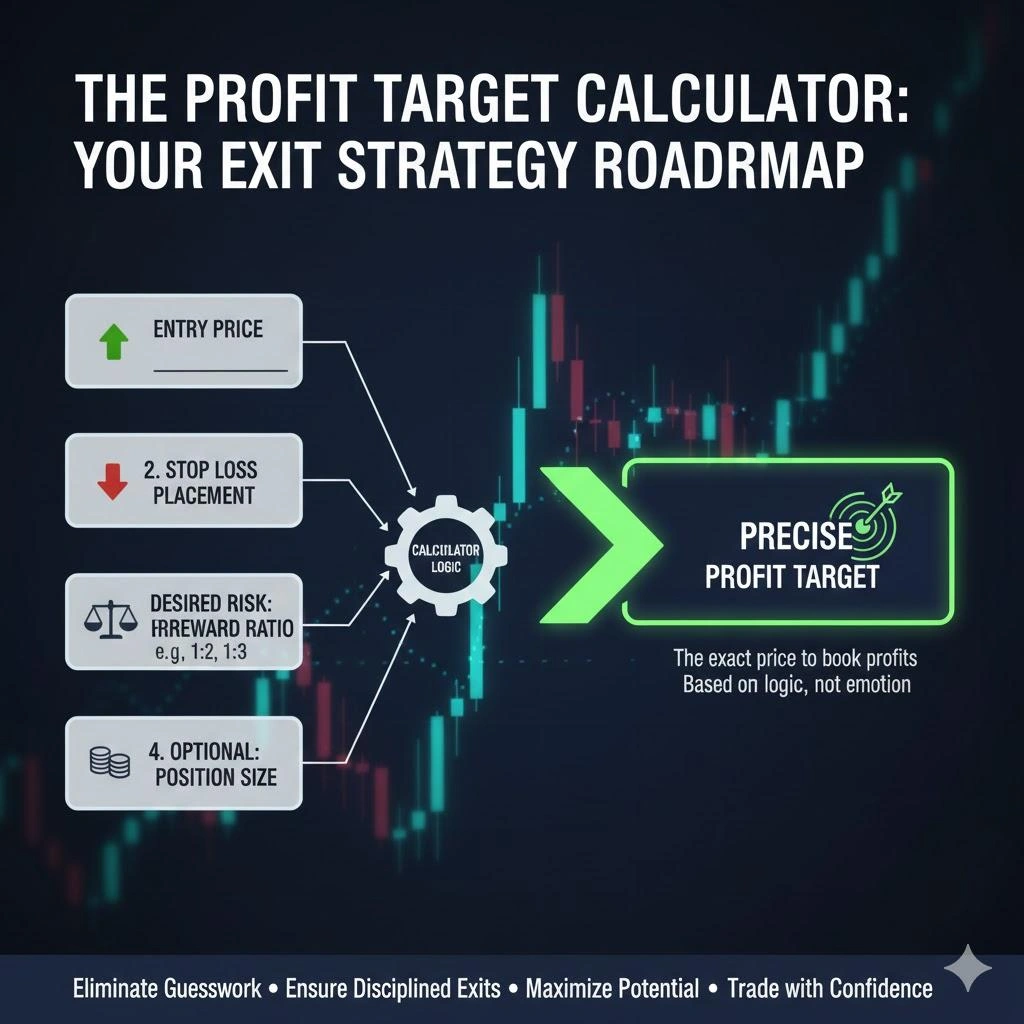
A profit target calculator is essential to determine the exit price for your trade. Instead of guessing or picking any number,this tool uses specific data such as entry price, risk level, stop loss, and desired risk-to-reward ratio to tell you exactly where you should be booking your profits.
Most of the traders prefer to use this calculator to avoid making mistakes or panicking to define profit targets before entering a trade, which supports disciplined execution.
Core Purpose of a Profit Target Calculator
The calculator serves several important functions:
- It lets you see exactly how much money you can make, before you even put your capital at risk, which improves your decision-making quality.
- It keeps your risk-reward ratio in check by ensuring that your expected profit is larger than the amount you’re risking.
- It helps you in avoiding emotions while trading by giving you a logic based exit points based.
When you use a profit target calculator correctly, it becomes the foundation of a structured profit planning method.
Why Profit Target Planning Matters for Intraday and Swing Traders
Whether you are a day trader or swing trader, the challenge is always the same: knowing exactly when to take your money and run.
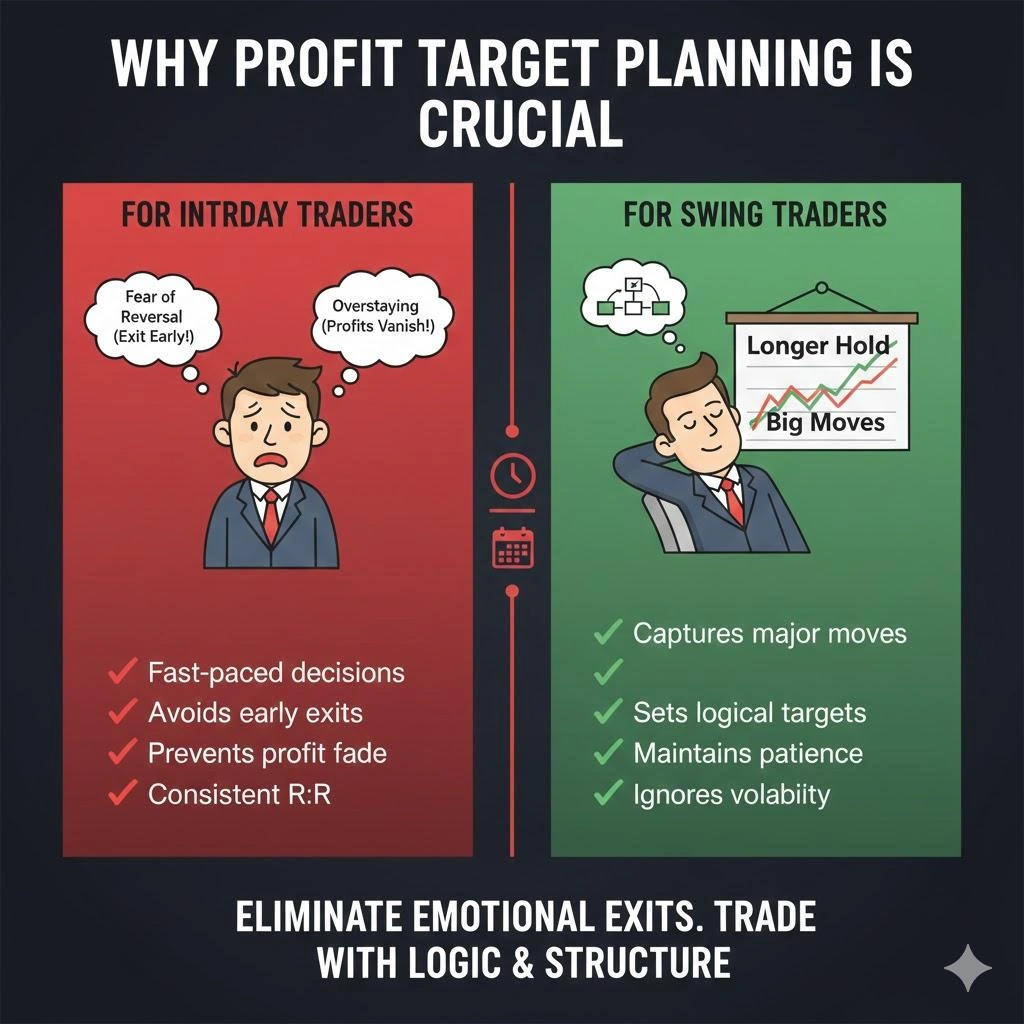
For Intraday Traders
For Intraday traders the market moves fast and the pressure for decision making can often lead to costly mistakes. Without a profit target calculator:
- You might close a winning deal too early in the fear of reversal.
- You could end up overstaying in a profitable deal, watching the profit disappear in seconds.
- Your risk-reward ratios can become inconsistent.
A profit target calculator will help you align targets with volatility, chart structure, and stop-loss placement.
For Swing Traders
For swing traders the goal is to capture major market moves, for which usually you have to hold the position for several days. Swing trading is a game of patience and endurance. For them, a profit target calculator helps:
- It helps you set a logical price target based on the technical levels and as per the necessity of your risk-to-reward ratio.
- This tool helps you maintain patience by giving you a clear and realistic price target.
- It helps you avoid early exits due to short term market volatility.
In both styles, profit planning is not optional—it is essential.
How a Profit Target Calculator Works (Step-by-Step)
Understanding the mechanics of a profit target calculator makes it easier to apply in real trades.
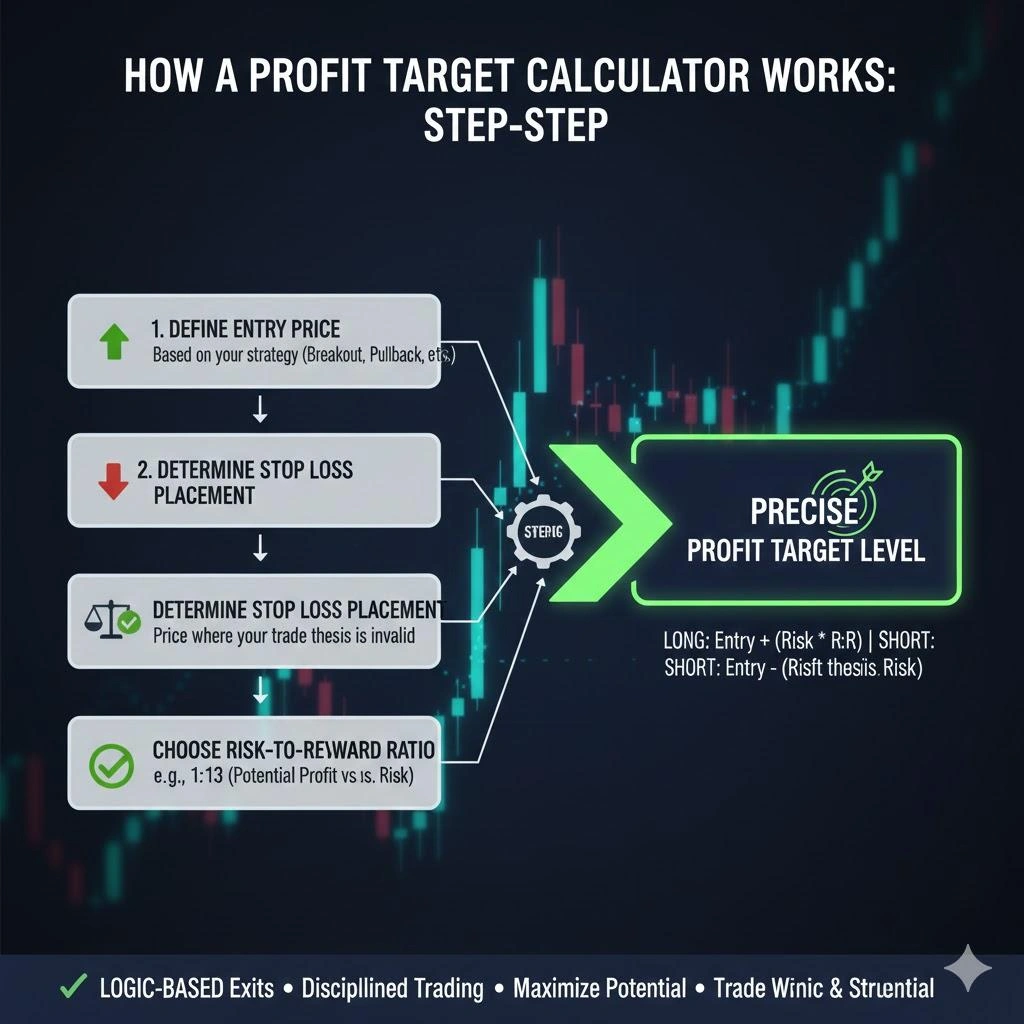
Step 1: Define the Entry Price
The entry price is the level where you plan to jump into a trade. Whether you are buying a breakout, selling a pullback, or entering after a specific pattern confirmation, this number serves as an anchor for your entire trade.
- For intraday trades, this is often based on lower timeframe setups.
- For swing trades, this may align with daily or four-hour chart structures.
Step 2: Determine Stop Loss Placement
Before you think about how much money you will make in this trade, you must admit till where you accept to lose. Your stop loss is the price level where you exit to protect your capital.
- A tight stop is common for intraday trading.
- A wider stop is often required for swing trades to accommodate market fluctuations.
The distance between entry and stop loss determines your risk per trade.
Step 3: Choose a Risk-to-Reward Ratio
Setting a risk-to-reward ratio is like setting a term of contract with the market. This step is important because it protects your capital from inevitable losses that every trader faces.
- Common ratios include 1:2, 1:3, or higher for swing trades.
- A high ratio ensures that winning trades compensate for losing ones over time.
Step 4: Calculate the Profit Target
Once you enter your entry price, stop-loss and expected profit the profit target calculator does its work and determines the exit price where profits should be booked.
- For long trades, the profit target is above the entry price.
- For short trades, the profit target is below the entry price.
This calculated level becomes your planned exit unless market conditions justify adjustments.
Practical Example:
Let’s look at a simple intraday example to see the calculator in action.
Trade Setup
- Entry price: ₹500
- Stop loss: ₹495
- Risk per share: ₹5
- Risk-to-reward ratio: 1:2
Profit Target Calculation
- Profit target = ₹500 + (₹5 × 2)
- Profit target = ₹510
This means the trade only makes sense if the market has a reasonable probability of reaching ₹510 within the session.
Tools and Inputs Used in Profit Target Calculators
A reliable profit target calculator often integrates multiple factors beyond simple arithmetic.
Common Inputs
- Your entry price and stop loss levels.
- Your expected risk-to-reward ratio.
- The position size or lot size
- Market volatility measures such as ATR (Average True Range).
Supporting Technical Tools
Traders often combine the profit target calculator with:
- Support and resistance levels to validate price objectives.
- Fibonacci extensions for swing trade projections.
- VWAP or pivot points for intraday target alignment.
This layered approach improves accuracy and realism when setting profit targets.
Common Mistakes Traders Make Without a Profit Target Calculator
Ignoring structured profit planning often leads to repeatable mistakes.
Emotional Exits
- Traders exit early due to fear when trades move in their favor.
- Profitable trades are cut short while losses are allowed to run.
Inconsistent Risk-Reward Profiles
- Sometimes traders end up risking more than they reward.
- Others often chase unrealistic targets that have no market justification.
Overtrading and Burnout
- A lack of clear targets often leads to frequent guessing, which ends in a mistake.
- Burnout often happens when traders feel they have to babysit there each trades
A profit target calculator helps you eliminate these behavioral pitfalls.
How to Set Realistic Profit Levels Using a Calculator
Setting realistic profit levels is just as important as calculating them.
Align Targets with Market Structure
- Your profit targets should align with resistance or support zones that cause the price to bounce or reverse.
- Setting a target just beyond a strong technical level significantly lowers the probability of your trade reaching its goal.
Match Targets with Timeframe
- Intraday targets must reflect the session volatility means you shouldn’t expect the move that takes weeks to happen in just a few hours.
- Swing targets should be given enough room for multi-day price development.
Adjust, Don’t Abandon
- Targets can be adjusted based on evolving market conditions.
- However, changes should be rule-based, not emotional.
This disciplined approach strengthens long-term performance.
Integrating Profit Target Calculators Into Your Trading Workflow
A profit target calculator works best when embedded into your routine.
Before the Trade
- Define your entry, stop loss, and profit target upfront.
- Confirm that your trade’s risk-to-reward ratio makes sense to your trading plan.
During the Trade
- Let the market move without micromanaging your exits.
- Monitor the market only for major structural changes.
After the Trade
- Review whether your profit target was realistic.
- Use trade logs to refine your profit planning methods.
Over time, this process improves consistency and confidence.
Conclusion: Why Every Trader Needs a Profit Target Calculator
Look, a profit target calculator is much more than just a math tool—it’s a system that keeps you disciplined. It stops you from guessing where to exit and helps you set real targets that actually make sense with the risk you’re taking. And with a clear target, it becomes much easier to keep your emotions in check and stick to your plan.
Whether you are an intraday trader or a swing trader, having a structured plan is essential to survive during a volatile market. It keeps you calm and helps in achieving the maximum number of winning streaks when the market gets messy.
At InsightfulTrade, we are dedicated to teaching you how to use tools like profit target calculators to build a strategy that lasts. We believe in steady, sustainable growth over short-term gambles, providing you with the practical frameworks and education you need to trade smarter and with more clarity every single day.
Frequently Asked Questions (FAQs)
What is the main benefit of using a profit target calculator?
The single main benefit of using a profit target calculator is that it helps you decide how you will exit a trade before entering a trade, which improves discipline and consistency.
Can beginners use a profit target calculator effectively?
Yes, in fact it’s the most important tool for a beginners because it removes guesswork and teaches proper risk-to-reward planning from the start.
Is a profit target calculator suitable for all markets?
A profit target calculator can be used for stocks, forex, crypto, and commodities as long as inputs reflect the market’s volatility.
Should profit targets always be fixed?
Profit targets should be predefined but can be adjusted if market structure changes in a rule-based manner.
How does a profit target calculator support risk management?
It ensures that potential rewards justify the risk taken, which is essential for long-term profitability.
Author: Kumkum Chandak
Experience: 3+ Years in Trading Research & Market Content Strategy
Kumkum Chandak is a trading content strategist and market research writer who specializes in simplifying technical analysis, trading tools, and strategy-driven educational content. Her work is optimized for EEAT, accuracy, and user intent, ensuring every article delivers practical insights for traders of all levels.
Risk Disclaimer:
All content is strictly educational and not financial advice. Trading involves substantial risk. Always perform your own analysis or consult a professional advisor.
Last Updated: 26 December 2025