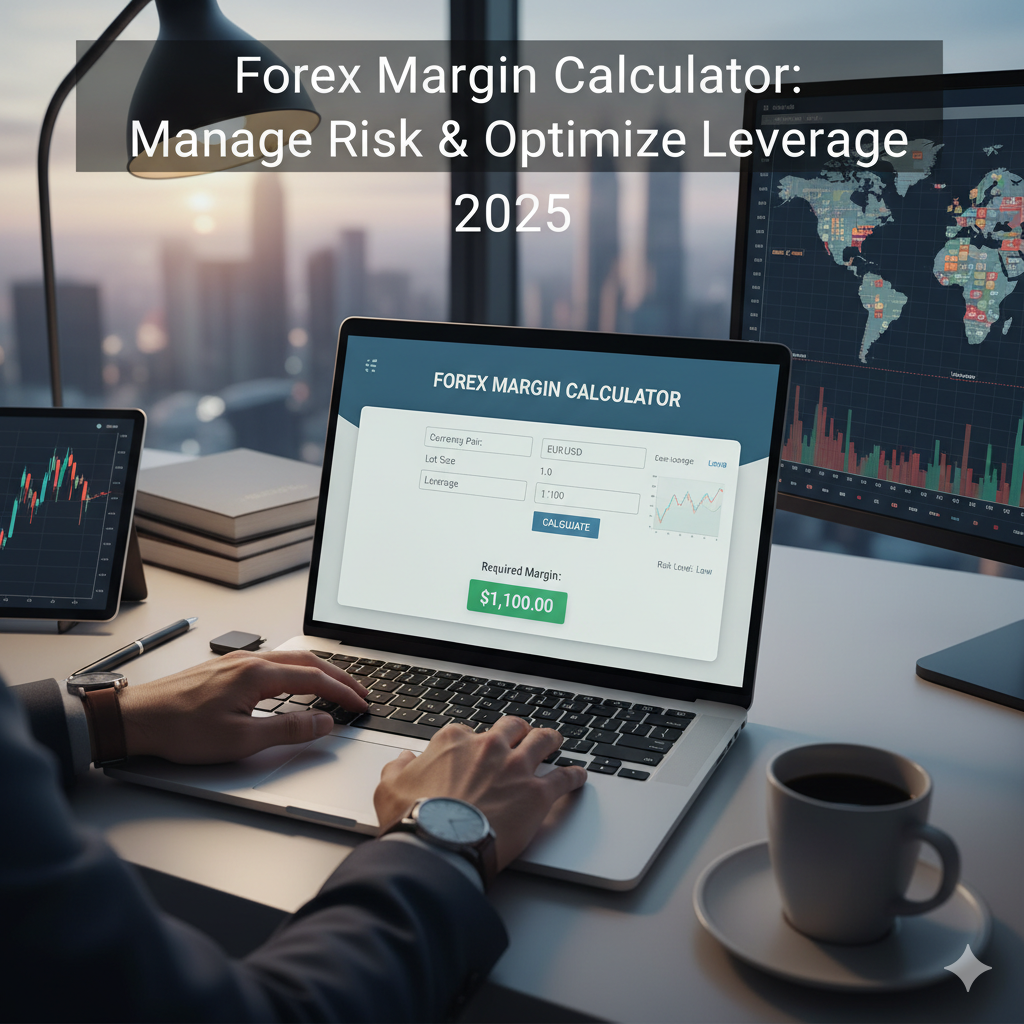
Introduction to Position Size Calculator
In trading, you must know how to manage your risk properly to achieve long-term success in the market. That’s where a position size calculator comes in, playing an important role by helping you decide how much to trade on any given position while keeping your risk under control. By using one, you can ensure that each trade you make is in line with your risk tolerance, account size, and current market dynamics – ensuring you’re protected from significant losses.
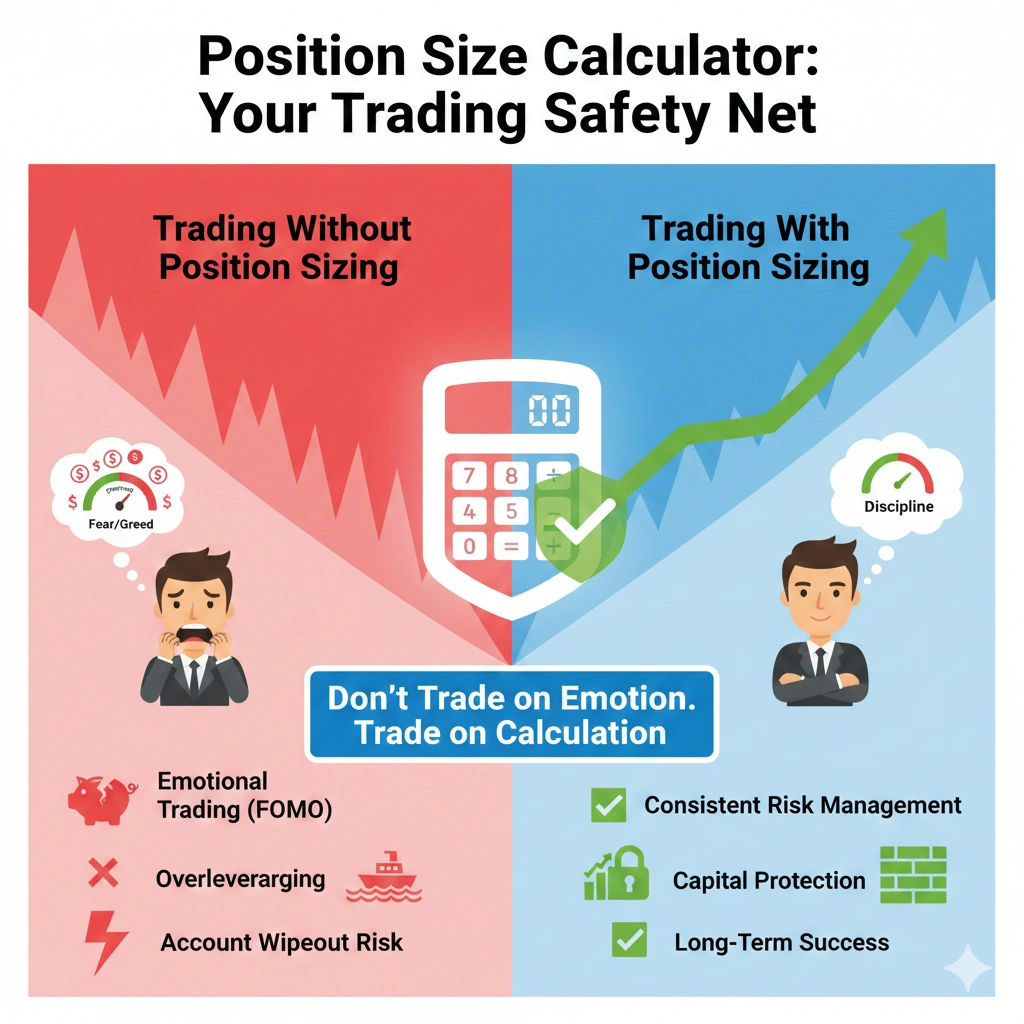
If you are trading without proper position sizing then it is like building a house on sand—dangerous and unpredictable. So it is important to have the right knowledge of how to calculate your position size using a reliable position size calculator, no matter what you trade—forex, stocks, commodities, or crypto—for steady profits and less losses.
Why Using a Position Size Calculator is Important
It becomes essential for a safe and profitable trader to protect your capital by risking only a small, predetermined percentage of your account on each trade. It is important if you are a beginner to use the risk per trade formula. As most of the experienced traders risk between 1% to 2% per trade, ensuring that one or a few losing trades will not wipe out the account.
A position size calculator automates the complex calculations required to position your trades precisely, factoring in:
- Your trading balance
- Risk percentage per trade
- Entry price and stop-loss level
- Asset volatility and price range
These are the tools that prevent emotional trading decisions, FOMO entries, reduce errors in manual calculations, and maintain discipline in your trading strategy.
Understanding Position Sizing and Risk Management
During a trade the number of units, shares, contracts, or lots you buy or sell is known as Position sizing. It helps you control your trade size based on how much money is at risk if the trade moves against you toward the stop-loss level.
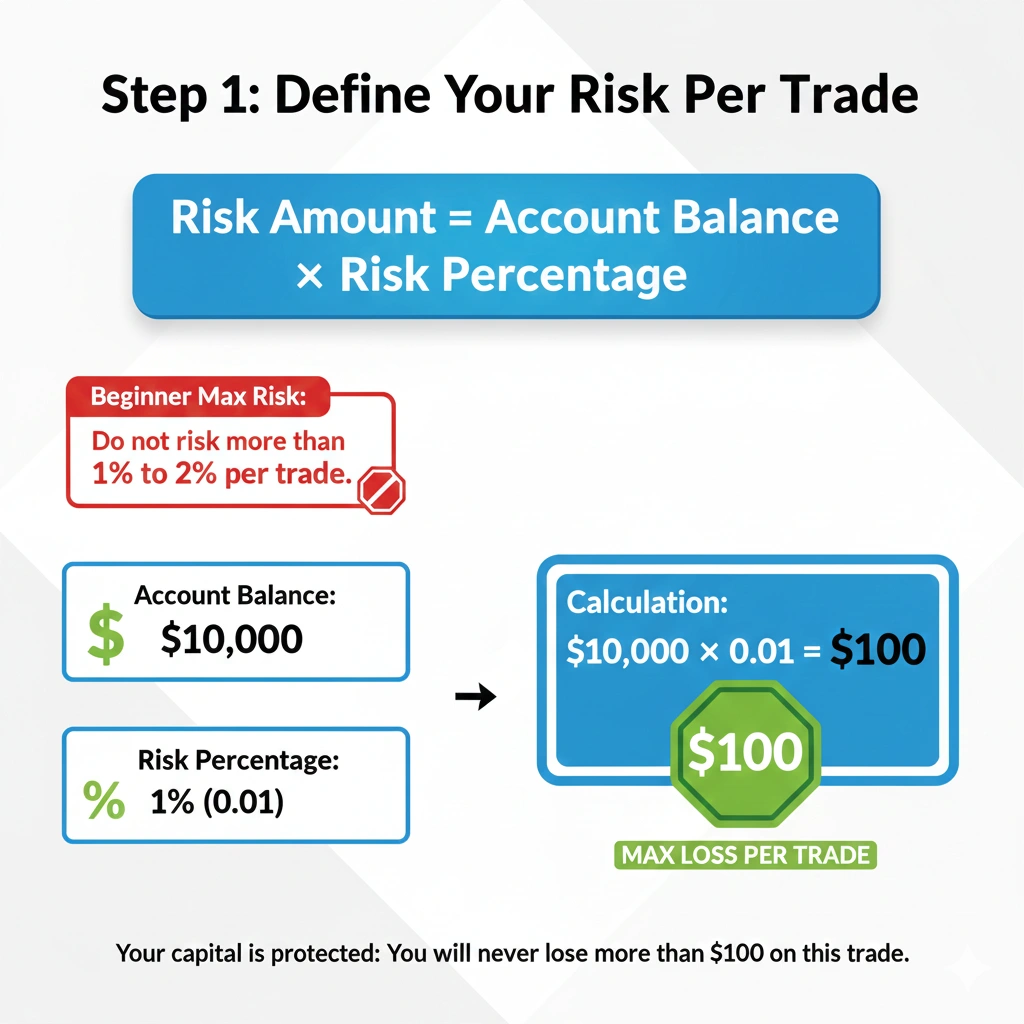
Risk per trade refers to the percentage of your account capital that is in your capacity to lose on a single trade. That’s why this risk per trade formula is important for beginners:
Risk per Trade = Account Balance × Risk Percentage
For example, if you have a $10,000 trading account and you risk 1% per trade:
Risk per trade = 10,000 × 0.01 = 100
This means that your maximum risk (loss) on any given trade should not exceed $100.
How to Calculate Position Size: The Formula
The fundamental formula that you should know to determine the right position size is:
Position Size = Risk per Trade
Entry Price−Stop Loss Price
Where:
- Risk per Trade refers to the maximum amount of money in a single trade you are willing to lose.
- The entry price is the price at which you enter the trade.
- The stop loss price is the price level where you exit to minimize losses.
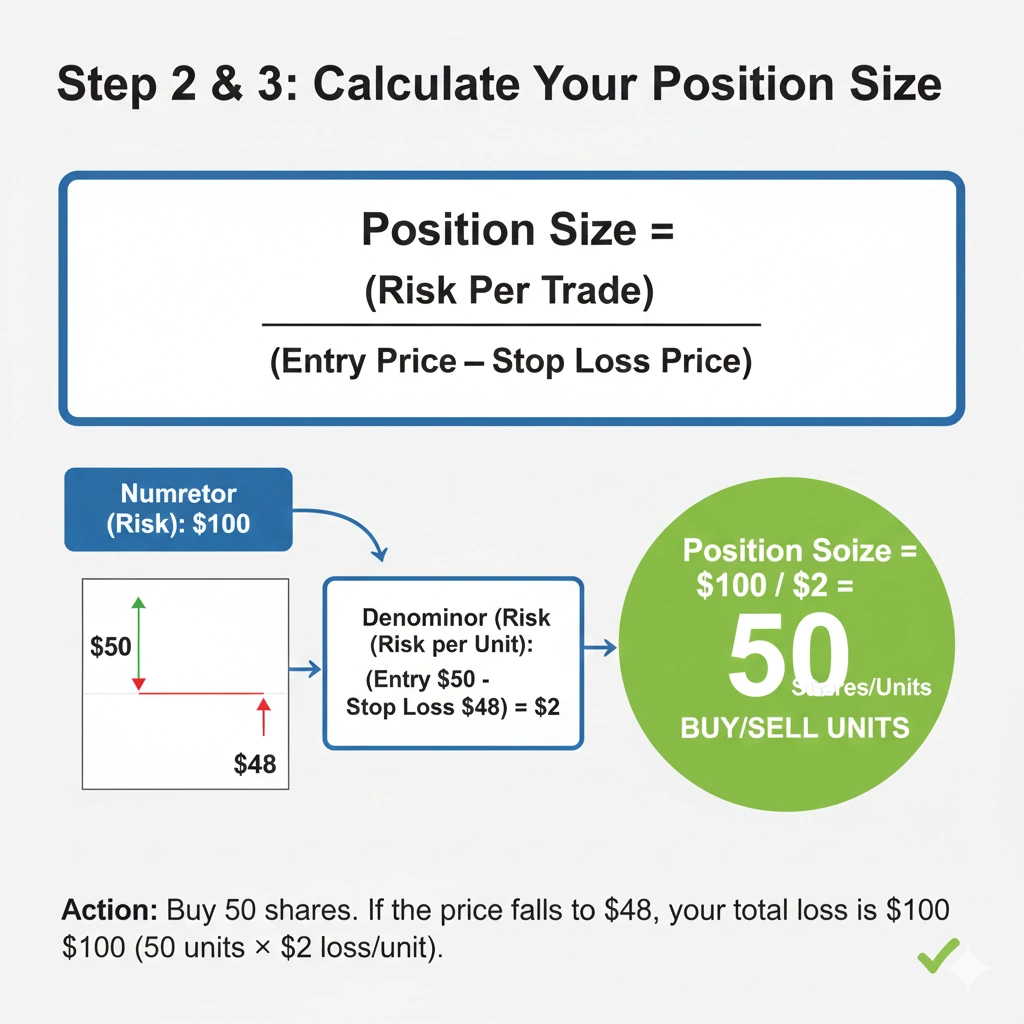
For example, if you intend to risk $100, invest $50 per stock, and hold stop-loss at $48, the risk per share would be $2 ($50 – $48). Your portfolio size is:
Position Size = 100 / 2 = 50 shares
According to the position size, you’ll be able to buy 50 shares. And if the price drops to your stop-loss level of $48, your loss will be approximately $100, which is equal to your risk tolerance.
How to Calculate Position Size: Step-by-Step Process
Most trading platforms and online calculators automate the position size calculation. Here’s how to use them effectively:
Step 1: Set Your Risk Per Trade
- Firstly, set the percentage of the amount you are willing to put at risk in a single trade, like 1-2% on each trade to control risk and ensure trading success.
- For example, with a $10,000 account balance and 1% risk, your risk per trade is $100.
Step 2: Define Stop-Loss Distance
- This is the difference between your entry and stop-loss.
- For example, if you buy at $50 with a stop-loss of $48, your risk per unit (share, contract, lot) is $2.
Step 3: Use the Core Position Size Formula
The classic risk per trade formula for beginners is:
Position Size = Account Risk
Entry Price − Stop Loss
- Example: Account risk = $100; Entry = $50; Stop loss = $48 → Position Size = $100 / $2 = 50 units.
- And in forex trading, incorporating the pip value and lot calculations can adjust this formula slightly.
Step 4: Input Data into the Position Size Calculator
The most common online position size calculator, such as the one from Myfxbook or your broker, automatically adjusts for pip or point value, account currency, and the specifics of each asset.
Position Sizing Strategies for Safe Trading
There are many factors that influence effective position sizing other than just using a calculator. Here are some practical strategies you can apply to strengthen your overall risk management:
Fixed Percentage Method
A certain percentage of your account is risked on each trade (e.g., 1% or 2%). This method is simple and widely used by professional traders.
Risk Multiple Method
Adjust your risk percentage based on market conditions or your confidence in the trade. For example, risk 1% in volatile markets and 2% in stable markets.
Account Balance Scaling
Scale your position size as your account grows or shrinks. This ensures that your risk exposure remains proportional to your capital.
Risk-Reward Ratio
To evaluate your trading strategies you should use a risk-reward ratio. For example, aim for a minimum of 1:1.5 ratio for short-term trades and increase the ratio as per your strategies.
Advantages of Using a Position Size Calculator
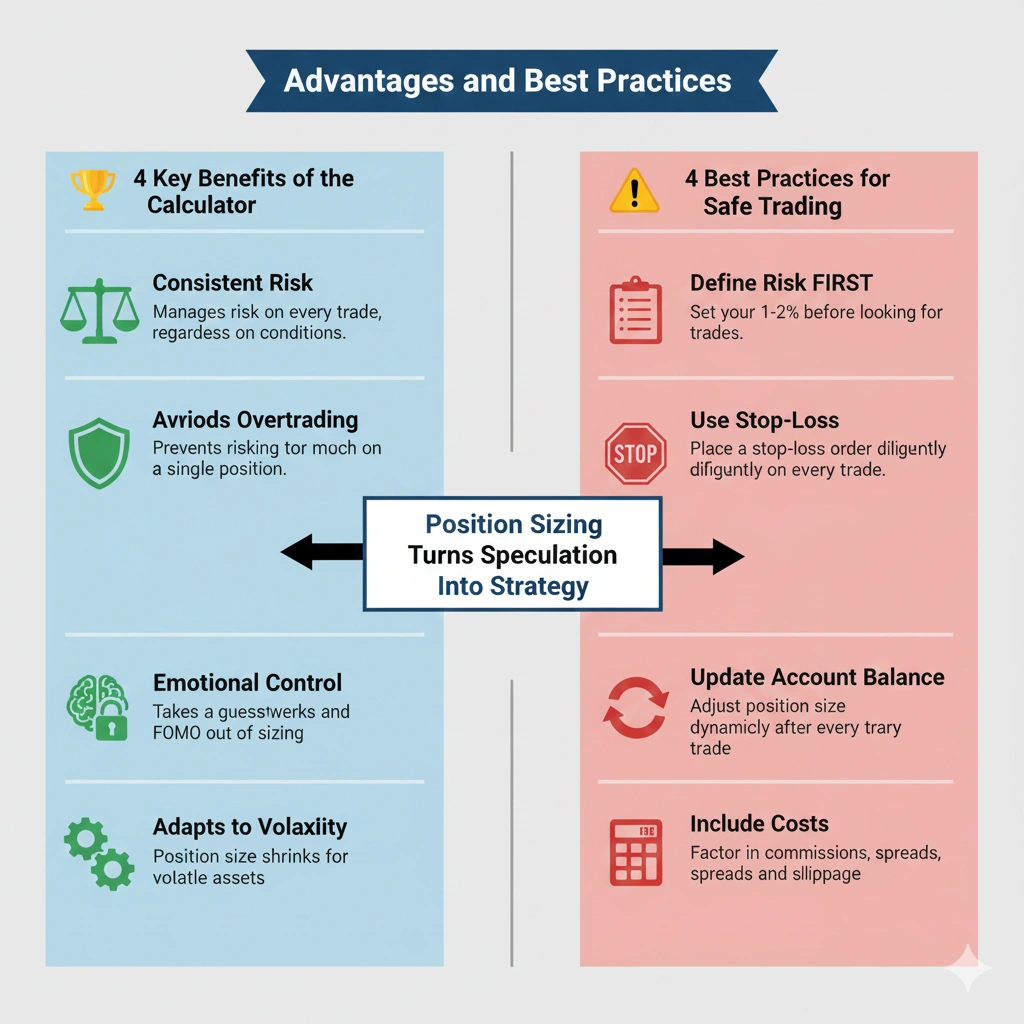
- Consistent Risk Management: It is beneficial in managing risk for each trade regardless of market conditions.
- Avoids Overtrading: With a proper position size calculator you can avoid risking too much on a single trade and protect your account from large losses.
- Emotional Control: It helps in keeping the guesswork and emotions out of trading by proper position sizing decisions.
- Adapts to Market Conditions: Position size calculator will help you set your stop-loss, ensuring your position size always matches the risk of the trade.
- Fits All Trading Styles: Position size calculator is useful for everyone, whether you are a day trader, swing trader, or for investing.
Common Mistakes to Avoid
- Ignoring Volatility: Keep your position size accordingly in the cases of highly volatile assets to avoid big losses.
- Overleveraging: With the correct leverage amount you can increase both gains and losses but too much of it can also wipe out your account quickly.
- Not Updating Account Balance: You must update your account balance after every trade to avoid inaccurate position sizing and unnecessary risk.
- Emotional Trading: Don’t let your emotions guide your position sizing instead of following your risk management rules.
Best Practices for Safe Trading With Position Size Calculator
- Always define your risk per trade before looking for trades.
- Use stop-loss orders diligently.
- Adjust your position size dynamically as your account balance changes.
- Use a position size calculator available for quick and accurate results.
- Continuously review and refine your risk management plan.
Best Online Position Size Calculators: Quick Reference Table
| Tool Name | Supported Assets | Key Features |
| Myfxbook Position Size Calculator | Forex, Stocks, Commodities | User-friendly interface, customizable risk % |
| BabyPips Position Size Calculator | Forex | Simple, well-explained for beginners |
| Tradejini Position Size Calculator | Stocks, Forex | Calculates shares or lots, risk control |
| Dhan Position Size Calculator | Stocks | Supports share trading sizes, margin input |
| InfinityAlgo Position Size Calculator | Stocks, Forex, Crypto | Multi-asset support, leverage options |
| FXTM Pip Calculator | Forex | Pip value and position sizing integration |
FAQs: Position Size Calculator and Safe Trading
- What is a position size calculator?
A position size calculator is the amount you should use in a trade based on the number of units, shares, or lots to buy or sell on a trade, to manage your risk effectively and set proper stop-loss.
- What is the risk per trade formula for beginners?
As a beginner you should risk only 1-2% of your capital per trade. The risk per trade formula is:
Risk Amount = Account Size × Risk Percentage
With this you can predict how much you can afford to lose on a single trade.
- Should I include commissions and spreads in my calculations?
Yes, you must include charges like commissions, spreads, slippage, and currency conversion fees to determine risk exposure and position size.
- How much should a beginner risk per trade?
As a beginner you should not be risking more than 1% of your account per trade, with a maximum limit of 2%, as in starting you need to control and protect your capital.
- Can I use a position size calculator for all types of assets?
Yes, a position size calculator can be used for forex, stocks, commodities, and cryptocurrencies. Just make sure that the calculator you are using supports the markets and assets you trade.
Conclusion
To bring it all together, a position size calculator is essential if you want to stay disciplined and protect your capital. Position size calculator helps you calculate your position size accurately, you manage risk more effectively, safeguard your trading account, and maintain consistency regardless of market conditions. With the consistent use of the risk-per-trade formula you can set the position size for your every trade, you can turn risky speculation into strategic decision-making, paving the way for long-term success.
Visit Insightful Trade’s website which will guide you to understand how a position size calculator works and how to use them in your daily trading. It empowers you as a trader to calculate your position size confidently and maintain strong risk management with well-researched tutorials and step-by-step guides on complex concepts like margin, pip value, and risk percentage. Their documentation is of the best quality in the industry, ensuring you have the knowledge and tools you need to protect your account and trade safely.
Author: Arihant Jain
Trading Experience: 5+ Years
Arihant Jain is a financial markets analyst and trading educator with expertise in Forex, Indices, Crypto, and risk-managed trading systems. His insights are based on real trading experience, data-driven analysis, and transparent market understanding. All content is reviewed for accuracy and aligns with Google’s EEAT guidelines.
Risk Disclaimer:
Trading involves substantial risk. All information is for educational purposes only and should not be taken as financial advice. Always do your own research.
Last Updated: 24 November 2025