
Introduction
The pin bar strategy is one of the most reliable and widely used techniques in the Forex market. Professional traders often rely on this strategy because it reflects market psychology rather than depending on complicated indicators. A pin bar candle represents rejection of a particular price level, showing that buyers or sellers attempted to push the market in one direction but failed. This rejection often signals that momentum is shifting, creating high-probability trading opportunities.
Unlike indicator-based systems that lag behind price movements, the pin bar strategy focuses on real-time market behavior. This makes it especially valuable for traders who prefer clean charts and straightforward decision-making. Whether you are a beginner learning Forex or an experienced trader looking to improve consistency, understanding pin bars can significantly enhance your trading performance.
One of the greatest advantages of this strategy is its versatility. Pin bars appear on every timeframe, from one-minute charts used by scalpers to weekly charts preferred by swing traders. They can also be traded across all major, minor, and exotic currency pairs. However, simply identifying a pin bar is not enough. Successful traders combine it with trend analysis, support and resistance zones, market structure, and proper risk management. This combination transforms a simple candlestick pattern into a powerful trading method capable of producing consistent results over time.
Why Pin Bars Work in Forex Trading
The Forex market is driven by continuous competition between buyers and sellers. Every price movement reflects changes in supply, demand, expectations, and market sentiment. The pin bar strategy works because it captures these shifts in real time.
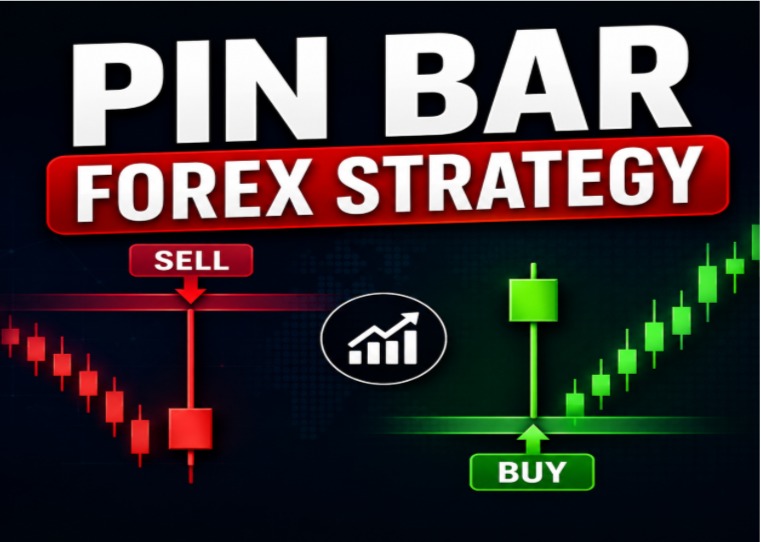
Consider a bullish pin bar forming after a market decline. Sellers successfully push prices downward, encouraging additional traders to join the bearish move. Suddenly, institutional buyers recognize value at lower prices and begin purchasing aggressively. Their buying pressure overwhelms sellers, forcing the market back above the opening price before the candle closes.
This sequence creates the distinctive long lower wick. The rejected price level demonstrates that sellers failed to maintain control, while buyers proved willing to defend lower prices. Traders viewing this price action often interpret it as an early signal of bullish momentum.
The same principle applies to bearish pin bars. Buyers attempt to continue an uptrend but fail when strong selling pressure enters the market. The resulting rejection often signals weakening bullish momentum and the beginning of a downward move.
Because this strategy reflects actual buying and selling behavior instead of mathematical calculations, many professional traders trust pin bars as reliable indicators of potential reversals and trend continuations.
Candlestick Trading: Using Pin Bars to Read Market Sentiment
Candlestick trading is one of the oldest and most respected forms of technical analysis, and the pin bar is among its most powerful patterns. Every candlestick records the battle between buyers and sellers over a specific period. By studying these formations, traders gain valuable insight into market sentiment before making trading decisions.
Within candlestick trading, the pin bar stands out because it highlights strong rejection of price. Rather than simply showing where the market opened and closed, it reveals failed attempts by one group of traders to control the market. This additional information helps traders identify areas where institutional participants may be entering positions.
Experienced traders rarely rely on a single candlestick alone. Instead, they analyze surrounding candles, support and resistance zones, trend direction, and overall market structure. A bullish pin bar forming after multiple bearish candles near a strong support level often signals that selling pressure is weakening. Likewise, a bearish pin bar appearing near major resistance after a prolonged rally may indicate that buyers are losing strength.
Candlestick trading becomes even more effective when traders remain patient and wait for high-quality setups rather than forcing trades on every pin bar they see. Quality always outweighs quantity in successful Forex trading
Price Action Trading: Mastering the Pin Bar Strategy Without Indicators
Price action is the foundation of the pin bar strategy. Instead of relying on lagging indicators, price action traders analyze the movement of the market itself to identify high-probability trading opportunities. Every candlestick reflects the ongoing battle between buyers and sellers, and the pin bar is one of the clearest signs that control may be shifting from one side to the other.
When using price action, traders first identify the overall market trend before looking for pin bars. In an uptrend, bullish pin bars that form at support levels often provide excellent buying opportunities because they indicate that buyers have successfully defended the price. Similarly, during a downtrend, bearish pin bars forming at resistance suggest that sellers remain in control and the market could continue moving lower.
Price action trading also emphasizes patience. Many beginners make the mistake of entering every time they see a pin bar, regardless of market conditions. Professional traders wait for the pin bar to appear at meaningful price levels where multiple technical factors align. For example, a bullish pin bar forming at a previous support zone, combined with a Fibonacci retracement level and an upward trend, offers much higher probability than a random pin bar appearing in the middle of a ranging market.
Reversal Trading: Identifying Market Turning Points with Pin Bars
Reversal trading is one of the most popular applications of the pin bar strategy because pin bars frequently appear when trends begin to lose momentum. Although no trading signal guarantees success, a well-formed pin bar near an important support or resistance level often provides an early warning that the market may reverse direction.
A bullish reversal pin bar usually forms after a sustained downtrend. Sellers initially continue pushing prices lower, encouraging more traders to join the bearish move. However, buyers enter aggressively and absorb the selling pressure, forcing the price to close near the top of the candle. This strong rejection suggests that demand is increasing and that a bullish reversal could develop.
A bearish reversal pin bar follows the opposite process. Buyers continue driving prices higher until sellers enter the market with significant volume. The price then falls sharply before the candle closes, leaving a long upper wick that signals rejection of higher prices. This pattern often indicates that bullish momentum is weakening and sellers are beginning to take control.
It is equally important to understand that not every pin bar leads to a reversal. Sometimes the market simply pauses before continuing in the original direction. For this reason, traders should always wait for confirmation from the following candle before entering a position. Allowing the market to confirm the signal reduces false entries and improves long-term trading performance.
Forex Setups: High-Probability Pin Bar Trading Opportunities
Successful forex setups depend on combining the pin bar with favorable market conditions rather than treating every pin bar as a trading signal. The highest probability trades occur when several technical factors align, creating strong confluence that supports the direction of the trade.
One of the most effective forex setups involves trading bullish pin bars during an established uptrend. After a temporary pullback, price reaches a strong support level where buyers regain control. The bullish pin bar confirms rejection of lower prices, giving traders an opportunity to enter with the trend while maintaining a favorable risk-to-reward ratio.
Another powerful setup occurs during downtrends. Price retraces toward a resistance level before forming a bearish pin bar. This rejection suggests that sellers remain dominant and that the primary trend may soon continue. Trading with the prevailing trend generally offers greater consistency than attempting to predict major reversals.
Range-bound markets also provide valuable trading opportunities. When price repeatedly respects established support and resistance levels, bullish pin bars near support and bearish pin bars near resistance often generate reliable short-term trades. However, traders should remain cautious if the market begins breaking outside the range, as false signals become more common during breakout conditions.
Conclusion
The pin bar strategy remains one of the most trusted techniques in Forex trading because it combines simplicity with powerful insights into market psychology. By understanding how buyers and sellers interact at key price levels, traders can identify high-probability opportunities without relying on complicated indicators.
Combining pin bars with candlestick trading, price action, reversal trading, and carefully planned forex setups significantly improves the quality of trading decisions. Rather than focusing on quantity, successful traders wait patiently for the strongest setups, confirm their signals with market structure, and always manage risk responsibly.
Like any professional trading strategy, mastery comes through consistent practice, detailed trade journaling, and disciplined execution. Traders who dedicate time to learning the pin bar strategy and applying it correctly can build a repeatable trading approach that supports long-term success in the Forex market.