
Quick Summary
Times when a part of your orders is filled at your target price, while the rest goes either unfilled or filled at a different price, are called partial fills. It happens many times in index trading when the liquidity is low, market swings are wild or order sizes. You need to understand this so that you can prevent it from happening and improve your trade quality. In this blog, we’ll see why partial order fills in index trading happen, how they affects your trade quality, and the practical steps you can use to avoid them.

Key Insights at a Glance
| Factor | What Happens | Impact on Traders |
| Liquidity Depth | Limited quantity at price levels | Incomplete fills possible |
| Order Size | Large orders exceed available volume | Multi-price execution |
| Volatility | Rapid price movement | Delayed completion |
| Market Session | Thin periods reduce participation | Higher execution uncertainty |
| Slippage | Average fill price changes | Risk-reward distortion |
| Documentation | Execution varies from expectation | Compliance importance increases |
What Are Partial Order Fills in Index Trading?
Partial order fills in index trading mean when the market is not able to fully fill an order at a one price. Instead only a part of the order is filled, while the rest wait for the liquidity or fills at a different price level.
For example:
- A trader places an order for 100 contracts of an index derivative
- Only 40 contracts are available at the requested price
- Remaining 60 contracts are execute at higher or lower prices
This situation is called partial fill; it’s quite normal in the market. Understanding this helps you avoid panicking and execute your trades more realistically.
Why Liquidity Shortage Occurs in Index Markets
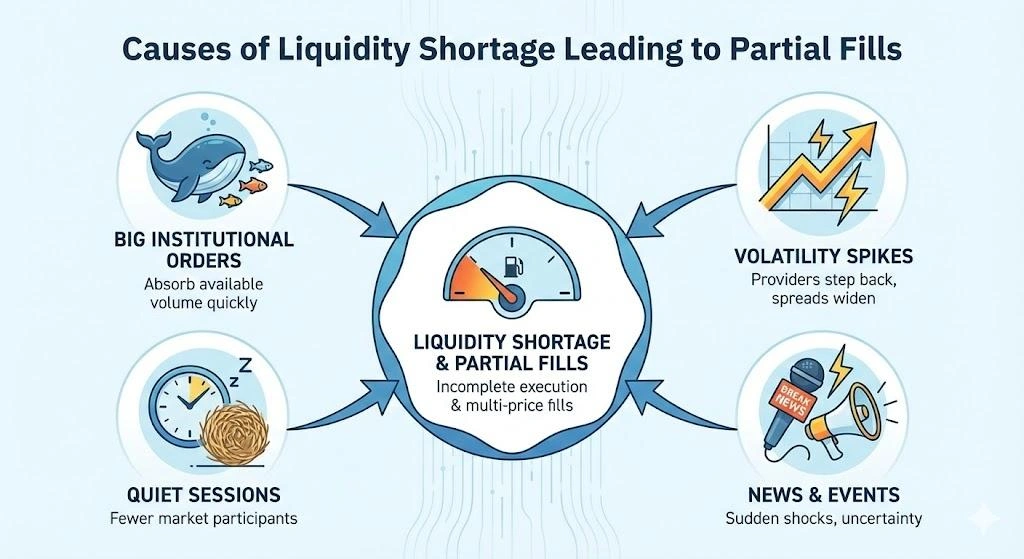
Many traders believe that the index market is always active as it tracks top economies. But there are times when the market lacks activity when:
- Big institutional orders absorbing up volume
- Sharp price jumps scare the market makers
- Quiet sessions with fewer players
- Unexpected News or big economic events
Even huge indices can face low liquidity under stress. And that is exactly what causes partial order fills.
The Trade Execution Process Behind Incomplete Fills
For better understanding of how incomplete fills take place, it helps to look at how trades are actually processed.
When you place an order:
- The system hunt for matching buyers or sellers
- It complete what it can at the best available price
- The rest of the order is moved to the next price level
In low liquidity the orders are filled slowly, at multiple levels. This step-by-step matching logic is what causes partial order fills in index trading.
Market Depth and Its Role
If you want to know whether your trade will be successfully placed or not, study market depth. It will help you know how many orders are waiting at each price level.
High depth:
- Faster execution
- Lower slippage
- Fewer incomplete fills
Low depth:
- Partial order fills in index dating becomes common
- It takes time for orders to complete
- Your trades pushes the price around
Volatility and Partial Order Fills
Rapid market moves cause more partial orders because:
- Prices move too fast for orders to match
- Brokers widen their spreads
- Orders start decreasing
During fast price jumps, available liquidity often decreases before your order is done. This makes order completion a bit tough and uncertain.
Incomplete Fills and Slippage
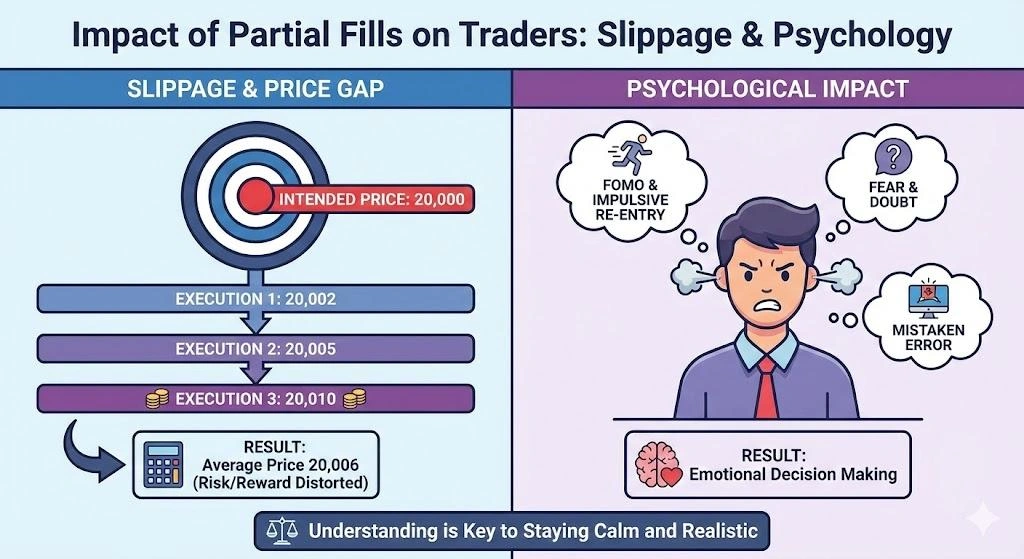
In partial orders there are chances for slippage.
For example:
- Intended price: 20,000
- Average execution: 20,006
This gap can shift your trades’ entire risk and reward ratio.
Market Orders vs Limit Orders
Here’s how, using order types, you can avoid partial fills.
Market Orders
- They Trigger right away
- They often fill at different price levels
- Higher slippage risk
Limit Orders
- These give you total price control
- But there are chances they might fill only half or not
- Lower slippage but slower execution
It totally depends on your strategy and the order type you choose.
Liquidity Shortage During Specific Market Conditions
Here are certain situations that can trigger partial fills like
- Market open and close
- Economic news release
- Overnight trading sessions
- Sudden global events
- Expiry dates for derivatives
In these situations traders should be aware of partial order fills.
Psychological Impact of Incomplete Fills
It can be really frustrating to have your orders left half filled.
- Mistaking them as execution errors
- Fear of missing opportunities
- It often triggers impulsive re-entries
However, incomplete fills are just the result of a supply and demand imbalance. Understanding this helps you stay calm and avoid emotional reactions.
Position Sizing and Liquidity Alignment
For a smooth trade, maybe you can match your trade size with the number of active buyers and sellers at different price levels. It helps you detect:
- Price impact
- Slippage
- Incomplete fills
Breaking your trade into parts can help you ensure more stable execution.
Compliance and Documentation
It’s important to keep proper records of your trades, especially in partial trades, as they increase the number of documents also.
Important details include
- Requested quantity
- Executed quantity
- Average price
- Timestamp
- Market conditions
Accurate documentation helps:
- Review your broker’s fill quality
- Improve strategies
- Meet the official reporting rules
This maintains the transparency between you and the law and keeps you ready for any sudden audit.
Managing Partial Order Fills in Index Trading
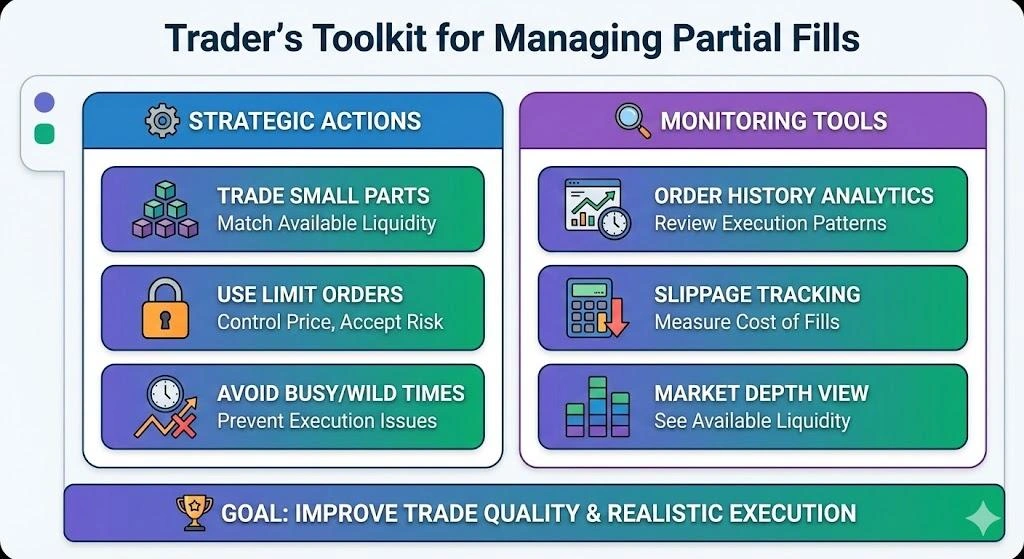
Practical strategies include:
- Trade in small parts to smoothly get the complete order
- Watch where the market lacks active traders early
- Use limit on your orders for complete control
- Adjust your position size during wild markets
Tools for Monitoring Execution Quality
Today there are a lot of tools that can help you with:
- Order history analytics
- Slippage tracking
- Clear view of market depth
- Execution speed reports
- Performance dashboards
These tools help you spot patterns in partial fills and identify exactly where there is a liquidity shortage.
Conclusion: Partial Order Fills in Index Trading
To wrap it up, you will witness partial order fills in index trading. It’s a natural part of the market; it can be due to anything like volatility, low liquidity, or even the size of your order. But these incomplete orders can directly impact your overall strategy performance. To control this, you should align your order size with the market debt and use the right order types. Connect with Insightful Trade to track execution quality and stay transparent.
FAQs: Partial Order Fills in Index Trading
1. Why do partial order fills in index trading happen?
It happens when there isn’t enough volume at the price level you want to fill your entire order at once.
2. Are incomplete fills common in major indices?
They are not as frequent as in smaller markets, but they definitely happen during high volatility or when placing very large orders.
3. Can traders avoid liquidity shortages completely?
No, you can’t, but you can reduce the impact by either placing small orders or using limit orders.
4. How should Indian traders document execution differences?
Keep clear notes on the quantity you wanted, what you got, the prices, and the timestamps for your own records and compliance.
Author: Kumkum Chandak
Experience: 3+ Years in Trading Research & Market Content Strategy
Kumkum Chandak is a trading content strategist and market research writer who specializes in simplifying technical analysis, trading tools, and strategy-driven educational content. Her work is optimized for EEAT, accuracy, and user intent, ensuring every article delivers practical insights for traders of all levels.
Risk Disclaimer:
All content is strictly educational and not financial advice. Trading involves substantial risk. Always perform your own analysis or consult a professional advisor.
Last Updated: 14 February 2026

