Quick Summary
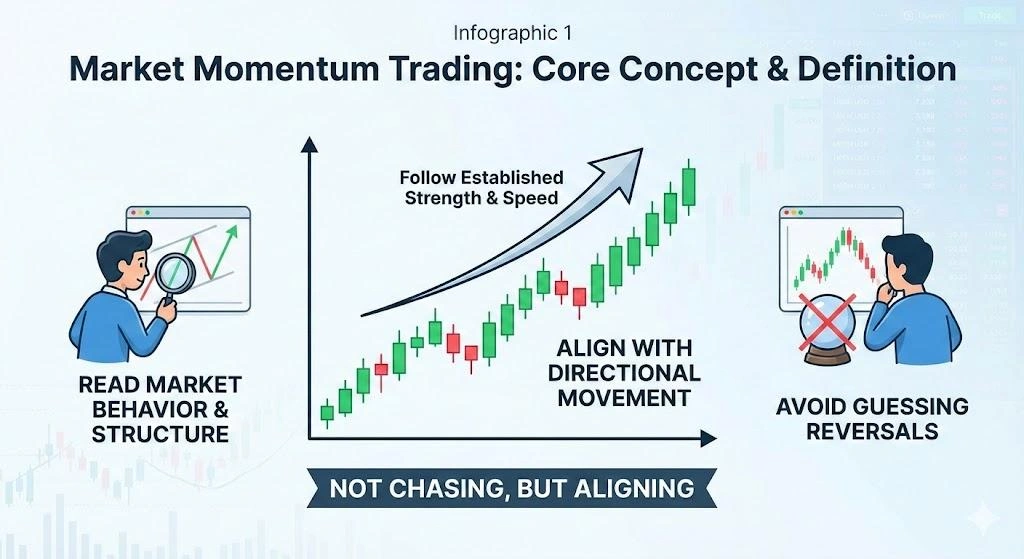
Market Momentum trading means jumping on price moves that show real speed and strength, rather than trying to guess when a trend will end. Instead of looking for the place from where the price will reverse, you just simply align yourself with where the market has already decided to go. This approach is not about using any fancy indicator, it’s about reading the market’s behaviour and recognizing when a move has enough gas to keep going. When done right, this approach helps in avoiding guesswork, and promotes trade alignment with current market energy.
Market Momentum Trading at a Glance
| Aspect | Description |
| Core Idea | Trading in the direction of strong and active price movement |
| Market Focus | Speed, expansion, and continuation |
| Decision Basis | Price behavior and structure, not prediction |
| Best Conditions | High participation and directional conviction |
| Key Risk | Entering after momentum is exhausted |
What You Will Learn in This Guide
- What market momentum trading actually means in real market structure
- Why momentum exists and how it forms in price action
- How momentum price action trading differs from indicator-based momentum
- When market momentum trading works best and when it fails
- Practical examples of momentum behavior in trending markets
- Common mistakes traders make when trading momentum
- Risk management and compliance considerations for Indian traders
The Core Problem: Why Many Traders Misread Momentum
Many traders attempt market momentum trading using indicators without understanding the underlying behavior driving price. This often leads to late entries, chasing the moves that are already over, or confusing a little price spike with a real trend. And at this point traders often end up buying the trade at the top or selling at the bottom because they don’t check if the big money is still active.
The real challenge is not identifying the fast-moving candle, but to also ensure if it still has “gas” to keep moving upward or if it’s just a quick burst of energy. Without that clarity, you’re just reacting to the chart instead of trading with a solid plan.
What Is Market Momentum Trading?
Market momentum trading is a strategy that focuses on trading in the direction of strong price movement supported by participation, structure, and follow-through. Instead of trying to guess which direction the market is about to take, you just get in line with the current pressure.
At its core, this style of trading answers one question:
Is the market currently committed to moving in one direction?
Momentum price action trading looks for three things:
- Powerful and confident moves in one direction.
- Small dips, shows that others aren’t strong enough to pull the trade back.
- Comfort at a new level, instead of snapping back immediately.
This approach isn’t about perfectly timing the very top or bottoms. It’s about being in sync with the market’s current energy rather than taking guesses.
Why Momentum Exists in Financial Markets
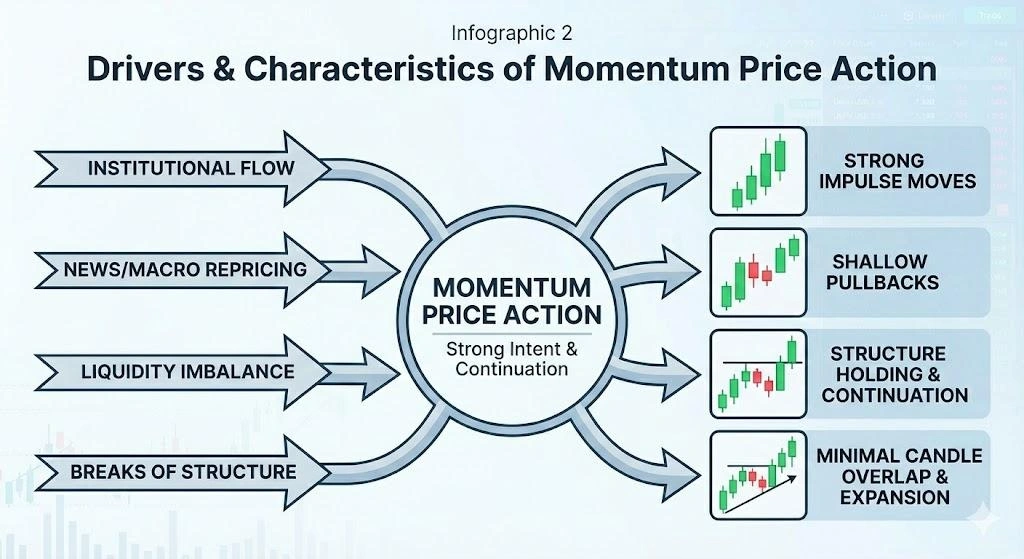
Momentums happen because the market is driven by real people and huge Institutions, all the different targets. When the big money decides to move, the price doesn’t wander aimlessly. It moves with the real purpose because those institutional orders are so massive the price often has to keep pushing in that direction for a while just to get them all filled.
Key reasons momentum forms include:
- Big banks and Institutions filling massive orders
- Major news or economic shift
- A shudder increase in orders
- Breaking through the past highs
Market momentum trading is simply about getting on the same side as these powerful forces rather than trying to fight against them.
Market Momentum Trading vs Indicator-Based Momentum
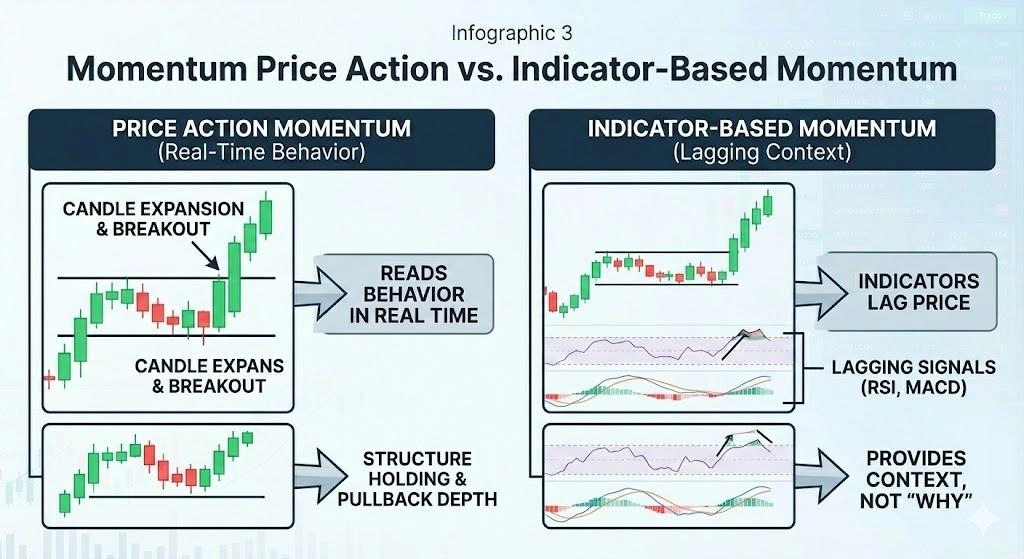
A lot of traders watch RSI or MACD charts to find momentum. This can be helpful, but they don’t really tell the real reason behind the move– they’re mostly just looking in the rearview mirror.
Momentum price action trading differs by focusing on:
- Big, bold candle moves
- Short price dips
- Holding the structure
- The speed factor
Indicators lag price. Momentum price action trading reads behavior in real time.
Identifying Momentum Through Price Structure
Momentum is not defined by one large candle alone. It tells us about the sequence in which the price is behaving.
Key structural characteristics include:
- Strong impulsive moves breaking prior levels
- Minimal overlap between candles
- Shallow retracements that fail to reverse structure
- Continued acceptance above or below key zones
When you see these actions taking place in the market, you know that you can trust these moves to be a part of momentum.
When Market Momentum Trading Works Best
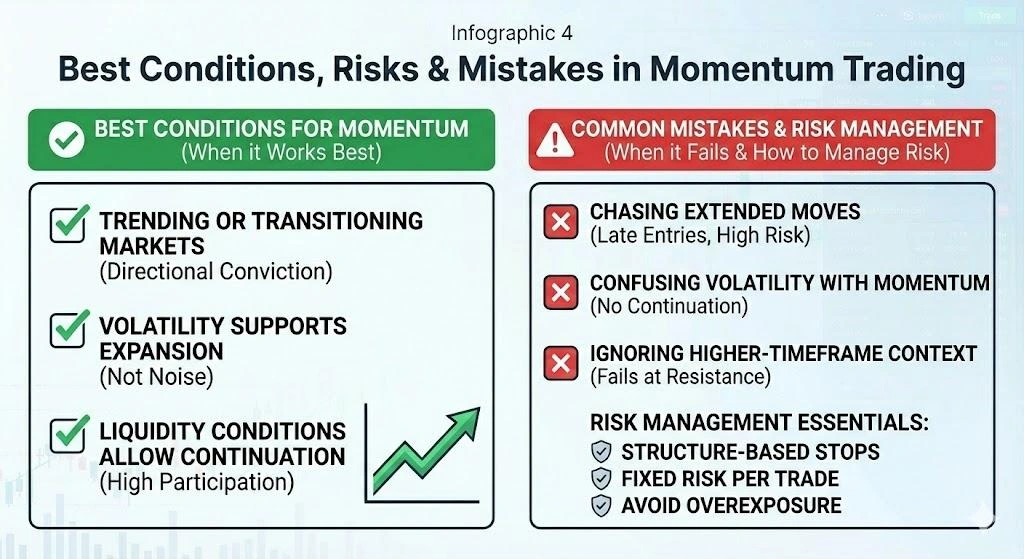
Market momentum trading performs best when:
- Markets are trending or transitioning into trends
- Volatility supports expansion, not noise
- Liquidity conditions allow continuation
For example, during major session opens or after structural breaks, momentum price action trading often provides clearer opportunities.
When Market Momentum Trading Fails
Momentum fails when:
- Price is near higher-timeframe resistance or support
- Volatility spikes without follow-through
- Markets are range-bound
Often you’ll see a sudden boost in speed, but if it has no real follow-through the move will die immediately. Recognising these traps help you stop forcing trades when the market isn’t actually ready to commit.
Practical Example: Trend Continuation Momentum
Imagine the price suddenly moving past the previous high with a lot of energy. And instead of reversing back down, it just dips a little bit and starts moving again toward a new high.
Why this represents market momentum trading:
- The breakout shows intent
- The shallow pullback suggests strong participation
- Continuation confirms acceptance
In this style of training, you don’t panic or jump in while the price is spiking. Instead you wait for a little breath or pullback to get in safely before the move continues.
Practical Example: Failed Momentum Attempt
Suppose the price surges out of its sideways range with a lot of speed, but instead of staying out it gets pulled back and stops moving.
Why momentum fails here:
- Lack of follow-through
- Rejection at higher prices
- Absence of acceptance
Momentum trading isn’t about just reacting to a fast-moving candle, it’s about waiting for structure confirmation rather than reacting to speed alone.
Common Mistakes in Market Momentum Trading
Chasing Extended Moves
Many traders enter after multiple large candles, assuming momentum will continue indefinitely. By then, risk increases while reward decreases.
Confusing Volatility With Momentum
Fast movement does not always equal directional commitment. Momentum price action trading requires continuation, not just expansion.
Ignoring Higher-Timeframe Context
Momentum on lower timeframes often fails near higher-timeframe levels. Context remains essential.
Risk Management in Momentum Price Action Trading
Risk management is important in momentum trading because you’re jumping into a market that is already in motion.
Key considerations include:
- Using structure-based stops
- Maintaining fixed risk per trade
- Avoiding overexposure during volatile conditions
To achieve success in momentum trading you need to stay calm and disciplined, and avoid aggression.
How Market Momentum Trading Fits Into a Broader Trading Plan
Market momentum trading works best as part of a structured trading framework rather than a standalone idea. Traders benefit by:
- Defining specific momentum conditions
- Limiting trades to valid sessions
- Reviewing execution consistency
Momentum price action trading becomes more effective when paired with patience and selective execution.
Tools That Support Market Momentum Trading
Even though market momentum trading is primarily price-based, a few tools can make your job much easier:
- Clean charting platforms
- Session overlays
- Trade journals
Remember these tools are just to help you in making your decisions, they are not a substitute for your own logic and understanding.
Regulatory and Compliance Considerations for Indian Traders
Indian traders must ensure:
- Use only SEBI-registered brokers
- Follow the guidelines provided by RBI and FEMA
- Stick to the currency pairs that are permitted officially
Market momentum trading is a very responsible way to trade, as long as you keep your risk limit firm and stay disciplined with your execution.
Conclusion
Market Momentum trading isn’t just about chasing fast moving candles, or getting emotional when the chart moves. It’s about recognising when the market is fully committed to a direction and stepping into that flow. By focusing on how price is built and who is joining in, you find a calm, disciplined way to handle the active market.
For further guidance, we have InsightfulTrade here who helps you understand why momentum sticks around and, just as importantly, when it’s better to avoid trading.
Frequently Asked Questions (FAQs)
What tools are useful for market momentum trading?
Clean charting platforms, session indicators, and trade journals help support momentum price action trading without overcomplicating analysis.
Is market momentum trading suitable for beginners?
Yes, provided beginners focus on structure and risk management rather than speed alone.
Can momentum price action trading work across markets?
Yes. Momentum behavior exists in forex, indices, commodities, and stocks when conditions support continuation.
Is forex trading legal in India?
Forex trading is legal in India when conducted through SEBI-regulated brokers and permitted currency pairs.
Does market momentum trading guarantee profits?
No trading approach guarantees outcomes. Market momentum trading improves alignment with price behavior but does not eliminate losses.
Author: Kumkum Chandak
Experience: 3+ Years in Trading Research & Market Content Strategy
Kumkum Chandak is a trading content strategist and market research writer who specializes in simplifying technical analysis, trading tools, and strategy-driven educational content. Her work is optimized for EEAT, accuracy, and user intent, ensuring every article delivers practical insights for traders of all levels.
Risk Disclaimer:
All content is strictly educational and not financial advice. Trading involves substantial risk. Always perform your own analysis or consult a professional advisor.
Last Updated: 6 January 2026