Introduction to MACD Trading in Forex
Forex traders constantly search for reliable methods that can help them identify profitable opportunities while minimizing market noise. Among the numerous indicators available, the Moving Average Convergence Divergence, commonly known as MACD, remains one of the most widely used tools in technical trading. A properly executed MACD forex strategy can help traders identify trend direction, measure momentum, and discover high-probability entry and exit points.
The popularity of the MACD forex strategy stems from its ability to combine both trend-following and momentum-based analysis into a single indicator. Whether you are a beginner or an experienced trader, understanding how MACD works can significantly improve your decision-making process.
The indicator performs exceptionally well in trend trading, where traders seek to capitalize on sustained directional movements. By combining MACD with other technical indicators, traders can create a complete trading system capable of adapting to changing market conditions.
This guide explains how the MACD indicator works, how to use the MACD crossover effectively, and why MACD remains an essential component of successful forex signals generation.
Understanding the MACD Indicator
Before implementing a MACD forex strategy, it is important to understand the mechanics behind the indicator.
The MACD indicator was developed by Gerald Appel and is designed to reveal changes in trend strength, direction, momentum, and duration. It consists of three primary components: the MACD line, the signal line, and the histogram.
The MACD line is created by subtracting the 26-period Exponential Moving Average from the 12-period Exponential Moving Average. The signal line is usually a 9-period moving average of the MACD line itself.
Because the indicator combines moving averages with momentum analysis, it is highly effective in trend trading environments. Traders frequently use MACD alongside other technical indicators to confirm market direction and improve trade accuracy.
Many traders rely on the MACD forex strategy because it provides clear visual representations of trend strength and momentum shifts.
Why MACD Works Well in Trending Markets
One of the primary reasons traders prefer the MACD forex strategy is its effectiveness in trending market conditions.
Financial markets often experience prolonged upward or downward trends driven by economic events, monetary policy decisions, and market sentiment. During these periods, MACD can help traders remain aligned with the prevailing trend.
The indicator excels in trend trading because it filters out short-term price fluctuations and focuses on broader market movements. This allows traders to stay in profitable trades longer while avoiding unnecessary exits.
Strong trends often generate reliable forex signals, making the MACD particularly valuable for swing traders and position traders. Since the indicator reacts to changes in momentum, it can also warn traders when a trend may be weakening.
By incorporating the MACD forex strategy into their trading plan, traders can improve their ability to identify sustainable market trends.
Understanding MACD Crossover Signals
The foundation of most trading systems involving MACD is the MACD crossover.
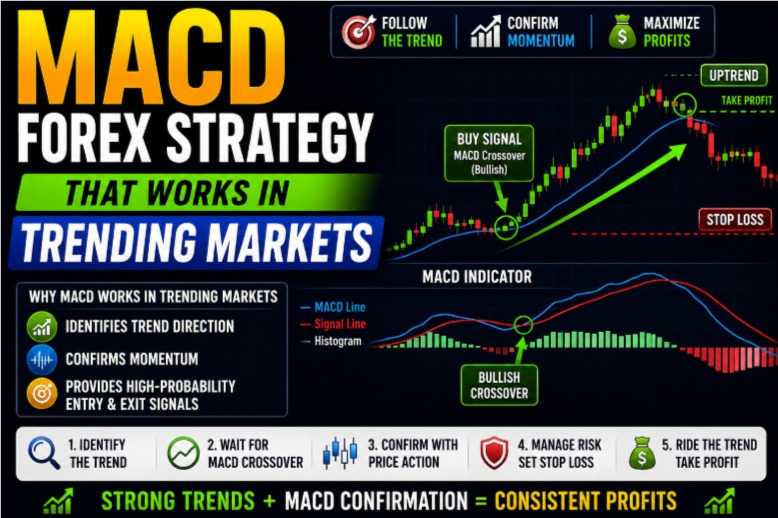
A bullish MACD crossover occurs when the MACD line crosses above the signal line. This event suggests increasing bullish momentum and may indicate a potential buying opportunity.
Conversely, a bearish MACD crossover develops when the MACD line crosses below the signal line. This often signals weakening bullish momentum or the emergence of bearish pressure.
Many traders consider the MACD crossover to be one of the most reliable forms of forex signals because it reflects shifts in market momentum.
However, traders should avoid relying exclusively on crossovers. Combining the MACD crossover with other technical indicators and price action analysis often improves signal reliability.
A successful MACD forex strategy typically includes additional confirmation before entering trades.
Using MACD for Trend Trading
The MACD indicator is especially effective for trend trading because it helps traders identify both trend direction and momentum strength.
When the MACD line remains above the zero line, bullish momentum generally dominates the market. This condition often supports long trading opportunities.
When the MACD line stays below the zero line, bearish momentum tends to prevail, indicating potential selling opportunities.
Many professional traders incorporate zero-line analysis into their MACD forex strategy to confirm trend direction before acting on crossover signals.
Combining zero-line analysis with a MACD crossover can significantly improve the quality of generated forex signals.
Since trend trading seeks to capture substantial market moves, waiting for MACD confirmation can help traders avoid false breakouts and low-probability setups.
MACD Histogram and Market Momentum
The MACD histogram is another important element within a complete MACD forex strategy.
The histogram measures the distance between the MACD line and the signal line. Expanding histogram bars indicate strengthening momentum, while shrinking bars suggest weakening momentum.
During trend trading, increasing histogram bars often confirm that the existing trend remains strong. Conversely, declining histogram bars may warn traders of an upcoming reversal or consolidation.
Monitoring histogram behavior can significantly improve the effectiveness of a MACD crossover system because it provides additional information about momentum shifts.
Many traders use histogram analysis to refine their forex signals and improve entry timing.
When combined with other technical indicators, histogram analysis can offer valuable insight into changing market conditions.
Combining Technical Indicators with MACD
Although the MACD forex strategy is powerful on its own, combining it with other technical indicators often increases overall accuracy.
Support and resistance levels are frequently used alongside MACD to identify high-probability trading zones. For example, if price approaches a major support level while a bullish MACD crossover occurs, the likelihood of a successful trade may increase.
The Relative Strength Index can also complement MACD effectively. RSI helps identify overbought and oversold conditions, while MACD confirms momentum direction.
Moving averages serve as additional technical indicators that can strengthen trend confirmation. Traders often align moving average direction with MACD readings to improve trend trading performance.
By integrating multiple technical indicators, traders can generate more reliable forex signals and reduce false entries.
MACD Divergence and Trend Reversals
Another advanced application of the MACD forex strategy involves divergence analysis.
Divergence occurs when price moves in one direction while the MACD indicator moves in the opposite direction. Such discrepancies frequently indicate weakening momentum and possible trend reversals.
Bullish divergence forms when price creates lower lows while MACD forms higher lows. This pattern may signal diminishing bearish pressure.
Bearish divergence develops when price records higher highs while MACD forms lower highs, suggesting fading bullish momentum.
Divergence analysis is particularly valuable in trend trading because it provides early warning signs that existing trends may be losing strength.
However, traders should always confirm divergence using additional technical indicators and price action before acting on these potential forex signals.
Building a Complete MACD Forex Strategy

A comprehensive MACD forex strategy begins with identifying the prevailing market trend on higher timeframes.
Once the overall direction is established, traders can move to lower timeframes and monitor potential MACD crossover opportunities aligned with the dominant trend.
For example, in an uptrend, traders may focus primarily on bullish MACD crossover setups while ignoring countertrend signals. In a downtrend, bearish crossovers may receive greater attention.
The most effective trend trading systems often combine MACD with support and resistance analysis, candlestick patterns, and additional technical indicators.
This multi-layered approach enhances the reliability of generated forex signals while reducing exposure to false market movements.
Consistency and disciplined execution remain essential components of every successful MACD forex strategy.
Risk Management in MACD Trading
Even the strongest MACD forex strategy cannot guarantee profits on every trade. Therefore, effective risk management is essential.
Traders should always use stop-loss orders to protect trading capital. Stop losses are commonly placed beyond recent swing highs or swing lows depending on trade direction.
Position sizing is equally important. Many professional traders risk only a small percentage of their trading account on any individual position.
Although forex signals generated by MACD can be highly effective, unexpected market events may still lead to losses.
Successful trend trading depends not only on accurate analysis but also on disciplined money management practices.
Combining sound risk management with reliable technical indicators creates a sustainable long-term trading approach.
Common Mistakes Traders Should Avoid
Many beginners misuse the MACD forex strategy by trading every crossover without considering broader market conditions.
A MACD crossover occurring during sideways market conditions often produces unreliable forex signals. Since MACD performs best in trending markets, traders should first confirm that strong directional movement exists.
Another common mistake involves ignoring higher timeframe trends. Effective trend trading requires alignment between short-term signals and broader market direction.
Overreliance on a single indicator is also problematic. Combining MACD with additional technical indicators typically improves decision-making.
Lastly, emotional trading and poor risk management frequently undermine even the best MACD forex strategy.
Conclusion
The MACD forex strategy remains one of the most effective approaches for identifying opportunities in trending markets. Its ability to combine trend analysis and momentum measurement makes it an invaluable tool for forex traders.
Understanding how the MACD crossover works, analyzing histogram behavior, and incorporating additional technical indicators can substantially improve trading performance.
Because MACD excels in trend trading, it is particularly suitable for traders seeking to capture sustained market moves. When combined with disciplined risk management and proper market analysis, MACD can generate reliable forex signals and support long-term trading success.
Mastering the MACD forex strategy requires practice, patience, and consistency, but the rewards can be significant for traders willing to develop and refine their skills.