

Financial markets move very fast; that’s why understanding your risk exposure and capital requirement is important for a smooth trading practice. One of the most important tools in trading is the leverage calculator trading tool. Whether you’re a professional trader with years of experience or a beginner placing your first order, this tool will help you see exactly how leverage changes your margin requirements and your overall risk.
In this blog, we’re going to understand the margin leverage relationship and learn how to use the calculator effectively and how you can achieve longevity in the market by sticking to safe leverage levels.
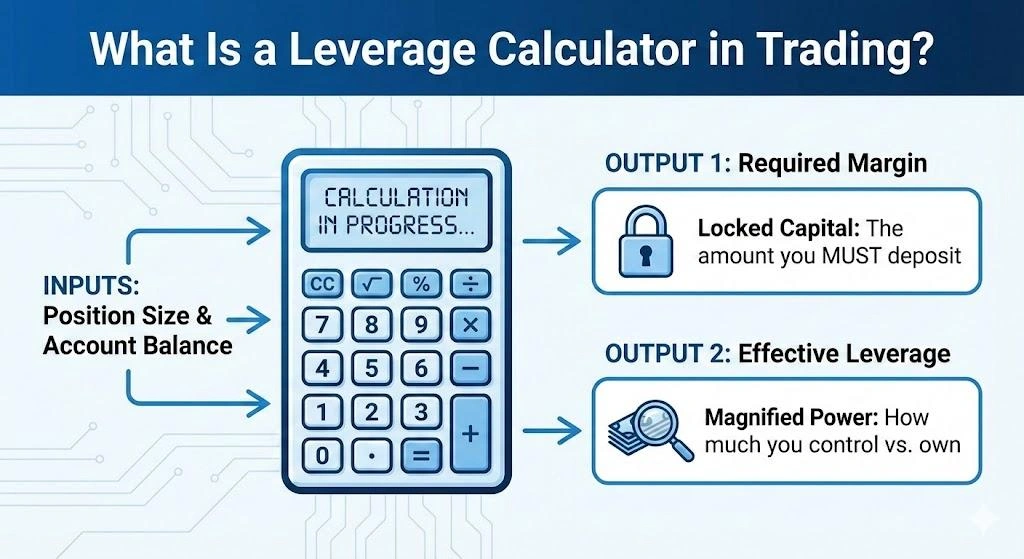
What Is a Leverage Calculator in Trading?
A leverage calculator is a convenient tool that helps you see how much power you’re using in a trade and work out the deposit you’ll need. It does the complex math for you so you can see the potential risk before you place a trade.
At its core, it calculates the amount of money you’ve borrowed compared to what you actually own, helping you see how that affects your potential wins and losses. This is what makes it one of the most important trading tools & calculators around.
Why Use a Leverage Calculator Trading Tool?
1. Clear Understanding of Margin Requirements
Margin is the amount of money you must have in your account to open and maintain a leveraged position. The leverage calculator trading tool computes the exact margin requirement based on leverage and position size, so you know upfront how much capital is tied up in the trade.
Example Formula (from margin calculators):
Margin Required = (Position Size × Price) ÷ Leverage
This basic formula is used across most margin and leverage calculators to determine how much capital a trader needs to allocate.
2. Evaluate Leverage’s Effect on Risk and Reward
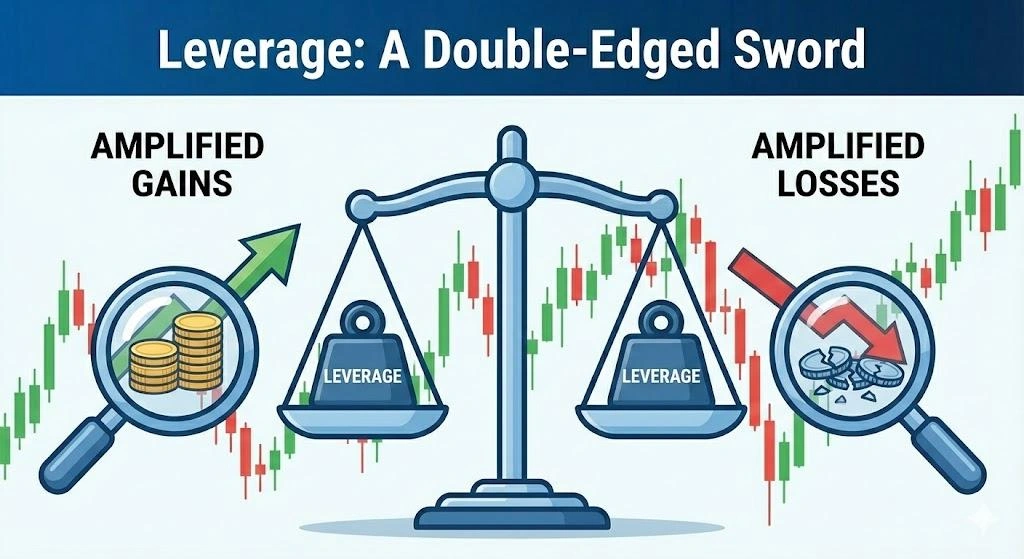
Leverage is like a magnifying glass for your money; it amplifies both gains and losses. This is why a leverage calculator trading tool is important before you execute a trade, it enables traders to:
- See exactly how a price move will affect your balance, which will help you decide if the potential profit is worth the risk you are taking.
- Identify the exact amount of cash you need as a deposit.
- Analyze the size of your position compared to the actual equity you have in your account.
To explain this further, imagine you want to control a position of $10,000 with 10:1 leverage means you’ll need only $1,000 of your own capital to open a trade —but also that potential losses are magnified.
3. Manage Volatility and Margin Calls
Because the market moves fast, any tiny price movement can have a huge impact when you’re trading with leverage. A leverage calculator trading tool gives you a clear view of your risk so that you can avoid margin calls— those situations where your broker asks for additional funds or shuts down your positions to cover losses.
Understanding the Margin Leverage Relationship
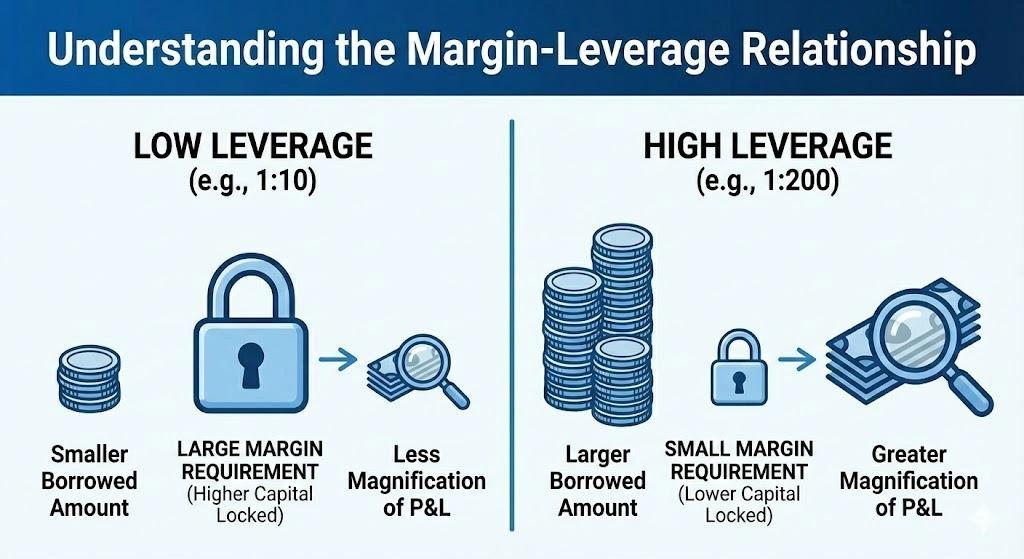
To master leverage, you must understand the margin leverage relationship—how changes in leverage affect the margin required and vice versa. Let’s break this down:
What Is Margin?
Margin is the collateral required to maintain a leveraged position. It doesn’t cost you directly like a fee; instead, it’s “locked” as a show of good faith with your broker.
How Leverage Influences Margin
Leverage determines how much larger your position can be relative to your account balance. For example:
- 1:50 leverage means every $1 in your account controls $50 in the market
- 1:100 leverage means $1 controls $100
As leverage increases, the required margin decreases because you’re borrowing more from your broker relative to your own capital. This is the core of the margin-leverage relationship. However, lower margin requirements mean higher risk exposure.
How to Use a Leverage Calculator Trading Tool
Using a leverage calculator trading tool is straightforward and typically involves three inputs:
- Account Balance or Equity – Your current free capital
- Position Size – The total value of the trade you plan to open
- Leverage Ratio – The leverage provided by your broker (e.g., 1:50, 1:100, etc.)
Once entered, the calculator returns:
- Required margin
- Effective leverage
- Potential profit/loss estimates
Some platforms even let you simulate multiple scenarios, helping you compare different leverage rates efficiently.
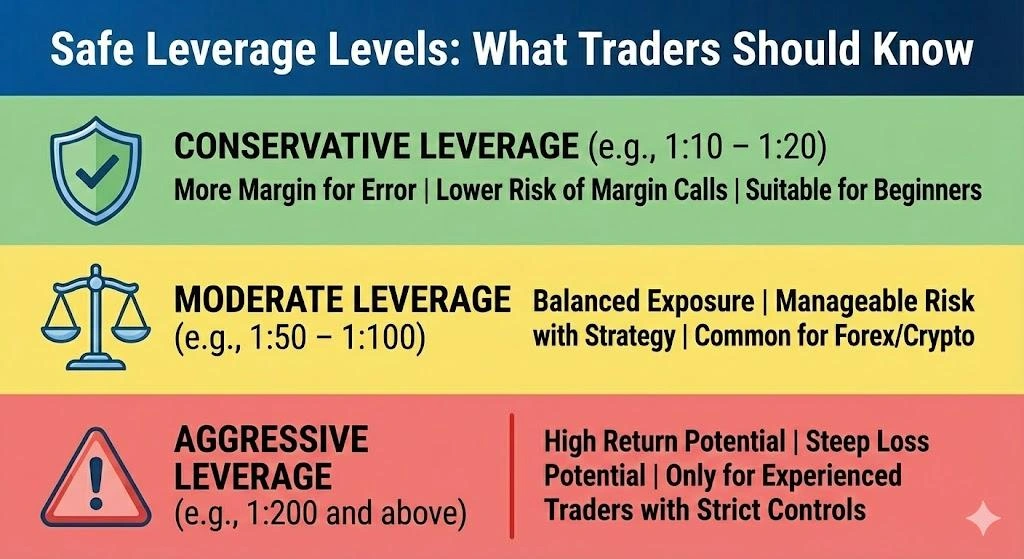
Safe Leverage Levels: What Traders Should Know
Although leverage can boost returns, it can also amplify losses. Choosing safe leverage levels is one of the most important decisions a trader makes.
Conservative vs. Aggressive Leverage
- Low Leverage (e.g., 1:10 – 1:20):
Often considered conservative, these leverage levels give traders more margin for error and reduce the risk of margin calls. - Moderate Leverage (e.g., 1:50 – 1:100):
A common choice among forex and crypto traders, offering balanced exposure with manageable risk if used responsibly. - High Leverage (e.g., 1:200 and above):
Can generate high returns but also steep losses. These levels are only appropriate for experienced traders with strict risk controls.
What Are Safe Leverage Levels?
There’s no confirmation about which leverage level is the safest because it depends on your capacity with risk and the strategy you’re using. But most of the traders prefer to stay away from massive leverage unless they have a very disciplined trading routine and know how to protect their money.
A few guiding principles for safe leverage levels include:
- Avoid risking more than 1–2% of your trading capital on a single trade
- Keep your leverage as low as you can
- Always use stop-losses with the help of a leverage calculator to plan exactly where you’ll exit.
When you mix these risk measurements in your daily trading practice, you give yourself a better chance of sustainable trading success with confidence and clarity.
Real-World Scenario: Leverage Calculator Trading Use Cases
Scenario: Forex Trading
A trader with $5,000 wants to open a EUR/USD position. Using a leverage calculator trading tool, they calculate:
- Position size: $100,000
- Leverage: 1:100
- Required margin: $1,000
The calculator shows the trader that with 1:100 leverage, they need at least $1,000 locked as margin. This insight helps them decide whether to proceed or adjust leverage.
Best Practices for Using a Leverage Calculator Trading Tool
To benefit fully from a leverage calculator:
- Always have a clear plan before you open a trade.
- Make sure the setting matches with your broker’s rules.
- Don’t forget to double-check your figures.
- Keep updating your input as the market moves.
Conclusion
Look, a leverage calculator trading tool is one very important thing that you can include in your trading routine. Whether you’re a trader involved in forex, stocks, or crypto, understanding exactly how your margin and leverage work together can completely change your results for the better.
It keeps guesswork away and replaces it with clarity, giving correct estimates of exactly how much cash you need and how leverage shifts the balance between your potential wins and losses. By using these tools, you stay disciplined and avoid reckless mistakes.
At Insightful Trade, we are dedicated to helping you master these essential mechanics so you can navigate the markets with confidence.
FAQs
Q1: What is a leverage calculator in trading?
A leverage calculator is a mathematical tool that does math for you, showing the leverage ratio and the amount needed to hold a specific position size. It gives you a clear look at the risk present in the trade before you execute it.
Q2: How does leverage affect my margin requirement?
Higher leverage lets you open a trade with a smaller margin, but it makes your position more risky. Lower leverage requires more margin, but it provides you with a safety net if the price moves against you.
Q3: What are safe leverage levels for beginners?
As a new trader, you will find lower leverage, such as 1:10 to 1:30, safer because it keeps your risk under control and helps in avoiding losses.
Q4: Can leverage calculators predict my exact profits?
It gives you a solid estimate of potential profit/loss, though actual trading results depend on market volatility, broker fees, and execution price.
Q5: Should I use a leverage calculator every trade?
Yes. Using a leverage calculator trading tool for every single trade will help you avoid guesswork. It helps you control your risk and make much more informed trading decisions.
Author: Kumkum Chandak
Experience: 3+ Years in Trading Research & Market Content Strategy
Kumkum Chandak is a trading content strategist and market research writer who specializes in simplifying technical analysis, trading tools, and strategy-driven educational content. Her work is optimized for EEAT, accuracy, and user intent, ensuring every article delivers practical insights for traders of all levels.
Risk Disclaimer:
All content is strictly educational and not financial advice. Trading involves substantial risk. Always perform your own analysis or consult a professional advisor.
Last Updated: 26 December 2025