
As you all know, today’s markets are very fast-moving, and mastering entries is everything. But facing a late entry trading case is one of the most persistent problems for you as a trader. This strategy focuses on aligning entries with higher-timeframe trends and accepting partial entries to reduce hesitation.
With the help of this guide, we’ll explore a story of how you can overcome the late entry trading case while sharing some actionable strategies to implement them in the right way. Let’s learn together how you can convert your trading game from lagging to leading.

What is a Late Entry Trading Case?
Simply, it happens when you enter a position after the ideal signal that results in:
- Higher risk exposure
- The probability of winning for traders is lower
- Reduces profit potential
Especially, these are common in fast-paced markets, such as crypto, high-beta stocks, or during news-driven volatility spikes.
Strategies that are Trending for 2026
The broader trading world has brought new dynamics to the late entry trading case:
- Now, before you even see the patterns AI identifies, it creates more opportunities before the occurrence of the late entry trading cases.
- It identifies market bias before the price reacts fully and helps you reduce the risk.
- It allows you to scale into positions at predefined price levels instead of waiting for a single perfect entry athe risk of nd helps you to reduce a late entry trading case.
Case Study: Fixing Entry Timing Errors in a Real Trading Environment
To understand it properly, let’s look at the documented case.
Background
During the volatile sessions, Alex, a trader, was trading index futures and high-beta stocks. The performance suffered due to repeated timing mistakes, despite identifying valid setups. Especially, it happens at the time of breakouts and momentum continuations.
Do you know why it happens? The real issue was the timing of execution, and also, there were no strategy flaws.
- What was the biggest issue before the fix in your trading?
- “My trades were not wrong, but the entry timing error quietly killed my edge.”
- Did you make changes in your strategy?
- “No, I didn’t change my strategy, but I changed execution rules.”
- What was the biggest difference it made?
- “When I placed orders before the price reached the level. It completely removed my hesitation.”

Real Results: What You Can Expect
You can see measurable improvements if you commit to these strategies
| Metric | Before Fixing | After implementing |
| Win Rate | 42% | More than 62% |
| Average Entry Lag | 3-7 candles | 0-2 candles |
| Efficiency of Trade | Low | High |
| Emotional Stress | High | Manageable |
Timeline-Based Trade Journal Excerpts
- Week 1-2: Identify the Problem
- Week 3-6: In the first 25 trades, the execution rules were applied and tested
- Week 7-12: Stabilization Phase
Improvements came gradually, not instantly, over this period of 3 months. With this journal, it is proven that fixing these timing mistakes requires review, repetition, and consistency instead of aggressive strategy changes.
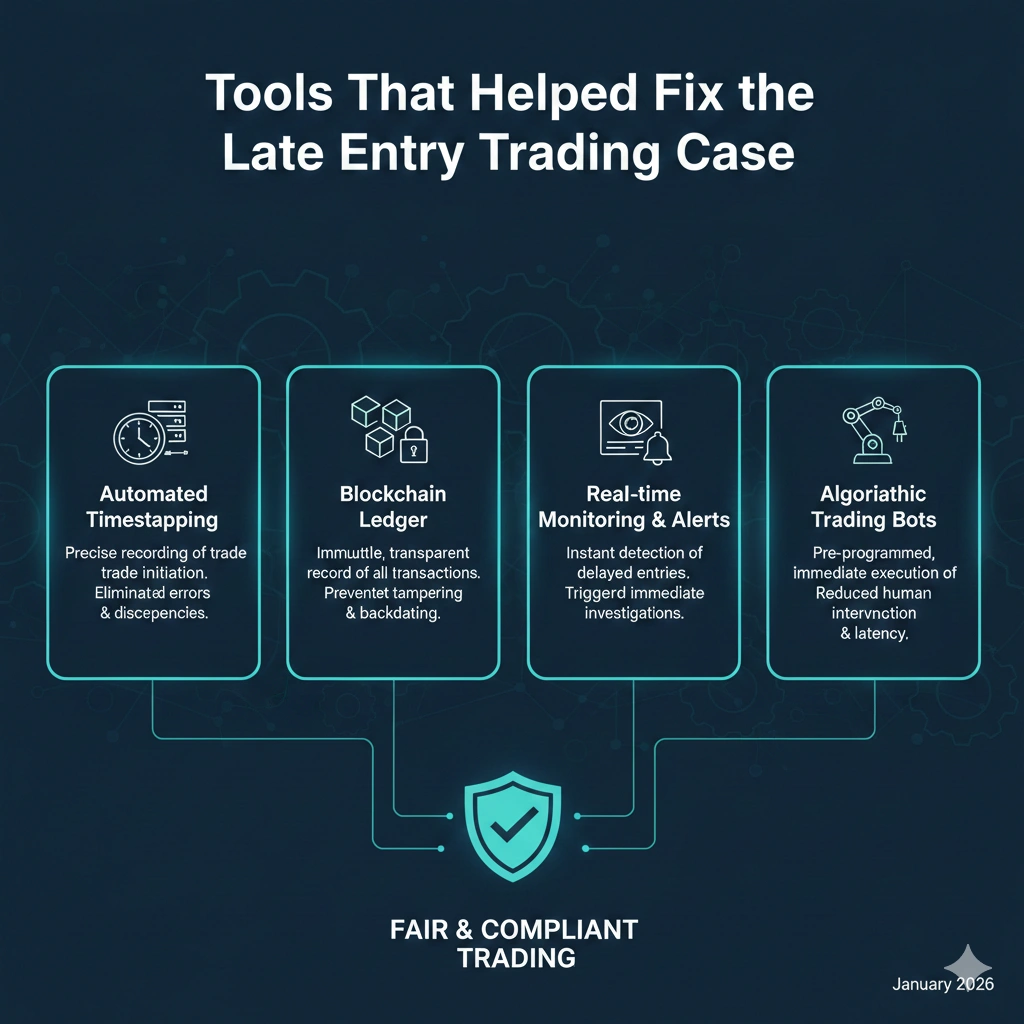
Tools That Helped Fix the Late Entry Trading Case
- AI-powered trade signals help you by reducing lag and processing complex data faster than scanning manually.
- Smart alerts help you to avoid late entry trading cases
- For high-frequency execution, bots are game changer that eliminates delay entirely
- When a late entry case occurs, trade journaling software makes it clear.
Timeline of the Fix
- The initial period for review is 2 weeks
- Execution changes applied over the next 50 trades
- The evaluation window is ~3 months of live trading
With this timeline, you can measure the real improvement and remove randomness.
Checklist: Avoiding the Next Late Entry Trading Case
Follow this quick checklist to reduce the frequency of your late entry case immediately:
- You should have predefined entry prices before the form opens, or a setup form.
- Use multi-condition alerts because simple price alerts are no longer enough in the modern market.
- One of the most effective ways to eliminate execution delay is to place limit or stop orders in advance.
- You should track your entry timing in your trade journal that exposes recurring late entry trading case patterns.
- If you are ignoring market context that often, hesitating or chasing moves, and even with good setups, it creates a late entry trading case.
Psychological Shift — The #1 Factor Behind Every Late Entry Trading Case
Most late entry trading cases lie in a psychological battle rather than a technical one. Many traders, including you, already know where to enter, but because of hesitation that comes from internal conflicts like fear of losses, fear of being wrong, and fear of entering just before the reversal, which cause delays and turn valid setups into late entries. Some common psychological traps:
- Confirmation addiction
- Lack of Confidence
- Fear of Missing Out
- Fear of loss and self-doubt

Trader’s Mindset Shift
“Before entering, I stopped trying to feel confident, and then I decided just to trust my preparation. After i accepted that, it is not a market problem and is just a timing problem, my performance stabilized.”
Conclusion
The key to profitability is mastering entries, and in today’s rapid markets, the late entry trading case has become a defining challenge. You can say that it is a recurring entry timing mistake case, which is a reflection of how, in today’s market, you can interact with speed, emotion, and information.
Are you serious about fixing execution mistakes? If yes, then continuous learning is essential. Check out Insightful Trade for deeper insights into trade execution and advanced techniques. Experts of InsightfulTrade will break down real market cases with actionable strategies.
Short FAQs
Q1: What exactly defines a late entry trading case?
When a trade is entered after the ideal signal, a late entry trading case occurs, which leads to reduced profit potential and higher risk.
Q2: Can automation completely prevent a late entry trading case?
No, it can reduce a late entry trading case but can’t completely prevent it. Automation works best when combined with risk controls, clear rules, and trader oversight.
Q3: Does a late entry trading case always mean I lose money?
No, a late entry trading case doesn’t mean that you will always lose money, but it often reduces your edge and increases the risk. However, it makes profitable outcomes harder.
Q4: Is backtesting useful for reducing late entry trading cases?
Yes, it is extremely useful for reducing late entry trading cases and helps you to identify how often entries were delayed, and it also builds confidence in executing signals faster.
Q5: How soon can I fix my late entry trading case?
You can fix it with proper routines and tools, and you can see the improvements in weeks.
Author: Arihant Jain
Trading Experience: 5+ Years
Arihant Jain is a financial markets analyst and trading educator with expertise in Forex, indices, crypto, and risk-managed trading systems. His insights are based on real trading experience, data-driven analysis, and transparent market understanding. All content is reviewed for accuracy and aligns with Google’s EEAT guidelines.
Risk Disclaimer:
Trading involves substantial risk. All information is for educational purposes only and should not be taken as financial advice. Always do your own research.
Last Updated: 29 January 2026