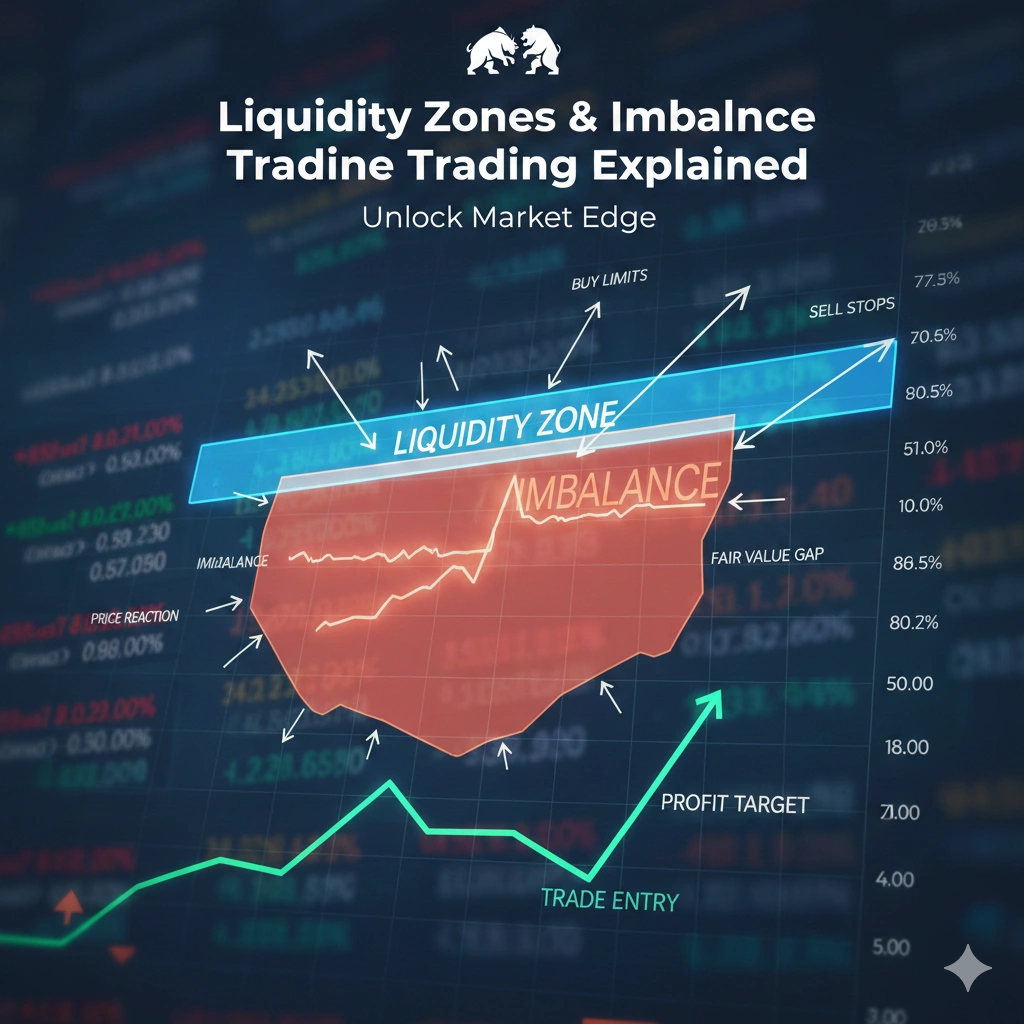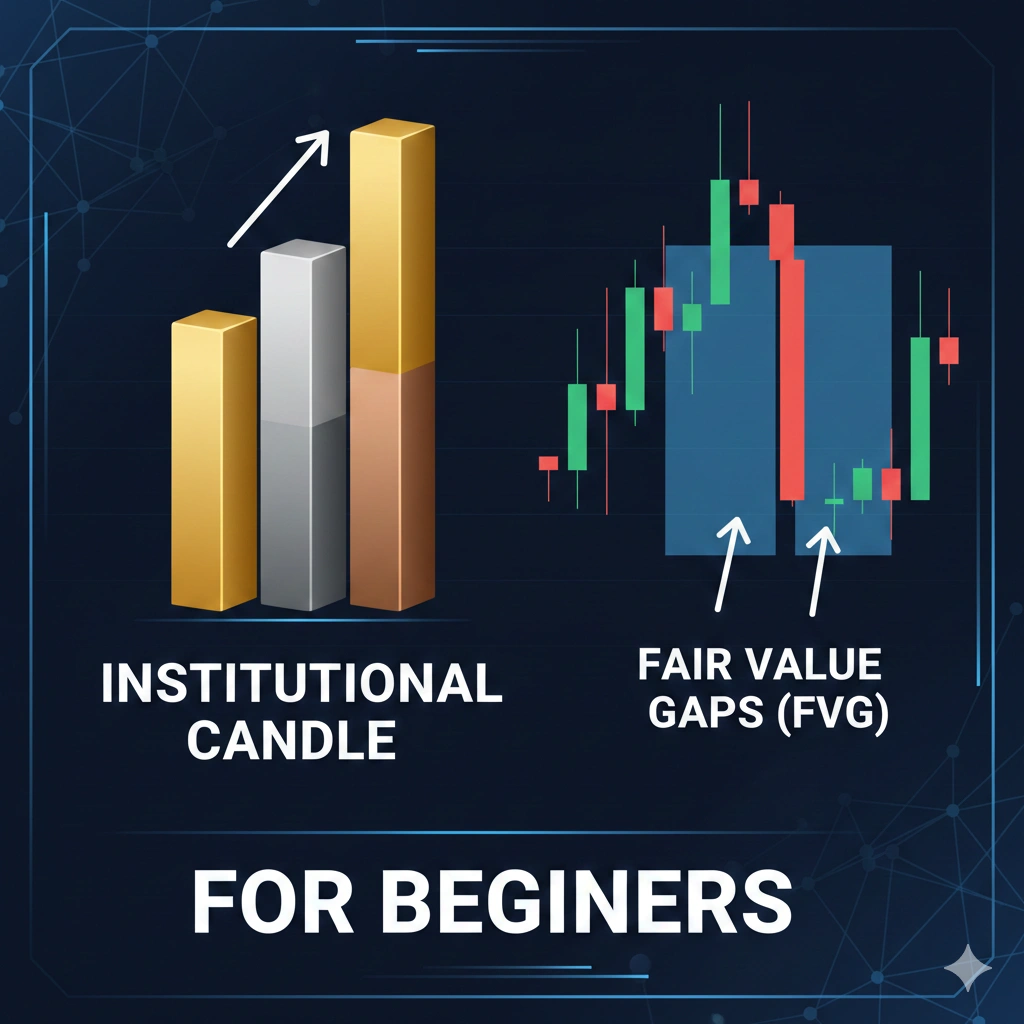
Institutional stock placement is all about thinking like a big bank and hedge funds. Most of the traders get kicked out of a good trade, not because they were wrong about the direction. But because they put their stops at the obvious place that the big institutions use for liquidity. By understanding this concept, you can easily identify these obvious areas to avoid getting kicked out early while keeping your risk under control.
Key Comparison Table
| Aspect | Retail Stop Placement | Institutional Stop Placement |
| Basis | Fixed points/indicators | Market structure & liquidity |
| Stop Logic | Tight and obvious | Adaptive and contextual |
| Risk Focus | Position-centric | Portfolio and exposure-centric |
| Liquidity Awareness | Low | High |
| Stop Hunting Vulnerability | High | Low |
| Compliance Alignment | Often ignored | Integrated into systems |
The Core Problem: Why Most Shops Fail
Most traders think of stop-loss placement as a mechanical decision. Usually, they use:
- A fixed percentage of their capital
- ATR-based stops without context
- Indicator-based stops (EMA, RSI, Supertrend)
Even though these methods are systematic, they often fail because they totally ignore how the big Institute operates.
Why This Is a Problem
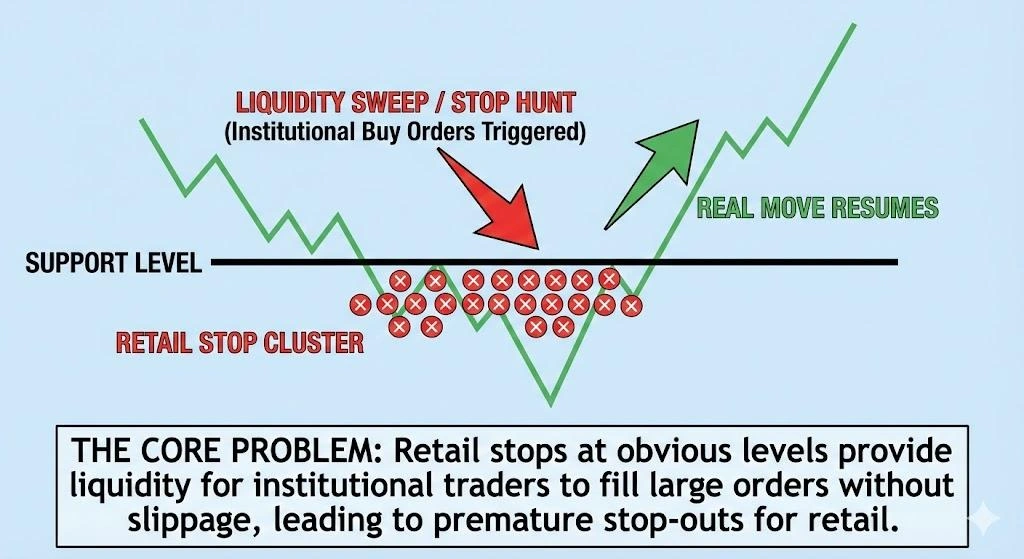
Institutional traders like banks and hedge funds trade such massive volumes that they need liquidity to get in or out of a trade. That’s why they look for spots were lots of orders are clustered, like
- Obvious highs and lows
- Trendline breaks
- Round numbers
- Retail stop clusters
As a result, retail stop placement becomes institutional liquidity.
This is why learning institutional stop placement is so important. Institutions are not hunting stops maliciously; they’re just going where the orders are so they can place their own trades.
What Is Institutional Stop Placement?
Institutional stop placement is all about how big players set their exit. They don’t pick any random number; they base it on:
- Market structure
- Expected order flow
- Current volatility
- Portfolio-level risk
- Liquidity availability
Unlike most traders who just set a certain limit to their loss, institutions use stops to:
- Stay away from structural noise
- Avoid being forced into a high-volume trades
- Keep their trades moving smoothly
This logic explains what smart stop placement is all about.
Why Institutions Cannot Use Retail-Style Stops
Size Constraint
Big institutional trades are huge in size. So, if they place their stops near the obvious level, their only risk is getting half-filled or dealing with bad slippage.
Liquidity Dependency
Stops that are placed too close to the current price get triggered very quickly just by small noise. The pros don’t care about small swings; they only want to get out if the actual market structure break and their trade idea is completely dead.
Risk Is Managed Elsewhere
For the pros, stop-loss is not the only way to protect their interest. There are several other ways like
- Smart position sizing
- Portfolio hedging
- Time-based exits
- Volatility adjustments
For them the stop-loss is the last line of defense, not the first one.
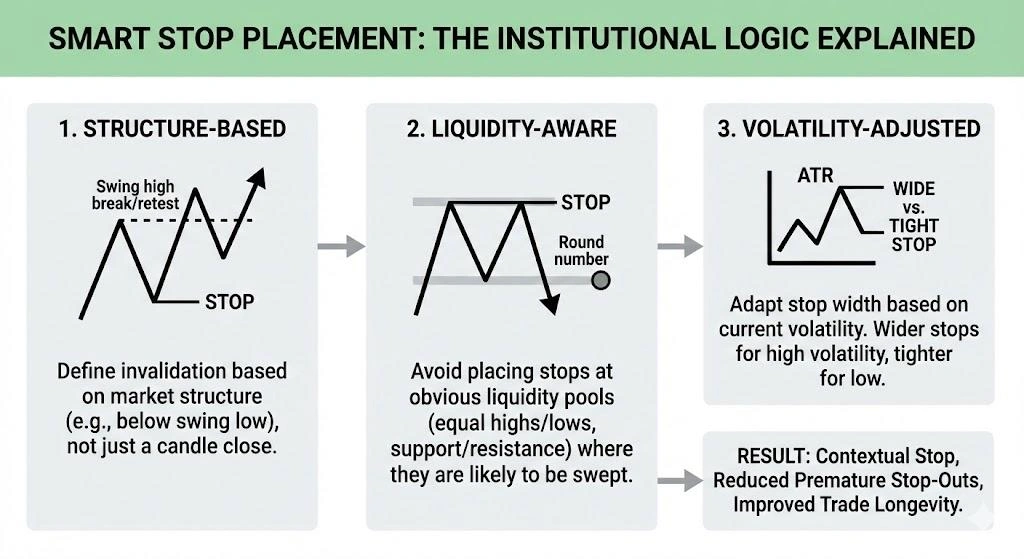
Smart Stop Placement: The Institutional Logic Explained
Smart stop placement isn’t just about using a wider stop-loss, it’s about putting them at the right place to avoid getting kicked out of a good trade, too soon.
1. Structure-Based Stop Placement
The pros define their risk based on when a market move is officially finished, not when a single candle closes.
Example:
If price breaks above a recent high and then comes back to tests it:
- Retail stop: Most traders place their stops right before the breakout candle
- Institutional stop placement: They place it under the actual structure that proves the higher high
Why?
Because a break of structure will tell you whether your trade was wrong or right; a small dip is not enough for that.
2. Liquidity-Aware Stop Placement
The pros know exactly where most of the traders are placing their orders.
Some of these common liquidity pools are
- Equal highs/equal lows
- Obvious support and resistance
- Previous day high/low
- VWAP deviations
Smart stops are not placed at these zones. They’re put beyond the places where big players are likely to go for liquidity.
3. Volatility-Adjusted Stop Placement
Institutions change their stops based on how wild the market is at the moment.
- High volatility → They use wider structural stops to give them room to breathe.
- Low volatility → They use tighter stops but still make sure they’ve placed it according to the market structure.
Most of them use ATR but only after they’ve looked at market structure first.
Why this matters:
If you use the same fixed stop for every trade regardless of how much the market is moving, your results are going to be very inconsistent.
Hypothetical Example: NIFTY Futures Trade
Suppose
- NIFTY breaks above 19,500
- Come back to test that level with high volume
- Retail traders jump in the trade with stops at 19,480
What happens next?
The price drops to 19,470, hitting everyone’s stops, and then moves toward 19,650.
Institutional Stop Placement
- Entry thesis: The market will stay above 19,500
- Invalidation: Failure below previous demand zone at 19,420
- Stop placed below 19,420
Result:
Retail gets stopped out. While institutional traders survive. This isn’t luck, it’s just smart stop placement.
Smart Stop Placement vs Wide Stops: A Critical Distinction
A lot of people think that institutional stops just mean having wider stops. Well, that’s just a myth.
| Wide Stop | Smart Stop Placement |
| Randomly large | Contextually justified |
| Poor risk control | Defined invalidation |
| Based on emotion | Structural logic |
Smart stop placement is actually set very precisely; it’s not just being lazy with it.
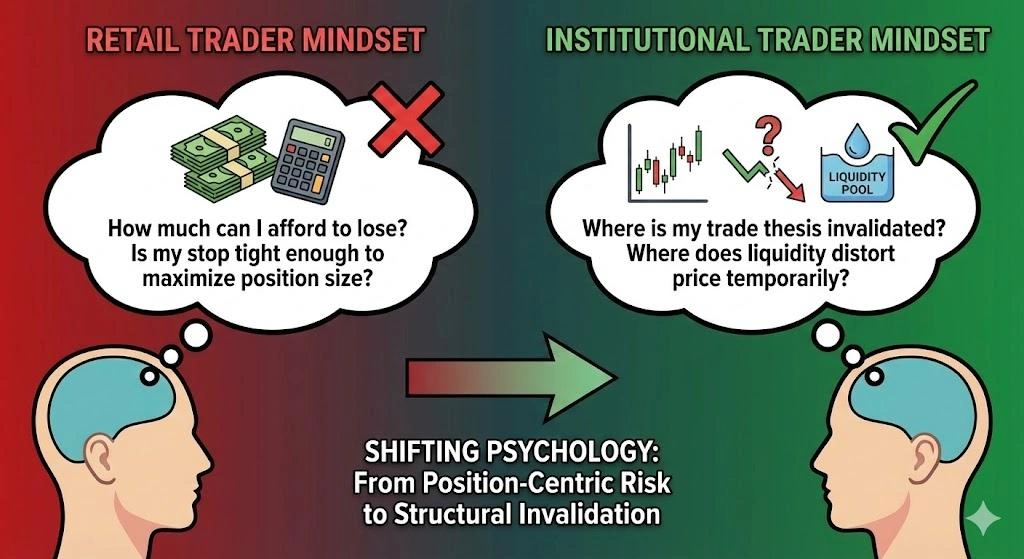
The Psychology Behind Institutional Stop Placement
Institutions think in probabilities and scenarios. They ask:
- “What can cause this trade idea to fail?”
- “At what price point will the market prove I’m wrong?”
- “Where is a temporary price spike likely to happen?”
On the other hand, retail traders ask:
- “How much money can I afford to lose in this trade?”
Both questions are important, but only one of them actually aligns with market mechanics.
Institutional Stop Placement and Risk-to-Reward
Smart stop placement actually improves your risk-to-reward ratio, even if the stop looks a bit bigger.
- Your stops hits less often
- Higher average trade duration
- Save money by not having to pay multiple re-entry costs
- Your long-term result improves with time
Big players don’t worry about having a perfect win; they care about the overall profit potential.
Tools That Support Institutional Stop Placement
Even though big banks have access to more high-tech tools, you can still use similar logic using:
- Market structure analysis
- Volume profile
- VWAP and its deviations
- Highs and lows from various sessions
- Volatility filters
Remember, tools don’t replace the fundamentals; they’re just there to help you see things clearly.
Common Mistakes Traders Make
- They place their stop at the most obvious levels
- Relying too much on indicators without looking understanding market context
- Using tight stops when market is volatile
- Ignoring how liquidity actually behaves
- Mistaking smart stops for having no stop-loss at all
Remember, the big players always manage their risk, even if they handle trades differently from retail traders.
Conclusion
To wrap it up, institutional stop placement isn’t about some secret formula or just making your stops wider. It’s a complete mindset shift. It’s about moving from “where should I put my stop?” To “at what place will the trade prove me wrong?”
By placing your exits behind the real market structure and avoiding obvious liquidity traps, you give your trades room to breathe; they need to run. Trading is tough; that’s why you need a proper stop-loss strategy. For further explanation of how to place a smart stop-loss, check out Insightful Trade. They offer expert guidance and tools that you need to trade with confidence.
FAQs
1. What tools help with institutional stop placement?
You can use market structure markers, volume, VWAP, and volatility tools to find your trade’s perfect stop loss.
2. Is institutional stop placement suitable for Indian traders?
Yes. In fact, due to high liquidity sweeps in Indian indices, institutional stop placement is especially relevant.
3. Does SEBI allow such trading methodologies?
SEBI does not restrict trading methodologies as long as they are transparent, non-misleading, and risk-defined.
4. Is smart stop placement the same as wide stops?
No, smart stop placement means putting your stop where it actually makes sense based on the chart, not based on a guess.
Author: Kumkum Chandak
Experience: 3+ Years in Trading Research & Market Content Strategy
Kumkum Chandak is a trading content strategist and market research writer who specializes in simplifying technical analysis, trading tools, and strategy-driven educational content. Her work is optimized for EEAT, accuracy, and user intent, ensuring every article delivers practical insights for traders of all levels.
Risk Disclaimer:
All content is strictly educational and not financial advice. Trading involves substantial risk. Always perform your own analysis or consult a professional advisor.
Last Updated: 17 January 2026