
Quick Summary
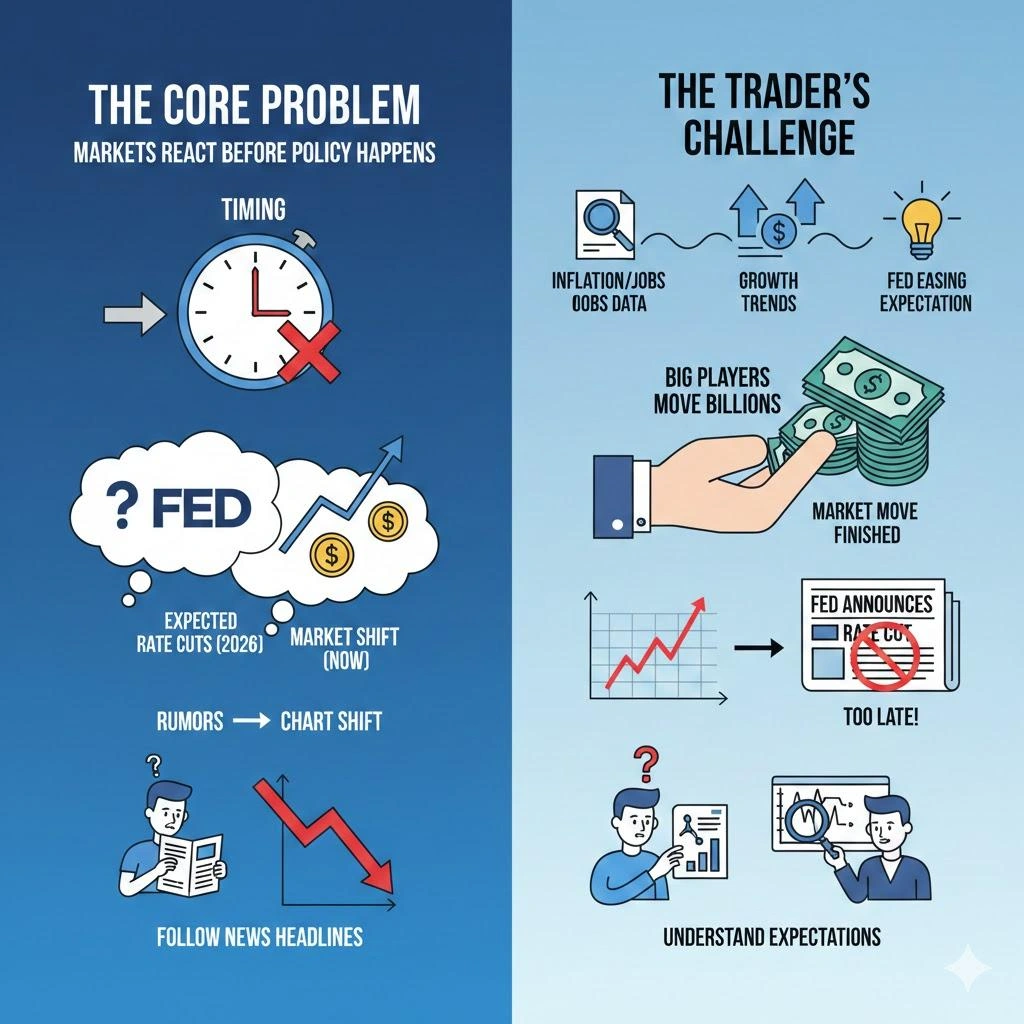
The Indian rupee at record low today has emerged as a macroeconomic development. The rupee’s weakness is primarily driven by cautious global risk sentiment, sustained dollar strength, and ongoing foreign capital outflows. All the businesses, policymakers, and investors are reassessing the risk that is tied to capital flows, inflation, and current stability as the rupee weakens against the US dollar. The rupee weakened to around ₹91.9–₹92.0 per US dollar during early trade on February 5, 2026, marking its lowest recorded spot level amid persistent dollar demand.
Snapshot: Indian Rupee at Record Low Today
| Factors | What is happening |
| Movement of currency | Indian rupee touched a fresh record low against the dollar |
| Key driver | Global dollar strength |
| RBI stance | Managed flexibility |
| Focus of Investor | Volatility of INR/USD and global data |
Introduction: Why the Indian Rupee at Record Low Today Matters
The Indian rupee at record low today is not just a currency market update or headline. For financial markets, the policy environment, and India’s economy, it is a macroeconomic signal because it directly affects economic outcomes. A weaker Indian rupee creates challenges with opportunities, and recently it fell to a fresh record low, which is sliding under ₹92 per US dollar.
Why does it matter?
Because if there is any movement in currency, it will directly influence inflation trends and corporate profitability and reshape market dynamics by impacting the stock sector differently.
What Happened to the Indian Rupee Today?
If we talk about the Indian rupee today, it marked a new milestone, and during today’s session of trading, it slipped past its previous all-time low in the spot USD/INR, which reflects sustained dollar demand.
Key observations:
- During market hours, USD/INR moved much higher, which reflects the demand for dollars.
- The “record low” does not refer to forward or offshore rates; it refers to spot market levels.
- Compared to recent weeks, the decline in the rupee has been gradual.
Why Is the Indian Rupee Falling Today?
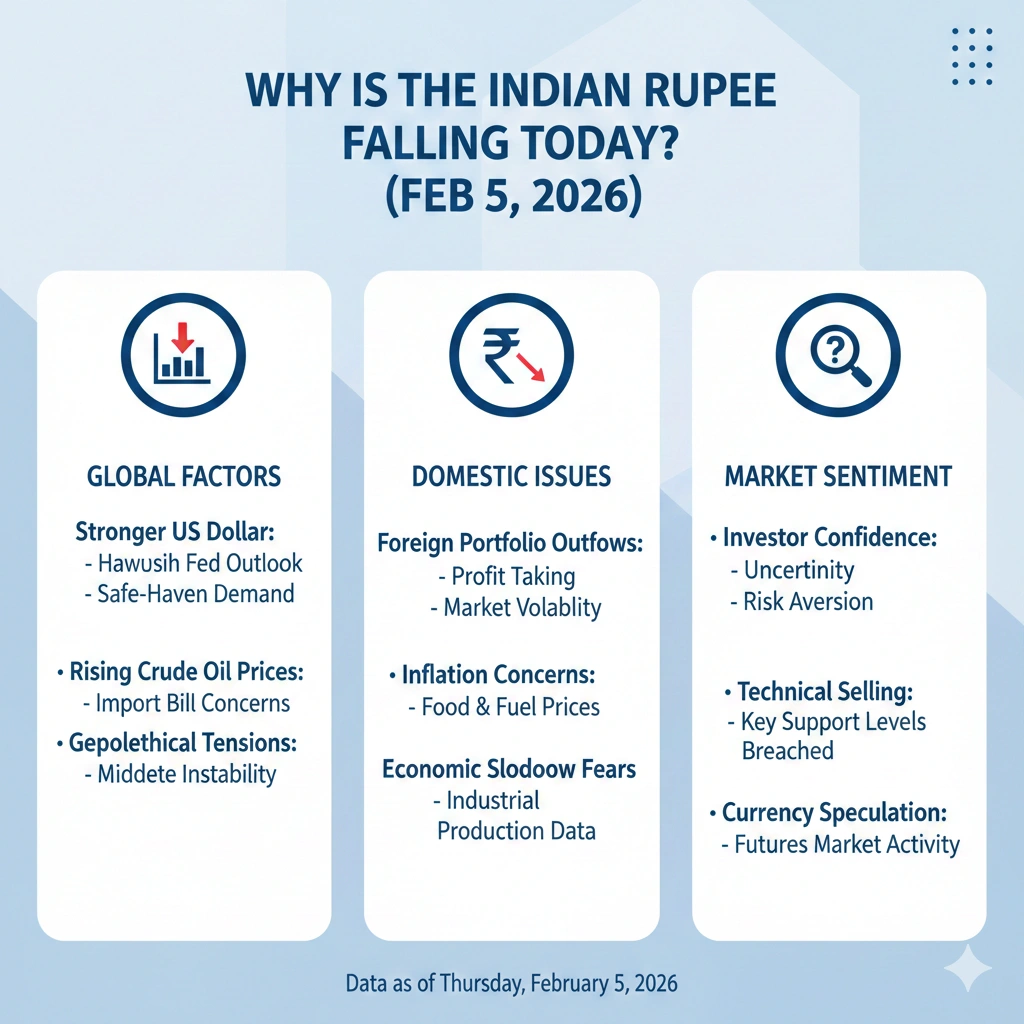
If you want to understand the Indian rupee at record low today, it will require breaking down multiple overlapping factors.
1. Global Dollar Strength
You can say it is a key driver behind the Indian rupee at record low today because it is pressuring emerging market currencies.
2. Foreign Capital Outflows
In India’s currency market, it plays a significant role, which is often driven by global portfolio rebalancing rather than concerns specific to India.
3. Trade and Current Account Dynamics
- Demand for high imports increases the usage of dollars
- Inflows for export do not rise at the same price
These flows are a major background reason behind the Indian rupee at record low today.
How a Weak Rupee Impacts the Indian Economy
It has wide-ranging economic results that go far beyond the forex markets:
Inflation and cost of living
- Crude oil, gas, and fuel become costly
- Manufacturing costs increased because of imported raw materials
- Machinery and electronics see price pressure
Impact on Indian stock markets
Its impact on the stock market is not wholly negative; it is mixed:
Potential benefits:
- IT services companies
- Export-oriented sectors
- Exporters of Pharma and chemicals
Sectors that are under pressure:
- Oil marketing companies
- Airlines
- Import dependent capital goods
- Foreign currency debt firms
Businesses and Consumers
For businesses:
- Cost is higher for imported units
- The burden for repayment on dollar loans has increased
- Needed better currency risk management
For Consumers:
- Traveling overseas becomes expensive
- Rise in expenses for foreign education
- Products that are imported become costly
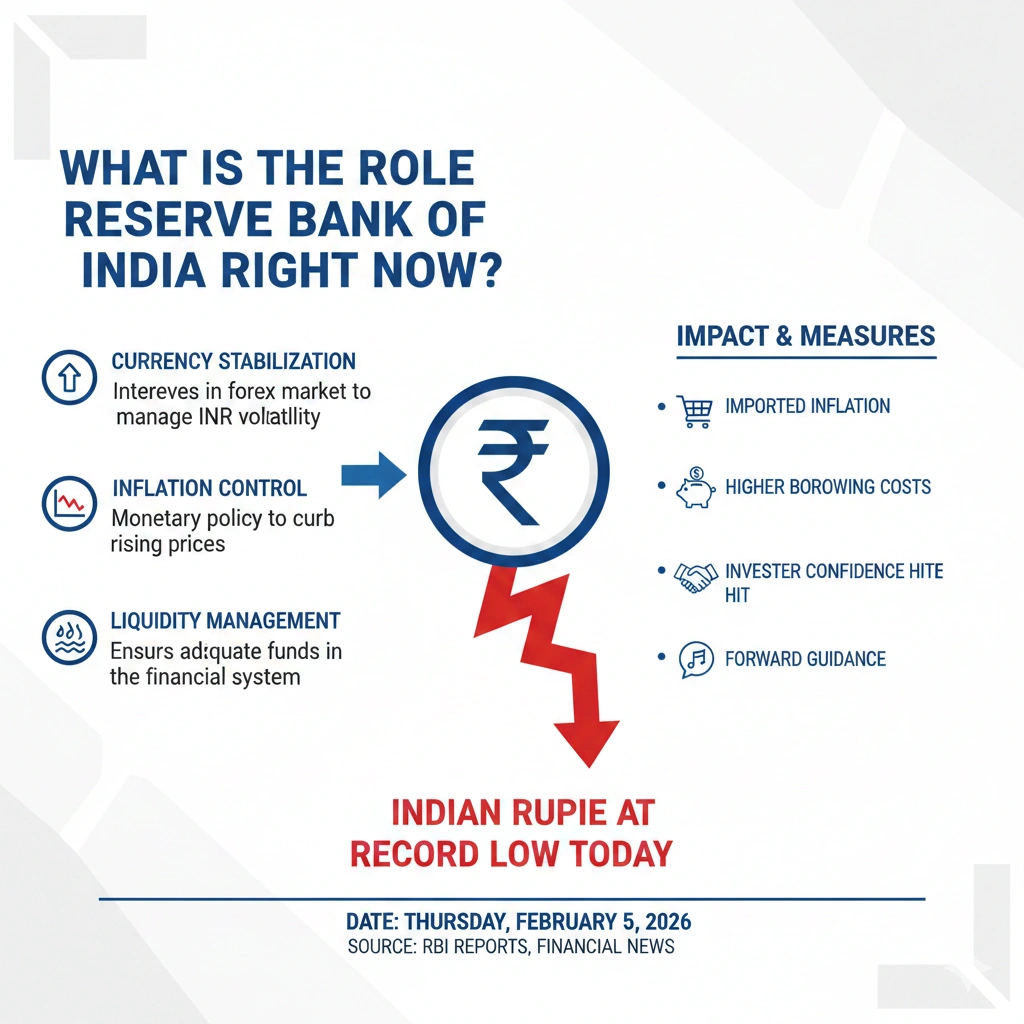
What Is the Role of the Reserve Bank of India Right Now?
The role of the RBI is often misunderstood because it does not target or defend a specific exchange rate level.
- Follows a managed-float regime
- Control excessive volatility
- RBI allows controlled weakness to help preserve reserves
- Controls excessive volatility
Is This a Short-Term Move or a Structural Trend?
Is this move temporary or structural? It is one of the biggest questions:
Cyclical Factors:
- Global risk sentiment
- Dollar strength cycles
- Capital flow volatility
Structural Factors:
- Requirements for long-term capital
- Energy import dependence
- Trade deficit dynamics
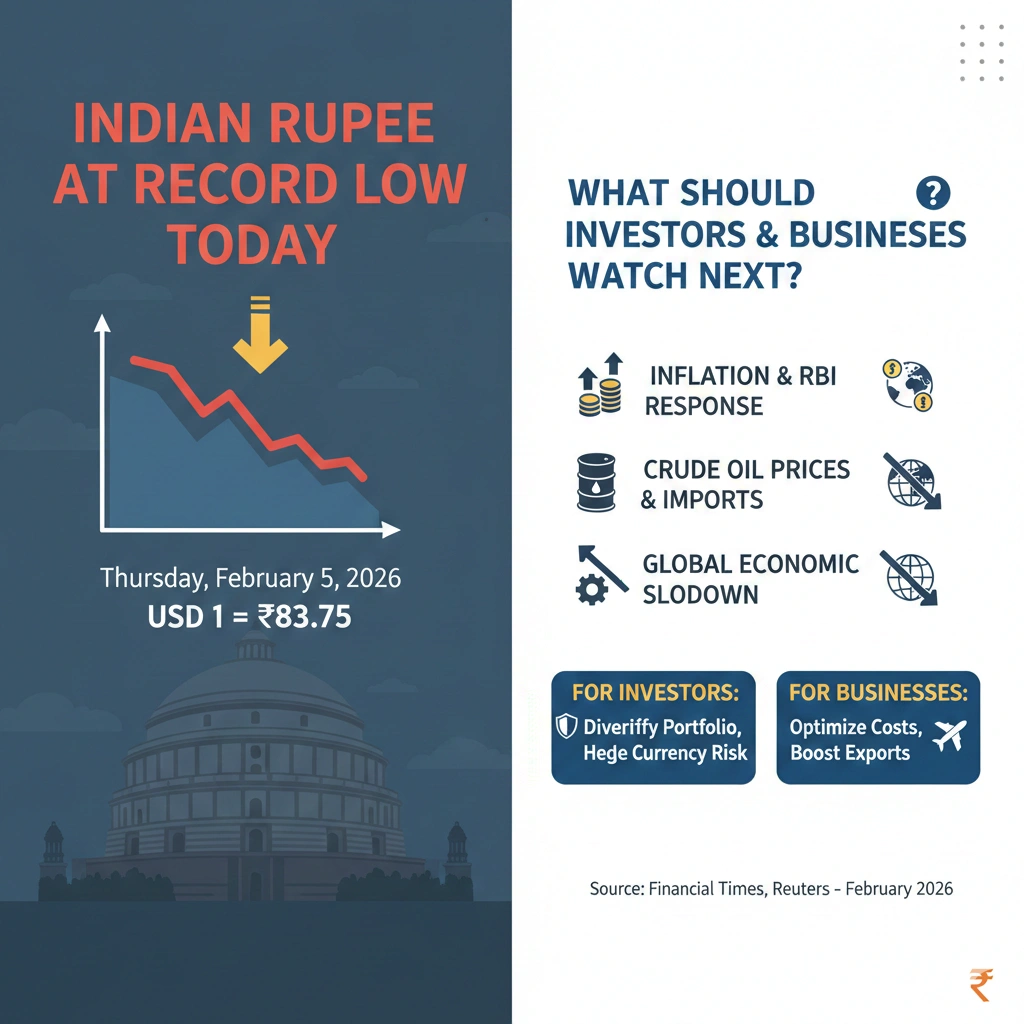
What Should Investors and Businesses Watch Next?
Market participants should monitor macro signals rather than reacting emotionally:
Key factors to watch:
- Statements of RBI policy and liquidity measures
- Volatility zones of USD/INR
- US economic data
- Federal Reserve Commentary
- Debt flow trends
FAQs: Indian Rupee at Record Low Today
Q1. Why is the Indian rupee falling today?
The market operates under three main factors, which include worldwide dollar market strength, foreign investment withdrawals, and ongoing international purchases of imports.
Q2. Does a weak rupee mean higher inflation in India?
The Indian economy faces higher imported inflation because weak currency values increase the cost of importing crude oil, fuel, and fertilizers.
Q3. Which Indian stocks benefit from rupee depreciation?
The Indian rupee’s depreciation creates advantages for export-based industries, which include IT service providers, pharmaceutical manufacturers, and specialty chemical producers.
Q4. Will RBI intervene to stop the rupee fall?
The RBI uses its intervention to manage market volatility instead of working to defend specific currency values.
Q5. How does a weak rupee affect common consumers?
Foreign travel, overseas education, and imported goods become more expensive as the Indian rupee is at a record low today.
Conclusion: Reading the Rupee Through a Macro Lens
Don’t think that the Indian rupee at record low today is a standalone crisis. Understand it instead of predicting because it is a reflection of changing global and domestic macroeconomic conditions. When a rupee is falling, it does not signal economic weakness, just like a rising rupee does not guarantee strength.
Don’t react to such headlines that the Indian rupee is at a record low today. Visit Insightful Trade to understand more about why currencies move and what to watch next without any hype or predictions that create fear.
Author: Arihant Jain
Trading Experience: 5+ Years
Arihant Jain is a financial markets analyst and trading educator with expertise in Forex, indices, crypto, and risk-managed trading systems. His insights are based on real trading experience, data-driven analysis, and transparent market understanding. All content is reviewed for accuracy and aligns with Google’s EEAT guidelines.
Risk Disclaimer:
Trading involves substantial risk. All information is for educational purposes only and should not be taken as financial advice. Always do your own research.
Last Updated: 05 February 2026