
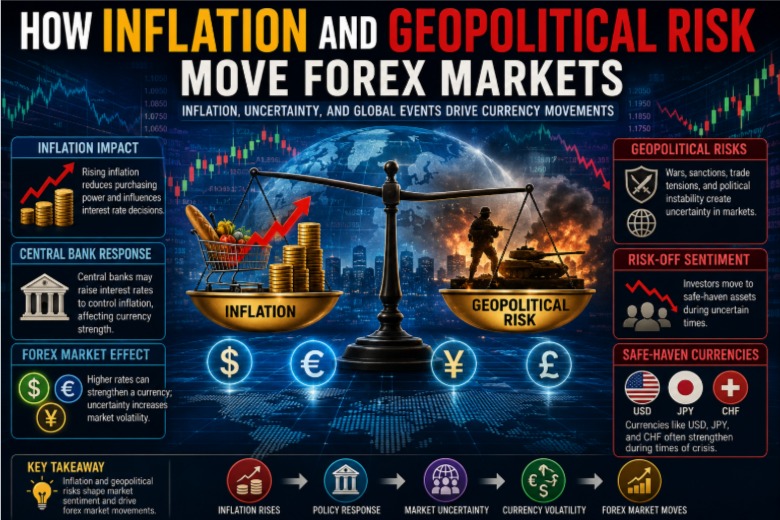
The forex market is one of the most dynamic financial markets in the world, constantly reacting to economic indicators, political developments, and global uncertainty. Among the biggest drivers of currency movements are inflation and geopolitical events. Understanding inflation and forex market relationships has become essential for traders because inflation rates and international conflicts can dramatically influence currency values within minutes.
In today’s highly connected financial environment, the global inflation currency trading landscape changes rapidly as traders respond to central bank policies, wars, sanctions, elections, and economic instability. At the same time, economic instability forex conditions create both risks and opportunities for traders who understand how macroeconomic forces impact currencies.
This article explores how inflation and geopolitical risks shape forex markets, how traders react to uncertainty, and why these factors are among the strongest forces influencing global currency movements.
Understanding Inflation and Forex Market Dynamics
The relationship between inflation and forex market movements is one of the most important concepts in currency trading. Inflation measures the increase in prices of goods and services over time. When inflation rises too quickly, the purchasing power of a currency weakens, causing investors to reconsider their positions.
Central banks closely monitor inflation because it directly affects economic stability. If inflation becomes too high, central banks often raise interest rates to slow economic activity. These rate hikes can strengthen a currency because higher interest rates attract foreign investment. As a result, the connection between inflation and forex market behavior becomes extremely significant for traders.
In the world of global inflation currency trading, investors constantly analyze inflation reports from major economies like the United States, the Eurozone, the United Kingdom, and Japan. Forex traders use inflation data to predict future interest rate decisions and currency trends.
Periods of rising inflation also increase economic instability forex conditions because businesses and consumers face uncertainty about future costs and economic growth. This uncertainty often creates volatility in currency pairs, leading to rapid market movements.
How Global Inflation Currency Trading Impacts Forex Markets
The rise of global inflation currency trading has transformed forex analysis over the past decade. Inflation no longer affects only domestic economies; it now has worldwide consequences because global markets are interconnected.
When inflation rises in major economies, investors shift their capital toward currencies expected to offer stronger returns. This creates substantial movement in the forex market. The relationship between inflation and forex market trends becomes even stronger during periods of global economic stress.
For example, if inflation in the United States rises faster than expected, the Federal Reserve may increase interest rates aggressively. This often strengthens the US Dollar because higher rates attract global investors. Such developments are central to global inflation currency trading strategies used by professional forex traders.
Inflation can also weaken currencies if investors believe central banks are losing control of price stability. In these situations, economic instability forex conditions intensify as traders seek safer currencies and more stable economies.
Commodity prices also influence global inflation currency trading because rising oil, gas, and food prices increase inflation worldwide. Forex traders carefully monitor commodity markets to anticipate inflation-driven currency movements.
Economic Instability Forex Conditions and Currency Volatility

The term economic instability forex refers to periods when uncertainty weakens investor confidence and increases currency volatility. Economic instability can result from inflation, recession fears, political crises, wars, banking problems, or supply chain disruptions.
One major reason inflation and forex market relationships are so important is because inflation directly affects economic stability. High inflation reduces consumer purchasing power and increases operating costs for businesses. If inflation remains uncontrolled, economies may slow down significantly.
During periods of economic instability forex activity, traders often move money into safe-haven currencies such as the US Dollar, Swiss Franc, or Japanese Yen. These currencies are considered more stable during uncertain economic conditions.
The role of global inflation currency trading becomes especially important when multiple countries experience rising inflation simultaneously. In such cases, traders compare central bank responses to determine which currencies may perform better in the long term.
Geopolitical tensions also contribute to economic instability forex environments. Conflicts between nations, trade wars, sanctions, and military tensions can quickly weaken currencies and increase market fear.
The Role of Central Banks in Inflation and Forex Market Trends
Central banks play a critical role in managing inflation and forex market conditions. Institutions like the Federal Reserve, European Central Bank, Bank of England, and Bank of Japan use monetary policy tools to control inflation and stabilize economies.
Interest rate changes are among the most powerful drivers in global inflation currency trading. When central banks raise rates, currencies often strengthen because higher returns attract foreign investment. Conversely, lower interest rates can weaken a currency.
Forex traders closely monitor central bank statements because even small policy hints can create major market movements. During periods of economic instability forex conditions, central banks may introduce emergency measures to support economic growth and calm financial markets.
For example, if inflation rises rapidly, traders expect tighter monetary policy. This directly impacts the inflation and forex market relationship because currencies respond quickly to changing interest rate expectations.
Central bank credibility is also important in global inflation currency trading. If investors trust a central bank’s ability to control inflation, the currency may remain relatively stable. However, weak policy responses can increase market volatility.
Geopolitical Risks and Their Influence on Forex Markets
Geopolitical events are another major factor influencing inflation and forex market trends. Wars, sanctions, elections, trade conflicts, and diplomatic tensions can significantly impact investor confidence and currency values.
The connection between geopolitical uncertainty and economic instability forex conditions becomes clear during global crises. Investors often react emotionally to uncertainty, causing rapid buying and selling activity in currency markets.
For example, military conflicts can increase energy prices, which in turn raises inflation globally. This creates stronger global inflation currency trading activity because traders anticipate changes in central bank policies.
Trade disputes between major economies can also weaken economic growth and disrupt global supply chains. These developments increase economic instability forex situations and create volatility across major currency pairs.
Political elections also influence the inflation and forex market relationship because changes in government policies can affect fiscal spending, taxation, trade agreements, and economic growth expectations.
Safe-Haven Currencies During Economic Instability Forex Conditions
Safe-haven currencies play a crucial role during economic instability forex periods. Investors typically seek currencies associated with economic stability, strong financial systems, and political security.
The US Dollar is one of the most important safe-haven currencies in global inflation currency trading. Even during global crises, investors often buy Dollars because of the size and strength of the US economy.
The Japanese Yen and Swiss Franc also benefit during uncertain market conditions. These currencies tend to strengthen when geopolitical risks increase or when inflation concerns dominate financial markets.
The relationship between safe-haven demand and inflation and forex market movements is significant because traders use these currencies to reduce risk exposure during volatile periods.
As inflation rises globally, economic instability forex conditions may intensify, increasing demand for safer investments. This creates strong market momentum in safe-haven currency pairs.
How Forex Traders Respond to Inflation and Geopolitical Risks

Professional traders develop strategies specifically designed for inflation and forex market volatility. Many traders rely on economic calendars to monitor inflation reports, employment data, and central bank announcements.
In global inflation currency trading, traders often focus on interest rate expectations because these expectations strongly influence currency trends. If markets anticipate aggressive rate hikes, traders may buy the affected currency before official announcements occur.
Risk management becomes essential during economic instability forex periods because volatility can increase dramatically. Traders often reduce leverage, widen stop-loss levels, and avoid overexposure to a single currency.
Technical analysis remains useful, but geopolitical events can suddenly override chart patterns. This is why traders combine technical indicators with fundamental analysis when navigating inflation and forex market conditions.
Long-term investors also monitor global inflation currency trading trends to diversify portfolios and protect assets from inflation-related risks.
The Future of Global Inflation Currency Trading
The future of global inflation currency trading will likely become even more complex as economies become increasingly interconnected. Rising energy costs, supply chain disruptions, climate-related events, and geopolitical tensions may continue driving inflation worldwide.
Central banks will remain major influencers in the inflation and forex market relationship because their policy decisions determine interest rates and economic stability. Traders who understand monetary policy will have a significant advantage in future forex markets.
Technology and real-time news access have also transformed economic instability forex trading. Traders now react instantly to breaking developments, increasing short-term market volatility.
As global uncertainty continues evolving, understanding inflation and forex market dynamics will remain essential for anyone involved in forex trading. Traders who adapt to changing economic conditions and geopolitical risks will be better positioned for long-term success.
Conclusion
The connection between inflation, geopolitical risks, and forex markets has become stronger than ever. The relationship between inflation and forex market movements influences currency trends, interest rates, and investor behavior worldwide.
The rise of global inflation currency trading reflects the growing importance of macroeconomic analysis in modern forex strategies. Inflation data, central bank decisions, and geopolitical developments all shape currency values on a daily basis.
At the same time, economic instability forex conditions create both opportunities and risks for traders. Those who understand how inflation and geopolitical events influence market psychology can better manage volatility and identify profitable trading opportunities.
In today’s interconnected financial world, mastering the relationship between inflation, global risks, and forex markets is essential for becoming a successful currency trader.
FAQs
What is the relationship between inflation and forex market movements?
The relationship between inflation and forex market movements is based on how inflation affects interest rates, investor confidence, and currency purchasing power. Higher inflation often leads to central bank policy changes that impact currency values.
Why is global inflation currency trading important?
Global inflation currency trading is important because inflation trends influence interest rates, economic growth, and forex market volatility across multiple countries simultaneously.
How does economic instability forex trading affect currencies?
Economic instability forex conditions increase uncertainty in financial markets, causing investors to move capital into safer currencies and creating higher market volatility.
Which currencies perform best during economic instability forex conditions?
Currencies like the US Dollar, Swiss Franc, and Japanese Yen often perform well during economic instability forex periods because investors consider them safer during global uncertainty.
How do geopolitical risks impact inflation and forex market trends?
Geopolitical risks can disrupt trade, increase energy prices, weaken economic growth, and influence investor sentiment, all of which directly affect inflation and forex market behavior.