The foreign exchange market is one of the most sensitive financial markets in the world, and global trade wars have become one of the biggest drivers of currency volatility in recent years. The topic of Global Trade Wars and Their Impact on Forex Traders has gained major importance because every new tariff announcement, import restriction, or diplomatic conflict between powerful nations directly affects currency values and trader sentiment. Understanding trade war forex impact is now essential for both beginner and professional traders who want to survive in the highly unpredictable economy forex environment.
Understanding Global Trade Wars and Their Impact on Forex Traders
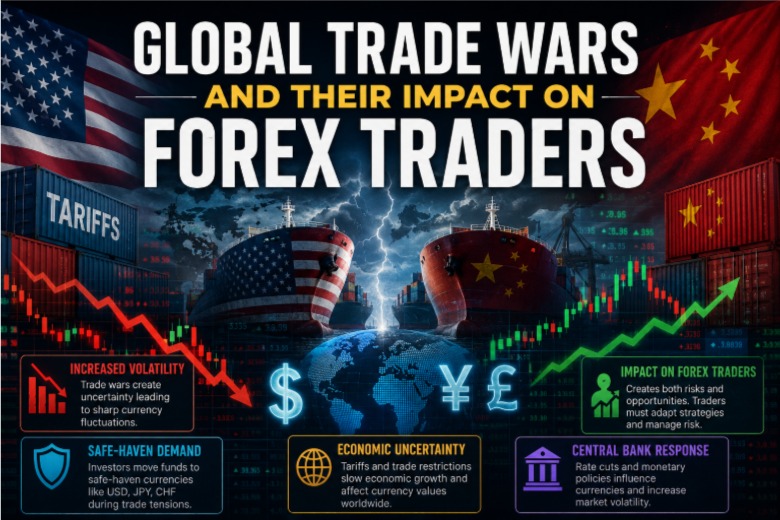
The discussion around Global Trade Wars and Their Impact on Forex Traders started becoming more important when major economies like the United States and China imposed heavy tariffs on each other. These conflicts created instability in global supply chains, weakened investor confidence, and caused strong fluctuations in currency pairs. As a result, the trade war forex impact became visible across major and minor forex markets.
Whenever governments increase tariffs or impose restrictions on imports and exports, investors immediately react by shifting funds toward safe-haven currencies. This creates strong currency volatility trade wars situations where traders experience rapid market swings. In many cases, the global economy forex market reacts faster than stock markets because currencies reflect international economic strength in real time.
Forex traders closely monitor trade negotiations because any positive or negative development can significantly affect currency demand. The growing connection between geopolitics and currency trading shows why Global Trade Wars and Their Impact on Forex Traders is now one of the most discussed subjects in modern forex analysis.
How Currency Volatility Trade Wars Affect Forex Markets
One of the biggest outcomes of trade disputes is increased currency volatility trade wars activity. Currency volatility occurs when exchange rates move aggressively within short periods. During international conflicts, traders become uncertain about economic stability, causing major fluctuations in forex pairs.
For example, when the US introduced tariffs on Chinese products, the Chinese Yuan weakened significantly. At the same time, traders moved investments into safer currencies like the US Dollar, Swiss Franc, and Japanese Yen. This is a perfect example of how trade war forex impact influences trader behavior globally.
The relationship between currency volatility trade wars and investor psychology is extremely strong. Fear and uncertainty cause sudden buying and selling pressure, leading to sharp movements in currency values. Traders who understand the dynamics of Global Trade Wars and Their Impact on Forex Traders can identify profitable opportunities during periods of market instability.
In the broader economy forex environment, volatility also affects interest rate expectations, inflation forecasts, and central bank policies. When economies slow down because of trade restrictions, central banks may lower interest rates to stimulate growth. These changes further influence forex market movements and increase the overall trade war forex impact.
The Connection Between the Global Economy Forex Market and Trade Wars

The global economy forex market depends heavily on international trade. Countries that export large volumes of goods rely on strong economic partnerships to maintain stable growth. When trade wars disrupt these partnerships, currency markets immediately react.
The connection between Global Trade Wars and Their Impact on Forex Traders becomes clear when examining economic data releases. Manufacturing output, employment reports, and export statistics often weaken during trade conflicts. As economic performance slows, investors lose confidence in affected currencies, increasing currency volatility trade wars activity.
For traders, the trade war forex impact is not limited to major currencies. Emerging market currencies often experience even stronger declines because developing economies depend more on international trade. Countries that rely heavily on exports can see dramatic currency depreciation during prolonged trade conflicts.
The global economy forex structure is interconnected, meaning a trade war between two major nations can affect currencies worldwide. Commodity-exporting countries may suffer if global demand decreases, while safe-haven currencies often gain strength. Understanding these relationships helps traders predict future market direction more effectively.
Why Forex Traders Must Monitor Trade War Forex Impact
Professional traders constantly analyze geopolitical news because the trade war forex impact can create both risks and opportunities. Sudden announcements related to tariffs, sanctions, or trade negotiations often trigger immediate reactions in the forex market.
The concept of Global Trade Wars and Their Impact on Forex Traders is especially important for short-term traders who depend on volatility for profits. During periods of intense geopolitical tension, market movements become larger and faster. While this increases potential profits, it also raises trading risks significantly.
Many traders use technical analysis to identify market trends, but geopolitical events can quickly invalidate technical patterns. This is why understanding currency volatility trade wars situations is critical. A single statement from political leaders can reverse market direction within minutes.
The economy forex environment also changes rapidly during trade wars because investors continuously reassess economic growth expectations. Forex traders who stay informed about global trade developments can adapt their strategies more effectively and reduce unnecessary losses.
Safe-Haven Currencies During Currency Volatility Trade Wars
Safe-haven currencies play an important role during periods of currency volatility trade wars. Investors often move their capital into currencies considered stable during uncertain times. The US Dollar, Japanese Yen, and Swiss Franc are common examples.
When discussing Global Trade Wars and Their Impact on Forex Traders, safe-haven flows become a major topic because they can significantly strengthen certain currencies even if the broader economy is struggling. For example, the US Dollar may rise during trade conflicts despite domestic economic concerns because global investors still view it as relatively secure.
The trade war forex impact becomes especially visible in USD/JPY and USD/CHF currency pairs. Traders often buy Yen or Swiss Francs when market uncertainty increases. These movements create profitable trading opportunities for those who understand geopolitical market behavior.
Within the broader global economy forex system, safe-haven demand also reflects investor confidence in financial stability. Countries with strong banking systems, low inflation, and political stability generally benefit during international trade disputes.
Strategies Forex Traders Use During Trade Wars
Understanding Global Trade Wars and Their Impact on Forex Traders helps traders develop stronger risk management strategies. During highly volatile periods, many traders reduce leverage to protect their capital from sudden market swings.
One common strategy involves trading safe-haven currencies during intense currency volatility trade wars conditions. Traders also focus on news trading because economic announcements related to tariffs or negotiations often create strong price movements.
Another approach involves monitoring correlations between commodities and currencies. In the global economy forex market, commodity-exporting countries like Australia and Canada may experience currency weakness if trade disputes reduce global demand. Traders use this relationship to identify trading opportunities linked to the trade war forex impact.
Long-term investors often diversify their portfolios during trade wars to reduce exposure to unstable currencies. Diversification helps traders manage uncertainty while still participating in forex opportunities created by geopolitical tensions.
Central Banks and Their Role in Trade War Forex Impact

Central banks play a major role in shaping the trade war forex impact because monetary policy decisions directly affect currency values. During economic slowdowns caused by trade conflicts, central banks may lower interest rates or introduce stimulus programs.
The relationship between Global Trade Wars and Their Impact on Forex Traders and central bank policy is extremely important. Lower interest rates usually weaken a currency because investors seek higher returns elsewhere. This creates additional currency volatility trade wars situations in the forex market.
For example, if trade restrictions hurt economic growth, a central bank may adopt an accommodative policy to support businesses and consumers. Forex traders closely watch these decisions because they strongly influence the global economy forex market.
Central bank communication is also important. Even hints about future policy changes can trigger significant market reactions. Traders who understand how central banks respond to trade wars can better anticipate currency trends.
Future Outlook of Global Trade Wars and Their Impact on Forex Traders
The future of Global Trade Wars and Their Impact on Forex Traders remains uncertain because geopolitical tensions continue evolving worldwide. Countries are increasingly focusing on economic nationalism, supply chain security, and domestic manufacturing protection.
As global competition intensifies, the trade war forex impact is likely to remain a major driver of currency volatility. Forex traders must continue adapting to rapidly changing market conditions influenced by politics, economics, and international relations.
The currency volatility trade wars trend may become even stronger as technology, energy, and manufacturing industries become strategic priorities for governments. Trade disputes involving semiconductors, artificial intelligence, and energy resources could create new forex market dynamics.
The global economy forex market will continue responding quickly to geopolitical developments because currencies reflect investor confidence in national economies. Traders who stay educated about global trade relationships and economic policies will have a stronger advantage in navigating future market volatility.
Conclusion
The topic of Global Trade Wars and Their Impact on Forex Traders has become increasingly important in today’s interconnected financial world. Trade disputes influence currency values, increase market uncertainty, and create significant trading opportunities for informed investors.
The growing trade war forex impact can be seen through rising market fluctuations, shifting safe-haven demand, and changing central bank policies. Traders who understand currency volatility trade wars conditions can better manage risks and capitalize on market movements.
In the modern global economy forex environment, geopolitical events are now just as important as technical indicators and economic reports. Successful forex traders must combine market analysis with a strong understanding of global trade developments to remain competitive in an increasingly volatile financial landscape.
FAQs
What is the trade war forex impact?
The trade war forex impact refers to the effect that international trade disputes have on currency markets. Trade wars increase uncertainty, influence investor sentiment, and create volatility in forex trading.
Why do currency volatility trade wars happen?
Currency volatility trade wars happen because investors react quickly to tariffs, sanctions, and geopolitical tensions. These events affect economic growth expectations and cause rapid currency price movements.
How does the global economy forex market react to trade wars?
The global economy forex market reacts to trade wars through changes in currency demand, safe-haven investments, and central bank policies. Countries heavily involved in exports are usually more affected.
Why is Global Trade Wars and Their Impact on Forex Traders important?
Understanding Global Trade Wars and Their Impact on Forex Traders helps traders predict market trends, manage risk, and identify profitable opportunities during geopolitical uncertainty.
Which currencies perform best during trade wars?
Safe-haven currencies such as the US Dollar, Japanese Yen, and Swiss Franc often perform well during periods of currency volatility trade wars because investors seek stability during uncertain economic conditions.