Introduction
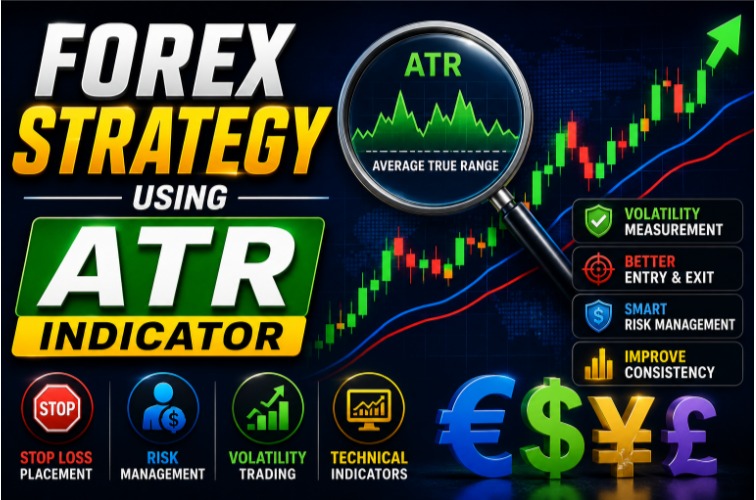
The foreign exchange market is one of the most dynamic financial markets in the world, with prices constantly moving due to economic events, geopolitical developments, central bank decisions, and market sentiment. While many traders focus solely on identifying entry and exit points, successful traders understand that managing volatility is equally important. This is where an ATR forex strategy becomes an invaluable tool. The Average True Range (ATR) indicator helps traders measure market volatility rather than predicting price direction, allowing them to make better trading decisions based on changing market conditions
The Average True Range was developed by J. Welles Wilder in 1978 and remains one of the most respected volatility indicators in financial markets. ATR calculates the average range between high and low prices over a selected period, usually 14 candles. Unlike oscillators that generate buy or sell signals, ATR simply measures how volatile the market currently is.
A higher ATR reading indicates increased volatility, meaning currency pairs are making larger price movements. Conversely, a lower ATR suggests reduced volatility and smaller price fluctuations. This information is extremely valuable because market volatility directly affects trade risk.
Professional traders rarely trade without considering volatility because every trading strategy performs differently under varying market conditions. ATR provides the flexibility needed to adapt rather than forcing the market to fit predefined rules.
Why Volatility Matters in Forex Trading

Every forex trader eventually realizes that volatility determines both opportunity and risk. High volatility creates larger profit potential but also increases exposure to sudden reversals. Low volatility may reduce risk but often limits trading opportunities.
This is why volatility trading has become a major component of modern forex strategies. Instead of fearing market volatility, experienced traders learn to measure and manage it.
ATR serves as the foundation of volatility trading because it provides an objective measurement rather than relying on emotions. During major economic releases like Non-Farm Payrolls, inflation reports, or central bank announcements, ATR readings often rise sharply, warning traders that wider stop losses and smaller position sizes may be necessary.
Stop Loss Placement Using ATR
One of the biggest reasons traders fail in the forex market is poor stop loss placement. Many beginners use fixed stop-loss distances such as 20 or 30 pips regardless of the currency pair, timeframe, or current market conditions. However, the forex market is constantly changing, and price volatility varies throughout the trading day. A stop loss that is too tight may be triggered by normal market fluctuations, while one that is too wide can expose traders to unnecessary losses. This is why incorporating stop loss placement into an ATR forex strategy is considered one of the most effective methods of protecting trading capital. The Average True Range (ATR) measures market volatility, allowing traders to place stop losses based on how much a currency pair typically moves rather than relying on arbitrary distances.
Effective stop loss placement also works hand in hand with risk management. A wider ATR-based stop loss does not necessarily mean taking on more risk because professional traders adjust their position size to maintain a consistent percentage of account risk. For instance, if a trader risks only 1% of their account on each trade, increasing the stop-loss distance simply requires reducing the trade size. This keeps the overall financial risk constant regardless of changing market volatility. By combining ATR-based stop losses with disciplined position sizing, traders can survive temporary market fluctuations while protecting their capital over the long term.
Ultimately, intelligent stop loss placement is one of the strongest advantages of an ATR forex strategy. It helps traders adapt to changing market conditions, reduces emotional decision-making, improves trade survival, and creates a more disciplined trading approach. By using the ATR indicator to calculate stop-loss distances and combining it with sound risk management, volatility trading, and complementary technical indicators, forex traders can significantly improve consistency and increase their chances of achieving long-term trading success.
Risk Management in an ATR Forex Strategy
Successful forex trading is not determined by how many winning trades a trader makes but by how effectively they protect their trading capital. This is why risk management is considered the foundation of every profitable trading system. Even the most accurate strategy can fail if traders risk too much on a single position or ignore changing market conditions. An ATR forex strategy strengthens risk management by using the Average True Range (ATR) indicator to measure market volatility and adjust trade size, stop-loss distance, and profit expectations accordingly. Instead of relying on fixed rules, ATR enables traders to make decisions based on real-time market behavior, helping them maintain consistency during both calm and highly volatile trading sessions.
Risk management also involves maintaining a favorable risk-to-reward ratio, and the ATR forex strategy helps traders establish realistic profit targets. During periods of high volatility trading, currency pairs often experience larger price swings, allowing traders to aim for wider profit targets while maintaining the same percentage risk. Conversely, when ATR readings are low, traders may reduce their profit expectations because the market is less
likely to make large moves. Aligning profit targets with market volatility prevents unrealistic expectations and encourages disciplined decision-making.
Another important aspect of ATR-based risk management is avoiding emotional trading. Fear and greed often cause traders to move stop losses, increase position sizes after losses, or exit winning trades too early. Because ATR provides an objective measurement of market volatility, trading decisions become based on data rather than emotions. Traders follow predetermined rules for stop loss placement, position sizing, and trade management, resulting in greater consistency and fewer impulsive mistakes. This disciplined approach is essential for long-term profitability in the highly competitive forex market.
Technical Indicators in an ATR Forex Strategy
Technical indicators play a vital role in improving the accuracy and reliability of an ATR forex strategy. While the Average True Range (ATR) is an excellent tool for measuring market volatility, it does not indicate whether the market will move upward or downward. Instead, it helps traders understand the strength of price movement and adjust their trading decisions accordingly. To generate high-probability trade setups, ATR should be combined with other technical indicators that identify trends, momentum, support and resistance, and potential reversal points. This combination allows traders to make informed decisions based on multiple layers of market analysis rather than relying on a single indicator.
One of the most effective indicators to use alongside ATR is the Moving Average. Moving Averages help traders identify the overall market trend, while ATR measures the level of volatility within that trend. For example, when the price is trading above the 50-day and 200-day Moving Averages, the market is generally considered to be in an uptrend. If ATR begins to rise at the same time, it indicates increasing volatility, which often supports stronger price movement in the direction of the prevailing trend. This combination helps traders avoid entering trades during weak or directionless market conditions.
Ultimately, combining technical indicators with an ATR forex strategy creates a well-balanced approach to forex trading. ATR measures how much the market is moving, while complementary indicators reveal where and why those movements are occurring. This combination enables traders to identify high-quality opportunities, manage risk more effectively, and adapt to changing market conditions with greater confidence. Consistent use of multiple technical indicators alongside ATR can help traders build a disciplined trading system capable of delivering more reliable results over the long term.
Conclusion
The ATR forex strategy is one of the most practical and effective methods for navigating the dynamic nature of the forex market. Rather than attempting to predict price direction, the Average True Range (ATR) indicator helps traders measure market volatility, enabling them to make smarter decisions based on current trading conditions. By understanding how much a currency pair typically moves, traders can improve stop loss placement, adjust position sizes, and develop stronger risk management practices that protect trading capital while maximizing potential opportunities.
Ultimately, long-term success in forex trading depends on discipline, consistency, and effective money management rather than simply finding perfect entry points. The ATR forex strategy supports these principles by providing an objective approach to volatility trading, enhancing stop loss placement, strengthening risk management, and complementing other technical indicators. While no trading strategy can guarantee profits, consistently applying ATR-based principles allows traders to reduce emotional decision-making, preserve capital during challenging market conditions, and improve overall trading performance. With patience, continuous learning, and disciplined execution, the ATR forex strategy can become a valuable tool for building sustainable success in the forex market.