
Quick Summary
FEMA rules for forex trading are basically the foundation of all current trading laws in India. Even though most of the time the main focus of traders is on their profit or the apps they use, the real challenge is knowing what the Foreign Exchange Management Act (FEMA) and RBI actually allow or forbid. The legality of your trading isn’t decided on the basis of winning or losing; it depends on the currencies you pick, the platform you use, and where you live. In this blog, we’ll learn how these rules work in real life, why people break them by mistake, and how you can trade while staying on the right side of the law and your tax duties.
Snapshot Overview
| Area | FEMA Position |
| Governing law | FEMA, 1999 |
| Regulating authority | Reserve Bank of India |
| Retail forex trading | Restricted |
| INR-based pairs | Conditionally permitted |
| Offshore forex trading | Non-compliant under FEMA |
Under FEMA rules for forex trading, Indian residents may trade only INR-based currency pairs on Indian exchanges regulated by RBI-authorized entities. All other retail forex activity is non-compliant
The Core Problem: Why FEMA Rules for Forex Trading Are Misunderstood
A lot of traders assume that if a platform is available online, then it’s legal. This belief often causes huge confusion about how FEMA rules actually work for forex.
The misunderstanding happens because:
- Brokers from abroad don’t follow Indian law
- Platforms rarely explain local legal limits
- FEMA rules are complex, not easy to understand
The lack of awareness of RBI rules led several individuals to violate the rule without even realizing it.
What Is FEMA, and Why It Governs Forex Trading
To understand forex legality in India, one must first understand FEMA.
Purpose of FEMA
FEMA was enacted to:
- Track foreign currency deals
- Manage India’s capital account
- To control capital outflow
- Keep the currency stable
Trading is covered by FEMA because it moves foreign exchange, even if the trades happen entirely online.
How RBI Fits into FEMA Rules for Forex Trading
Even though FEMA provides the legal framework, the RBI manages the daily details.
RBI’s Role
- Send out updates and guidelines
- Defines which trades are allowed
- Monitors authorized dealers
- Ensure FEMA rules are followed
Most of the limitations faced by traders come from RBI forex rules, rather than from FEMA text alone.
The Central Question: Is Forex Trading Legal Under FEMA?
This is where the details really matter.
Short Answer
Retail forex trading in India is permitted only in RBI-approved INR pairs on Indian exchanges. All other forms fall outside FEMA compliance.
Practical Reality
- Some traders are allowed
- Individuals often breaks the rules
- Authorities focus on your trading pattern and goals
Knowing this difference is the key to staying within the FEMA rules for forex trading.
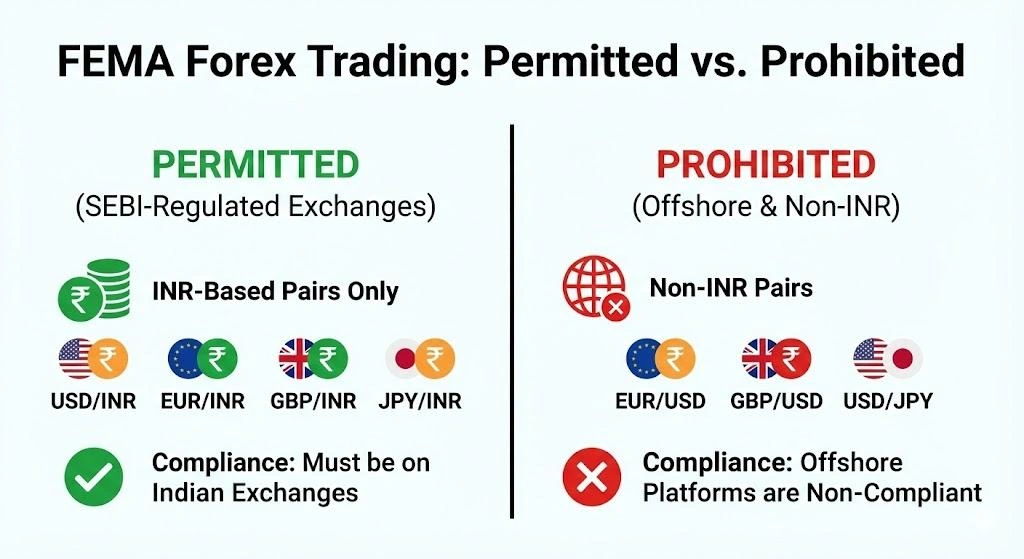
Permitted Forex Trading Under FEMA Rules
1. Trading in INR-Based Pairs
The RBI allows only the residents of this country to trade currency pairs that involve INR, like:
- USD/INR
- EUR/INR
- GBP/INR
- JPY/INR
And these trades must be done through:
- An Indian exchanges
- Or SEBI-approved platforms
This is the easiest way to trade forex legally in India.
Prohibited or Non-Compliant Forex Trading
1. Trading Non-INR Pairs
Examples:
- EUR/USD
- GBP/USD
- USD/JPY
If you’re trading any of these pairs, then it means you’re violating FEMA rules for forex trading, whether you make a profit or a loss.
2. Offshore Forex Platforms
Most brokers from abroad provide:
- Pairs without the rupee
- Extremely high leverage
- Settlement outside India
Using these apps while living in India is like going against the RBI forex rules.
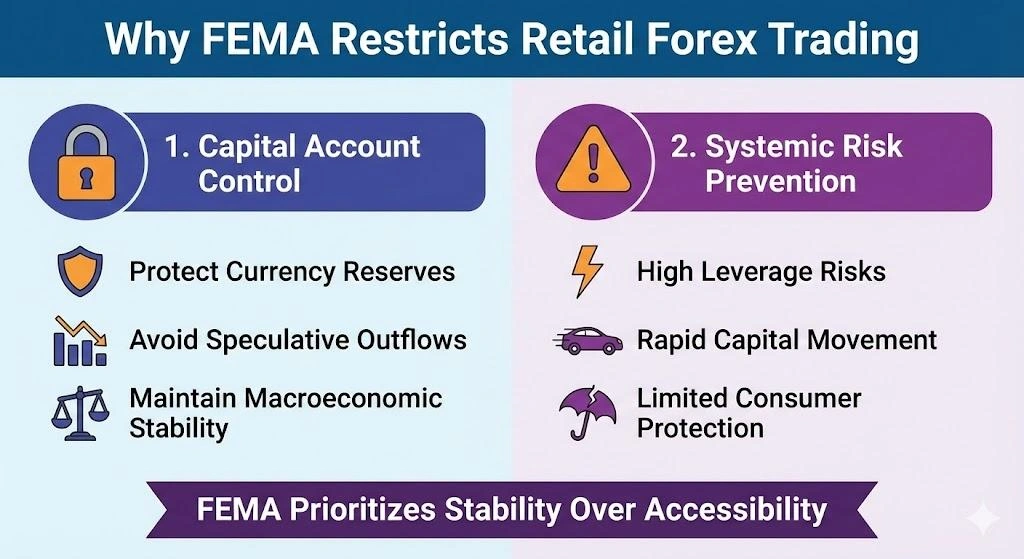
Why FEMA Restricts Retail Forex Trading
Understanding the reason behind this legal framework will help you respect the rules.
1. Capital Account Control
India uses controls to:
- Protect capital reserves
- Stop capital outflows
- Keep the economy stable
2. Systemic Risk Prevention
Retail trading often means:
- High leverage
- Fast money movement
- Very little safety
FEMA focuses more on stability than easy access.
Taxation vs FEMA: A Common Confusion
A lot of people assume that if FEMA is restricting trading, then it means there will be no tax to pay. But this is not correct.
Key Difference
- FEMA decides what’s allowed
- From a taxation perspective, profits from forex trading, legal or illegal, are taxable under the Income Tax Act.
Even if you trade, breaking the FEMA rules, you have to pay tax on profits. This case often catches traders off guard.
Documentation FEMA Compliance Relies On
For the purpose of scrutiny, the authorities might examine:
- The reason behind transaction
- Your contract with broker
- Your trading details
- How currency was converted
Well-maintained paperwork will save you from penalties, even if rules were broken.
Role of Banks in Enforcing RBI Forex Rules
Banks serve as authorized dealers for RBI.
What Banks Monitor
- Money sent abroad
- Frequent international transactions
- Vague reasons behind the payments
Banks often send signals to FEMA for an inspection before the government does.
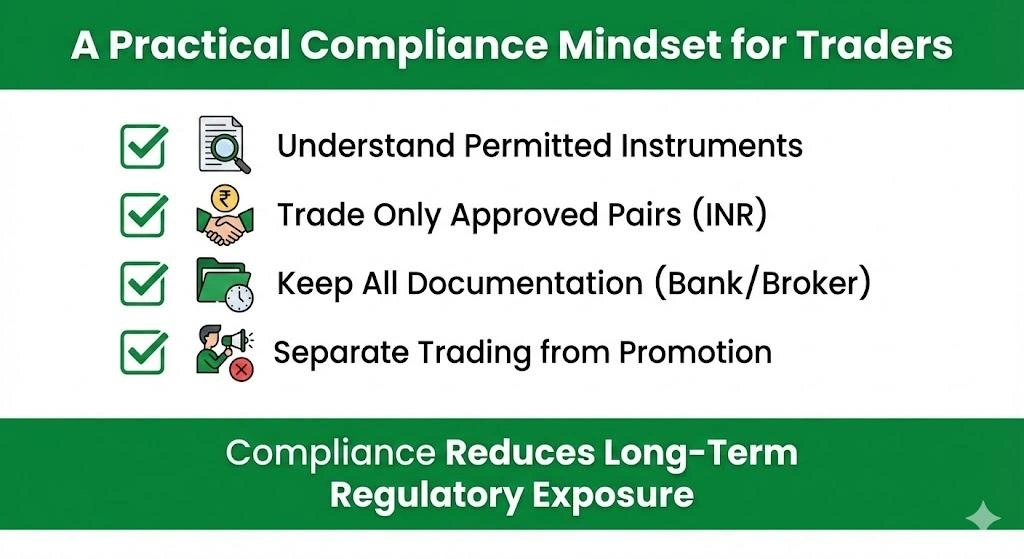
Common Compliance Mistakes Traders Make
Underestimating FEMA rules for forex trading leads to:
- Thinking offshore are legal
- Ignoring rules on which currency pair are allowed
- Mixing personal cash with trading transfers
- Working as an introducing broker
These mistakes can bring the attention of higher authorities to you.
India Compared to Other Countries
Many traders cite global norms to justify trading.
Why That Argument Fails
- FEMA is jurisdiction-specific
- India prioritizes capital stability
- Liberal markets do not face the same constraints
Thus, forex legality in India cannot be inferred from foreign practices.
Can FEMA Rules Change in the Future?
Yes, it can, but slowly.
Factors Influencing Change
- Loosening money controls
- A more established market
- Better risk handling
Until then, current RBI rules will stay the same.
Why Education Matters More Than Enforcement
Most FEMA rules are broken due to:
- Lack of awareness
- Misleading broker marketing
- Bad online advice
Informed traders slip less often than careless ones.
Conclusion
FEMA rules for forex trading are meant to control the movement of money across the borders, not to encourage currency speculation. Under current RBI forex rules, the legality of your trading depends on the currency pair you use, the platforms, and how the money is handled. Even though trading through a foreign site is quite common, it doesn’t actually follow the FEMA guidelines. Traders who maintain proper paperwork, respect the legal rules set by the authorities, and maintain their risk efficiently.
For more updates on global regulations and compliance, sites like InsightfulTrade offer excellent research to help you see where India stands in the whole market.
FAQs: FEMA Rules for Forex Trading
1. Are FEMA rules for forex trading applicable to individuals?
Yes. FEMA applies to all Indian residents, not just institutions.
2. Is forex trading legal in India under FEMA?
Only INR-based forex trading on Indian exchanges is permitted.
3. Are offshore forex platforms allowed under RBI forex rules?
No. Trading non-INR pairs on offshore platforms violates FEMA.
4. Are tools like MT4 or MT5 illegal?
No. Tools are neutral; compliance depends on how they are used.
5. Can FEMA violations still attract tax?
Yes. Tax liability and FEMA compliance are separate legal matters.
Author: Kumkum Chandak
Experience: 3+ Years in Trading Research & Market Content Strategy
Kumkum Chandak is a trading content strategist and market research writer who specializes in simplifying technical analysis, trading tools, and strategy-driven educational content. Her work is optimized for EEAT, accuracy, and user intent, ensuring every article delivers practical insights for traders of all levels.
Risk Disclaimer:
All content is strictly educational and not financial advice. Trading involves substantial risk. Always perform your own analysis or consult a professional advisor.
Last Updated: 3 February 2026