 Global energy crises have repeatedly reshaped financial markets, influenced economic growth, and created significant opportunities for forex traders. Whether caused by geopolitical conflicts, supply disruptions, sanctions, or unexpected demand surges, energy market shocks can trigger dramatic movements across currencies, commodities, and global stock markets.
For traders, understanding the relationship between energy prices and currency movements is critical. A successful energy crisis forex strategy requires monitoring oil market volatility, understanding commodity forex trading dynamics, analyzing the connection between inflation and forex, and adapting to rapidly changing conditions through effective geopolitical trading techniques.
This comprehensive guide explores how energy crises influence forex markets and how traders can capitalize on opportunities while managing risk during periods of global uncertainty.
Understanding Energy Crises and Currency Markets
An energy crisis occurs when the supply of essential energy resources such as oil, natural gas, coal, or electricity becomes constrained while demand remains high.
These disruptions often create sharp increases in energy prices and contribute to economic instability.
The relationship between energy markets and currencies forms the foundation of successful energy crisis forex trading.
Energy costs influence inflation, economic growth, trade balances, and central bank policy decisions. As a result, currency markets often react strongly to changes in global energy conditions.
Understanding the broader energy crisis forex environment helps traders anticipate market reactions and identify profitable opportunities.
Because energy remains essential to modern economies, energy crises frequently have global consequences.
Why Oil Market Volatility Matters
Among all energy resources, crude oil has the greatest influence on forex markets.
Periods of heightened oil market volatility often affect both commodity-exporting and energy-importing economies.
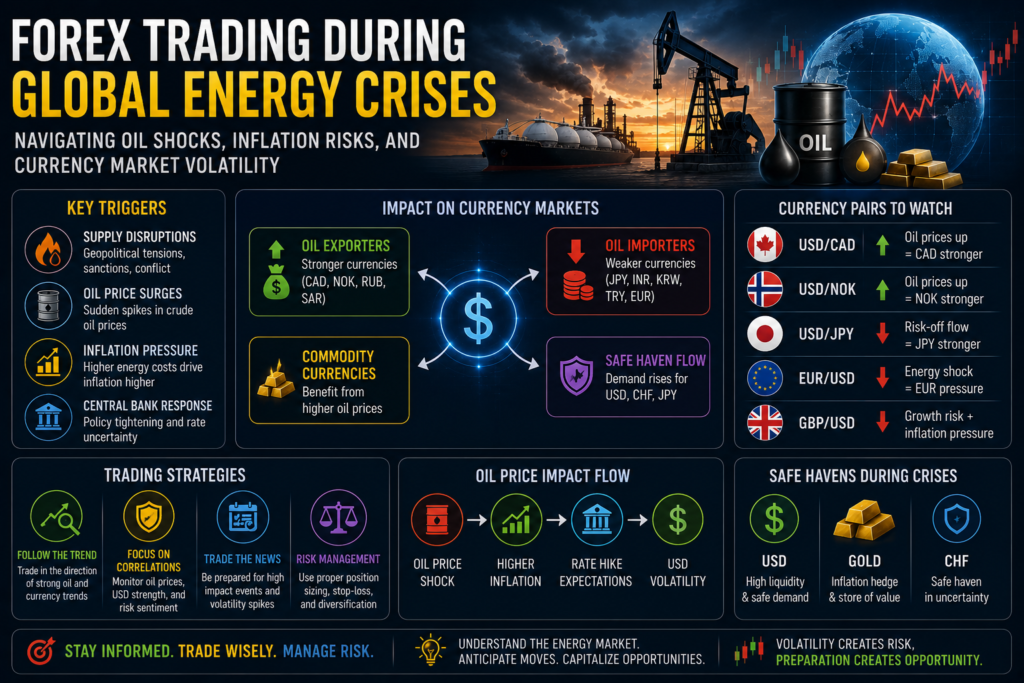
When oil prices rise sharply, countries that export crude oil may benefit from increased revenues and stronger currencies.
Conversely, energy-importing nations often face higher costs and slower economic growth.
For traders, monitoring oil market volatility provides valuable insights into future currency movements.
Many professional traders view oil market volatility as one of the most important indicators of macroeconomic conditions.
Understanding these dynamics is essential for effective commodity forex trading.
Energy Crisis Forex and Global Economic Growth
One of the primary effects of an energy crisis is its impact on economic growth.
Higher energy prices increase production costs for businesses and reduce consumer purchasing power.
These developments can slow economic activity and create uncertainty across financial markets.
A well-structured energy crisis forex strategy takes these macroeconomic effects into account.
During prolonged crises, investors often reassess growth expectations and adjust currency positions accordingly.
Understanding how energy prices influence economic performance helps traders anticipate broader market trends.
The connection between energy costs and growth remains a critical factor in geopolitical trading decisions.
Commodity Forex Trading During Energy Shocks
Periods of rising energy prices often create attractive opportunities in commodity forex trading.
Commodity-exporting countries such as Canada, Australia, and Norway frequently benefit from higher resource prices.
As export revenues increase, their currencies may strengthen.
Successful commodity forex trading requires understanding which economies are most exposed to energy markets.
Many traders focus on currency pairs involving the Canadian Dollar because Canada is one of the world’s largest oil exporters.
Analyzing resource market trends improves the effectiveness of commodity forex trading strategies.
Understanding commodity cycles is essential for long-term success.
Oil Market Volatility and the Canadian Dollar
The Canadian Dollar is among the currencies most sensitive to oil market volatility.
Canada exports significant amounts of crude oil to global markets, making energy prices a major driver of economic performance.
When oil prices rise, the Canadian Dollar often strengthens.
This relationship creates opportunities for traders engaged in energy crisis forex analysis.
Monitoring oil inventories, production levels, and geopolitical developments can improve forecasting accuracy.
Many professional traders incorporate oil market volatility analysis into broader currency market strategies.
Understanding these relationships can help traders identify high-probability setups.
Inflation and Forex During Energy Crises
One of the most important consequences of rising energy prices is inflation.
As fuel and transportation costs increase, businesses often pass these expenses on to consumers.
This creates a strong connection between inflation and forex markets.
Periods of elevated inflation frequently influence central bank policy and interest rate expectations.
For traders, understanding the relationship between inflation and forex is essential because monetary policy decisions often drive major currency trends.
Many successful macro traders closely monitor inflation data during energy crises.
Changes in inflation expectations can create substantial opportunities across currency markets.
How Central Banks Respond to Energy Crises
Central banks play a crucial role in managing the economic consequences of energy shocks.
Rising inflation often forces policymakers to consider interest rate increases.
These decisions can significantly influence inflation and forex relationships.
A strong energy crisis forex strategy includes monitoring central bank statements, inflation forecasts, and monetary policy outlooks.
Unexpected policy changes can increase market volatility and create new trading opportunities.
Understanding how central banks react to energy-driven inflation helps traders prepare for future market developments.
Policy expectations remain a key component of successful geopolitical trading.
Geopolitical Trading and Energy Markets
Many energy crises originate from geopolitical events.
Wars, sanctions, trade disputes, and diplomatic conflicts frequently influence energy supply and pricing.
This makes geopolitical trading an important aspect of forex market analysis.
Successful geopolitical trading requires understanding how political developments affect commodity production and transportation.
Traders often monitor:
International conflicts.
OPEC decisions.
Energy sanctions.
Trade agreements.
Supply chain disruptions.
These factors contribute significantly to both oil market volatility and broader currency market movements.
Understanding geopolitical risks helps traders anticipate potential market reactions.
Safe-Haven Currencies During Energy Crises
Energy crises often increase uncertainty and investor risk aversion.
As a result, capital frequently flows into defensive assets.
This behavior creates opportunities within energy crisis forex trading because safe-haven currencies may strengthen during periods of market stress.
The U.S. Dollar, Swiss Franc, and Japanese Yen often benefit from increased demand when geopolitical tensions rise.
Understanding investor behavior improves both commodity forex trading and geopolitical trading strategies.
Market sentiment remains an important factor during crisis-driven environments.
Commodity Forex Trading and Emerging Markets
Emerging markets often experience significant effects from energy price fluctuations.
Countries that depend heavily on imported energy may face economic challenges when prices rise.
Conversely, resource-exporting nations can benefit substantially.
Understanding these differences improves commodity forex trading performance.
Many traders analyze trade balances, inflation trends, and economic growth projections when evaluating emerging market currencies.
The relationship between energy markets and developing economies creates unique opportunities for experienced traders.
Risk Management During Energy Crisis Forex Trading

Risk management becomes especially important during periods of heightened oil market volatility.
Energy crises can produce large and unpredictable market movements.
Even the strongest energy crisis forex strategy requires disciplined risk controls.
Effective risk management includes:
Position sizing.
Stop-loss placement.
Leverage control.
Portfolio diversification.
Continuous market monitoring.
Successful traders understand that protecting capital is essential during volatile market conditions.
Strong risk management improves long-term consistency and sustainability.
Inflation and Forex Market Trends
The relationship between inflation and forex extends beyond short-term market reactions.
Persistent inflation can influence economic growth, central bank policy, and investor behavior for extended periods.
Understanding these long-term effects enhances geopolitical trading and macroeconomic analysis.
Many professional traders incorporate inflation forecasts into broader trading frameworks.
Monitoring inflation expectations helps identify potential currency trends before they become widely recognized.
This forward-looking approach often improves decision-making.
High-Volume Related Keywords for Energy Crisis Trading
In addition to the primary keywords, traders frequently search for:
Oil price forex strategy.
Energy market analysis.
Crude oil trading.
Commodity currency trading.
Inflation trading strategy.
Global macro trading.
Forex economic outlook.
Energy inflation impact.
Currency market volatility.
Oil and currency correlation.
These related keywords complement energy crisis forex, oil market volatility, commodity forex trading, inflation and forex, and geopolitical trading while helping traders develop a broader understanding of energy-driven market dynamics.
Common Mistakes Traders Make During Energy Crises
Many traders underestimate the influence of oil market volatility on currency markets.
Others focus solely on technical indicators while ignoring macroeconomic developments.
Failing to understand the relationship between inflation and forex can lead to poor trading decisions.
Some traders neglect risk management during periods of heightened uncertainty.
Successful traders combine fundamental analysis, technical analysis, and disciplined execution.
A comprehensive approach often produces more consistent results.
Conclusion
Global energy crises create powerful opportunities and significant challenges for forex traders. Understanding energy crisis forex dynamics, monitoring oil market volatility, implementing effective commodity forex trading strategies, analyzing the relationship between inflation and forex, and applying disciplined geopolitical trading techniques can help traders navigate these complex market environments.
As global energy markets continue to influence economic growth and monetary policy, traders who understand these relationships will be better positioned to identify opportunities and manage risk effectively.
Frequently Asked Questions
What is energy crisis forex trading?
Energy crisis forex trading involves analyzing how energy market disruptions influence currency values and forex market trends.
Why is oil market volatility important for forex traders?
Oil market volatility affects inflation, economic growth, trade balances, and currency performance, making it a critical factor in forex analysis.
What is commodity forex trading?
Commodity forex trading focuses on currencies that are influenced by commodity prices, particularly those of resource-exporting countries.
How does inflation affect forex markets?
The relationship between inflation and forex is important because inflation influences central bank policies, interest rates, and investor sentiment.
What is geopolitical trading?
Geopolitical trading involves analyzing political events, conflicts, sanctions, and international developments that impact financial markets.
Which currencies benefit from rising oil prices?
Currencies such as the Canadian Dollar and Norwegian Krone often benefit from higher oil prices due to their energy export industries.
How can traders manage risk during energy crises?
Traders can improve results by monitoring oil market volatility, following strong risk management principles, and adapting strategies to changing market conditions.