
Trading is often considered as a quick and easy source of income, but people often miss the fact that it comes with hard work, discipline, preparation, and structure. With a consistent day trader routine traders can manage their risk effectively, stay focused, and make decisions based on strategy rather than emotion.
A well-planned day trader routine will help you stay calm when the market gets crazy and stops you from making decisions out of greed and fear. And approach the market methodically, handle volatility calmly, and maintain consistent performance over time. In this blog, we’ll discuss what a realistic trading day actually looks like, from morning coffee to market hours and post-market reflection, so that you can build habits you need to survive this.
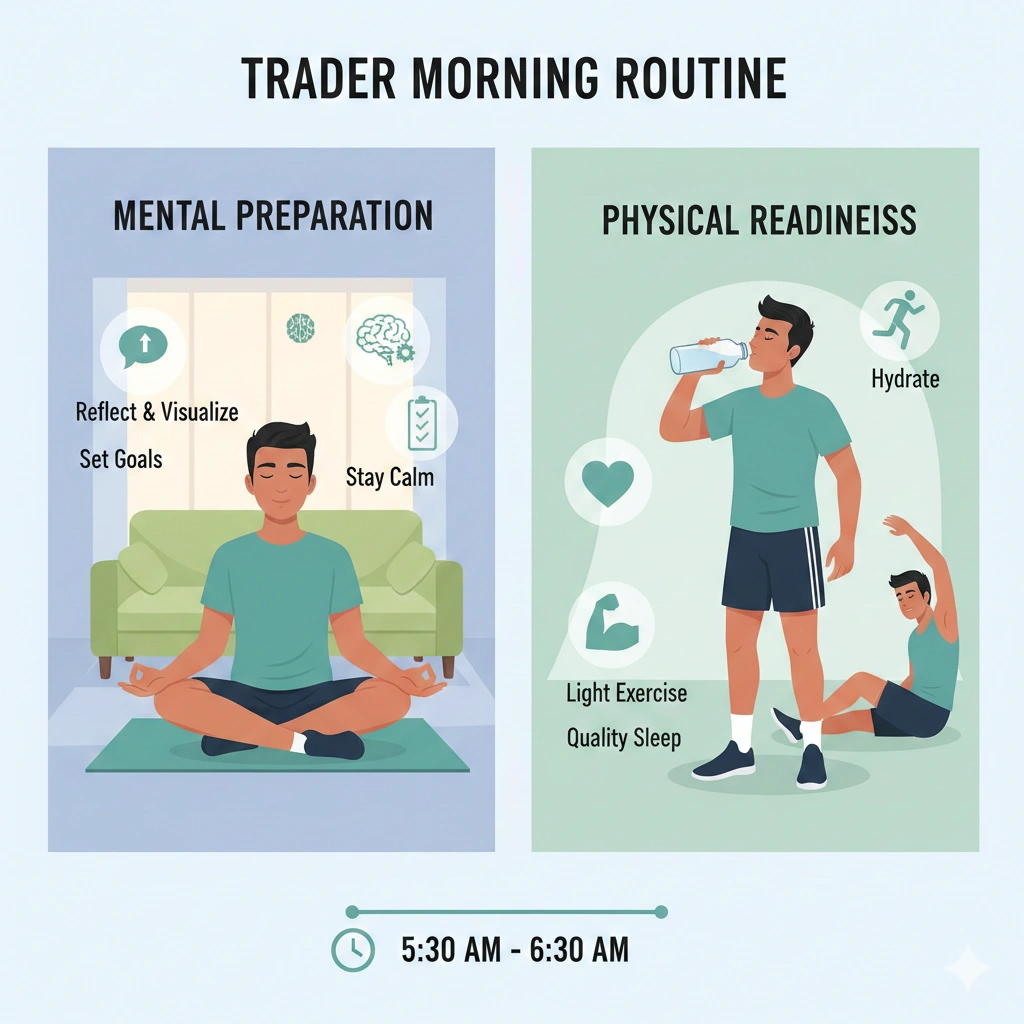
Trader Morning Routine – Preparing Mentally and Physically
Chirag, our example for day trader routine, begins his day early to ensure he is ready both physically and mentally. Because it’s important for you to stay focused and keep the emotions under control to trade.
Then he has some water and does some light stretches to relax his body. Reviews his past trades, sets goals for the day, and visualizes his setups. This mental warm-up is what keeps him calm and stops him from clicking ‘buy’ on a bad trade impulsively.
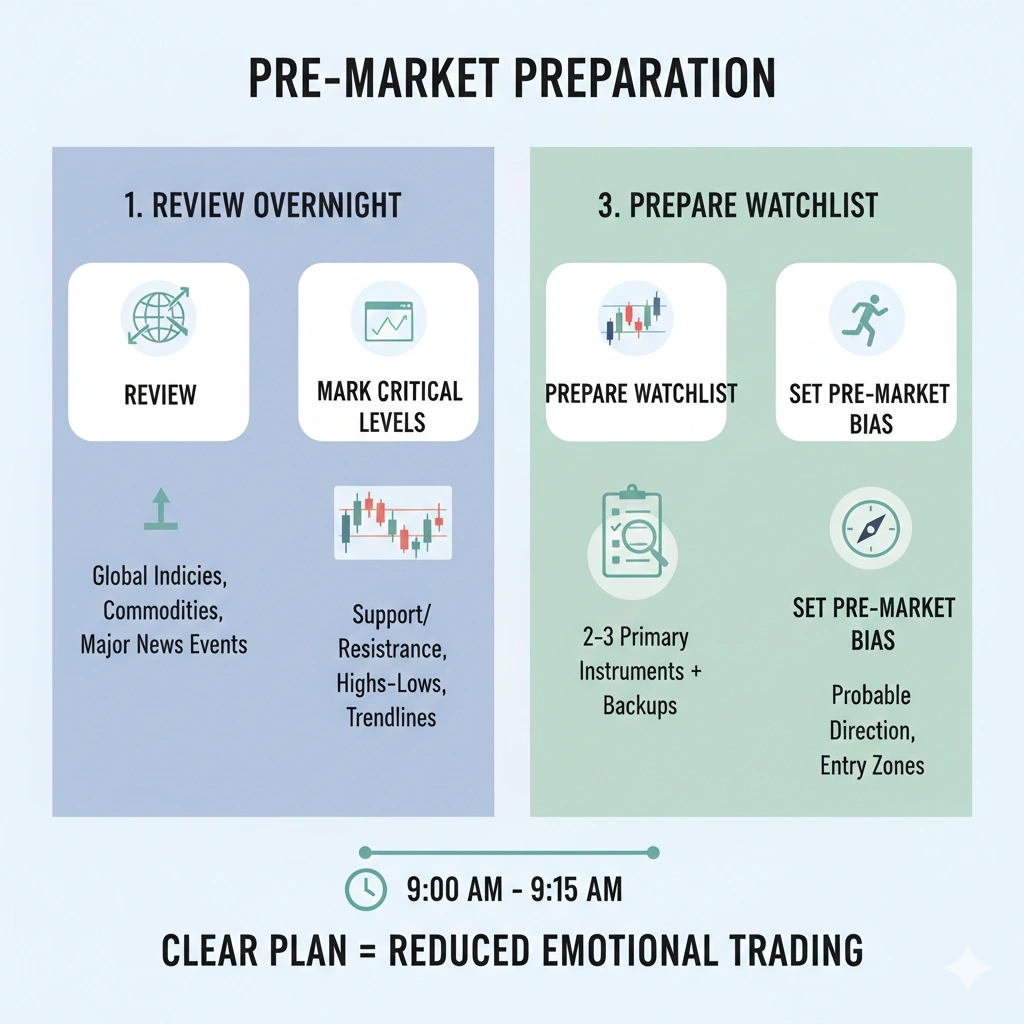
Pre-Market Preparation (9:00 AM – 9:15 AM)
Before the market opens at 9:15 AM, Chirag completes his pre-market preparation:
- Review overnight developments: Check global indices, commodities, and major news events.
- Mark critical chart levels: Mark your daily support and resistance, and find out where the liquidity is and trend lines are forming .
- Prepare a watchlist: Don’t try to pick 20-30 stocks. Stick to 2-3 setups that you find the best to prevent pressure.
- Set a pre-market bias: Try to identify the market conditions so that you don’t get shocked by sudden shifts in the market trends.
The Market Open: Controlled Chaos (9:15 AM – 11:30 AM)
The opening bell rings at 9:15 AM EST. This is when liquidity floods the market and volatility is at its peak. For a beginner, this is the most dangerous time; for a pro, it is the most profitable.
9:15 AM – 10:00 AM: The “Amateur Hour”
The first 30 minutes are often called “Amateur Hour” because inexperienced traders rush to buy or panic sell based on overnight news.
- Patience is key: the best move here is often to do nothing. Wait 5–10 minutes. Let the “whiplash” settle and wait for a clear direction to emerge.
- Executing the Plan: Remember that plan you made this morning? Once the dust settles, execute it without hesitation.
10:00 AM – 11:30 AM: The Golden Hours
By 10:00 AM, the fake-outs are usually over, and the true trend of the day reveals itself.
- Trend Following: By this time, usually the market picks a direction. You just need to realize it and then join it.
- Risk Management:
- The 1% Rule: Always stick to the rule of 1% risk.
- Stop Losses: Use proper stop-loss. Never leave your trade naked.
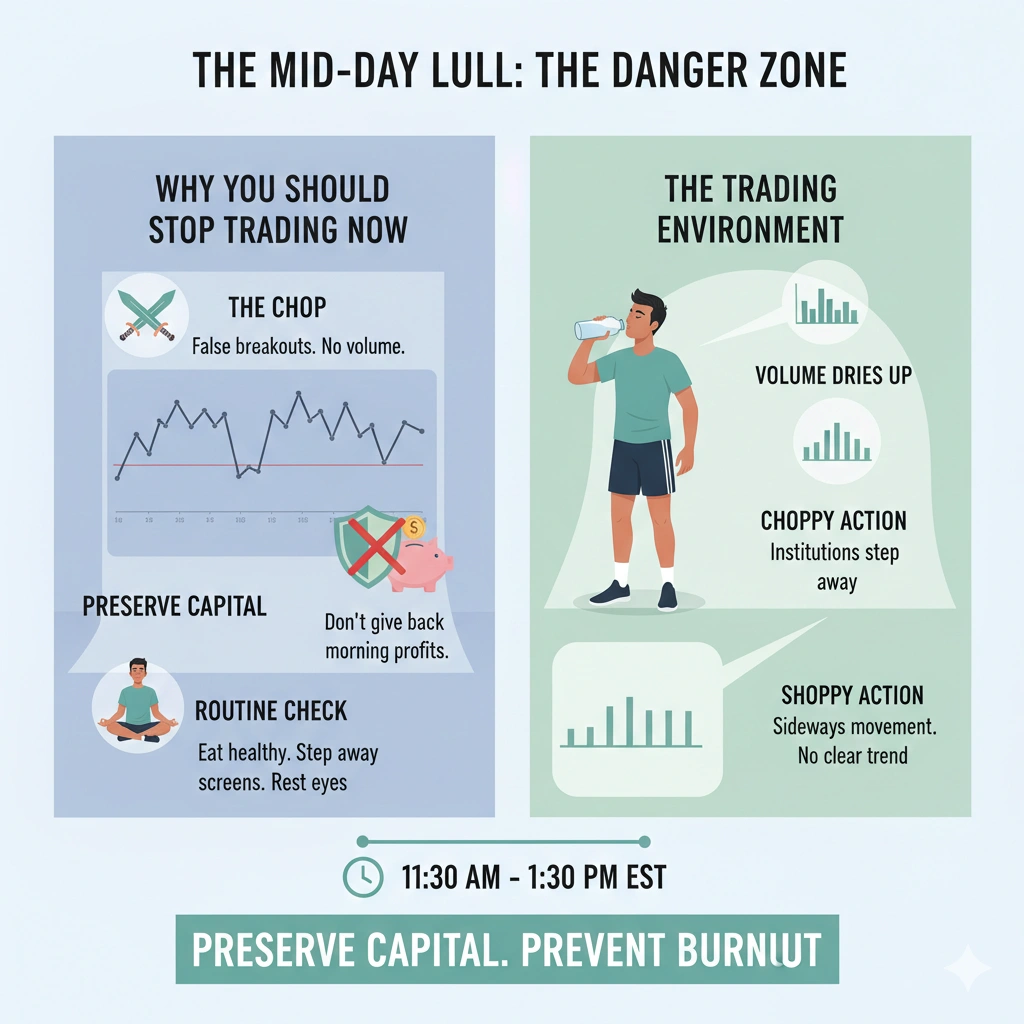
The Mid-Day Lull: The Danger Zone (11:30 AM – 1:30 PM)
During lunchtime the market slows down; big institutional players step away from their desks. When the big money leaves, the volume dries up, and stocks start moving in no clear direction.
Why You Should Stop Trading Now
One of the biggest mistakes in a daily trading workflow is over-trading during lunch.
- The Chop: Without volume the price moves in no fixed direction. You might see a breakout setup and buy it, only for it to immediately reverse.
- Preserve Capital: If you made money in the morning, stop. Don’t give it back to the market out of boredom.
- Routine Check: Use this time to eat a healthy lunch, step away from the screens, and let your eyes rest.
The Power Hour & The Close (2:00 PM – 3:30 PM)
Volume often returns in the afternoon as traders position themselves for the market close.
2:00 PM – 3:00 PM: The Setup
Traders return to their desks to see if the morning trends are holding or reversing.
- Reversals: Sometimes a stock that was up all day will start to sell off as day traders take their profits.
3:00 PM – 3:30 PM: Power Hour
The last half-hour of trading can be as volatile as the first.
- Closing Positions: At the end, your main goal is to protect your profits and close your positions. Don’t hold your trade overnight if you don’t want to wake up to gap down due to any bad news.
- The Final 15 Minutes: This period is often dominated by institutional algorithms balancing their books. It is usually too erratic for manual retail trading, so most experienced traders are done by 3:15 PM.
The Post-Market Routine: The Secret to Improvement (4:00 PM – 5:30 PM)
The market is closed, but your work isn’t done. To trade like a pro, you need to follow these steps:
4:00 PM – 4:30 PM: Journaling
Every professional business tracks its inventory; your inventory is your trades.
- Log the Details: Note down your entry price, exit price, position size, and the reason behind the trade.
- Emotional Check: How did you feel? Did you sell too early out of fear? Did you hold a loser too long out of stubbornness?
- Screenshots: Take a picture of the chart where you entered and exited. Learn from your mistakes to avoid them in the future.
4:30 PM – 5:30 PM: Review and Reset
- P&L Assessment: Look at your profit or loss for the day. If today it was red, learn why and then flush the stress. Do not hold grudges against the market for tomorrow.
- Preparation for Tomorrow: Start preparing for tomorrow. Check news and updates to avoid sudden shocks.

Lifestyle Habits That Support Trading Performance
Success in trading is reinforced by lifestyle choices:
- Maintain consistent sleep to enhance focus and reaction time.
- Eat healthy food rich in protein to stay focused and avoid fatigue.
- Do some light exercise or mindfulness practices to reduce stress and improve clarity.
- Take regular breaks from screens to avoid burnout and maintain focus.
- Maintain a structured daily schedule to support both trading and personal well-being.
Conclusion: Routine is Your Boss
In day trading, you have no boss telling you what to do. This freedom is a double-edged sword. Without a strict day trader routine, you will drift. You will take random trades, chase hype, and eventually blow up your account.
Think of your routine as your boss. It dictates your schedule, your entries, and your exits. Following InsightfulTrade’s guidance, remember that the goal isn’t to be a hero every day—it’s to be a survivor. Show up, do the prep, manage your risk, and stay in the game. That is how you win in the long run.
FAQs: Day Trader Routine
- What is the most important part of a day trader routine?
Pre-market preparation is crucial, as it sets the tone for disciplined trading and strategy alignment throughout the day. - How long should a trader’s morning routine last?
There is no fixed time for this, but it is a crucial time, so it should be at least 45–60 minutes for mental preparation, exercise, hydration, and market analysis. - How many trades should a professional day trader take in a day?
It’s not about quantity; it’s about quality. A good 1–3 high-quality trades is all you need. - Why is post-market reflection important?
It helps traders analyze performance, identify mistakes, and refine strategies for future sessions. - What lifestyle habits support trading performance?
Having a good night’s sleep, healthy food, exercise, mindfulness, and breaks in between to improve focus, emotional control, and decision-making.
Author: Kumkum Chandak
Experience: 3+ Years in Trading Research & Market Content Strategy
Kumkum Chandak is a trading content strategist and market research writer who specializes in simplifying technical analysis, trading tools, and strategy-driven educational content. Her work is optimized for EEAT, accuracy, and user intent, ensuring every article delivers practical insights for traders of all levels.
Risk Disclaimer:
All content is strictly educational and not financial advice. Trading involves substantial risk. Always perform your own analysis or consult a professional advisor.
Last Updated: 4 December 2025