
Quick Summary
CFD trading tax in Vietnam is often mistaken in Vietnam because these trades aren’t officially regulated for regular traders, yet the tax office still watches your earnings. While the legality of CFD is a bit of mystery without a formal framework, banks and tax officials care less about what you’re trading and more about your income and paperwork. This guide explains how these taxes work in real life, why things are so uncertain and how you can manage your paper work and stay compliant.
Snapshot Overview
| Aspect | Current Position in Vietnam |
| CFD trading legality | Not explicitly regulated |
| Licensed CFD brokers | Not available domestically |
| Offshore CFD platforms | Common but unregulated |
| Dedicated CFD tax rules | Not defined |
| Enforcement focus | Income source & capital flow |
Who This Guide Is For
- Vietnamese residents trading CFDs on offshore platforms
- Freelancers or investors receiving foreign trading income
- Traders unsure how to report CFD profits without clear laws
The Core Problem: Why CFD Trading Tax in Vietnam Is Unclear
A lot of traders feel like CFDs are invisible to the authorities. Since most of the platforms are from abroad and there aren’t any local brokers, people often think: if the law doesn’t officially recognise CFDs how can they tax them? This logic confuses a lot of people about the CFD trading tax in Vietnam.
The issue exists because:
- Vietnam doesn’t officially recognize CFDs for regular investors
- There’s no specific tax law for CFD income
- Authorities just use income rules instead
All of this leads to questions about the CFD legality in Vietnam and their actual tax duties.
Regulatory Bodies Involved in CFD & Tax Oversight (Vietnam)
While Vietnam has no dedicated CFD framework, oversight touches multiple authorities:
- State Bank of Vietnam (SBV): Controls capital flows, foreign currency transfers, and payment channels
- General Department of Taxation (GDT): Oversees personal income tax and income reporting
- Securities regulators: Focus mainly on listed and institutional products, not retail CFDs
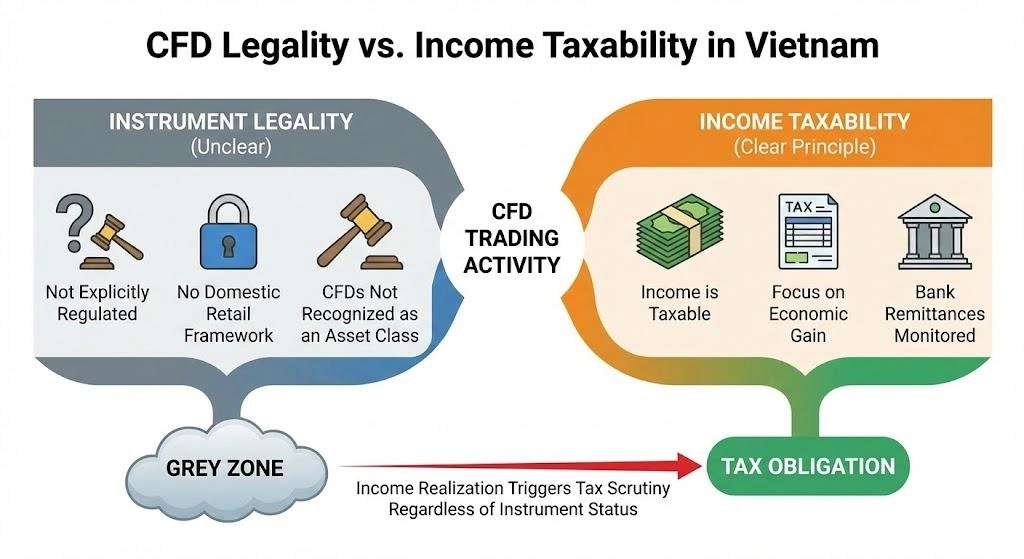
The absence of a single governing body is the main reason CFDs fall into a compliance grey zone.
Why Vietnam Has No Clear CFD Framework
Understanding the reason behind uncertainty will help explain the risk involved.
1. CFDs Are Considered High-Risk Instruments
Regulators associate CFDs with:
- High leverage
- Fast losses
- Retail investor harm
Vietnam’s regulators have always been cautious toward these kinds of speculative tools.
2. Focus on Institutional Markets
Vietnam prioritizes:
- Banking stability
- Controlled capital flows
- The traditional stock market
The policy does not regulate retail derivatives trading which enables CFDs to function without any formal regulation.
3. Offshore Nature of CFD Trading
Most of the CFD trader from Vietnam trade through:
- funds from abroad
- Foreign-currency accounts
- Sending money across borders
This makes direct regulation a bit difficult, but it doesn’t mean you’re exempted from tax duties.
CFD Legality in Vietnam: What Is (and Isn’t) Prohibited
You need to separate legality from official recognition.
What Is Clear
- No local CFD broker have a licence
- Promoting CFD service locally can lead to penalties
- Working as an agent can be risky
What Is Unclear
- Trading CFD on your own
- Trading through foreign platforms with your own cash
- Trading privately without recruiting others
These undefined areas are exactly how CFD legality in Vietnam works.
Why Tax Still Applies Even If CFDs Are Unregulated
Here’s where most of the traders slip, they assume they don’t need to pay tax on CFD due to its legality issues in Vietnam. But that’s not correct.
Tax Law Focuses on Income, Not Instruments
Here’s how income tax works in Vietnam:
- Income generation
- Economic benefit
- Residency and remittance
All these incomes are taxable under the law, they don’t need any instrument to be legal to be taxable.
The same logic is applied to:
- Crypto income
- Online freelancing
- Overseas investment profits
Vietnam’s tax system operates on income realization, not product approval. Once income is earned and traceable to a resident individual, it may fall under personal income tax assessment regardless of how the income was generated.
Is CFD Trading Income Taxable in Vietnam?
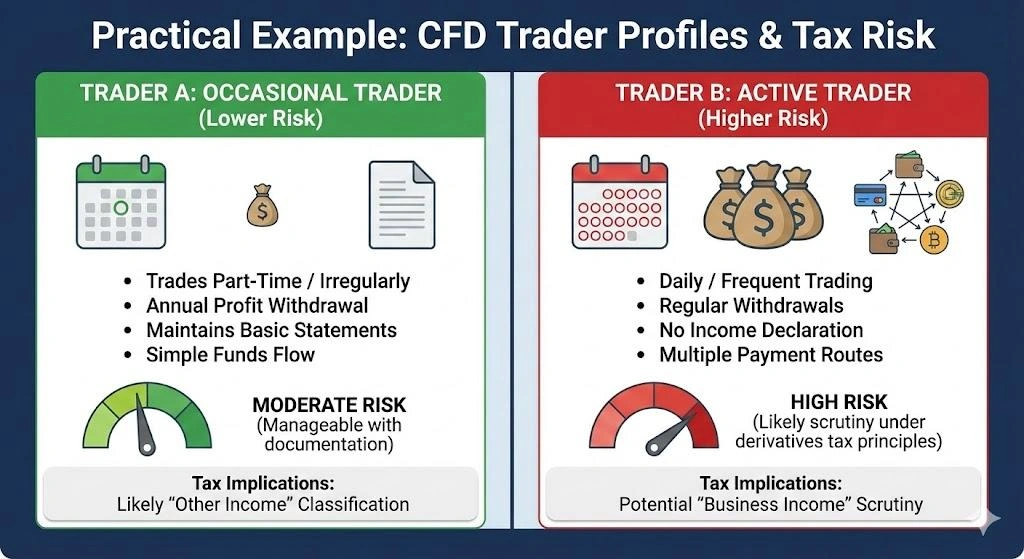
There isn’t any specific law in Vietnam related to CFD trading, but the money you earn through trading will be taxed as general income.
Why CFD Profits Can Be Taxable
- Profit counts in financial gains
- You’re bringing money in Vietnam
- Bank accounts act as reporting checkpoints
If you want to stay on the right side of the law, please maintain the decorum of CFD trading tax in Vietnam.
How CFD Income Is Usually Classified
Here’s how you can easily classify the taxable income under CFD trading:
1. Other Income
Most common for:
- Occasional traders
- Irregular profits
- Personal trading activity
2. Business or Self-Employment Income
More likely if:
- You trade more often
- It’s your main source of income
- You use a systematic strategies
Now that you know how to classify the income you must also know how it affects things like:
- Reporting format
- Documentation depth
- Audit likelihood.
Role of Banks in CFD Tax Scrutiny
Even though Banks are not tax collectors, they act like a monitor and keep an eye on your actions.
Why Banks Matter
- Monitor the source of money
- Flag frequent or repeated transactions
- Ask for proof of where your fund scheme from
The profit entering your account from CFD trading can raise questions even if you are trading through a platform from abroad.
Documentation: The Core Defense for CFD Traders
Since the things are uncertain related to CFD legality in Vietnam, keeping proper records is the best way to protect yourself from trouble.
Essential Records to Maintain
- Broker account statements
- Trade history and P&L reports
- Deposit and withdrawal records
- Exchange rate records
- Bank transfer receipts
Solid paperwork shows you’re trying to follow the rules, which matters if you’re ever checked.
Reporting CFD Income: Practical Approaches
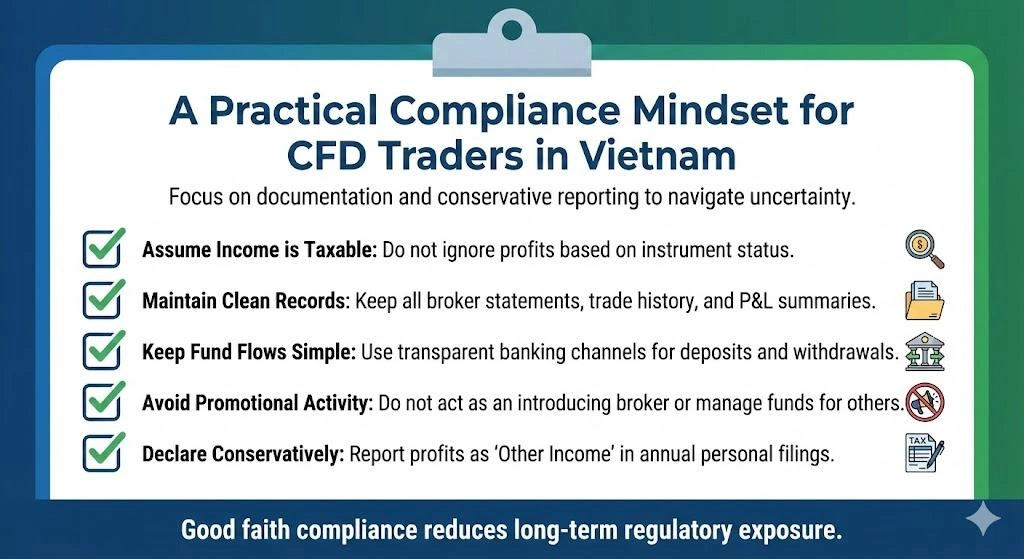
Due to the lack of a specific income genre for CFD trading tax in Vietnam, traders often take a cautious approach.
Common Safe Path
- Report profit as other income
- Use your yearly personal tax forms
- Keep all the records for backup
This helps in lowering your risk rather than getting every detail perfect.
Why Non-Reporting Is Riskier Than Over-Reporting
A lot of traders avoid reporting their earnings because they’re afraid of being noticed.
Risks of Ignoring CFD Trading Tax
- Freeze your accounts
- Surprise tax bills from the past
- Fines for lying
The large, unreported income always grab more attention of regulators, not the regular people being honest about their income.
Derivatives Tax: Why CFDs Are Viewed Cautiously
Around the world, taxes on derivatives are tougher because:
- Leverage makes gains and losses bigger
- Your earning can swing sharply
- The risk of money leaving the country increases
Vietnam’s careful approach to these taxes fits right in this global trend.
Vietnam vs India: A Useful Comparison
Comparing Indian law you can guess where Vietnam might be headed.
India’s Position
- CFDs largely restricted
- Derivatives income taxable as business income
- Enforcement focuses on income reporting
Tools related to trading are still unclear in Vietnam but could follow a similar part with India in future.India offers a reference model where derivative income is taxed based on activity frequency and intent. Vietnam has not adopted such classification yet, but income-based assessment remains common in both systems.
Why Vietnam Has Not Clarified CFD Tax Rules Yet
Here are a few reasons behind the delay:
- CFDs is not officially recognized yet
- Overlapping rules between the SBV and tax authorities
- Traditional income source being the priority
Until things change, CFD trading tax in Vietnam relies on general principles.
A Practical Compliance Mindset for CFD Traders
As a CFD trader rather than looking for shortcuts you should:
- Assume your profits as taxable income
- Keep your paperwork tidy
- Make your money moves easy to trace
- Avoid promotional activity
This mindset shows that you’re a tax-compliant.
Conclusion: CFD trading tax in Vietnam
To wrap it up, CFD trading tax in Vietnam is still quite uncertain about tax policies, but you still need to follow the existing rules. Till the legality for regular traders is defined, any money you earn will be taxed under other incomes, especially once you bring the profit back home. The best way to handle this uncertainty is by keeping great records and being honest in your reporting.
For more updates on global trading rules and tax trends, sites like InsightfulTrade provide excellent analysis to help you understand markets like Vietnam.
FAQs: CFD trading tax in Vietnam
1. Is CFD trading legal in Vietnam?
CFD trading is not officially regulated yet in Vietnam, therefore it currently sits in a grey area.
2. Is CFD trading income taxable in Vietnam?
There is no specific law for it, but profits may still be taxable under general income principles.
3. Are CFD trading tools like MT4 or MT5 illegal?
No. These tools are normally used in trading, there’s no legality issue here until the broker and usage enter the case.
4. How does Vietnam compare with India on CFD tax?
India has clearer enforcement. Vietnam relies more on discretionary assessment.
Author: Kumkum Chandak
Experience: 3+ Years in Trading Research & Market Content Strategy
Kumkum Chandak is a trading content strategist and market research writer who specializes in simplifying technical analysis, trading tools, and strategy-driven educational content. Her work is optimized for EEAT, accuracy, and user intent, ensuring every article delivers practical insights for traders of all levels.
Risk Disclaimer:
All content is strictly educational and not financial advice. Trading involves substantial risk. Always perform your own analysis or consult a professional advisor.
Last Updated: 3 February 2026