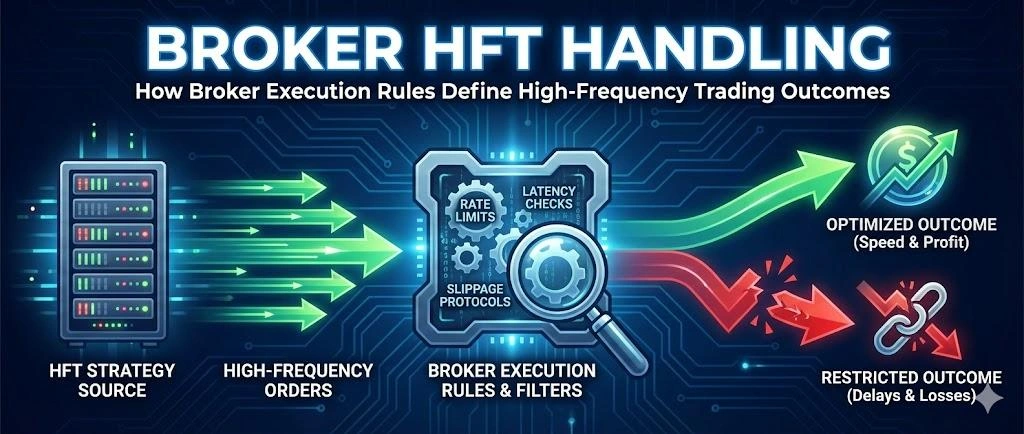
According to Finance Magnates data, 66.6% of all FX/CFD website traffic globally originates from Asia — yet most Asian traders are unaware of how broker restrictions can directly limit their execution, leverage, and withdrawal access.
Quick Summary
Broker restrictions for Asian traders are a significant but often misunderstood aspect of trading performance. Many traders focus on strategy development and cost comparison but overlook how trading limitations in Asia and broker rules directly affect execution flexibility, leverage access, instrument availability, and even withdrawal processes. Restrictions can vary depending on jurisdiction, regulatory framework, and broker policy. This guide explains why broker restrictions for Asian traders exist, how they impact execution and performance, and how traders can evaluate brokers responsibly while staying compliant with regional laws.
Who Is This For?
This guide is for beginner traders in India, Malaysia, Singapore, Indonesia, and Thailand who are opening their first live account. If you’re searching for how to choose a broker in Asia, confused about regulated forex brokers for Indian traders, wondering about broker restrictions for Asian traders, or just starting with forex trading for beginners in India — this guide walks you through every trading limitation in Asia you’ll actually face, in plain language.
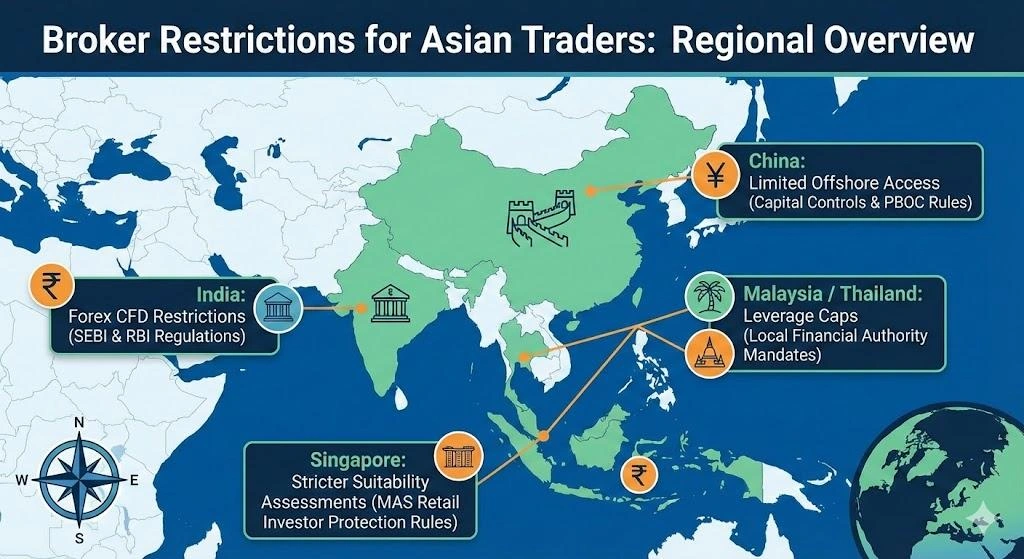
At a Glance: Common Broker Restrictions by Region
| Region | Common Restriction | Primary Reason |
|---|---|---|
| India | Forex CFD restrictions on non-INR pairs | SEBI & RBI regulations |
| China | Limited access to offshore brokers | Capital controls & PBOC rules |
| Malaysia / Thailand | Leverage caps on retail accounts | Local financial authority mandates |
| Indonesia | Restrictions on crypto-linked instruments | OJK regulatory oversight |
| Singapore | Stricter suitability assessments | MAS retail investor protection rules |
| Japan | 1:25 leverage cap, offshore brokers banned | FSA (Financial Services Agency) |
| Philippines | Offshore brokers must register locally | SEC Philippines |
Why Do These Broker Restrictions Even Exist?
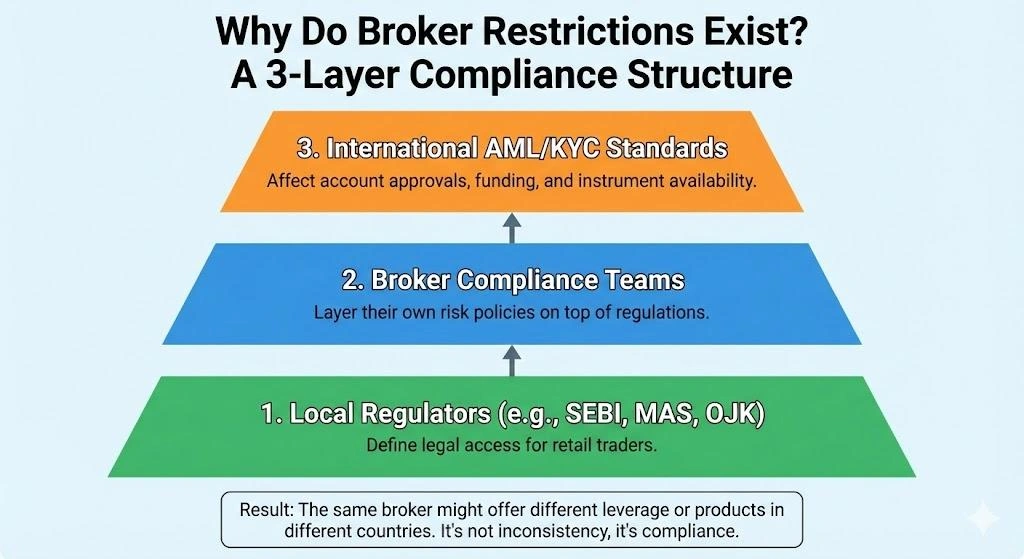
Many new traders assume broker restrictions are random — they are not. Broker restrictions for Asian traders come from three layers:
- Local regulators — SEBI/RBI in India, MAS in Singapore, OJK in Indonesia each define what retail traders can legally access
- Broker compliance teams — brokers layer their own risk policies on top of regulatory requirements
- International AML/KYC standards — cross-border obligations affect account approvals, funding, and instrument availability
The result: the same broker may offer 1:100 leverage in one country and cap it at 1:30 in another. That is not inconsistency — it is compliance. The legal risk of bypassing broker rules always falls on the trader, not the platform.
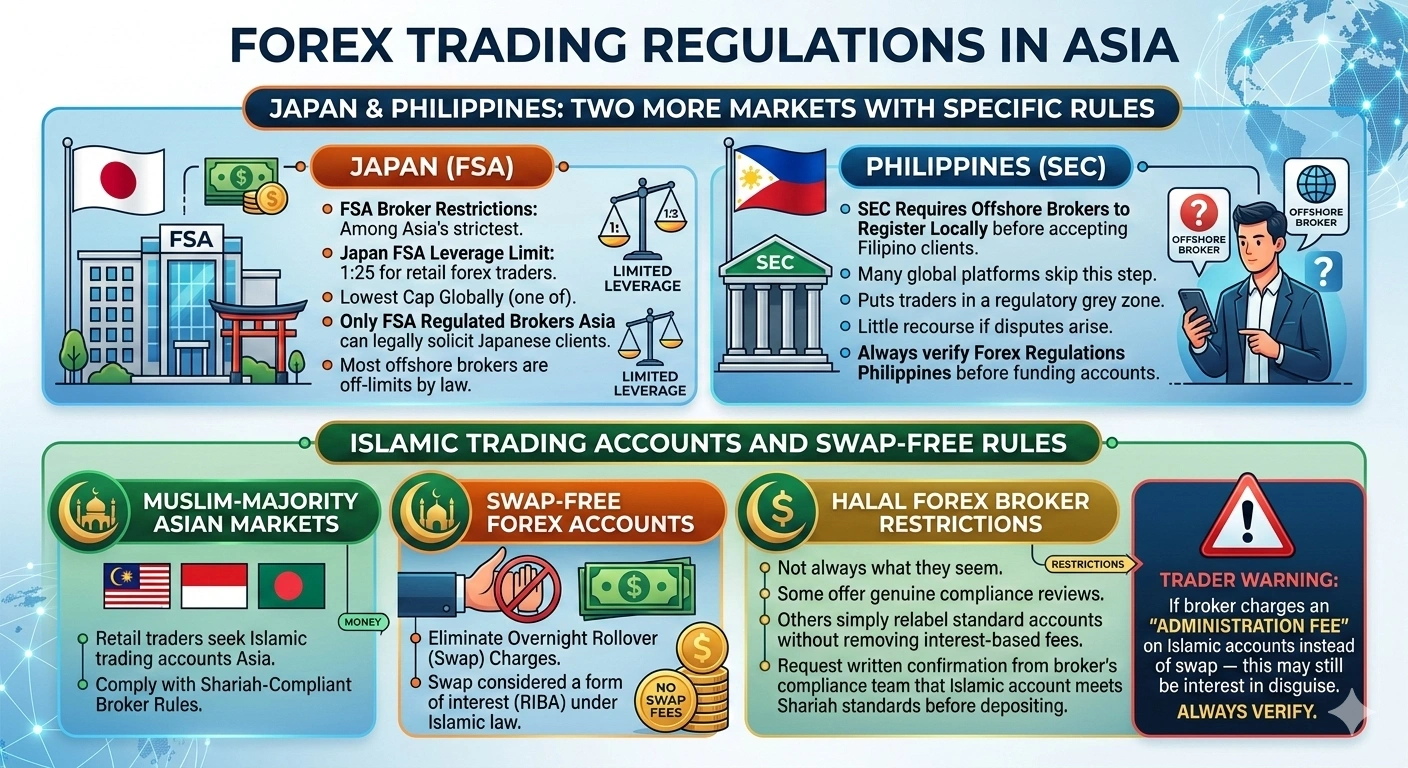
Japan and Philippines: Two More Markets with Specific Rules
Japan FSA broker restrictions are among Asia’s strictest. The Financial Services Agency (FSA) enforces a Japan FSA leverage limit of 1:25 for retail forex traders — one of the lowest caps globally. Only FSA regulated brokers Asia can legally solicit Japanese clients, meaning most offshore brokers are off-limits by law.
In the Philippines, the SEC requires offshore brokers to register locally before accepting Filipino clients. Many global platforms skip this step, putting traders in a regulatory grey zone with little recourse if disputes arise. Always verify forex regulations Philippines before funding any account.
Islamic Trading Accounts and Swap-Free Rules in Muslim-Majority Asian Markets
In Malaysia, Indonesia, and Bangladesh, many retail traders specifically look for Islamic trading accounts Asia that comply with Shariah-compliant broker rules. These swap-free forex accounts for Muslim traders eliminate overnight rollover (swap) charges — which are considered a form of interest (riba) under Islamic law.
However, halal forex broker restrictions aren’t always what they seem. Some brokers offer genuine Islamic accounts with full compliance reviews, while others simply relabel standard accounts without removing all interest-based fees. Always request written confirmation from the broker’s compliance team that their Islamic account meets Shariah standards before depositing.
Trader Warning: If a broker charges an “administration fee” on Islamic accounts instead of swap — this may still be interest in disguise. Always verify.
The Most Common Trading Limitations in Asia
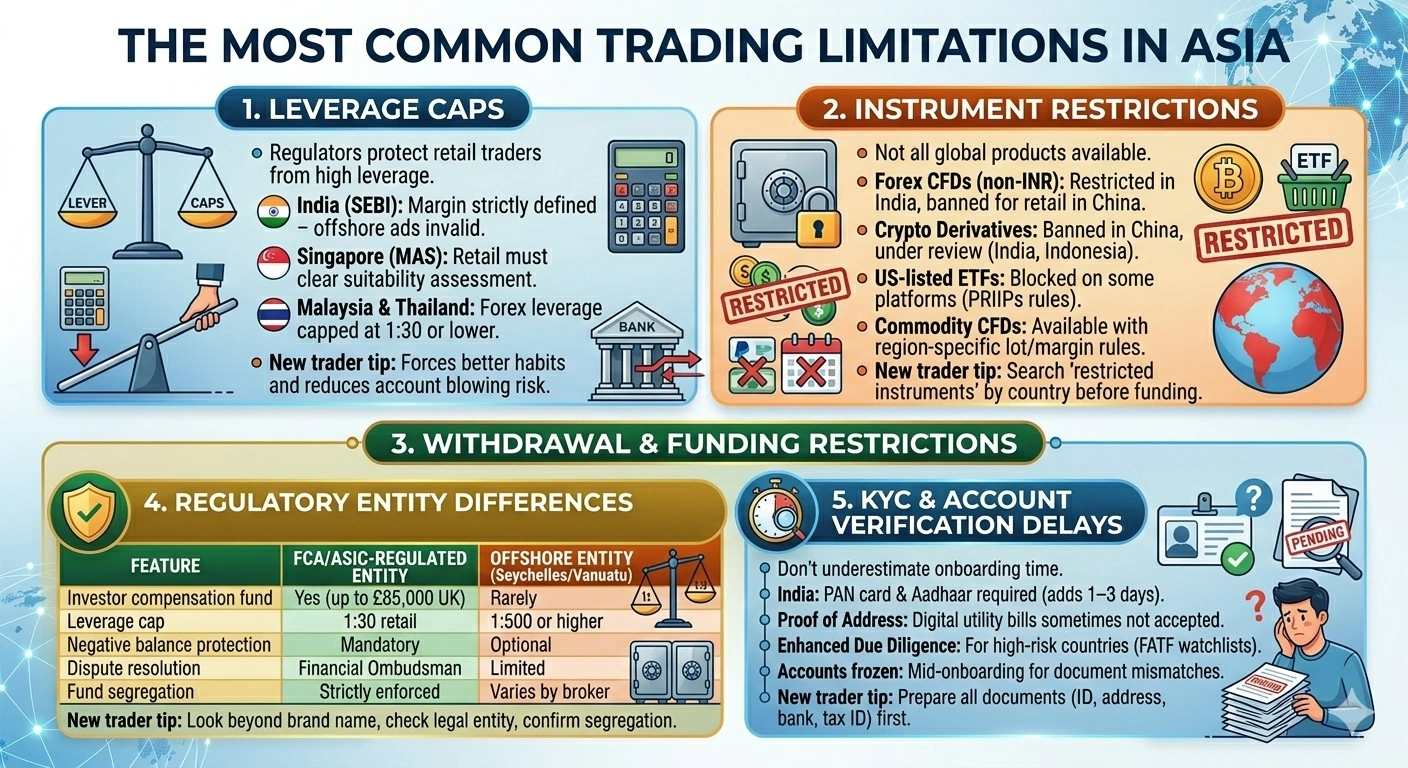
1. Leverage Caps
Leverage is the first friction point most traders notice. Regulators across Asia have moved toward lower caps to protect retail traders — because high leverage multiplies losses just as fast as it multiplies gains.
What new traders need to know:
- India (SEBI): Margin requirements for equity derivatives are strictly defined — offshore broker ads showing higher leverage do not apply to Indian residents
- Singapore (MAS): Retail traders must clear a suitability assessment before accessing leveraged products
- Malaysia & Thailand: Retail forex leverage is often capped at 1:30 or lower
New trader tip: Lower leverage is not always bad — it forces better position sizing habits and reduces the risk of blowing an account early
2. Instrument Restrictions
Not every product visible on a global platform is actually available to you. Broker restrictions for Asian traders on instruments commonly include:
- Forex CFDs on non-INR pairs — restricted in India, banned for retail in China
- Crypto derivatives — banned in China, under review in India and Indonesia
- US-listed ETFs — blocked on some platforms due to PRIIPs rules tied to the broker’s EU entity
- Commodity CFDs — available in most markets but with region-specific lot and margin rules
New trader tip: Always search your country name in the broker’s “restricted instruments” or “product disclosure” section before funding. What you see on the homepage may not be what you get in your account.
3. Withdrawal and Funding Restrictions
This is where many new Asian traders get caught off guard. Broker rules around funding vary widely and the friction often happens at the bank level, not the broker level.
Common issues:
- International wire transfers blocked or delayed by local banks
- Skrill, PayPal, or Neteller unavailable for trading accounts in certain markets
- Currency conversion fees on mandatory local-currency deposits
- Withdrawal hold periods of 3–7 business days due to AML reviews
India-specific: Sending USD to an offshore broker requires purpose coding under the Liberalised Remittance Scheme (LRS). Banks can — and do — reject transfers that don’t meet their internal criteria, even if the broker accepts them.
New trader tip: Test a small withdrawal before committing significant capital. This tells you exactly how long the process takes and whether your payment method actually works end-to-end.
4. Regulatory Entity Differences
| Feature | FCA/ASIC-Regulated Entity | Offshore Entity (Seychelles/Vanuatu) |
|---|---|---|
| Investor compensation fund | Yes (up to £85,000 UK) | Rarely |
| Leverage cap | 1:30 retail | 1:500 or higher |
| Negative balance protection | Mandatory | Optional |
| Dispute resolution | Financial Ombudsman | Limited |
| Fund segregation | Strictly enforced | Varies by broker |
New trader tip: Look beyond the brand name. Find the exact legal entity your account is registered under, check which regulator oversees it, and confirm whether client funds are held in segregated accounts.
5. KYC and Account Verification Delays
New traders often underestimate how long account verification takes across Asian markets. Broker restrictions for Asian traders at the onboarding stage include:
- PAN card and Aadhaar verification required for Indian accounts (adds 1–3 business days)
- Proof of address requirements that don’t accept digital utility bills in some jurisdictions
- Enhanced due diligence for high-risk countries — which several APAC nations fall under on FATF watchlists
- Accounts frozen mid-onboarding if documents don’t match broker compliance standards
New trader tip: Prepare all documents before starting the application — ID, address proof, bank statement, and tax ID. Incomplete submissions are the single biggest cause of delayed account openings.
How Trading Platform Availability Is Affected by Broker Restrictions
When researching broker restrictions for Asian traders, most people focus on leverage and instruments — but platform access is equally affected. MT4 MT5 broker availability Asia varies significantly depending on which legal entity your account falls under. Some brokers onboard Asian traders through their offshore entity, which may offer slower execution speeds, fewer automated trading features, or a stripped-down MT5 version compared to what EU/UK clients receive on the same brand.
For traders asking about the best trading platform for Indian traders specifically — MT4/MT5 operates in a different legal standing than NSE/BSE-approved platforms under SEBI. The MT4/MT5 you use for forex CFDs is not the same as a SEBI-regulated equity derivatives platform, even if the interface looks identical. Understanding MetaTrader restrictions by country before you fund is critical — because switching platforms after deposit can mean restarting KYC entirely.
New Trader Tip: Always open a demo account first to confirm which platform version your region gets — not the version shown in the broker’s promotional videos.
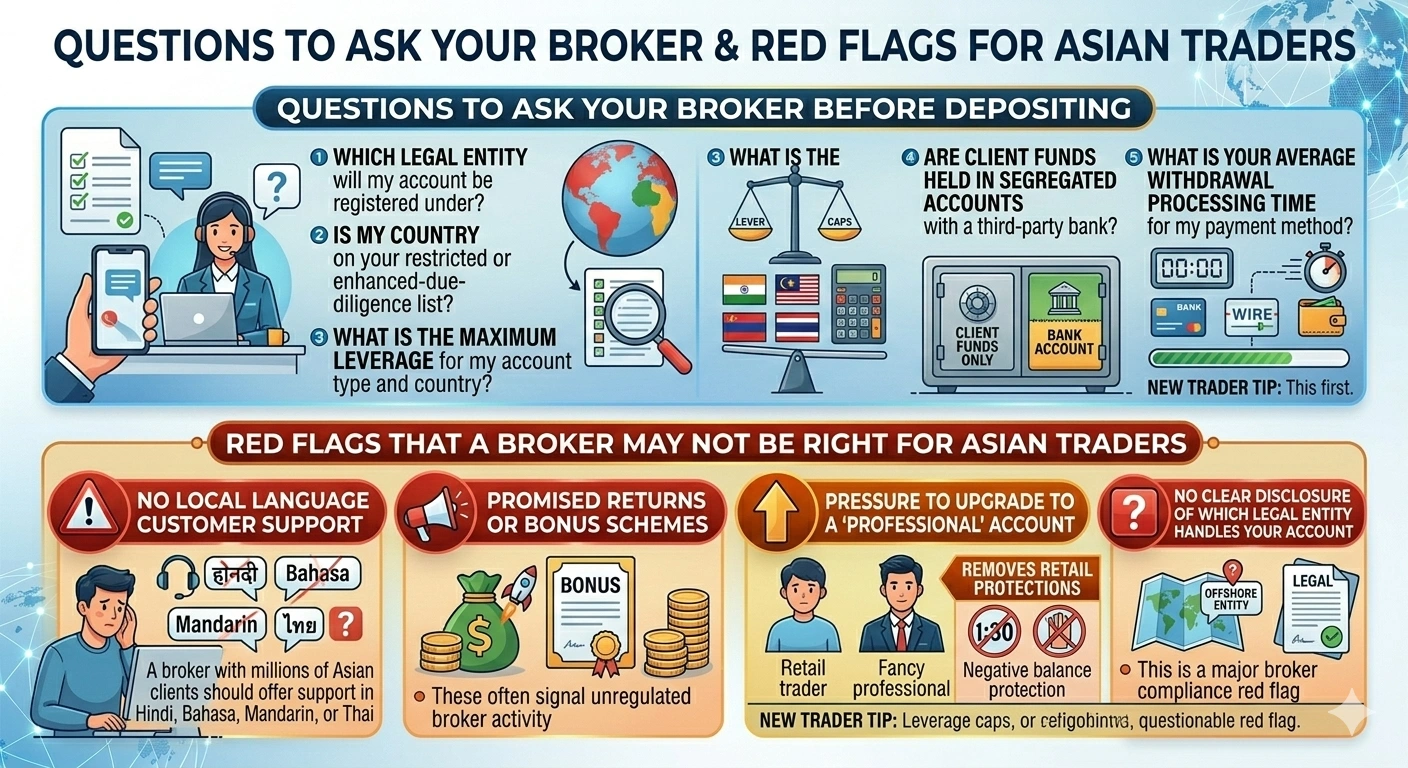
Questions to Ask Your Broker Before Depositing
Before funding any live account, ask these directly:
- Which legal entity will my account be registered under?
- Is my country on your restricted or enhanced-due-diligence list?
- What is the maximum leverage for my account type and country?
- Are client funds held in segregated accounts with a third-party bank?
- What is your average withdrawal processing time for my payment method?
Red Flags That a Broker May Not Be Right for Asian Traders
Watch for these warning signs:
- No local language customer support — a broker with millions of Asian clients should offer support in Hindi, Bahasa, Mandarin, or Thai
- Promised returns or bonus schemes — these often signal unregulated broker activity
- Pressure to upgrade to a “professional” account — this removes retail protections like leverage caps and negative balance protection
- No clear disclosure of which legal entity handles your account — this is a major broker compliance red flag
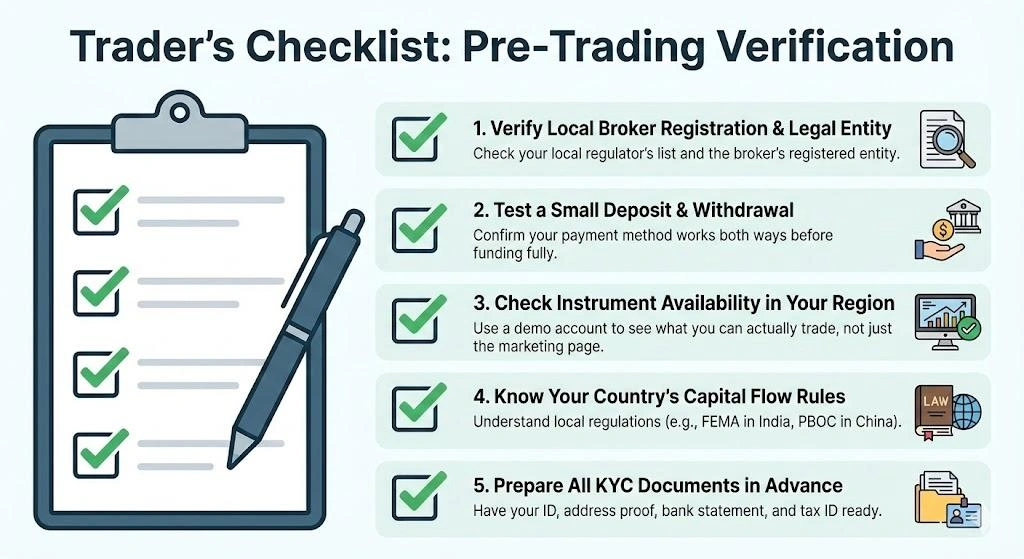
What Traders Can Do: A Quick Checklist
Before opening any live account, run through this list:
- Verify local broker registration — Check SEBI’s registered intermediaries list in India, or your local regulator’s equivalent
- Confirm which legal entity your account falls under — Not the brand, the actual registered entity and its regulator
- Test your payment method — Confirm deposits and withdrawals work in your country before funding fully
- Check instrument availability in your region — Use a demo account to verify this, not just the marketing page
- Know your country’s capital flow rules — FEMA in India, PBOC rules in China, OJK guidelines in Indonesia
- Prepare KYC documents in advance — ID, address proof, bank statement, tax ID ready before you start
Conclusion: Broker Restrictions for Asian Traders
Broker restrictions for Asian traders exist to protect retail participants — not to limit opportunity. Understanding leverage caps, instrument availability, KYC requirements, and withdrawal rules across India, Singapore, Malaysia, Indonesia, Japan, and the Philippines gives you a real edge before you fund. Use the checklist above, verify your broker’s legal entity, and trade within your region’s regulatory framework. Insightful Trade can help you identify the right broker and build a compliant, disciplined trading approach from day one.
FAQs: Broker Restrictions for Asian traders
Q: Why do broker restrictions for Asian traders differ by country?
Each country has its own financial regulator — SEBI in India, MAS in Singapore, OJK in Indonesia, FSA in Japan — each defining different rules for leverage, instruments, and account access. A broker must comply with every jurisdiction it operates in, which is why the same platform offers different conditions to traders in different countries.
Q: Is forex trading regulated in India?
Yes. SEBI and RBI regulate forex trading in India. Retail traders can only legally trade currency pairs involving INR (USD/INR, EUR/INR etc.) on NSE/BSE-approved platforms. Trading forex CFDs on non-INR pairs through offshore brokers falls outside SEBI’s framework and carries legal risk.
Q: Which brokers are allowed for Indian traders?
Only brokers registered with SEBI as authorized intermediaries are fully legal for Indian residents. Offshore brokers may accept Indian sign-ups but operate outside RBI/SEBI oversight, which limits your legal protection.
Q: What is the maximum leverage allowed for retail forex traders in Asia?
It varies by country — Japan caps at 1:25 (FSA), Singapore and Malaysia typically at 1:30 (MAS), while offshore brokers may advertise 1:500 but those limits don’t legally apply to residents of regulated markets.
Q: Are Islamic swap-free accounts available across Asia?
Yes, many brokers offer swap-free Islamic accounts for traders in Malaysia, Indonesia, and Bangladesh. However, always verify in writing that the account is genuinely Shariah-compliant and not a rebranded standard account with hidden administration fees.
Author: Kumkum Chandak
Kumkum Chandak Trading Research Writer & Market Content Strategist
Kumkum Chandak specializes in retail trading education, broker compliance, and financial market analysis across Asian markets. With over 3 years of experience covering forex regulations, trading platform comparisons, and risk management strategies, her work has helped thousands of retail traders navigate broker rules across India, Southeast Asia, and beyond. She focuses on making complex regulatory and execution concepts accessible to first-time and intermediate traders.
Risk Disclaimer: All content on this page is strictly educational and does not constitute financial or investment advice. Forex and CFD trading involves substantial risk of loss and is not suitable for all investors. Leverage can work against you as much as in your favour. Always conduct your own due diligence and consult a licensed financial advisor before making any trading decisions. Regulatory rules mentioned in this article are subject to change — verify current conditions with your local financial authority.
Last Updated: 27 February 2026