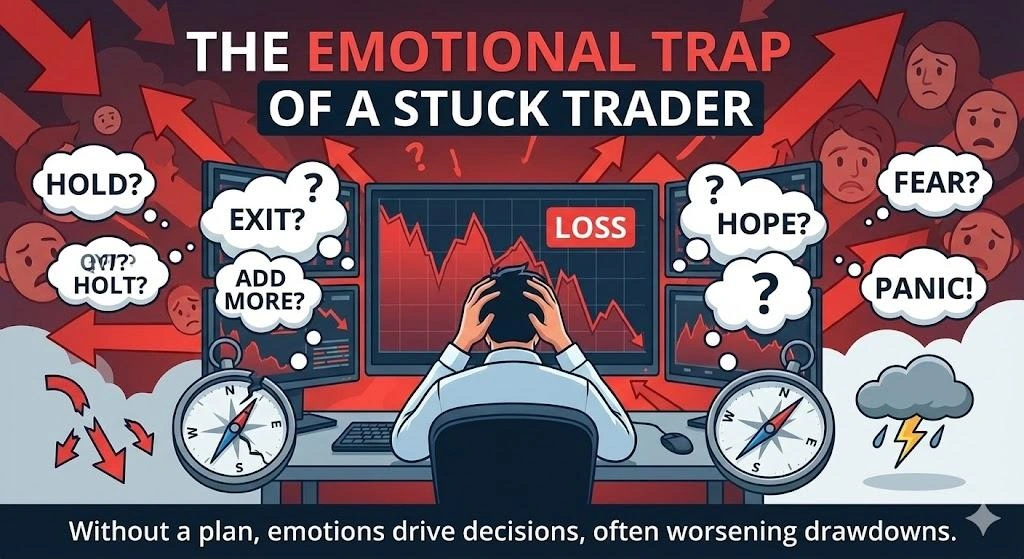
We’ve all been in a situation – where we are looking at the deep red chart, with a heavy feeling in the stomach wondering if we should exit or wait for a miracle. This is the moment when emotions take over and we start moving on the basis of hope, which makes the situation worse, turning manageable losses into long-term drawdowns. By using an averaging calculator trading tool, you can easily calculate your next move based on clarity rather than prayer. Today, we’ll discuss how a position averaging calculator works, and how you can make a disciplined plan to recover your losses from a losing trade without gambling.
Understanding Position Averaging in Trading
When in an existing trade you add more positions at different price levels to improve the overall average entry is called position averaging. But it’s successful only if it’s done with strategy and discipline. Otherwise it’s considered as gambling where you’re hoping for a miracle.
What Position Averaging Really Means
Position averaging is not about “throwing more money at a bad trade.” Instead, it involves:
- Adding capital only when you spot a strong reversal sign on the chart based on technical or fundamental reasoning.
- Reducing the average entry price to make breakeven or recovery more realistic.
- Managing risk by calculating exposure before placing additional trades.
Without calculations, traders often underestimate how much price movement is needed to recover after averaging down.
What Is an Averaging Calculator Trading Tool?
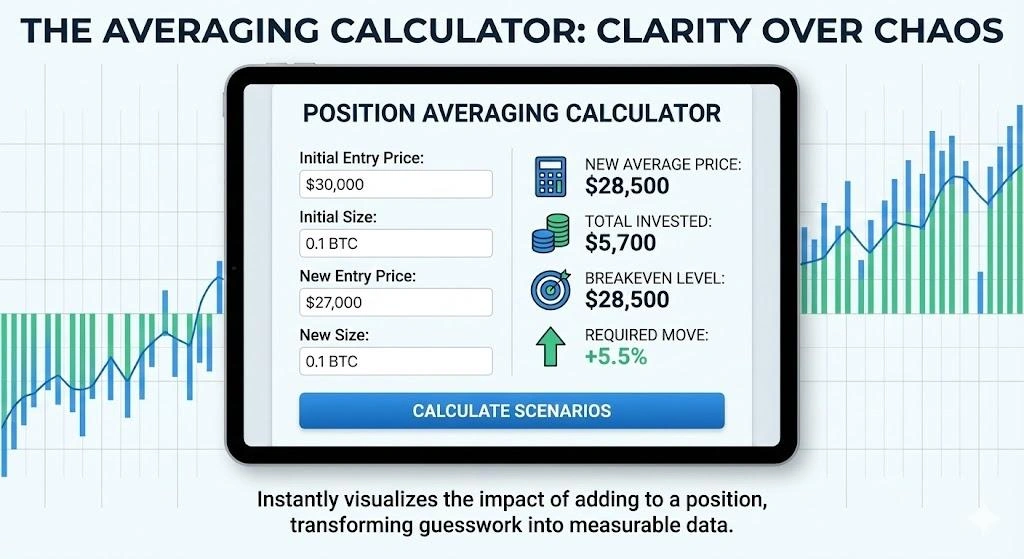
An averaging calculator trading tool is designed to show traders exactly how additional entries affect their average buy price, total position size, and breakeven level. This clarity helps traders make informed decisions instead of emotional ones.
Core Functions of an Average Buy Price Tool
A reliable average buy price tool typically provides:
- The updated average entry price after adding new positions.
- The total invested capital and position size.
- The price level required to reach breakeven or a specific profit target.
These calculations allow traders to visualize outcomes before committing more capital.
Why Stuck Traders Need an Averaging Calculator
Traders feel “stuck” when price moves against them and emotions cloud judgment. An averaging calculator trading workflow brings logic back into the process.
Common Problems Faced by Stuck Traders
Many traders experience similar challenges when managing losing trades:
- They add positions without knowing how much price recovery is needed.
- They underestimate how quickly position size grows.
- They rely on hope instead of a structured recovery losing trades method.
Using a calculator transforms uncertainty into measurable scenarios.
How an Averaging Calculator Trading Workflow Actually Works
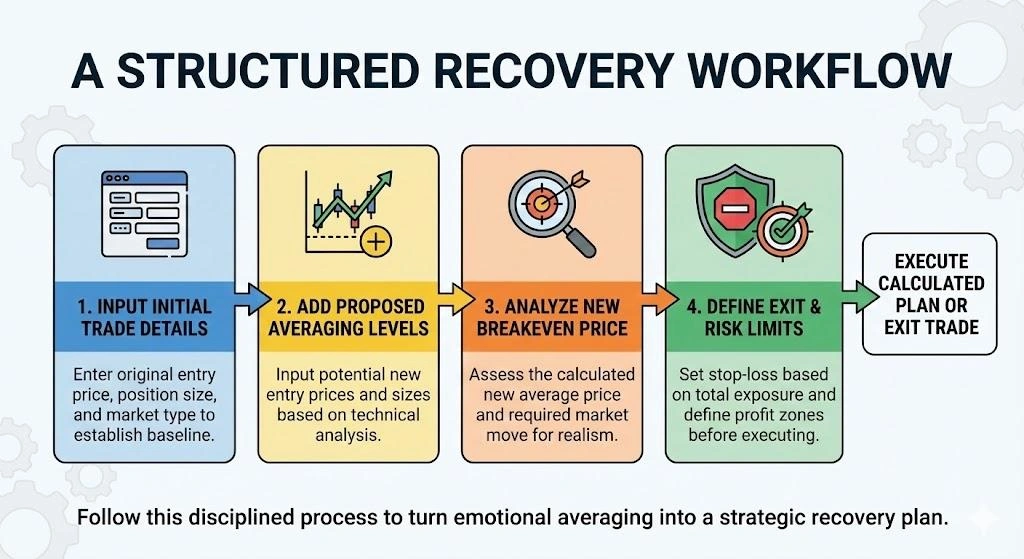
Understanding the workflow is essential before applying it in live markets. Below is a step-by-step breakdown that traders can follow.
Step 1: Enter Your Initial Trade Details
Start by entering the original trade information:
- Initial entry price and position size.
- Direction of the trade (long or short).
- Market type, such as stocks, crypto, or forex.
This establishes the baseline for all calculations.
Step 2: Add Proposed Averaging Levels
Next, input the additional entries you are considering:
- The price level at which you plan to add.
- The size of each additional position.
- The maximum capital you are willing to allocate.
An average buy price tool instantly recalculates your new average entry.
Step 3: Analyze the New Breakeven Price
This step is critical for decision-making:
- The calculator shows how far the price must move to recover.
- Traders can assess whether that move is realistic based on market structure.
- If you realize that even after averaging the price still moving against you, then it’s better to close the trade.
Step 4: Define Exit and Risk Limits
Before executing, you should:
- Set a stop-loss based on total exposure.
- Define a profit-taking zone above breakeven.
- Confirm that the risk aligns with your trading plan.
This transforms averaging into a calculated recovery strategy rather than a gamble.
Practical Example: Using Averaging Calculator Trading in a Real Scenario
Let’s consider a simplified example to show how this works in practice.
Example: Crypto Trade Recovery
Assume a trader buys Bitcoin at $30,000 with a position size of 0.1 BTC. Price drops to $27,000, and the trader considers averaging.
Using an averaging calculator trading tool:
- Initial investment: $3,000.
- Second entry: 0.1 BTC at $27,000 ($2,700).
- New average price: $28,500.
- Total investment: $5,700.
Instead of needing a price to return to $30,000, the trader now needs a move to $28,500 to break even. This calculation provides clarity on whether averaging makes sense based on market conditions.
When Averaging Down Makes Sense (and When It Doesn’t)
Averaging is not universally appropriate. Successful traders apply it selectively.
Situations Where Averaging Can Be Effective
Averaging can be useful when:
- When your trade is based on strong fundamentals of the company
- Market structure supports a potential reversal or range-bound movement.
- Risk is predefined and capital allocation is controlled.
Situations Where Averaging Is Dangerous
Averaging becomes risky when:
- The trade was entered without a clear plan.
- When the price is moving against you and don’t seem to recover any time soon
- When you let emotions take control over your trades.
An averaging calculator trading tool highlights these risks by making the math visible.
Integrating Averaging Calculators into a Recover Losing Trades Method
Position averaging works best when combined with a broader recovery framework rather than used in isolation.
Building a Structured Recovery Plan
A disciplined recover losing trades method includes:
- Don’t just buy because the prices are cheap, wait for prices to enter the support zone.
- Strict limits on total exposure per trade to avoid emotional decisions.
- Set a proper stop-lose, if it hits you close the trade.
The calculator acts as a decision-support tool within this system, not a replacement for strategy.
Common Mistakes Traders Make with Averaging Tools
Even with the right tool, it is easy to make mistakes if you’re not careful.
Mistakes to Avoid
Traders often fall into these traps:
- Adding too many small positions without reassessing risk.
- Ignoring broader market trends while focusing only on breakeven.
- Using the calculator after entering trades instead of before.
Treat the average buy price tool as a planning instrument, not a damage-control button.
Benefits of Using Averaging Calculator Trading Tools Consistently
The tool has a lot of benefits and if used properly, you can build a healthier way of trading.
Key Benefits for Traders
Consistent use leads to:
- Using this tool will keep you calm, stop you from panicking when you’re losing.
- This tool will help you understand the exposure, the total amount you’re risking so you don’t over-bet.
- Instead of hoping for a miracle, it gives clear direction on whether the recovery is possible or not.
Over time, traders develop a data-driven mindset rather than a reactive one.
Conclusion: Turning Stuck Trades into Structured Decisions
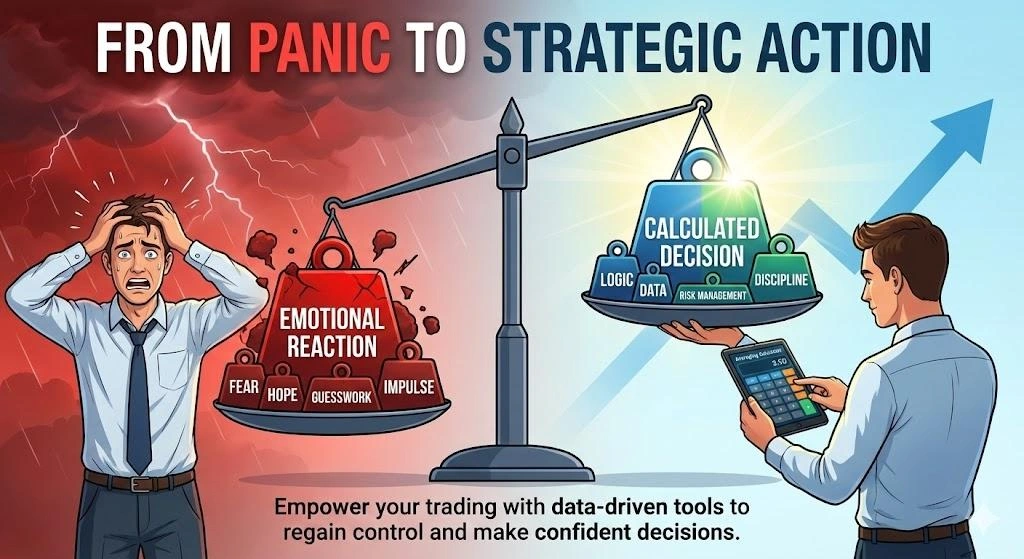
Being stuck in a losing trade is something every pro trader has gone through– it’s a part of the journey. But it does not mean that you start panicking and make reckless decisions. You can use an averaging calculator trading approach, which will help you react to the situation more mathematically and avoid emotions from leading to increased risk exposure.
When combined with sound analysis and risk management, it helps you survive when the market turns against you. But you don’t need to be alone in this situation, InsightfulTrade can help you by offering guidance and educational resources to support smarter, more confident trading decisions.
Frequently Asked Questions
What is averaging calculator trading used for?
Averaging calculator trading is used to calculate how adding positions at different prices affects the average entry, total investment, and breakeven level of a trade.
Is an average buy price tool suitable for beginners?
A beginner can use the average buy price tool only if he maintains his discipline with proper stop-loss and when he is sure about the set up of his trade.
Can averaging help recover losing trades safely?
Averaging can support a recover losing trades recovery method when applied strategically, but it becomes risky if used emotionally or without predefined exit rules.
Does averaging always reduce risk?
Yes, averaging can reduce the risk, but it increases the total exposure, which means if the market turns against you, you’ll end up losing double.
How often should traders use averaging calculators?
Traders should use averaging calculators during trade planning and review, not impulsively during market stress, to ensure disciplined decision-making.
Author: Kumkum Chandak
Experience: 3+ Years in Trading Research & Market Content Strategy
Kumkum Chandak is a trading content strategist and market research writer who specializes in simplifying technical analysis, trading tools, and strategy-driven educational content. Her work is optimized for EEAT, accuracy, and user intent, ensuring every article delivers practical insights for traders of all levels.
Risk Disclaimer:
All content is strictly educational and not financial advice. Trading involves substantial risk. Always perform your own analysis or consult a professional advisor.
Last Updated: 23 December 2025