Quick Summary
Algorithmic trading sessions aren’t just about how a bot trades, but when it’s allowed to work. A lot of strategies often fail because they ignore the market’s behavior throughout the day. By using these sessions and focusing on time-based trading, you can sync your system with the real-world facts of liquidity and volatility, especially in markets like India.
Session Comparison Table
| Aspect | Unrestricted Algo Trading | Algorithmic Trading Sessions |
| Trading Window | Entire market hours | Defined time blocks |
| Volatility Control | Low | High |
| Liquidity Awareness | Often ignored | Built-in |
| Risk Management | Reactive | Preventive |
| Compliance Readiness | Weak | Strong |
| Institutional Alignment | Low | High |
Introduction: Key Points to Understand
- Algorithmic trading sessions decides exactly when an algo is on and running
- The market acts totally different depending on the time of day
- Algo time-based trading shows how big Institutions execute the trades
- Session-based algos helps you avoid unnecessary losses
- In Indian markets using a section-aware algorithm is really beneficial and can make a huge difference in performance
The Core Problem: Why Many Algorithms Underperform
A lot of algo traders think that if a strategy makes money, it will work all day long. Because of that, more systems are built to trade non-stop from open to close.
Why This Is a Problem
The markets are not the same throughout the day. Things like liquidity, volatility, and who is actually trading keeps changing throughout the day. When an algorithm ignores these shifts:
- A Pattern appears, but due to less liquidity the price doesn’t move much
- Slippage gets worse and eats away profits
- Losses pile up during specific bad hours
- Overall performance drops, even when strategy is good
This is why focusing on algorithmic trading sessions is so important.
What Are Algorithmic Trading Sessions?
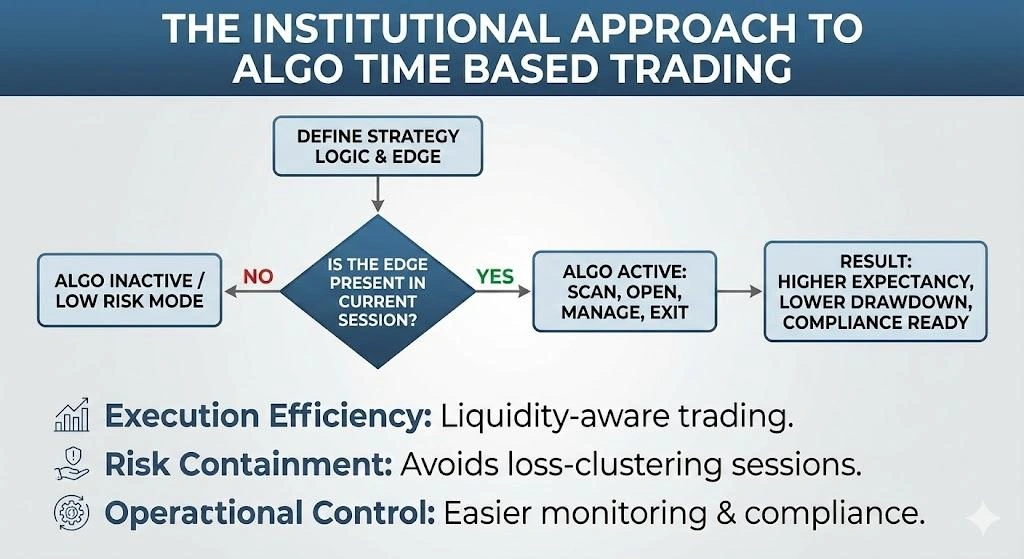
Algorithmic trading sessions are basically predefined time slots where your algo is on duty to:
- Scan for signals
- Open new trades
- Manage your positions
- Exit trades
Once that window closes, the algo either takes a break or switches to a much safer and lower-risk mode. This is the core of time-based algo trading, and it’s exactly how big professional trading desks operate.
Why Time Matters More Than Most Traders Realize
Time impacts the market in three big ways:
- Liquidity concentration
- Volatility distribution
- Participant dominance
Big Institutions build their algos based on these three things, rather than depending on some simple indicator signals.
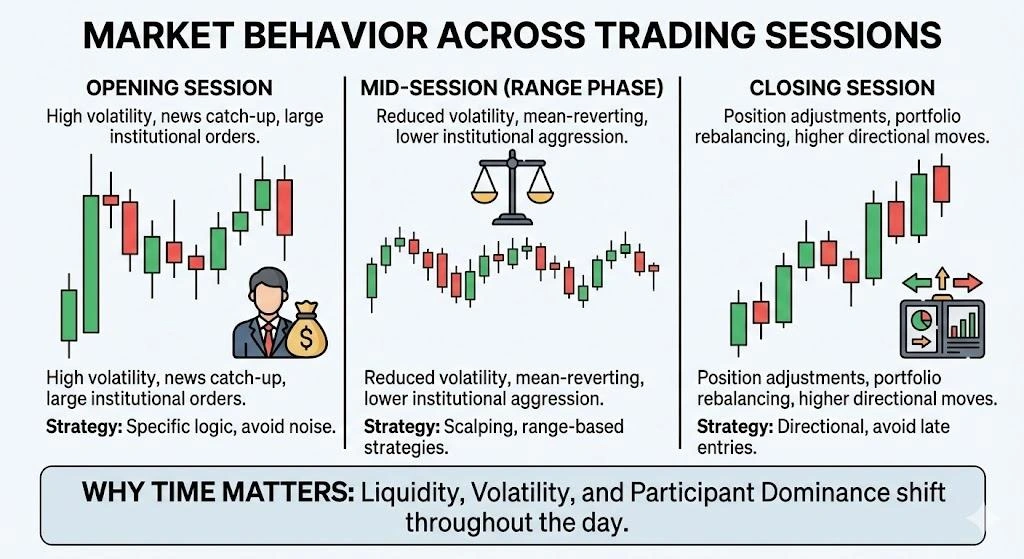
Market Behavior Across Trading Sessions
Opening Session
- High volatility
- The market is busy catching up with all the news that happened overnight
- Large institutional orders enter the market
Trading in the open session requires very specific logic; many standard strategies fail here due to noise.
Mid-Session (Range Phase)
- Low volatility
- Price tends to bounce back and forth
- Lower institutional aggression
This time of day is perfect for time-based strategies designed for scalping or playing within a range.
Closing Session
- Traders are busy adjusting their positions
- Big funds are rebalancing their portfolio
- You often see stronger, one-side moves
Many Institutions won’t let their algo open new trades here because the market is so fast that they need to focus on closing out positions smoothly.
Why the Pros Use Algorithmic Trading Sessions
Professional operators never let their algos run without a schedule.
Here’s why:
- Execution: The number of buyer and sellers keep changing throughout the day
- Risk control: Losses tends to happen during specific hours
- Better monitoring: It’s easy to keep an eye on everything and stay compliant
- Strategy specialization: Different algos for different time of the day
Retail traders who ignore this are basically trading blindly when it comes to time-based risk.
Algo Time-Based Trading: The Institutional Approach
Time-based algo trading is all about setting your strategy to only turn on during specific hours when you actually have an edge.
It doesn’t mean you are missing out; it just means you are filtering out the bad, low-quality trades.
Practical Example: Index Breakout Strategy
Strategy Logic
- Breakout above previous high
- Volume confirmation
- Fixed stop-loss and target
Without Trading Sessions
The algorithm trades breakouts all day and shows inconsistent results.
With Algorithmic Trading Sessions
- Trades only between 9:30 AM – 11:00 AM
- Avoids lunch-hour noise
- Ignores late-session false breakouts
Result:
Lower trade count, higher expectancy.
Why it works:
Liquidity and institutional participation are highest during that session.
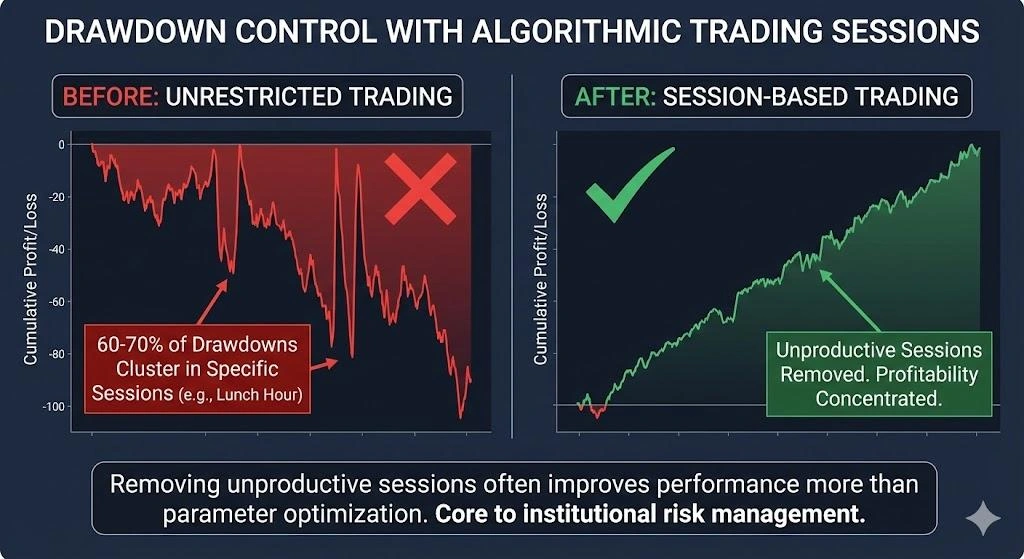
Algo Time-Based Trading and Drawdown Control
One of the best yet most ignored benefits of using trading sessions is how it helps manage drawdown.
Many algos show that:
- 60–70% of drawdowns occur during specific time windows
- Profitability concentrates in limited sessions
Cutting off those bad sessions often improves your result more than constantly changing your strategy setting.
Hypothetical Example: Bank Nifty Mean Reversion Algo
- Makes money between 10:15 AM – 12:00 PM
- Consistently loses between 1:00 PM – 2:30 PM
Instead of messing with indicators, a professional would just stop the algo from trading during that losing session entirely.
Why Indicators Alone Are Not Enough
Indicators are helpful, but they can’t do everything. They miss:
- Order book depth
- Institutional participation
- Regulatory constraints
- Human execution behavior
Algorithmic trading sessions add an extra layer of context that basic indicators often don’t have.
Algorithmic Trading Sessions in Indian Markets
Unique Indian Market Characteristics
- Strong retail participation
- High derivative volumes
- Sharp intraday volatility shifts
- SEBI-regulated execution norms
All of these make session-based trading even more important.
Common Indian Algo Sessions
- Opening range session
- Mid-day consolidation session
- Closing momentum session
Professional algo traders in India usually use different algos for different time sessions, rather than just trying to use one strategy for everything.
Tools That Support Algorithmic Trading Sessions
You can easily set up session logic by using:
- Time filters that are built into more trading platform
- The official market has provided by your broker
- Tools that analyse volume and volatility
- Strategy-level session constraints
But always remember, the specific tool you use isn’t as important as having the discipline to stick to those time-based edges.
Common Mistakes in Algo Time-Based Trading
- Running strategies all day without session analysis
- Optimizing indicators instead of time filters
- Ignoring drawdown-by-time data
- Forcing trades in low-liquidity hours
- Treating time filters as optional
Institutions treat trading sessions as non-negotiable parameters.
Conclusion
Algorithmic trading sessions are not a restriction; in fact, they’re a great way to improve your strategy. Time-based trading is exactly how pros operate: they are selective, aware of the context, and disciplined. Most algos fail due to ignoring the market changes throughout the day, not because of poor strategies.
By using these sessions, you align your system with the real-world facts of liquidity, volatility, and law. And if you want to improve your trading and need help in understanding the complex concepts of trading, connect with InsightfulTrade for expert guidance.
FAQs
1. What tools are used for algorithmic trading sessions?
Most of the traders use time filters in their algo platform along with volatility data and backtesting tools.
2. Is algo time-based trading suitable for Indian markets?
Yes, it’s completely suitable for Indian markets, as they have strong session-specific behaviour, and it will make time-based trading especially effective.
3. Does SEBI allow session-restricted algorithms?
Yes, there are no restrictions over session-based strategies as long as your strategy is transparent and follows the rules and has a clear risk control.
4. Do institutional traders use multiple algos for different sessions?
Yes, pro traders use different algos for different setups, like one algo for the morning and another for the afternoon session.
Author: Kumkum Chandak
Experience: 3+ Years in Trading Research & Market Content Strategy
Kumkum Chandak is a trading content strategist and market research writer who specializes in simplifying technical analysis, trading tools, and strategy-driven educational content. Her work is optimized for EEAT, accuracy, and user intent, ensuring every article delivers practical insights for traders of all levels.
Risk Disclaimer:
All content is strictly educational and not financial advice. Trading involves substantial risk. Always perform your own analysis or consult a professional advisor.
Last Updated: 17 January 2026