
In the stock market, swing trading is the most preferred type of trading because of its structure, clarity, and time freedom—without the intense pressure of day trading. In this Swing Trading Case Study, we break down the journey and 2026 strategy of a trader who turned the swings of the market into consistent opportunities.
In this swing trading case study, we’ll discuss the strategies of a disciplined trader. Through this blog you will learn how to plan your trades, execute them, and manage the risk while maintaining psychological balance, making it valuable insight for both beginner and intermediate traders.
1. Introduction: Why This Case Study Matters
The year 2025 was filled with high ups and downs due to global market conditions. Creating an impact on the trader’s portfolio. To some traders it caused harm, while for some it brought new opportunities.
This case study is about Reyansh, who is a disciplined trader, and every move was pre-planned with great risk management, helping him grab great market opportunities. Now his plan for 2026 is to maintain his achievement with a calm and structured process.
This breakdown not only explains his strategy but also the swing trader process he follows before placing any trade.
2. Meet Reyansh — The Swing Trader Behind the Strategy
Reyansh is not like other social media traders who chase after the hyped or extreme predictions. He started his trading journey eight years ago, and with the passing time, he shifted to swing trading because he wanted something that is less time-consuming and has a more analytical process.
He is not like other traders; he didn’t chase profits; instead, he remained consistent in his journey. He didn’t promise overnight success; he kept moving forward. According to him, swing trading only works when:
- You follow a structured plan
- You combine technical and macro awareness
- You treat trading as a profession, not a gamble
His philosophy created the foundation of the 2026 swing trading strategy explored in this case study.
3. The Core of His 2026 Swing Trading Strategy
Reyansh believed strongly in these three key points that helped him form his swing strategy:
- Trend direction
- Premium/discount zones
- High-probability confirmation signals
He never trades in a rush. Instead, he believed that swing trading rewards those who are patient—and punishes those who rush.
4. The Market Environment He Focused On
It was common for Reyansh to analyze the market conditions before making a trade, as swing trades depend heavily on market structure.
Here’s how he approached market context:
- Macro Trend Awareness
He monitored the economic cycle, inflation reports, interest rate-related inflation, and geopolitical factors. If economic growth appeared to be slowing, he would look for medium-term bearish setups. If markets were recovering, he would be prepared for bullish swings. - Sector Strength Analysis
He used to watch the sector-wise market: which sector is attracting more liquidity, and what is their response in the market? Like in 2025, tech and energy were highly volatile, making them perfect for swing trading. Reyansh used to identify strong opportunities with clear trend behavior.
5. His Swing Trader Process (Step-by-Step)
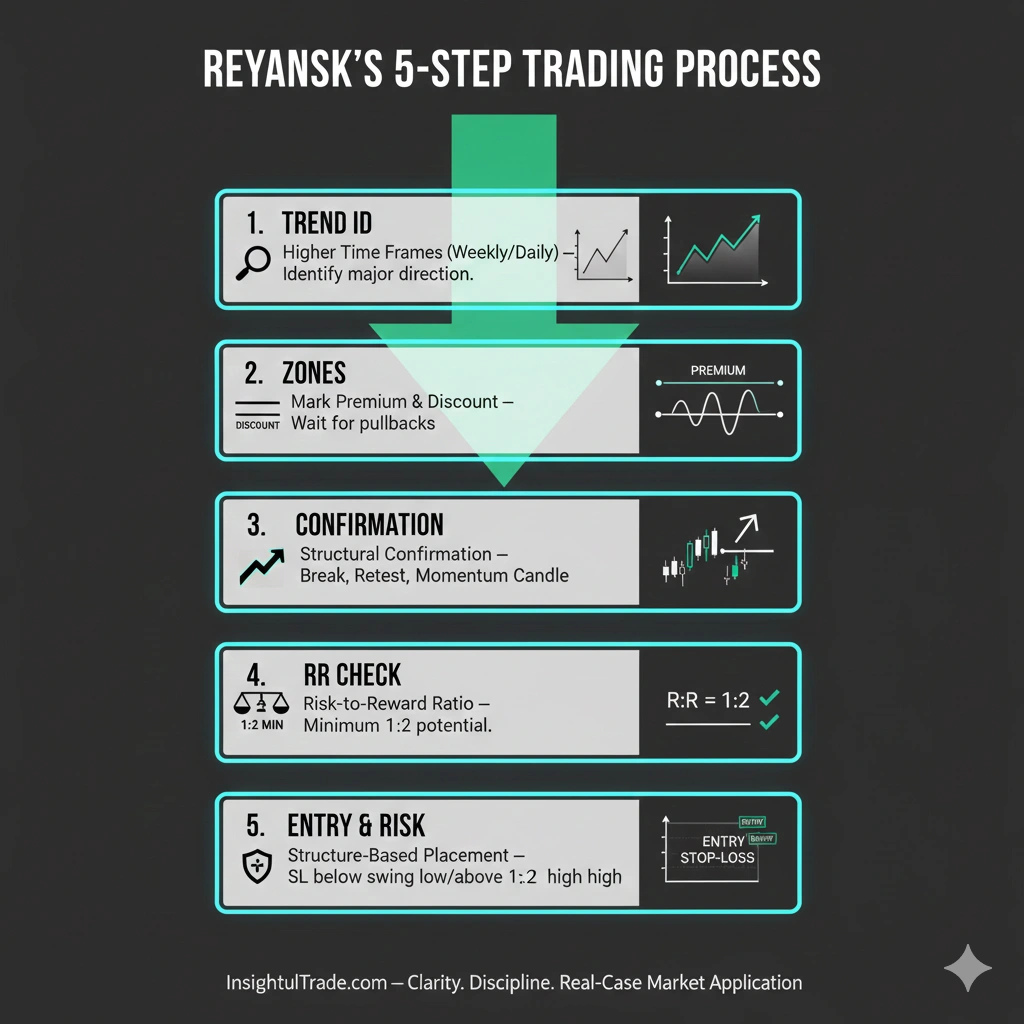
Here is the exact process he followed before taking any trade:
- Identify Trend on Higher Time Frames
With the help of weekly and daily charts he used to study the trend, the stock was forming. He believed that swing traders should first confirm the reversal and then enter the trade.
- Mark Premium and Discount Zones
He never chased the breakouts; instead. He used to wait for the price to come to the fair value to make an entry.
- Wait for Structural Confirmation
He never entered after a single candle pattern. Instead, he used to wait for:
- Break of structure
- Retest of key levels
- Momentum candle confirming direction
This step helped eliminate emotional entries.
- Risk-to-Reward Check
He always used to trade with the one who offered him at least a risk ratio of 1:2. Otherwise, he used to ignore the trade.
- Entry and Risk Placement
He always uses proper his stop-loss as per his risk tolerance, staying protected
6. Swing Strategy Real Example (2025 Trade Breakdown)
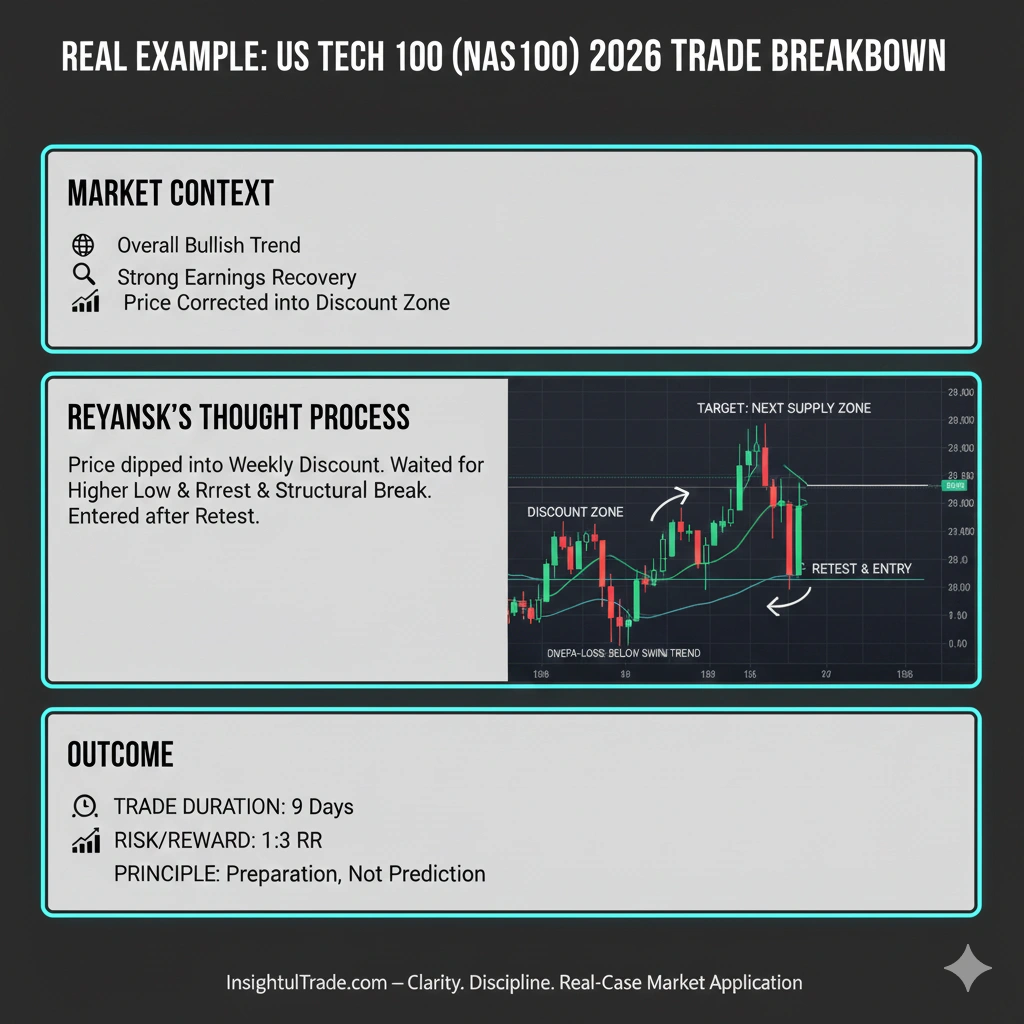
Let’s break down one of his actual swing trades on US Tech 100 (NAS100) from 2025.
Market Context
- Overall bullish trend
- The macro environment showed strong earnings recovery
- Price corrected deeply into a discount zone
His Thought Process
He noticed that the price had fallen into the weekly discount area and formed a higher low. Instead of entering early, he waited for confirmation. When the price broke the previous structure and retested it, he entered with confidence.
Entry Details
- Entry Point: Retest of broken structure
- Stop-Loss: Below previous swing low
- Target: Next major supply zone
Outcome
The trade lasted 9 days and hit a 1:3 RR target. Becoming a well-executed winning trade.
7. How He Managed Risk in 2025
Reyansh knew that without proper risk management, swing trading is dangerous. That’s why he believed that: survival comes first, profit second.
His risk guidelines included:
- Never ever risk more than 1-2% of his trading capital.
- Never holding positions during incredibly high-impact events.
- Never buying stock to average the price in a losing trade.
- Scaling out profits slowly to reduce emotional pressure.
This discipline allowed him to stay calm and confident even in volatile markets.
8. How He Handled Psychology — The Hidden Strength
To stay mentally calm and avoid making mistakes based on emotions. Reyansh followed a few psychological principles that made a huge difference:
- He never used to spend too much time on a lost trade, regretting it. Instead, he used to treat them as a part of a long series.
- After a trade is placed, he stops checking the chart repeatedly to avoid anxiety.
- After every trade, he writes down his emotions to avoid fear and greed.
- During the volatile market, he preferred to just sit and watch instead of trading.
By 2025, he mastered the ability to detach himself from the profits and focus on the quality.
9. Lessons Traders Can Learn from Swing Trading Case Study
This swing trading case study is filled with practical takeaways:
- Only make the entry when you are sure.
- Use chart pattern like higher time frames for direction instead of 5-minute charts
- Never fight with the macro trend
- Place your stop-loss behind a structured level, not based on your guesswork
- Journalize your every trade to find out where you can improve.
These lessons will make your trading safer, calmer, and more predictable.

Conclusion — What This Swing Trading Case Study Teaches Us
This swing trading case study highlights the fact that success in trading is not a gift of guesswork it’s pure hard work, market analysis, and proper risk management. As we look forward to 2026, we can say that Reyansh’s success is proof that you can achieve long-term profitability in trading with risk management, patience, and structure.
If you are looking for guidance, then Insightful Trade is here to help you guys. Here they will provide you with a with a clear and easy understanding and step-by-step guidance on how to be disciplined and follow the market rules to stay strong in the long run. Let’s start trading with confidence and strategy in 2026.
FAQs
- What is a swing trading case study?
These case studies are the real trading examples that help you understand how a trader identifies, plans, and executes swing trades based on market structure and trend behavior.
- How long do swing trades usually last?
Usually the swing trades last for 2–14 days, based on the market conditions and the strength of the trend.
- Is swing trading good for beginners?
Swing trading is way better than intraday trading; it’s less stressful and risky, making it easy to trade for beginners.
- Which are the most preferred tools in swing trading?
Tools like higher-time-frame charts, support/resistance, liquidity zones, trendlines, and macroeconomic updates are often used in swing trading.
- What mistakes do swing traders often make?
Usually it is either entering the trade too early without a confirmation move or holding to a trade emotionally instead of following the stop-loss.
Author: Kumkum Chandak
Experience: 3+ Years in Trading Research & Market Content Strategy
Kumkum Chandak is a trading content strategist and market research writer who specializes in simplifying technical analysis, trading tools, and strategy-driven educational content. Her work is optimized for EEAT, accuracy, and user intent, ensuring every article delivers practical insights for traders of all levels.
Risk Disclaimer:
All content is strictly educational and not financial advice. Trading involves substantial risk. Always perform your own analysis or consult a professional advisor.
Last Updated: 3 December 2025