 Introduction
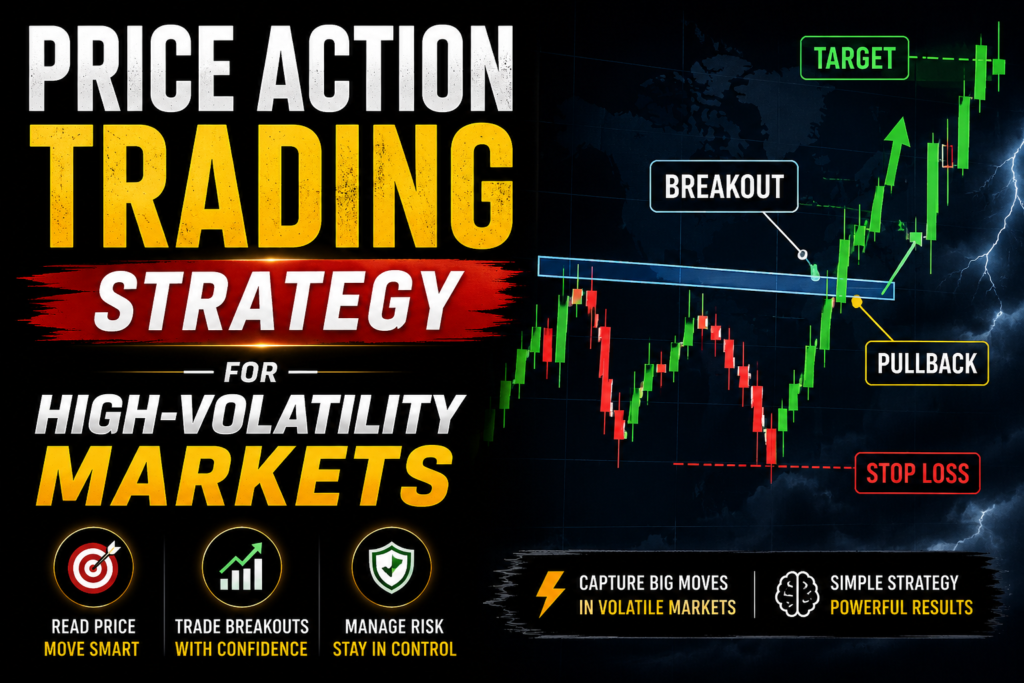
Provided that you are a person who prefers to read the market as it is rather than being clogged up in indicators, then price action trading. In high volatility markets, where the candles give out, the wick elongates, and the price action can reverse in a few seconds, nothing can lead us but clean price actions. This is the reason why this strategy is concerned with what is actually happening with price, rather than what is being predicted by a lagging tool.
You can be a stock trader or rather use price action of indices; it is always the same. you need to know the story behind every push, pullback, and breakout, and at times with volatility, where the volatility strikes hard, some volatility patterns of candles, such as engulfing candles or sharp pin bars, tend to provide the first hint.
What is price action?
When we discuss the topic of price action trading, we are simply sitting and observing price talk, no indicators, no additional noise. You read how the buyers and sellers battle it out and that is all the instructions you give your trades.
In case you are in the index market business, index price action is even less turbulent since structure is more prominent. The correct candle patterns of volatility, such as pin bars or engulfing candles, can enable you to identify genuine moves in a brief period of time.
Why skip indicators?
- You are aware of the fact that indicators are lagging, but price action trading gives you the picture of what is occurring at present rather than after the wave of action has been missed.
- Price action in indices is a good thing to use when you are trading something that moves fast, such as indices.
- Candle volatility patterns, such as strong engulfing candles, convey the story in high volatility moves way ahead of any indicator.
How do candlestick charts work?
- You read the candle’s story
Each candle tells you about the struggle of buyers and sellers, and it is ideal to trade clean price action trading without any additional equipment.
- You spot structure fast
Trading indices with candles simplifies the process of price action since trends and levels become noticeable.
- You catch volatility early
Big wicks or strong bodies provide immediate hints and the correct candle formation of volatility indicates when the momentum is changing.
What are support & resistance?
The first thing you and I would key in on a chart is support and resistance since it is the foundation of the price action trading. The only difference is that in support, buyers are constantly pushing in, whereas in resistance, the sellers have been pushing back.
As soon as you begin to identify these areas, every trade is easier to interpret, particularly in fast markets where you are trading or index trading based on price action where levels are more frequently honored.
How to spot a trend?
Like you observe the swing structure
Under price action trading, the trend is clear when the higher the highs and the higher the lows in an uptrend or the lower the highs and the lower the lows in a downtrend.
Confirmation with volatility candle you confirm it
Once volatility makes its appearance, there are volatility and clear patterns that can confirm to you whether the volatility trend is still strong or it is on the point of fading away.
Which candle patterns matter?
| Pattern | What it tells you |
| Pinbar | The high rejection another good indicator of price action trading |
| Engulfing | Large-scale movement and, most particularly, volatility candle patterns |
| Inside bar | Market pauses and then breaks out are good in the price action of indices |
How to detect volatility spikes?
You watch the candle size
- In price action trading, big candle suddenly indicate to you that volatility has just set in.
- When such candles are present around major levels, we are aware that the action can explode fast.
You track the wick aggression
- long wicks are classic candle patterns for volatility, showing wild rejection on both sides.
- If these wicks keep growing, you know the market is heating up, not calming down.
How do you trade indices with price action?
- In trading, it is better to maintain the chart orderly, where price action trading allows you to respond more quickly to each push and pull.
- Indicators honor levels in a very good way; thus, index price action allows one to read the support, resistance, and trends almost instantly.
- You simply concentrate on the structure direction of the trend, Breakout zones, clean retests, and the index will tend to provide you with smooth and high-probability setups.
When do candle patterns beat noise?
| When it works | What it tells you |
| At support/resistance | Candle patterns show real moves, not noise |
| In trending markets | Patterns like engulfing or pin bars show strong momentum |
| On index moves | Price action for indices makes patterns easier to read. |
| During high volatility | Candle patterns for volatility tell you who’s in control |
How do you manage risk smartly?
In price action trading, you never hope that the market will work to your advantage but rather always have a plan for where to exit in case it turns against you. Regarding trading indices, price action of indices assists you to identify clean levels in order to safely place tops and size positions.
What if the market reverses fast?
Stay calm and watch the price:
When something goes wrong and you know at once that you are being reversed, the first thing you learn is not to break into a frenzy.
Use volatility clues:
Volatility charts and big swings and candles provide you with early warning of possible traps.
How to trade a volatile index? (real-life example)

Example:
Market: S&P 500 Futures
Situation: Decrease in price 1% in 10 min.
Signal: Hits high-level support with a strong signal of support
Action: Buy long at support, shut a little bit below the wick.
Rationale: The price action of indexes can be used to reason that the market is rejecting the support, which indicates a high probability of movement.
Result: Price rebounds at the next resistance; the trade track will not be guessed.
What if a candle gives a false signal? (real-life example)
Market: Nifty50
Situation: you have noticed a pin bar on a support level; it appears as though you are about to see a reversal.
Signal: pin bar indicates to buy
Reality: breaks the support and falls in the next candle
Lesson: Not all the candles are accurate, even in price action trading; confirmation is important.
Takeaway: before entering, wait until the candle , or otherwise , additional indicators, particularly indices.
How do you combine price action and context?
- Before any candle is trusted in price action trading, you will always look to the bigger picture: Trend, support, and resistance.
- In the case of index trading, index price action assists you in understanding whether a signal is appropriate to the overall movement or it is simply noise.
- Contest has got you not overtrading; you never overtrade, you just take trades that follow the structure ,Trend, and volatility indications.
When should you avoid trading?
- When the markets are in disarray or lost, there is no need to force trades; you will only be doing guesses.
- Do not trade immediately before major news or events; unexpected developments can spoil your trades very quickly.
- You are stressed or tired or impatient, then it is better to step aside and wait until the clear setups have been made.
FAQs
- What is price action trading?
It is simply reading the chart and price movement without any indicators, no noise.
- How do you use price action for indices?
Quick setups on chart trends of indexes, spot support, resistance, and clean.
- Which candle patterns for volatility matter?
Pin bars and engulfing candles give you the indication that the market is literally on the move.
- Can price action trading beat indicators?
Yes, since you are not led by the laggard indicators but actual price conduct
Conclusion
Before you start, take one thing out of this: it has to do with the idea that price action trading is not about fancy indicators; it is about looking into the market with directness and responding intelligently. Once you begin using price action on indices or spotting candles on volatility, you will find that formerly high volatility markets cease being frightening and begin to provide actual opportunities. The secret is easy enough: observe the swings, do not disrespect support and resistance, study the candles, and never forget about the context when committing to a trade.
All that in combination with good risk management and you get to be in the game longer to make the moves that count. The next time the market spikes, have it in your mind that it is not about guessing but it is about knowing what the price is telling you and trading with confidence. It is a strategy to adhere to, and trading will become much more natural and profitable.
Author: Arihant Jain
Trading Experience: 5+ Years
Arihant Jain is a financial markets analyst and trading educator with expertise in Forex, Indices, Crypto, and risk-managed trading systems. His insights are based on real trading experience, data-driven analysis, and transparent market understanding. All content is reviewed for accuracy and aligns with Google’s EEAT guidelines.
Risk Disclaimer:
Trading involves substantial risk. All information is for educational purposes only and should not be taken as financial advice. Always do your own research.
Last Updated: 1 December 2025