Hello traders! Have you ever chased behind the “sure thing” without checking if it’s worth taking the risk? Well, you’re not alone—stats show that most of the retail traders make the same mistake and lose money due to poor risk management. This is why the risk-reward ratio is an important tool for traders and investors to quantify and balance between potential risk and expected reward in their trades or investments.
In this blog you will understand the importance of the RR ratio, how to use the risk reward calculator and the reward-to-risk planning method for any financial instrument.

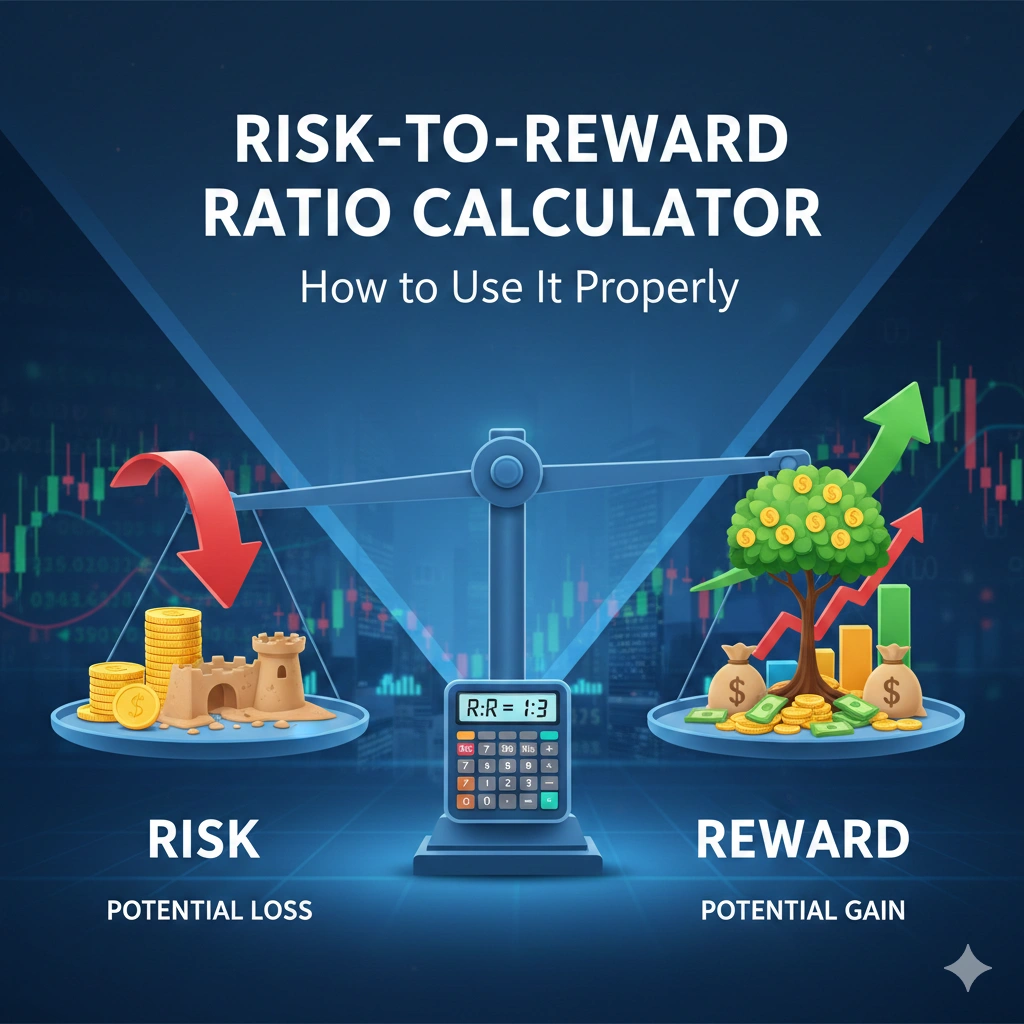
What is a Risk Reward Calculator?
With a risk reward calculator you can measure how much capital you’re putting at risk for a potential profit in a trade; this is also known as the risk-to-reward ratio(RR ratio). To calculate the risk-reward ratio, you divide the possible loss in a trade by the expected profit. Let’s say that in a trade you’re risking $100 to make a profit of around $300; in this situation the risk-reward ratio is 1:3, meaning you gain three dollars against each dollar risked.
Key Components
- Entry Price: The price at which you make an entry in the trade or investment.
- Stop Loss Price: It’s the price level at which you automatically exit if the trade goes against you to prevent further losses.
- Take Profit Price: The target price to close the trade and lock in profits.
Here’s the formula of risk-reward ratio:
Risk Reward Ratio = Entry Price − Stop Loss Price
Take Profit Price − Entry Price
This shows how much you have put at risk for a potential gain.
Interpreting Risk Reward Ratio Results
Understanding the outputs of a risk reward calculator improves decision-making
- A low ratio like 1:1, which means that the reward and risk are equal, will only be profitable if the win rates are high.
- A moderate ratio such as 1:2 makes a good balance, where you are risking one point to earn a profit of two.
- A high ratio of 1:3 represents a bigger profit as compared to the risk; it is most preferred by the professional traders as it keeps them profitable even with lower win rates.
Additionally, the break-even win rate tells you how many times you need to win to break even. For example, in a trade with a 1:3 ratio, it is important to win at least 25% to stay profitable, which is important for psychological state of mind and professional trading success.
Reward to Risk Planning Method: Step-by-Step Strategy
To use a risk reward calculator properly, you need to follow these steps:
- Identify the Entry Price: select the price at which you will buy the asset.
- Set the Stop Loss: Decide the limit of your risk tolerance, and set your stop-loss there to exit if the move goes wrong.
- Determine the Take Profit: Calculate the profit level in the trade to realize potential rewards.
- Input Values Into the Calculator: Enter these three key values into the risk reward calculator.
- Interpret the Output: And then let the calculator compute the risk-reward ratio and the minimum percentage of the trade that you need to achieve success to avoid losses.
For example, a risk-reward ratio of 1:3 means a risk of $1 to gain $3. And if the winning rate in such trades is 25%, then you have to win at least one-fourth of your trades to stay profitable in the end.

Practical Use Tips
- Keep the aim of at least a 1:2 or higher risk-reward ratio to ensure you stay profitable by the end.
- Using the ratio with stop-loss and profit level set, you can prevent emotions from interrupting you during a volatile market.
- Your trade size should be based on the maximum risk you’re taking per trade.
RR Ratio Examples in Real Trading Scenarios
Examples help clarify how the risk-reward ratio works in practice:
Example 1: Buy shares at $2,000, set stop loss at $1,900, and take profit at $2,400.
- Potential Risk = $100
- Potential Reward = $400
- Risk Reward Ratio = 1:4 (highly favorable)
Example 2: Purchase shares at $1,500, stop loss at $1,450, take profit at $1,650.
- Potential Risk = $50
- Potential Reward = $150
- Risk Reward Ratio = 1:3 (commonly preferred by traders)
Example 3: Risking ₹100 to gain ₹300 results in a 1:3 ratio, a conservative and profitable setup often favored by professional traders.
Top Risk Reward Calculator Tools: Features and Best Use Cases
| Tool | Key Features | Best For | Link Example |
| SmartTradingSoftware | Pip-based, breakeven win rate, forex focus | Forex & commodities | Free online tool |
| Market-Bulls | Instant RR ratio + win %, mobile-friendly | Beginners | Quick calculator |
| LuxAlgo | Trade sizing + reward to risk integration | MT4/MT5 users | Advanced setups |
| TrendSpider | Chart-linked risk reward calculator | Technical analysts | Visual plotting |

FAQs on Risk Reward Calculator and RR Ratio
- What is a good risk reward ratio?
An effective risk-reward ratio falls between 1:2 and 1:3, indicating that you expect to earn at least 2 to 3 units for each unit of risk taken. This approach allows you to remain profitable even if your success rate is below 50%.
- What is the method to determine the risk reward ratio?
Calculate it by dividing the potential reward (target price minus entry price) by the potential risk (entry price minus stop-loss price). Formula:
Risk Reward Ratio = (Target Price – Entry Price) / (Entry Price – Stop-Loss Price).
- What is the breakeven win rate?
Breakeven win rate represents the winning trade percentage required to avoid financial loss. It is determined by:
Win Rate = Risk / (Risk + Reward). For instance at a 1:2 ratio a 33% win rate is required to break even.
- Is it possible to utilize a risk reward calculator for stocks, forex and crypto?
Indeed, the risk reward calculator can be applied to any asset you are trading, including stocks, forex, commodities, and cryptocurrencies.
- What makes the reward=to-risk planning approach significant?
As per the risk-reward ratios, you can plan trades in your favor before entering, improving long-term profitability and reducing emotional mistakes.
Wrap-Up: Start Your Risk Reward Calculator Journey Now
To summarize, with the correct use of a risk reward calculator you can achieve long-term success in trading. The reward-to-risk planning method helps you evaluate your trades and focuses more on the setups where the potential of profit is higher than the risk, aiming for ratios like 1:2 or 1:3. With this approach you stay practically confident with your trades, drawing emotions out of the game.
InsightfulTrade simplifies risk management using calculators, easy-to-follow tutorials, and practical examples for forex commodities such as gold, stocks, and beyond. They assist you in determining position size, stop-loss and take-profit points, and breakeven win rates—whether you are a beginner or a seasoned trader. Visit Insightful Trade’s website and start your trading with confidence and discipline.
Trade smart. Plan better. Profit more with Insightful Trade.
Author: Kumkum Chandak
Experience: 3+ Years in Trading Research & Market Content Strategy
Kumkum Chandak is a trading content strategist and market research writer who specializes in simplifying technical analysis, trading tools, and strategy-driven educational content. Her work is optimized for EEAT, accuracy, and user intent, ensuring every article delivers practical insights for traders of all levels.
Risk Disclaimer:
All content is strictly educational and not financial advice. Trading involves substantial risk. Always perform your own analysis or consult a professional advisor.
Last Updated: 28 November 2025