 Introduction
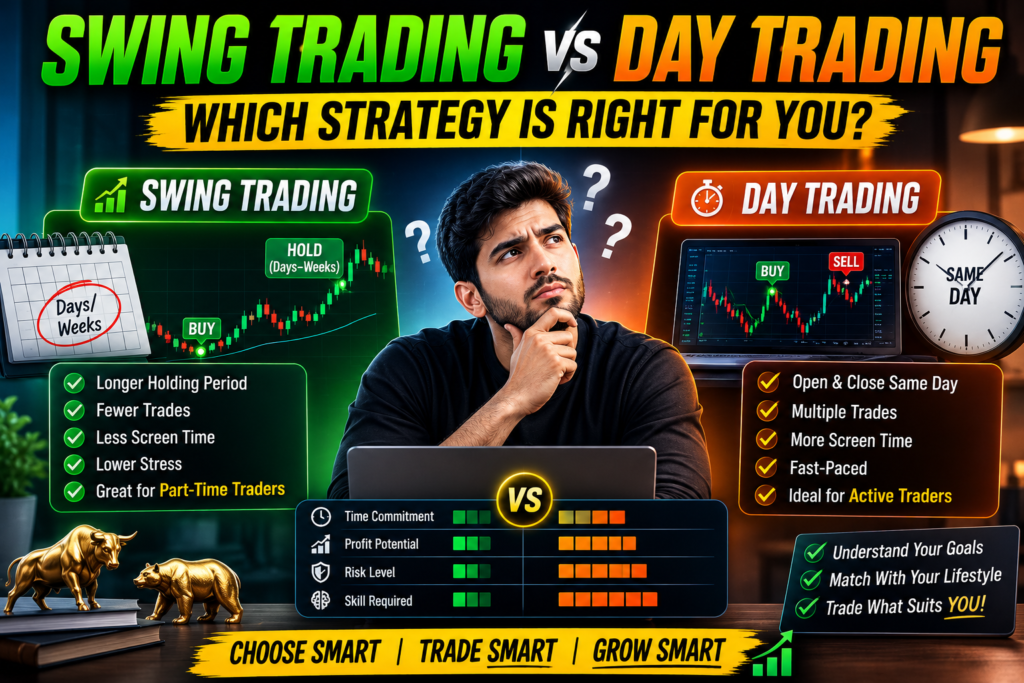
Whether swing vs day trading would be more effective in 2026 or not, you are not alone in wondering. Swing trading involves the holding of positions for a matter of days or even several weeks, in the hope that it can capture larger price swings in the course of time. It is ideal when you prefer a trading approach that is not only consuming, as you do not need to look at charts throughout the day. Day trading, however, is everything related to the fast trades, including opening and closing the position in one day to respond to the short-term market changes. This guide covers the key pros and cons of both styles to help you decide
Why then swing vs day trading? It is simply a matter of the time you can dedicate, your risk-taking ability, and your feeding objectives. These styles can be deconstructed, and you can decide what works best on you in 2026.
Swing Trading vs Day Trading — Quick Decision Table
| Swing Trading | Day Trading | |
|---|---|---|
| Best for | Beginners, part-timers | Full-time, experienced traders |
| Time needed | 1–3 hrs/day | 6–8 hrs/day |
| Min. capital (US) | ~$1,000–$5,000 | $25,000 (PDT rule) |
| Trade duration | Days to weeks | Minutes to hours |
| Avg. trades/week | 2–5 | 10–50+ |
| Stress level | Moderate | High |
| Tax treatment | Short-term gains | Short-term gains |
Real Data / Statistics
What the Data Shows:
- Academic research tracked over 5,000 UK retail traders over three years and found day traders averaged negative annual returns after costs, while swing traders achieved modest positive returns.
- Transaction costs for a day trader executing 100 round trips monthly can exceed $9,600 per year before spreads and slippage — a significant hurdle any strategy must overcome.
- Swing trading strategies historically outperformed buy-and-hold in trending markets but underperformed during sideways or range-bound conditions.
What makes swing trading different?
Swing trading involves using a day’s or a week’s stay to trade to profit on a rising price. There is no need to observe the market continuously as in day trading. It is all about the ability to see trends and swing on swings with such tools as moving averages and RSI.
This is the style that suits the traders who need flexibility and less costly trades. It is not as stressful and is a balanced method of achieving good profits in the short to medium term.
Best Indicators for Each Style
Best Technical Indicators for Swing Trading:
- Moving Averages (20/50/200 MA) — identify trend direction
- RSI (Relative Strength Index) — spot overbought/oversold conditions
- MACD (Moving Average Convergence Divergence) — confirm momentum shifts
- Support & Resistance levels — define logical entry and exit zones
- ATR (Average True Range) — set realistic stop-loss distances based on volatility
Best Technical Indicators for Day Trading:
- VWAP (Volume Weighted Average Price) — the #1 intraday benchmark
- Level 2 order book — read real-time buyer/seller pressure
- Candlestick patterns (1-min, 5-min charts) — identify momentum breakouts
- Bollinger Bands — gauge intraday volatility
Best Markets for Each Style
What Markets Work Best?
Swing trading works best in:
- US equities (AAPL, TSLA, NVDA) — high liquidity + predictable trends
- Forex (EUR/USD, GBP/USD) — 24-hour access suits multi-day holds
- Crypto — high volatility creates larger swing opportunities
Day trading works best in:
- Futures (ES, NQ contracts) — low commissions + high leverage
- High-volume stocks — requires tight bid-ask spreads for fast entries/exits
- Forex during London/NY session overlap — peak liquidity window
How Does Day Trading Work?
- Day trading involves buying and selling assets on the same day to make profits through exploiting short-term fluctuations.
- The charts and indicators are used to choose the entry and exit points and to control risk with a tight rein using stop-loss orders.
Which needs less daily time in Swing vs Day Trading?
- Swing trading also requires less time on a day-to-day basis since you trade over several days or weeks and rarely check the market for more than a few hours in a day.
- Day trading requires a full-time commitment where one has to monitor the market and make timely decisions throughout the trading day.
What are the cons of day trading?
Day trading is also very risky:
It is easy to make or lose money quickly, particularly when one has leverage or if one has to make decisions without taking full responsibility.
The pressure of emotions is overwhelming:
The rush may exhaust you and may cause expensive errors in cases where you allow the defeat to get into your head.
Expenses are increasing at a rapid rate:
Commissions and charges on various trades can go through your profits before you can begin winning.
What are the pros of swing trading?
- Swing trading enables you to gain larger movements of prices in days or weeks, and you have a good opportunity to make good profits without having to observe the market every minute.
- It is flexible, and part-time trading works well with it; thus, you are able to trade around with your day-to-day life and get the adventures of the market momentum.
How do you calculate risk for Swing vs Day Trading?
In order to know the risk of swing vs day trading, firstly, determine the amount of the account you are ready to lose, conventionally 1%. Then place your stop loss, the price at which you will leave in case of trading in the wrong direction.
Divide yourself into position size by the following formula:
Position size = account risk/stop loss size
This easy way will make you manage losses and trade wisely, regardless of whether you are swing vs day trading.
Can day trading bring fast profits?
Yes, it is quick money-making, as day trading involves buying and selling the same day, and you are just taking advantage of price fluctuations. When you get it just right in terms of strategy and timing, then you will realize gains within seconds of the trading.
However, do keep in mind, it is a fast-paced business, which requires discipline and control over the risk and the strong emotion to avoid losses. Therefore, although day trading is a venture that can cause rapid profitability, good strategies and practice are the key to success.
How risky is overnight holding?
- The most important reason why overnight holding is risky is that the market may be highly volatile, as seen by a sharp rise or fall in prices once the market opens and incurs unexpected losses.
- There is also less liquidity and larger price movements because of lower trading volumes during the night, and it is difficult to get out of trades at good prices.
Which fits part-time trading best?
Swing trading is the most appropriate type of trading to start with since it does not need as much time in front of the screen per day, it does not demand such rapid decision-making, and it is easier to learn.
It allows new traders to hold positions for days or weeks and eliminates pressure and stress. Swing vs day trading provides an easy entry into the markets for new traders.
Does patience matter more for swing?
- The most important thing in swing trading is to be patient, as you are holding positions for days or weeks and waiting until the price works out.
- Swing traders should also have patience and control their emotions in order to adhere to their strategy to prevent rusting out, unlike day traders, who require fast reactions.
How Much Capital Do You Need?
One of the most overlooked differences between swing and day trading is the minimum capital requirement.
In the US, the Pattern Day Trader (PDT) rule — enforced by FINRA — requires that anyone who executes 4 or more day trades within 5 business days must maintain a minimum of $25,000 in their trading account. This is a hard regulatory requirement, not a suggestion.
Swing trading, by contrast, has no such rule. You can begin with as little as $500–$2,000, though $5,000–$10,000 gives you more meaningful position sizing. This makes swing trading significantly more accessible for most retail traders.
How do commissions affect profits?

Day trading commissions consume more of your profit since you incur several trade commissions per day. As an illustration, when your broker charges you $5 per trade, 10 trades in a day will go to $50, which is a significant cut right into the profits.
Swing trading also has a lower number of trades during days or weeks, and the commission cost assists in retaining more profit.
How do trading costs and commissions compare between these two styles?
| Trading style | Commission impact | Example |
| Swing trading | Lower commissions due to fewer trades | 5 trades/month × $5 fee = $25 total |
| Day trading | Higher commissions from frequent trades | 10 trades/month × $5 fee = $50 daily cost |
How does each style handle market volatility and sudden price changes?
Swing trading
The wider stop-loss and longer holding period allow swing traders to absorb short-term volatility without being stopped out prematurely — making patience and strategic planning essential.
Day trading
You respond to the market quickly to capitalize on the market, and you move in and out of the market with tight stops.
Risk handling
Swing trading tolerates greater gap risk, but day trading does not tolerate overnight risk and endures severe market volatility.
How does each handle volatility?
- Swing trading is gentle and volatile through larger tops and longer holding times so that you can ride the market’s wings and target larger movements.
- Day trading involves making market decisions on tight stops and making rapid decisions based on intraday price movements in order to maximize capital and enjoy short-term volatility.
FAQs for Swing vs Day Trading
1. Which trading style is easier for beginners?
Swing trading is the better starting point for beginners. It requires less screen time, allows slower decision-making, and gives new traders time to study market patterns, trends, and technical indicators without the pressure of intraday volatility. Most trading educators recommend mastering swing trading before attempting day trading.
2. How much capital do I need to start swing vs day trading?
Swing trading can be started with as little as $500–$2,000, with $5,000–$10,000 being more practical for meaningful position sizing. Day trading in the US requires a minimum of $25,000 in your account if you execute 4 or more trades within 5 business days, due to the Pattern Day Trader (PDT) rule enforced by FINRA. This regulatory requirement makes day trading significantly more capital-intensive.
3. Which style carries more overnight risk?
Swing trading carries higher overnight gap risk because positions are held open for days or weeks. During off-hours, earnings reports, geopolitical news, or macroeconomic data releases can cause sharp price gaps at market open — directly impacting open swing positions. Day traders close all positions before market close, eliminating overnight exposure entirely.
4. Is day trading more profitable than swing trading?
Not necessarily. Day trading can generate faster, more frequent returns but comes with higher transaction costs, emotional pressure, and a steep learning curve. Studies suggest the majority of retail day traders lose money after accounting for commissions and spreads. Swing trading tends to have a better risk-to-reward ratio for part-time traders since fewer trades mean lower costs and more time for analysis.
5. Can I switch between swing trading and day trading?
Yes — many experienced traders use both styles depending on market conditions. A trader might swing trade trending stocks while day trading during high-volatility events like Federal Reserve announcements or earnings seasons. However, beginners are advised to master one style completely before switching, as each requires a different mindset, toolkit, and risk management strategy.
Tax Implications
Tax Treatment: Swing vs Day Trading
In the US, day trading profits are typically taxed as short-term capital gains (ordinary income rates — up to 37%). The same applies to swing trades held under 12 months. However, positions held over 1 year qualify for long-term capital gains rates (0%, 15%, or 20%). Since swing traders sometimes hold positions for weeks rather than months, most gains still fall under short-term rates, but the tax profile is similar to day trading. Always consult a tax professional for your specific situation.
Common Mistakes in Swing vs Day Trading
Swing Trading Mistakes:
- Ignoring the overnight gap risk on news-heavy days like Fed meetings or earnings
- Setting stop-losses too tight, getting shaken out before the swing plays out
- Overtrading — taking every setup instead of waiting for high-probability signals
Day Trading Mistakes:
- Trading without a daily loss limit — one bad session can wipe a week of gains
- Ignoring VWAP and trading against the dominant intraday trend
- Underestimating the impact of commissions and spreads on net profitability
Conclusion
There are two styles of trading: swing vs day trading. Swing trading is more appropriate for beginners and part-time traders since it does not require as much time in front of the screen and gives you the ability to hold your positions over days or weeks to allow you to capture bigger moves.
Day trading is suitable for active investors who have full-time availability, are fast-market oriented, and can make quick decisions. It is faster in profits and more stressful and costly in transactions.
Swing trading has a lighter learning curve and less risk as a newcomer, allowing one to learn without the stress of fast trading. Select according to your available time, risk tolerance, and investment objectives. It is better to master a single style instead of varying. Master market moves with Insightful Trade! Discover whether swing or day trading suits your goals. Learn strategies, timing, and profit styles with expert insights—start trading smarter today!
Author: Arihant Jain
Trading Experience: 5+ Years
Financial Markets Analyst | 5+ Years Active Trading Experience in Forex, Indices & Crypto
Arihant has personally executed hundreds of swing and day trades across volatile market conditions. His analysis draws from real account data and ongoing market participation — not theory.
Risk Disclaimer:
Trading involves substantial risk. All information is for educational purposes only and should not be taken as financial advice. Always do your own research. All data verified against current regulatory guidelines.
Last Updated: 23 February 2026 Statistics sourced from 2024–2025 research data.