Introduction
The order block strategy has become one of the most respected trading methods among forex traders who want to understand how institutional investors move the market. Unlike traditional strategies that rely solely on technical indicators, the order block strategy focuses on price action, market structure, and the footprints left behind by banks and large financial institutions. Since institutional traders control a significant percentage of the daily forex volume, recognizing where they enter and exit trades can provide retail traders with a considerable advantage.
The concept behind the order block strategy is straightforward: institutions cannot execute large orders all at once without dramatically affecting price. Instead, they accumulate or distribute positions in specific price zones known as order blocks. These zones often become areas where price reacts repeatedly, creating high-probability trading opportunities.
When combined with smart money forex concepts, proper market structure analysis, and well-defined forex setups, order blocks offer traders a structured approach to entering and exiting trades with improved precision. This guide explains everything you need to know about identifying, validating, and trading order blocks successfully
What is an Order Block Strategy?
The order block strategy is a price action trading method that identifies areas where institutional traders place large buy or sell orders. These price zones often become support or resistance levels because unfilled institutional orders remain in the market.
Unlike retail traders who often chase momentum, institutional traders build positions over time. Their buying or selling activity creates distinctive candle formations before a major market move. These formations become the order blocks traders use for future entries.
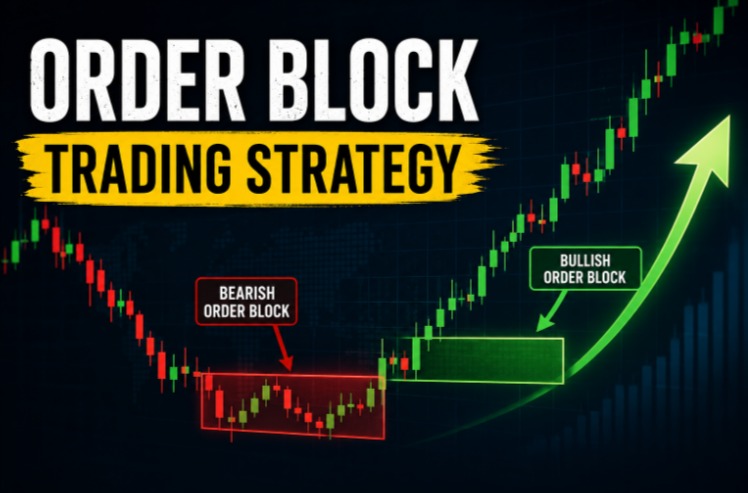
A bullish order block forms before a strong upward movement. It is usually represented by the last bearish candle before an impulsive bullish move. A bearish order block forms before a strong downward movement and is typically the last bullish candle before a sharp bearish decline.
These areas represent institutional interest rather than random price movement, making them valuable components of professional trading strategies.
Smart Money Forex: Understanding How Institutions Drive the Market
The concept of smart money forex is based on following the trading activity of major financial institutions such as banks, hedge funds, investment firms, and market makers instead of relying solely on retail trading signals. These institutional participants execute trades worth millions or even billions of dollars, giving them the power to influence market direction. Because their orders are too large to fill at a single price, they strategically accumulate or distribute positions over time, creating identifiable price patterns that experienced traders can recognize.
One of the primary objectives of smart money trading is to locate areas of high liquidity. Institutions often push prices above recent highs or below recent lows to trigger retail traders’ stop-loss orders and pending breakout entries. This process creates the liquidity needed for institutions to enter or exit large positions without causing excessive market disruption. Once enough liquidity has been collected, price frequently reverses and moves strongly in the intended institutional direction.
The order block strategy is closely connected to smart money concepts because order blocks represent the zones where institutional buying or selling activity originated. By identifying these areas alongside changes in market structure, traders can anticipate where price is likely to react in the future. Instead of chasing fast-moving markets, smart money traders patiently wait for prices to return to these institutional levels before looking for confirmation to enter a trade.
Institutional Trading: Following the Footprints of Professional Market Participants
Institutional trading refers to the buying and selling activities carried out by major financial organizations such as central banks, commercial banks, hedge funds, investment firms, pension funds, and other large market participants. Unlike retail traders who place relatively small orders, institutions execute trades worth millions or even billions of dollars. Because of their enormous order sizes, they cannot enter or exit positions instantly without significantly affecting market prices. Instead, they divide their orders into smaller transactions and execute them over time, leaving behind identifiable footprints in the form of order blocks, liquidity zones, and changes in market structure.
The order block strategy is built around identifying these institutional footprints. When institutions accumulate buy or sell positions, they often create strong impulsive price movements after a period of consolidation. The last bullish or bearish candle before this explosive move frequently becomes an order block, marking an area where unfilled institutional orders may still exist. As price revisits these levels, the remaining orders can trigger another reaction, creating high-probability trading opportunities for traders who understand institutional behavior.
Although retail traders cannot compete with institutions in terms of capital, they can improve their performance by studying institutional behavior and patiently waiting for high-quality setups. Focusing on order blocks, liquidity, market structure, and disciplined risk management allows traders to make more informed decisions and increase the probability of consistent results. Instead of reacting emotionally to short-term price fluctuations, traders who understand institutional trading learn to follow the flow of professional money, making the order block strategy a powerful tool for long-term success in the forex market.
Forex Setups: Building High-Probability Trades with Order Blocks
Successful forex setups are built on patience, discipline, and a clear understanding of how the market moves. Instead of entering trades based on emotions or random indicator signals, professional traders wait for multiple technical factors to align before taking a position. The order block strategy provides a structured framework for identifying these high-probability setups by combining institutional order blocks with market structure analysis and smart money forex concepts. When several confirmations appear together, traders can enter the market with greater confidence and a well-defined risk-to-reward ratio.
The best forex setups are not those that appear frequently but those that satisfy every rule in the trading plan. By combining the order block strategy with smart money forex, institutional trading, and proper market structure analysis, traders can consistently identify high-quality opportunities while avoiding unnecessary trades. Over time, following a disciplined process rather than chasing every market movement leads to more consistent performance and long-term success in the forex market.
Market Structure: The Foundation of Every Successful Order Block Strategy
Understanding market structure is one of the most important skills a forex trader can develop because it reveals the overall direction of the market and helps identify where high-probability trading opportunities are likely to occur. The order block strategy becomes significantly more effective when traders analyze market structure before entering a trade. Rather than relying on indicators alone, market structure focuses on the sequence of higher highs, higher lows, lower highs, and lower lows to determine whether the market is trending upward, trending downward, or moving sideways. This approach enables traders to trade with the dominant trend instead of fighting against it.
Market structure also helps traders validate order blocks. A bullish order block becomes more reliable when it forms before a strong bullish break of structure, while a bearish order block gains strength when it appears before a decisive bearish break. Instead of trading every order block that appears on the chart, experienced traders focus only on those that align with the overall market structure. This simple filtering process significantly improves the quality of forex setups and reduces the number of low-probability trades.
Higher-timeframe market structure plays an equally important role in successful trading. Many professional traders begin their analysis on the daily or four-hour chart to identify the primary trend before moving to lower timeframes for precise entries. Trading in the direction of the higher-timeframe structure increases the probability of success because it aligns retail traders with the broader movement driven by institutional participants. By combining market structure, smart money forex concepts, institutional trading, and the order block strategy, traders can develop a disciplined approach that focuses on high-quality opportunities, better timing, and consistent long-term performance in the forex market.
Conclusion
The order block strategy has become one of the most effective approaches for traders who want to understand how the forex market truly operates. Instead of relying on lagging indicators or emotional decision-making, this strategy focuses on reading price action and identifying the footprints left behind by major financial institutions. By learning where banks, hedge funds, and other large market participants enter the market, traders can position themselves alongside professional money rather than against it. This shift in perspective allows traders to make more informed decisions and develop a structured trading process based on logic instead of guesswork.
One of the greatest strengths of the order block strategy is its connection with smart money forex principles. Institutional traders move the market because of the size of their orders, and their activity often creates recognizable price zones that become valuable trading opportunities. Understanding liquidity, order blocks, break of structure, and market behavior enables traders to anticipate potential reversals and trend continuations with greater confidence. Rather than chasing fast-moving prices, successful traders patiently wait for prices to revisit institutional zones before looking for confirmation to enter a trade.
By combining the principles of smart money forex, understanding institutional trading, analyzing market structure, and waiting for high-quality forex setups, traders can build a professional trading approach that focuses on probability rather than prediction. With consistent execution, disciplined risk management, and a commitment to continuous improvement, the order block strategy can become a powerful foundation for achieving long-term success in the forex market.