Introduction
A risk reward forex strategy is one of the most important principles that separates consistently profitable traders from those who struggle over the long term. Many beginners spend countless hours searching for the perfect indicator or trading system, believing that a high winning percentage is the key to success. In reality, professional traders understand that profitability depends far more on how much they risk compared to how much they expect to earn on every trade. Even a strategy with only a 40–50% win rate can generate excellent returns if the average winning trade is significantly larger than the average losing trade.
The foreign exchange market is unpredictable, and no trader can accurately predict every market movement. This uncertainty makes risk management the foundation of successful trading. A well-designed risk reward forex strategy helps traders maintain discipline, protect trading capital, and eliminate emotional decision-making. Instead of focusing solely on winning trades, traders begin concentrating on maximizing profits while minimizing losses.
Every successful trading plan includes proper trade management, effective money management, a reliable stop loss strategy, and a clear understanding of long-term profitability. These elements work together to create a structured approach where each trade is planned before entering the market. Traders know exactly how much they are willing to lose and how much they aim to gain, allowing them to trade with confidence rather than emotion.
Trade Management: Turning Good Entries into Profitable Trades
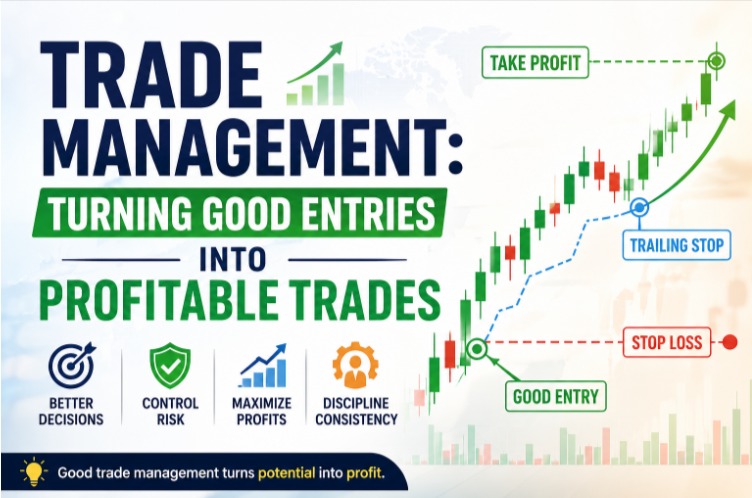
Effective trade management is one of the biggest differences between amateur and professional traders. Entering a trade is only the beginning; how you manage the position afterward often determines the final outcome.
Successful trade management starts with a predefined plan. Traders decide where to place their stop loss, where to take profits, and under what conditions they will adjust their positions. These decisions are made before emotions become involved.
As trades move into profit, experienced traders may adjust their stop loss to break-even, reducing risk while allowing the trade to continue. Others choose partial profit-taking, securing gains while leaving part of the position open for larger market moves.
Trailing stops can also be useful during strong trends, allowing traders to capture extended price movements without exiting too early. However, trailing stops should follow market structure rather than arbitrary distances.
Trade management also involves knowing when not to interfere. Constantly adjusting stop losses or profit targets based on emotions often reduces overall profitability. Sticking to a structured plan usually produces better long-term results.
Money Management: Protecting Trading Capital
Strong money management forms the backbone of every successful risk reward forex strategy. Even the best trading system cannot survive poor capital management.
Professional traders rarely risk more than one or two percent of their total account balance on a single trade. This conservative approach protects their accounts during inevitable losing streaks.
Money management also involves calculating appropriate position sizes based on stop-loss distance rather than using fixed lot sizes. Wider stop losses require smaller position sizes, while tighter stops allow larger positions without increasing financial risk.
Diversification also contributes to effective money management. Avoiding excessive exposure to correlated currency pairs helps reduce overall portfolio risk during volatile market conditions.
Patience is another essential part of money management. Professional traders understand that preserving capital during uncertain market conditions is often better than forcing low-quality trades.
Common Mistakes That Destroy Risk-Reward Performance
Many traders unknowingly undermine their own strategies through poor habits.One common mistake is taking profits too early while allowing losing trades to continue. This creates unfavorable risk-reward ratios that eventually produce overall losses.Another frequent error involves moving stop losses farther away after entering a trade. Instead of accepting a planned loss, traders increase risk hoping the market reverses.
Overtrading also reduces profitability. Entering low-quality setups simply to remain active often produces unnecessary losses.Ignoring position sizing rules is equally dangerous. Increasing trade size after several winning trades or attempting to recover losses through larger positions exposes accounts to excessive risk. Finally, abandoning a proven strategy after a short losing streak prevents traders from benefiting from long-term statistical advantages.
Psychological Benefits of Risk Reward Forex Strategy
One overlooked advantage of structured risk management is improved trading psychology.Knowing the maximum possible loss before entering a trade significantly reduces emotional stress. Traders become less anxious during normal market fluctuations because risk has already been accepted.
Confidence also improves when every trade follows identical rules. Instead of reacting emotionally to individual outcomes, traders focus on executing their strategy consistently. This disciplined mindset reduces revenge trading, fear of missing out, and impulsive decision-making—all of which commonly destroy trading accounts. Over time, disciplined execution becomes a habit, allowing traders to approach the market with greater objectivity and patience.
Stop Loss Strategy: Protecting Your Capital in Every Trade
A well-planned stop loss strategy is one of the most important components of a successful risk reward forex strategy. No matter how accurate a trading setup appears, the forex market can move unexpectedly due to economic news, geopolitical events, or sudden changes in market sentiment. A stop loss acts as a safety net by automatically closing a trade when the price reaches a predetermined level, preventing a small loss from turning into a significant one. Professional traders accept that losses are an unavoidable part of trading, and they use stop losses to protect their capital so they can continue trading over the long term.
The placement of a stop loss should always be based on technical analysis rather than an arbitrary number of pips. Traders often position their stop loss below a recent swing low for buy trades or above a recent swing high for sell trades. Support and resistance levels, trendlines, moving averages, and the Average True Range (ATR) indicator can also help determine logical stop-loss locations. These methods allow the trade enough room to fluctuate naturally while protecting the account if the market proves the trade idea wrong.
Ultimately, an effective stop loss strategy is not about avoiding losses; it is about controlling them. By limiting downside risk, preserving trading capital, and removing emotional decision-making, a disciplined stop loss strategy helps traders remain consistent and improves the long-term profitability of any forex trading system. When combined with sound money management and a favorable risk-reward ratio, it becomes a powerful tool for achieving sustainable success in the forex market.
Profitability: Achieving Long-Term Success with a Risk Reward Forex Strategy
Profitability is the ultimate goal of every forex trader, but consistent profits are achieved through discipline and effective risk management rather than winning every trade. A successful risk reward forex strategy focuses on ensuring that profitable trades outweigh losing ones over time. Instead of trying to predict every market movement correctly, professional traders concentrate on maintaining a favorable balance between risk and reward. This approach allows them to remain profitable even if they experience a series of losing trades, provided their average winning trade is significantly larger than their average loss.
Trade management also contributes significantly to long-term profitability. Traders who know when to hold winning positions, trail their stop losses during strong trends, or take partial profits can maximize returns without exposing themselves to unnecessary risk. At the same time, accepting small, planned losses instead of hoping for market reversals prevents large drawdowns that can damage both trading capital and confidence.
Ultimately, profitability in forex trading is not determined by luck or by finding a perfect trading system. It is built through consistent execution, disciplined risk management, patience, and continuous improvement. By combining a well-planned risk reward forex strategy with sound money management, effective trade management, and a reliable stop loss strategy, traders can create a sustainable trading approach that delivers steady growth over the long term. The goal is not to win every trade but to ensure that the overall trading performance remains positive across hundreds of carefully managed trades, leading to lasting success in the forex market.
Conclusion
A successful risk reward forex strategy is far more than a simple calculation between potential profit and potential loss—it is a complete framework for professional trading. By combining disciplined trade management, intelligent money management, a reliable stop loss strategy, and a consistent focus on long-term profitability, traders create a sustainable approach that can withstand the natural ups and downs of the forex market.
No trading strategy can eliminate losses, but proper risk-reward planning ensures that losses remain small while profitable trades have room to grow. This mathematical advantage allows traders to remain consistently profitable even if they do not win every trade. Professional forex trading is not about being right all the time; it is about managing risk effectively and allowing probabilities to work over a large number of trades.