Introduction
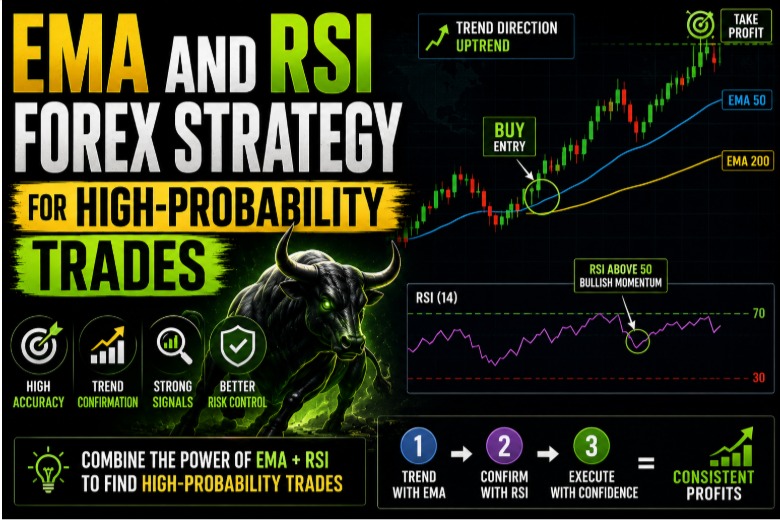
The EMA RSI strategy is one of the most popular Forex trading methods because it combines trend identification with momentum analysis. Instead of relying on a single indicator, this strategy uses moving averages to determine the overall market direction and the RSI indicator to measure momentum and identify potential entry opportunities. When combined correctly, the EMA RSI strategy helps traders filter low-quality setups and focus on high-probability trades.
Many professional traders prefer this approach because it is simple, effective, and suitable for beginners as well as experienced traders. By understanding how the RSI indicator, moving averages, trend trading, and forex signals work together, traders can make more informed decisions while avoiding emotional trading.
What Is the EMA RSI Strategy?
The EMA RSI strategy combines Exponential Moving Averages (EMA) with the Relative Strength Index (RSI) to identify potential buying and selling opportunities.
The EMA reacts faster to price changes than a Simple Moving Average, making it useful for identifying current market trends. Meanwhile, the RSI indicator measures the strength of price momentum on a scale from 0 to 100.
A successful EMA RSI strategy uses moving averages to identify the trend first and then uses the RSI indicator to confirm whether the market has enough momentum for a trade. This combination helps traders avoid entering trades against the prevailing trend.
Understanding the RSI Indicator
The RSI indicator is one of the most widely used momentum indicators in Forex trading. It helps traders determine whether the market is overbought or oversold.
Generally:
- RSI above 70 indicates overbought conditions.
- RSI below 30 indicates oversold conditions.
However, experienced traders understand that the RSI indicator should never be used alone. During strong trend trading, RSI can remain above 70 or below 30 for an extended period. This is why combining it with the EMA RSI strategy significantly improves trading accuracy.
Instead of blindly buying oversold conditions or selling overbought conditions, traders first analyze the trend using moving averages before making trading decisions.
Why Moving Averages Are Important
Moving averages help traders identify the overall market direction by smoothing price fluctuations.
One of the biggest advantages of moving averages is that they remove unnecessary market noise, making trends easier to recognize.
Most traders using the EMA RSI strategy combine two EMAs, such as the 20 EMA and 50 EMA or the 50 EMA and 200 EMA.
When the shorter EMA remains above the longer EMA, the market generally remains bullish.
When the shorter EMA stays below the longer EMA, the market is usually bearish.
Using moving averages allows traders to trade with the trend rather than against it.
How Trend Trading Improves Success
One of the biggest mistakes beginner traders make is trading against the market trend.
Successful trend trading means following the dominant market direction instead of trying to predict reversals.
The EMA RSI strategy naturally supports trend trading because the EMA identifies the trend while the RSI indicator confirms momentum.
For example, during a strong uptrend, traders look only for buying opportunities when RSI temporarily moves lower before recovering.
Similarly, during a downtrend, traders focus only on selling opportunities.
This disciplined approach improves trading consistency while reducing unnecessary losses.
How to Generate Forex Signals
Every trading strategy requires reliable forex signals.
Within the EMA RSI strategy, quality forex signals occur when multiple conditions align.
First, determine the overall trend using moving averages.
Second, wait for the RSI indicator to confirm momentum.
Third, observe price action for additional confirmation.
Only when all conditions agree should traders consider entering the market.
Following this structured process helps eliminate emotional decisions and improves trade quality.
Buy Setup Using EMA RSI Strategy
A bullish setup begins by confirming an uptrend with moving averages.
Price should remain above both EMAs while the shorter EMA stays above the longer EMA.
Next, wait for the RSI indicator to temporarily move toward the oversold region before turning upward.
This pullback often provides excellent buying opportunities during trend trading.
Once bullish price action confirms the move, traders can consider entering long positions.
These conditions generate much stronger forex signals than relying on RSI alone.
Sell Setup Using EMA RSI Strategy
The process works similarly during bearish trends.
First, identify a downtrend using moving averages.
Price should remain below both EMAs while the shorter EMA stays below the longer EMA.
Next, allow the RSI indicator to recover toward the overbought region before turning downward.
This pullback often provides high-probability selling opportunities.
Following this process keeps traders aligned with the overall trend trading direction.
Risk Management
Even the best EMA RSI strategy cannot eliminate losing trades.
Professional traders understand that protecting capital is more important than winning every trade.
Always use stop-loss orders.
Risk only a small percentage of your account per trade.
Maintain positive risk-to-reward ratios.
Good risk management allows traders to remain profitable even if several forex signals fail.
Common Mistakes Traders Make
Many traders misuse the RSI indicator by treating every overbought reading as a sell signal.
During strong trend trading, markets can remain overbought for extended periods.
Others ignore moving averages completely and rely only on momentum.
Some traders also enter trades before waiting for proper forex signals, resulting in unnecessary losses.
Following the complete EMA RSI strategy helps eliminate these common mistakes.
Best Timeframes for EMA RSI Strategy

The EMA RSI strategy works across multiple timeframes.
Swing traders often prefer the 4-hour and daily charts.
Day traders commonly use the 15-minute and 1-hour charts.
Scalpers may use the 5-minute chart with proper risk management.
Regardless of timeframe, combining moving averages, the RSI indicator, trend trading, and strong forex signals remains essential.
Advantages of EMA RSI Strategy
The biggest advantage of the EMA RSI strategy is its simplicity.
It provides objective entry rules.
It works in multiple markets.
It combines trend and momentum.
It reduces emotional decision-making.
It generates higher-quality forex signals than using either indicator individually.
When used correctly, it becomes a reliable framework for consistent trend trading.
Conclusion
The EMA RSI strategy remains one of the most effective Forex trading methods because it combines the strengths of moving averages and the RSI indicator into a single trading system. Instead of relying on one indicator, traders first identify the overall trend, then use momentum confirmation before entering trades. This structured approach improves trend trading, produces more reliable forex signals, and helps traders avoid many common mistakes.
Although no trading strategy guarantees profits, combining disciplined risk management with the EMA RSI strategy can significantly improve consistency over the long term. Regular practice, backtesting, and patience are the keys to mastering this strategy.
Frequently Asked Questions (FAQs)
What is the EMA RSI Strategy?
The EMA RSI strategy combines Exponential Moving Averages with the RSI indicator to identify trend direction and momentum for higher-probability Forex trades.
Why are Moving Averages important?
Moving averages help traders identify the overall market trend by smoothing price movements and filtering market noise.
How does the RSI Indicator work?
The RSI indicator measures price momentum on a scale from 0 to 100 and helps identify overbought and oversold market conditions.
Is the EMA RSI Strategy good for beginners?
Yes. The EMA RSI strategy is simple to understand and provides clear rules for identifying trend trading opportunities and reliable forex signals.
Which timeframe is best for the EMA RSI Strategy?
The strategy works on all timeframes, but many traders prefer the 1-hour, 4-hour, and daily charts because they produce more reliable forex signals and reduce market noise.