
Introduction
The foreign exchange market is one of the most dynamic financial markets in the world, offering traders countless opportunities to profit from price movements. However, consistent profitability does not come from chasing every market move. Instead, successful traders focus on strategies that allow them to trade in the direction of the prevailing trend while minimizing unnecessary risk. One of the most effective methods used by both beginner and professional traders is the EMA pullback strategy. This strategy combines the power of moving averages, trend following, technical analysis, and carefully timed forex entries to identify high-probability trading opportunities.
The strength of the EMA pullback strategy lies in its simplicity and versatility. It can be applied to major, minor, and exotic currency pairs, as well as stocks, indices, commodities, and cryptocurrencies. Whether you are a day trader looking for intraday opportunities or a swing trader aiming to capture larger price movements, this strategy can be adapted to suit your trading style. It also helps traders develop patience and discipline because it encourages waiting for quality setups rather than entering trades impulsively.
Understanding the EMA Pullback Strategy
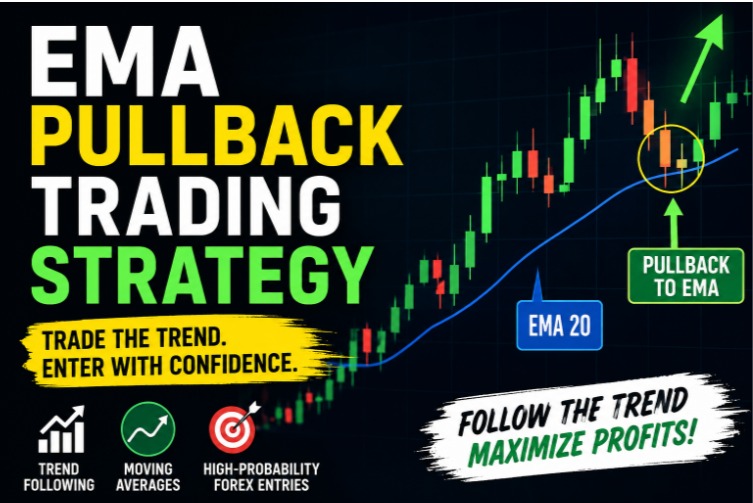
The EMA pullback strategy is based on a simple concept: trade in the direction of the dominant trend after a temporary retracement. Financial markets rarely move in straight lines. Even during strong bullish or bearish trends, prices periodically pause or retrace before continuing in the original direction. These retracements create opportunities for traders to enter the market at better prices without chasing momentum.
Unlike reversal strategies that attempt to predict when a trend will end, the EMA pullback strategy assumes that the existing trend is likely to continue until proven otherwise. This approach aligns traders with market momentum rather than positioning them against it. As a result, many professional traders consider trend-following strategies to be more reliable than countertrend trading.
The Exponential Moving Average serves as a dynamic support or resistance level. In an uptrend, the EMA often acts as support where buyers return to the market after a temporary decline. In a downtrend, the EMA behaves as resistance where sellers regain control after a short-lived rally. By waiting for price to revisit the EMA before entering a trade, traders increase their chances of participating in the next leg of the trend.
Why Trend Following Is the Foundation of Success
One of the biggest reasons traders fail is that they try to predict market reversals instead of following the existing trend. The principle of trend following is based on the idea that markets often continue moving in the same direction for extended periods due to economic conditions, institutional participation, and market sentiment.
When a currency pair establishes higher highs and higher lows, buyers clearly dominate the market. During these periods, every pullback represents an opportunity rather than a reason to panic. Similarly, when lower highs and lower lows develop, sellers maintain control, making bearish pullbacks attractive selling opportunities.
The EMA pullback strategy reinforces disciplined trend following by encouraging traders to ignore unnecessary market noise. Instead of reacting emotionally to every candle, traders focus on the broader direction indicated by the EMA. This approach reduces overtrading and improves overall consistency.
Strong trends also tend to produce multiple pullback opportunities, allowing traders to participate several times during the same market move. Rather than attempting to capture every price fluctuation, traders simply wait for the market to return to the EMA before considering another entry.
The Importance of Moving Averages in Forex Trading
Moving averages are among the most widely used indicators in technical analysis because they simplify price data and reveal the underlying market direction. While both Simple Moving Averages (SMA) and Exponential Moving Averages (EMA) help identify trends, the EMA gives greater weight to recent prices, making it more responsive to current market conditions.
The 20 EMA is commonly used by short-term traders because it follows price closely and generates more trading opportunities. Swing traders often prefer the 50 EMA, which filters out minor market fluctuations while highlighting stronger trends. Long-term investors frequently monitor the 200 EMA to determine the overall market direction.
The slope of the EMA is just as important as its position. A steadily rising EMA indicates strong bullish momentum, while a falling EMA signals sustained bearish pressure. Flat EMAs usually suggest a sideways market where pullback strategies become less effective because trends are weak or nonexistent.
Many traders combine multiple moving averages to improve decision-making. For example, when the 20 EMA remains above the 50 EMA, the market generally reflects bullish conditions. Pullbacks toward either moving average can provide buying opportunities, particularly when confirmed by bullish candlestick patterns. Conversely, when the 20 EMA remains below the 50 EMA, traders focus on selling opportunities during temporary rallies.
The EMA also helps traders remain objective. Instead of relying on emotions or market rumors, they use the indicator to determine whether the trend remains intact. This consistency allows traders to develop confidence in their strategy over time.
Forex Entries in the EMA Pullback Strategy
Successful forex entries are one of the most important aspects of the EMA pullback strategy because even a strong trend can produce losing trades if the entry is poorly timed. Instead of chasing the market after a large bullish or bearish candle, experienced traders wait patiently for price to retrace toward the Exponential Moving Average (EMA). This pullback offers a more favorable entry point while reducing the distance to the stop-loss and improving the overall risk-to-reward ratio. In an uptrend, traders look for prices to pull back to the 20 EMA or 50 EMA before searching for bullish confirmation. In a downtrend, they wait for price to rally back toward the EMA before looking for bearish confirmation. This disciplined approach helps traders enter the market alongside the prevailing trend rather than reacting emotionally to short-term price movements.
Before executing any forex entries, traders should confirm that the market structure supports the trend. An uptrend should continue forming higher highs and higher lows, while a downtrend should maintain lower highs and lower lows. The EMA should also have a clear upward or downward slope, indicating strong momentum rather than a sideways market. Entering trades only when these conditions align significantly improves the probability of success.
Risk management should always accompany every forex entry. A stop-loss is typically placed below the recent swing low in a bullish trade or above the recent swing high in a bearish trade. Profit targets can be based on previous support and resistance levels or by maintaining a minimum risk-to-reward ratio of 1:2 or higher. By combining accurate forex entries with disciplined technical analysis, proper use of moving averages, and a strong trend following approach, traders can improve consistency and increase their chances of achieving long-term success in the forex market.
Technical Analysis in the EMA Pullback Strategy

Technical analysis is a fundamental component of the EMA pullback strategy because it helps traders make informed decisions based on price action, market structure, and historical data rather than emotions or speculation. While the Exponential Moving Average (EMA) is the primary indicator used in this strategy, combining it with other technical analysis tools significantly improves the accuracy of trading decisions. By analyzing chart patterns, support and resistance levels, candlestick formations, and overall market trends, traders can identify high-probability opportunities and avoid low-quality setups.
One of the first aspects of technical analysis is identifying the overall trend. In a bullish market, prices should consistently form higher highs and higher lows while remaining above the EMA. In a bearish market, lower highs and lower lows should dominate, with price trading below the EMA. The direction and slope of the EMA provide additional confirmation of market momentum. A rising EMA indicates that buyers are in control, while a falling EMA suggests strong selling pressure. Traders should avoid using the EMA pullback strategy when the EMA is flat because this often signals a sideways or ranging market where trend-following strategies are less effective.
Although technical analysis cannot predict every market movement with complete accuracy, it provides a structured framework for evaluating price action and making disciplined trading decisions. When combined with effective trend following, proper use of moving averages, accurate forex entries, and sound risk management, technical analysis becomes an essential part of the EMA pullback strategy, helping traders improve consistency and make higher-probability trading decisions over the long term.
Conclusion
The EMA pullback strategy is one of the most dependable approaches for traders who want to trade with the market rather than against it. By focusing on trend following, traders can capitalize on existing market momentum instead of attempting to predict uncertain reversals. The use of moving averages, particularly the Exponential Moving Average, helps identify dynamic support and resistance levels where temporary retracements often come to an end. When combined with sound technical analysis, market structure, support and resistance, and candlestick confirmation, the strategy provides clear and disciplined forex entries that can significantly improve trading consistency
However, success with the EMA pullback strategy depends on more than simply applying an indicator to a chart. Traders must learn to recognize strong trends, avoid ranging markets, exercise patience while waiting for quality setups, and manage risk responsibly on every trade. Emotional discipline, proper position sizing, and continuous performance evaluation through a trading journal are equally important components of long-term success.