
Introduction
The forex market offers traders numerous ways to generate returns, from short-term scalping to long-term investing. Among these approaches, the carry trade has remained one of the most popular strategies used by institutional investors, hedge funds, and experienced retail traders. Unlike strategies that rely solely on price movements, this method focuses on profiting from differences in interest rates between two currencies while also benefiting from favorable exchange rate movements.
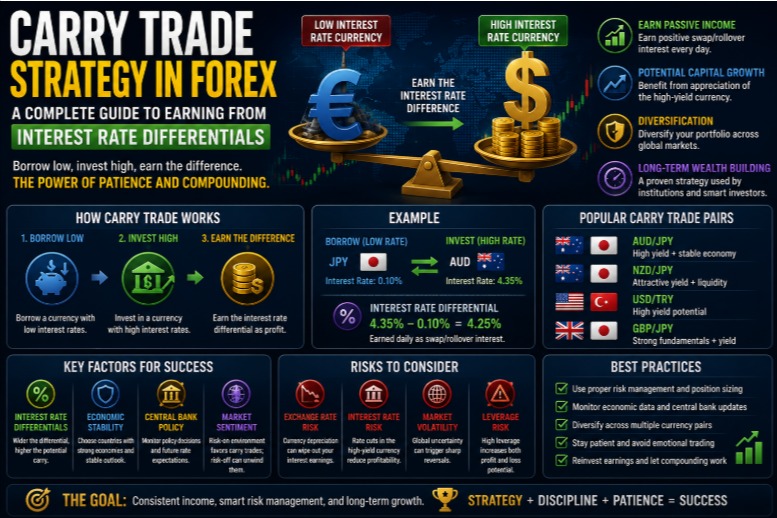
A successful carry trade involves borrowing a currency with a relatively low interest rate and using those funds to purchase another currency that offers a higher interest rate. As long as market conditions remain favorable, traders can earn daily rollover interest while potentially benefiting from appreciation in the currency pair itself. Although the strategy appears straightforward, long-term success depends on understanding global economic conditions, central bank policies, and risk management.
This guide explains how carry trading works, why interest rates play such a crucial role, and how traders can develop a disciplined approach to maximize long-term opportunities.
Understanding Carry Trading
The concept behind carry trade is relatively simple. Every currency is influenced by the monetary policy of its respective central bank. When two countries maintain significantly different interest rates, traders can potentially earn the difference by holding positions overnight.
For example, if one country’s central bank offers considerably higher rates than another, traders may buy the higher-yielding currency while simultaneously selling the lower-yielding one. The broker then credits or debits rollover interest depending on the interest rate differential between the two currencies.
Although daily interest payments may appear small, they can accumulate significantly over weeks or months when positions are managed carefully. This makes carry trading particularly attractive for traders who prefer medium to long-term market exposure instead of frequent short-term transactions.
Why Interest Rate Differentials Matter
The primary factor driving this strategy is interest rate differentials. Every central bank establishes benchmark interest rates to influence inflation, borrowing costs, and economic growth. These rates directly affect the returns investors receive when holding assets denominated in a specific currency.
Currencies offering higher interest rates often attract global investment because investors seek improved returns. Increased demand for those currencies can strengthen their value over time, providing traders with both rollover income and potential capital appreciation.
However, interest rate differences alone are not sufficient for making trading decisions. Traders must also evaluate economic stability, inflation trends, and central bank guidance before entering long-term positions.
How Central Banks Influence Carry Trades
Central banks continuously adjust monetary policy according to changing economic conditions. Inflation, employment growth, consumer spending, and economic expansion all contribute to future policy decisions.
When central banks begin increasing borrowing costs, higher-yielding currencies often become more attractive to international investors. Conversely, interest rate reductions may decrease demand as investors search for better returns elsewhere.
Monitoring speeches, policy statements, and economic forecasts allows traders to anticipate future changes rather than reacting after decisions have already influenced market prices.
Choosing the Right Currency Pairs
Selecting suitable currency pairs is one of the most important aspects of a successful carry trading strategy. Traders typically focus on currencies with substantial interest rate differences while also considering liquidity and overall market stability.
Historically, currencies from countries with relatively high interest rates have been paired against currencies from economies maintaining lower borrowing costs. This combination increases the likelihood of earning positive rollover interest while also benefiting from favorable long-term trends.
Liquidity also plays an important role because actively traded currency pairs generally provide tighter spreads and more efficient execution compared to less frequently traded markets.
Market Conditions That Favor Carry Trading
Not every market environment supports carry trading. Stable economic conditions, moderate inflation, and predictable monetary policies generally create favorable opportunities for this strategy.
Periods of low market uncertainty often encourage investors to seek higher returns by purchasing higher-yielding currencies. During these environments, positive investor sentiment supports stronger capital flows into attractive economies.
However, periods of financial instability or geopolitical uncertainty frequently encourage investors to move capital toward lower-risk assets, reducing the effectiveness of carry-based approaches.
Understanding broader market conditions helps traders determine whether current environments support long-term carry positions.
Risk Management for Carry Trades
Although the strategy focuses on earning interest income, exchange rate fluctuations remain the largest source of risk. A significant currency depreciation can easily outweigh months of accumulated rollover payments.
Effective risk management begins with appropriate position sizing. Traders should never assume that positive interest income eliminates market risk. Instead, stop-loss orders and carefully planned exit strategies help protect trading capital during unexpected market events.
Diversification also reduces exposure by avoiding excessive concentration in a single currency or economic region.
Maintaining realistic expectations and preserving capital remain essential components of long-term success.
Combining Technical and Fundamental Analysis
Successful traders rarely depend on a single form of analysis. Technical indicators help identify long-term trends, support levels, and resistance zones, while economic research provides valuable insight into future monetary policy decisions.
Combining chart analysis with forex investing principles creates stronger trading decisions because both price action and economic fundamentals support the overall strategy.
Long-term moving averages, trendlines, and momentum indicators often help traders identify favorable entry points while reducing the likelihood of entering positions during temporary market corrections.
Long-Term Investing Through Carry Trading

Many investors consider carry trading a form of long-term trading because positions are frequently held for weeks or even months. Instead of reacting to every short-term price fluctuation, traders focus on broader economic trends that influence currency values over extended periods.
Patience becomes one of the most valuable qualities for successful carry traders. Daily market volatility often creates temporary fluctuations, but disciplined investors maintain focus on their overall strategy rather than reacting emotionally to short-term movements.
Reviewing central bank decisions regularly helps ensure that existing positions continue to align with changing economic conditions.
The Role of Forex Investing
Carry trading represents an important component of broader forex investing strategies. Unlike speculative approaches focused solely on rapid price movements, this method combines income generation with long-term market participation.
Institutional investors frequently evaluate global interest rates, inflation forecasts, and economic growth before allocating capital across different currencies. Individual traders can apply similar principles by developing disciplined investment plans supported by thorough research.
A structured investment approach reduces emotional decision-making while encouraging consistent evaluation of market fundamentals.
Common Mistakes Traders Should Avoid
Many beginners assume that the highest interest rate automatically creates the best trading opportunity. In reality, economic instability can quickly offset the benefits of higher rollover income through adverse exchange rate movements.
Another common mistake involves ignoring upcoming central bank meetings. Sudden changes in monetary policy may reduce interest rate advantages and dramatically alter market sentiment.
Excessive leverage also increases unnecessary risk because relatively small currency movements can produce significant account losses despite positive rollover payments.
Patience, discipline, and continuous market analysis consistently produce better long-term outcomes than attempting to maximize returns through excessive risk-taking.
Building Long-Term Consistency
Long-term success requires continuous learning and disciplined execution rather than searching for perfect market timing. Maintaining a detailed trading journal allows traders to evaluate previous positions, identify recurring mistakes, and improve future decision-making.
Reviewing economic forecasts, monitoring policy statements, and understanding changes in global capital flows contribute significantly to stronger long-term performance.
As market conditions evolve, successful traders remain flexible while continuing to follow structured investment principles instead of emotional reactions.
Conclusion
Carry trading remains one of the most unique approaches in the forex market because it combines income generation with potential currency appreciation. A disciplined carry trade approach focuses on understanding interest rate differentials, selecting appropriate currency pairs, developing sound forex investing principles, and maintaining patience during long-term trading opportunities.
Although no strategy guarantees profits, combining economic research, technical analysis, disciplined risk management, and continuous learning provides traders with a strong foundation for navigating global currency markets successfully.