Introduction
Gold has always held a unique position in global financial markets. For centuries, it has been considered a store of value, a hedge against inflation, and a reliable asset during periods of economic uncertainty. In today’s financial landscape, traders closely monitor the relationship between gold prices and currency markets because movements in one often influence the other. Understanding this relationship allows traders to anticipate potential opportunities and make better-informed decisions.
A successful gold forex approach is built on understanding how gold prices interact with major currency pairs, global economic events, and investor sentiment. Instead of analyzing currency charts in isolation, experienced traders study how commodities, interest rates, inflation expectations, and geopolitical developments influence both markets simultaneously. This broader perspective often provides valuable insights that technical analysis alone cannot offer.
This guide explores how gold and forex markets are connected, why these relationships matter, and how traders can incorporate correlation analysis into their trading strategies for improved consistency.
Understanding the Relationship Between Gold and Forex
Gold and currencies are interconnected because both respond to many of the same economic factors. Inflation, central bank decisions, geopolitical tensions, economic growth, and investor confidence all influence the movement of precious metals and foreign exchange markets.
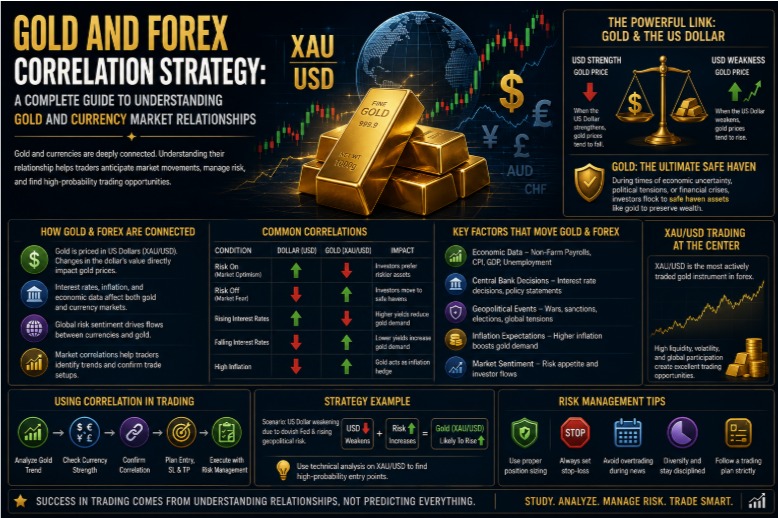
One of the strongest relationships exists between gold and the US Dollar. Since gold is primarily priced in US Dollars, changes in the value of the dollar frequently affect gold prices. When the dollar weakens, gold often becomes less expensive for international buyers, increasing demand and supporting higher prices. Conversely, a stronger dollar can reduce demand for gold, placing downward pressure on prices.
Understanding these relationships allows traders to develop a structured gold forex strategy instead of relying solely on individual price movements.
Why Gold Is Considered a Safe Haven
During periods of financial uncertainty, investors often move their capital away from riskier investments and toward assets that have historically preserved value. Gold has earned this reputation over many decades, making it one of the world’s most recognized safe haven assets.
Economic recessions, geopolitical conflicts, banking instability, and financial crises frequently increase demand for gold as investors seek stability. At the same time, demand for certain currencies may either strengthen or weaken depending on global market sentiment.
This shift in investor behavior creates valuable trading opportunities for those who understand how market participants react during uncertain economic conditions. Monitoring demand for safe haven assets helps traders better interpret broader market sentiment rather than focusing exclusively on individual currency pairs.
The Role of XAU/USD in Forex Markets
Among commodity-related currency instruments, XAU/USD trading remains one of the most actively traded markets. The symbol represents the value of one ounce of gold measured against the US Dollar, making it one of the most closely monitored instruments by both commodity and forex traders.
The popularity of gold stems from its liquidity, volatility, and sensitivity to economic news. Central bank announcements, inflation reports, employment data, and geopolitical developments frequently influence the price of gold within minutes.
Many traders include XAU/USD trading alongside traditional currency pairs because it often provides additional confirmation regarding overall market direction. Observing both markets together creates a more comprehensive understanding of changing investor sentiment.
How Market Correlations Influence Trading Decisions
Financial markets rarely move independently. Commodities, stocks, bonds, currencies, and indices continuously influence one another as investors respond to changing economic conditions. Understanding these market correlations helps traders recognize relationships that may otherwise remain hidden when analyzing only one chart.
For example, a weakening US Dollar may coincide with rising gold prices, while stronger economic data may simultaneously support the dollar and reduce demand for precious metals. These relationships are not permanent, but they often provide valuable context during periods of significant market activity.
Professional traders regularly monitor market correlations because they improve confidence when multiple markets support the same trading idea.
Economic Factors That Affect Gold Prices
Several economic variables consistently influence gold prices over time. Inflation expectations remain one of the most important because investors often purchase gold to protect purchasing power during periods of rising consumer prices.
Interest rates also play a significant role. Higher interest rates generally increase the attractiveness of interest-bearing investments, reducing demand for non-yielding assets such as gold. Lower interest rates, however, frequently increase investor interest in precious metals.
Currency strength, global economic growth, and central bank reserves further contribute to changes in gold prices. Understanding how these factors interact provides traders with a broader foundation for evaluating market opportunities.
Combining Technical Analysis with Market Fundamentals
Although economic factors strongly influence gold prices, technical analysis remains an essential component of successful trading. Support levels, resistance zones, moving averages, trendlines, and momentum indicators help traders identify potential entry and exit opportunities.
Experienced traders rarely rely exclusively on either technical or fundamental analysis. Instead, they combine both methods to improve decision-making. When technical signals align with favorable economic conditions, trading opportunities often become more reliable.
This balanced approach reduces emotional decision-making while encouraging disciplined trade execution.
Using Forex Analysis to Confirm Gold Trends
Professional traders often strengthen their decisions by combining gold price movements with broader forex analysis. Currency strength, interest rate expectations, inflation data, and central bank policy all provide additional context before entering positions.
If both currency markets and gold move in ways that support the same market outlook, confidence in the overall trading idea generally increases. Conversely, conflicting signals may encourage traders to remain patient until market direction becomes clearer.
Comprehensive forex analysis helps traders avoid relying solely on price charts while improving their understanding of changing economic conditions.
Trading During Periods of Economic Uncertainty
Financial markets experience recurring periods of uncertainty caused by inflation, banking concerns, geopolitical events, recessions, and central bank policy changes. During these periods, volatility often increases across both currency and commodity markets.
Gold frequently attracts increased investor attention because it has historically maintained value during uncertain economic environments. However, traders should avoid assuming that gold will always rise whenever uncertainty appears.
Successful traders evaluate each situation individually by considering economic data, monetary policy, and broader market sentiment before making investment decisions.
Risk Management When Trading Gold
Gold is well known for its large daily price movements. While this volatility creates attractive opportunities, it also increases potential risk. Effective risk management remains essential regardless of market conditions.
Position sizing, stop-loss placement, and realistic profit expectations help protect trading capital during unpredictable market movements. Traders should also recognize that sudden economic announcements can temporarily increase volatility beyond normal levels.
Maintaining disciplined risk management allows traders to remain consistent over the long term rather than focusing solely on short-term profits.
Common Mistakes Traders Should Avoid

Many beginners assume that every decline in the US Dollar automatically results in higher gold prices. While this relationship frequently exists, numerous additional economic factors influence both markets simultaneously.
Another common mistake involves ignoring broader economic conditions. Gold should always be analyzed within the context of inflation expectations, monetary policy, and investor sentiment rather than relying exclusively on chart patterns.
Overtrading also reduces long-term performance. Waiting patiently for stronger confirmation generally produces better results than reacting to every short-term price movement.
Building Long-Term Consistency
Successful traders develop consistency through preparation, education, and disciplined execution. Keeping a detailed trading journal helps identify recurring strengths and weaknesses while improving future decision-making.
Studying historical relationships between gold, currencies, inflation, and central bank policy gradually strengthens analytical skills. Experience allows traders to recognize changing market environments more effectively over time.
Continuous learning, patience, and structured planning remain essential for long-term success in both commodity and forex markets.
Conclusion
Understanding the relationship between gold and currencies provides traders with valuable insights that extend beyond traditional chart analysis. A disciplined gold forex strategy combines knowledge of XAU/USD trading, the behavior of safe haven assets, evolving market correlations, and comprehensive forex analysis to improve trading decisions.
Although no market relationship remains constant forever, combining technical analysis with economic understanding helps traders identify higher-probability opportunities while managing risk effectively. By remaining patient, following a structured trading plan, and continuously improving market knowledge, traders can build greater confidence when navigating both the gold and forex markets.