Introduction to Supply and Demand Trading
The forex market is driven by one fundamental principle: the continuous interaction between buyers and sellers. Every price movement, whether large or small, occurs because of imbalances between supply and demand. Understanding these imbalances forms the foundation of the supply and demand forex approach, one of the most powerful trading methodologies used by both retail and institutional traders.
Unlike indicator-based systems that rely on historical calculations, the supply and demand methodology focuses on identifying areas where significant buying or selling activity previously entered the market. These zones often represent locations where large market participants accumulated or distributed positions.
The popularity of supply and demand forex trading has increased significantly because it allows traders to understand how markets move from a price action perspective. Rather than chasing price movements, traders anticipate future reactions based on historical order flow and institutional behavior.
Mastering this methodology requires patience, discipline, and a thorough understanding of market dynamics. However, traders who consistently apply these principles often develop a significant advantage in the market.
Understanding the Concept of Supply and Demand
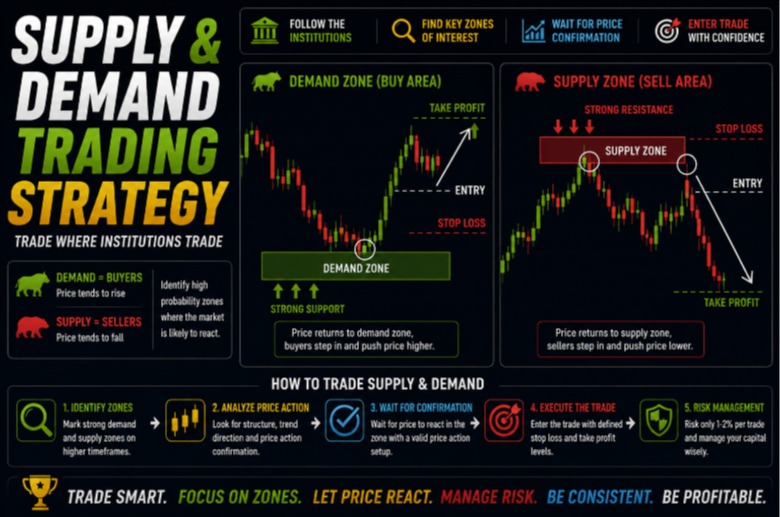
Supply and demand are the driving forces behind all financial markets. In forex trading, supply represents areas where sellers exceed buyers, causing price to decline. Demand represents areas where buyers outnumber sellers, resulting in upward price movement.
A successful supply and demand forex trader identifies these areas and anticipates future market reactions when price revisits them.
The reason these zones remain important is that unfilled institutional orders often remain within the market. When price returns to these areas, market participants may once again enter positions, creating potential trading opportunities.
Understanding the relationship between supply, demand, and price movement forms the cornerstone of successful trading.
The Role of Institutional Trading in Supply and Demand
One of the most important aspects of this methodology is understanding institutional trading. Large financial institutions such as banks, hedge funds, and investment firms control substantial market capital.
Because of their size, institutional trading activity frequently leaves identifiable footprints on price charts. Sharp market reversals, explosive price movements, and strong momentum often indicate institutional participation.
Retail traders cannot compete directly with institutional participants in terms of capital. However, by recognizing the footprints left by institutional trading, smaller traders can align themselves with dominant market forces.
Successful traders frequently focus on areas where institutional activity previously caused significant market movement, increasing the probability of favorable outcomes.
Why Price Action Is Essential
At the heart of every successful supply and demand forex methodology lies price action. Price action refers to the direct observation of market movement without excessive reliance on indicators.
Through price action analysis, traders can identify market structure, momentum shifts, and significant buying or selling pressure.
When price approaches a supply or demand zone, price action often reveals whether market participants are likely to defend the area. Rejection candles, engulfing patterns, and strong momentum bars frequently provide valuable clues.
Many professional traders prefer price action because it offers immediate insight into market behavior and reflects real-time interactions between buyers and sellers.
Understanding Market Structure in Forex Trading
Effective supply and demand trading requires a strong understanding of market structure. Market structure refers to the arrangement of highs, lows, trends, and consolidations that define overall market behavior.
Analyzing market structure helps traders determine whether the market is trending upward, trending downward, or moving sideways.
A trader using supply and demand forex principles should always evaluate market structure before entering positions. Trading demand zones during strong downtrends or supply zones during powerful uptrends may reduce probability.
Market structure analysis provides valuable context and improves overall trade selection.
Developing a Forex Trading Plan
A structured forex trading plan is essential for long-term success. Without predefined rules, traders often make emotional decisions that negatively affect performance.
A comprehensive forex trading plan should include criteria for identifying supply and demand zones, evaluating market structure, managing risk, and executing trades.
Successful forex trading depends not only on identifying opportunities but also on maintaining consistency and discipline.
Developing a detailed plan helps traders remain objective and reduces impulsive behavior during volatile market conditions.
Identifying High-Quality Supply Zones
Supply zones represent areas where significant selling pressure previously entered the market. These zones often appear before sharp price declines.
In supply and demand forex trading, high-quality supply zones typically exhibit strong momentum away from the zone and minimal prior retests.
Institutional trading activity frequently creates these powerful price movements. Traders seek evidence that large market participants aggressively entered positions.
Combining supply zones with broader market structure analysis significantly improves trade quality.
Identifying Strong Demand Zones
Demand zones represent areas where buyers previously overwhelmed sellers, causing rapid price appreciation.
Strong demand zones often form before impulsive upward moves. Traders monitor these areas closely when price returns because institutional trading interest may reappear.
Price action confirmation at demand zones further strengthens trading opportunities.
Accurately identifying demand zones remains a fundamental skill for successful forex trading.
The Relationship Between Price Action and Market Structure
The combination of price action and market structure provides traders with a comprehensive understanding of market behavior.
Price action reveals immediate market sentiment, while market structure provides broader directional context.
For example, bullish price action forming within a demand zone during an uptrend generally represents a stronger opportunity than bullish price action occurring against prevailing market structure.
Integrating both concepts significantly enhances decision-making and improves consistency.
Institutional Trading Footprints on the Chart
Professional traders frequently search for evidence of institutional trading within market charts.
Large institutional orders often create distinctive price patterns, including explosive breakouts, strong momentum candles, and rapid reversals.
Recognizing institutional trading footprints allows traders to align their positions with dominant market participants rather than opposing them.
This alignment frequently improves probability and supports more effective supply and demand analysis.
Using Market Structure for Trend Identification
Understanding market structure helps traders determine the prevailing trend and identify favorable trading opportunities.
Higher highs and higher lows generally indicate bullish market structure, while lower highs and lower lows suggest bearish conditions.
In supply and demand forex trading, trend direction often influences which zones traders prioritize.
Trading in alignment with market structure typically produces more consistent results than attempting to predict reversals.
Price Action Confirmation at Supply and Demand Zones
Many traders avoid entering positions immediately upon price reaching a zone. Instead, they wait for price action confirmation.
Candlestick patterns such as pin bars, engulfing formations, and rejection candles frequently provide confirmation signals.
Price action confirmation reduces exposure to false signals and enhances overall trade quality.
Patience remains essential because not every supply or demand zone produces a valid trading opportunity.
Risk Management in Forex Trading
No forex trading strategy guarantees success. Therefore, effective risk management remains essential.
Traders should determine acceptable risk levels before entering positions and ensure that losses remain manageable.
Position sizing, stop-loss placement, and disciplined execution protect trading capital and support long-term sustainability.
Even the strongest supply and demand setups occasionally fail, making capital preservation a priority.
Common Mistakes in Supply and Demand Forex Trading
Many traders encounter difficulties because they incorrectly identify zones or ignore broader market context.
One common mistake involves placing excessive emphasis on minor price fluctuations rather than significant institutional trading areas.
Another frequent error is neglecting market structure when evaluating opportunities.
Some traders also enter positions without waiting for price action confirmation, increasing the likelihood of false entries.
Avoiding these mistakes significantly improves trading performance.
Building a Complete Supply and Demand Forex Strategy
A successful supply and demand forex strategy integrates multiple analytical components. Traders should evaluate institutional trading activity, analyze price action, assess market structure, and maintain a disciplined forex trading plan.
Each element contributes to a more comprehensive understanding of market behavior.
Consistency in execution often proves more important than strategy complexity.
Continuous learning and regular trade review further strengthen long-term results.
Long-Term Success Through Discipline and Patience
Achieving sustainable profitability requires more than technical knowledge alone. Traders must consistently apply their methodology while maintaining emotional discipline.
Understanding institutional trading behavior, interpreting price action, analyzing market structure, and following a structured forex trading plan all contribute to long-term success.
Patience remains particularly important because high-quality opportunities do not occur continuously.
Disciplined traders focus on quality rather than quantity.
Conclusion
The supply and demand forex methodology provides traders with a powerful framework for understanding market behavior. By studying institutional trading, interpreting price action, analyzing market structure, and maintaining disciplined forex trading practices, traders can significantly improve their decision-making and consistency.
While no strategy guarantees profits, traders who consistently apply these principles with patience and discipline are better positioned to navigate market uncertainty and achieve long-term success in the forex market